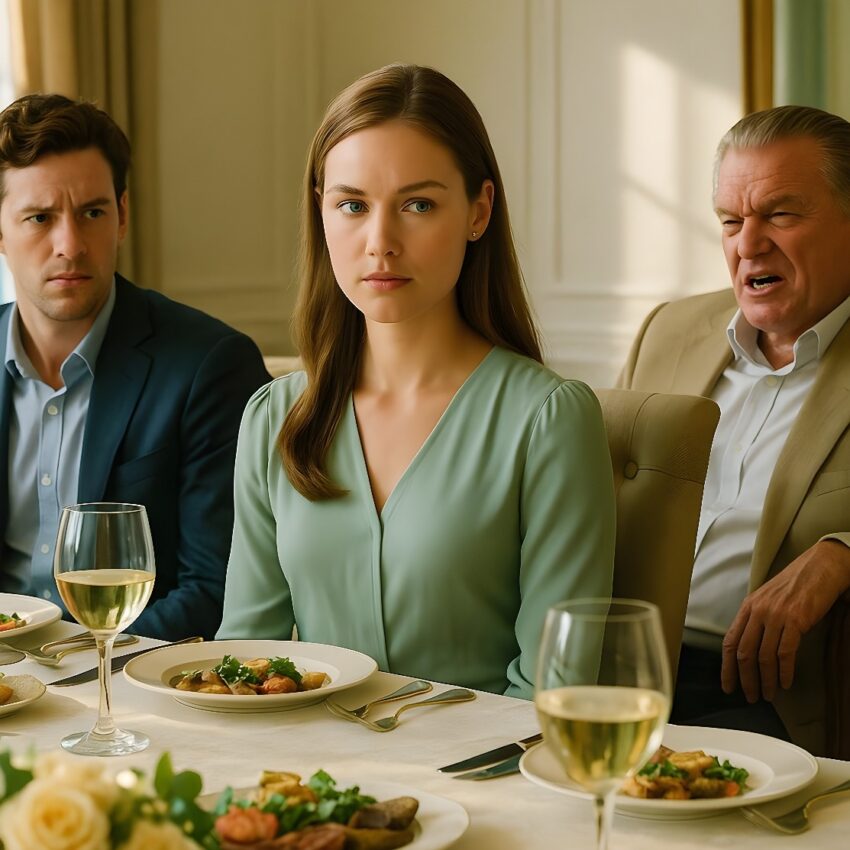
The dinner reeked of wealth—crystal glasses glinting under chandeliers, velvet curtains smothering the walls, a Monet on display so rare it had never left a vault. William Harrington thrived in such arenas. Power was his oxygen. He cultivated control the way others cultivated vineyards—pruning, cutting, killing what did not serve him. His cufflinks, heavy with diamonds, caught the light as he lifted his glass. His expression was carved in disdain.
“My son deserves better than gutter trash,” he announced to thirty guests while a quartet dragged Schubert from strings. “A woman dressed in silk pretending she belongs here.”
I had heard men like him spit venom before, but never while staring me in the face. I sat opposite, my dress—my own design—armored me. Silk, fluid, sharp as steel. I folded my napkin, set it by my untouched salmon, and rose. Rachel, Quinn’s mother, whispered my name in panic. Patricia, his sister, smirked in half-pleasure, half-pity.
“Thank you for dinner, Mr. Harrington,” I said evenly. “And thank you for finally saying aloud what you’ve always thought.”
“Zafira,” Quinn whispered, fingers trembling under the table. I held his hand for a second, then let go.
“It’s fine, love,” I said, never taking my eyes off William. “Your father is right. I should know my place.”
He smirked. A banker chuckled. A violin froze mid-note. I walked past his curated empire—paintings purchased for tax relief, cars costing fortunes, statues that screamed of taste without soul. Even the valet’s eyes apologized as I left.
My car was modest. Functional. The kind critics called “quiet wealth.” But once inside, my hands trembled. I called my assistant.
“Danielle. Cancel the Harrington merger.”
She froze. “The $2 billion deal?”
“Yes.”
“The board—”
“He called me garbage. Publicly. He made it clear I will never belong to his family or his business. End it.”
Her fingers flew. “Reason?”
“Irreconcilable cultural and visionary differences.”
“Do we leak it?”
“Not yet. He hears it from us first. The media by noon.”
“Consider it done.” Her voice hardened. “Anything else?”
“Breakfast with Fairchild on Monday. If Harrington won’t sell, his fiercest rival will.”
By dawn, Danielle had turned my fury into order. The Harrington empire woke to chaos.
“Bloomberg wants a comment,” she told me.
“Tell them Cross Technologies seeks partners that match our values. Keep it vague, keep it lethal.”
“Also,” she said dryly, “William Harrington is downstairs in the lobby. Security won’t let him up without your word.”
“Send him to Room C.”
“Excellent choice—the chairs are designed to break spines.”
When I entered, the titan looked diminished. His suit sagged. His hair rebelled. His eyes burned with desperation.
“Ms. Cross,” he stood. “Thank you for meeting me.”
“You have five minutes.”
“I apologize for last night—”
“You called me garbage,” I cut him. “That wasn’t a slip. That was your truth.”
“I was drunk.”
“No. You were honest. Drunk lips don’t lie.”
“What do you want? A public apology? A statement?”
“I don’t do business with men who consider me beneath them,” I said. “How can your board follow me when you treat me like dirt?”
“This is business, not personal.”
“Everything turns personal when you humiliate someone.”
He shifted, cornered. “Cross Technologies only succeeds because of luck.”
“Wrong,” I snapped. “We succeed because I know hunger. Because I know locked doors. Every hire, every deal, every line of code—built on remembering what it means to start at zero.”
His silence admitted defeat.
“The merger is dead,” I declared. “Not just because of your insult—though that sped things up—but because you revealed your rot.”
“This will destroy us,” he whispered.
“Then perhaps you should be destroyed.”
At the door he spat: “What about Quinn? You’ll ruin him.”
I turned. “Quinn doesn’t need your throne. He’ll build his own.”
The crack in his eyes was grief, not rage. I left him with it.
Hours later, Quinn sat in my office, wrecked but resolute.
“I should have stopped him,” he said. “I let him poison every room. No more.”
“You’ll pay the price,” I warned. “Headlines. Inheritance gone.”
He smiled. “You just walked away from $2 billion because he called you garbage. If you can afford that, we can afford anything.”
Danielle barged in. “Emergency board meeting. Rumor: they’re moving to sideline William.”
I didn’t hesitate. “Tell them Cross will negotiate—with fresh leadership.”
Quinn swallowed. “You’ll oust my father.”
“I’ll give them math: evolve or perish.”
The board acted quickly. William was pushed out under the polished phrase “retiring to focus on family.” I laughed at the press release. Danielle suggested we send him a guillotine-shaped fruit basket.
Cross merged with Harrington Industries—under strict reforms. Diversity audits. Board reshuffles. Scholarships for the poor William mocked. Supplier accountability. Culture rebuilt from ash.
Quinn signed on as head of strategy. Patricia fumed. Rachel wept, caught between shame and pride. William vanished, stripped of the crown he thought eternal.
And me? I declared what mattered most: You don’t need gates to build something worth protecting.
But storms linger. Patricia sent letters demanding forgiveness. Sabotage rumors surfaced. Old money fought dirty. Anonymous critics painted me as dangerous. Hedge funds shorted us on cigar smoke and whispers. None of it mattered. We had truth, law, and fire.
My family called when tragedy struck—my brother in a hospital bed, broken but alive. I paid without blinking. “This isn’t debt,” I told my mother. “Love doesn’t run on ledgers.” She wept, shedding years of silence.
On my wedding day, vows were forged not for show, but for survival: I’ll be the one you call at 3 a.m. I’ll fight when you can’t. Your family is mine. Your war is mine.
At the reception, Danielle toasted: “To the woman who turned garbage into gold, and locked doors into open rooms.”
Late at night, William appeared outside. Thin. Tired. Broken.
“Congratulations,” he said quietly.
“Why are you here?”
“To admit what you already know. Pride costs too much.”
“Apologize then.”
“I am sorry,” he said. “For that night. For teaching my son cruelty. For misjudging myself.”
“I don’t need it,” I said. “But he does.”
“I told him,” William admitted. “The only trash at that table was me.”
I nodded. “Then maybe there’s hope.”
Years passed. We built something real. Not perfect—we made mistakes, we bled, we rebuilt—but real. Workers respected, cleaners treated as colleagues, students rising to boardrooms. Rachel visited often. Quinn grew into his strength. Danielle took her first real vacation. William wrote governance essays, never mentioning me. Fitting. He was no longer the story.
One night, I reread a letter I had once sent a young girl:
If a man calls you garbage, remember—garbage is simply what the world is too blind to value. Build. Invite everyone inside, except those who spit on you.
Power is not a throne. Power is a room. If it’s locked, break the lock. If it’s guarded, climb the wall. But the highest form of power is this: tearing down the walls and setting the table wide enough for everyone.
And I, Zafira Cross, will never again ask permission to belong. I draft the blueprints now—doors open, exits many, light everywhere. And no seat too poor to claim.