I never thought Christmas would begin with a silence so heavy it felt physical.
Not the dramatic kind you see in movies, but the quiet that settles slowly, pressing against your chest until even breathing feels different.
My plane had just broken through a sheet of falling snow when I checked my phone. The last message from my husband was a photo: our living room, empty and glowing, the Christmas tree standing alone in the corner like it was waiting for something.
It made my throat tighten.
This was supposed to be our Christmas.
After seven years filled with doctor visits, injections, fragile hopes, and losses too early to even name, we had finally decided to stop pushing ourselves. This year wasn’t about miracles. It was about peace.
No questions from relatives. No forced smiles. No pretending we were still “trying.” Just the two of us at home, staying in pajamas, watching terrible holiday movies, and letting ourselves breathe.
Then my boss called.
An urgent project. Critical timing. Just two days before Christmas.
I agreed before my heart could catch up with my mouth. Regret followed immediately.
“I’ll make peppermint cocoa when you’re back,” my husband, Aaron, said when I told him. He smiled, but it didn’t quite reach his eyes. “We’ll do everything we planned. Cozy and lazy.”
“Are you sure you’ll be okay alone?” I asked.
“I’ll miss you,” he said softly. “But I’ll manage.”
Something about his tone felt distant. His hug was shorter than usual. In the days leading up to my trip, he seemed distracted, as if part of him was somewhere else entirely.
The night before I left, I walked into the kitchen and caught him staring at his phone. He startled and slipped it into his pocket too quickly.
“Everything alright?” I asked.
“Yeah,” he replied, smiling too fast. “Just looking at Christmas stuff.”
“For who?”
“For you. Socks and things.”
I laughed, but unease settled in my stomach. When I turned away, I caught a brief reflection of his screen in the microwave door before it went dark. It wasn’t shopping.
It was a baby carrier.
I said nothing. December had always been difficult for us. I told myself grief makes people do strange things.
After I left, the silence grew worse. Aaron took calls outside in the cold. He lingered by the front window late at night. When I asked, he brushed it off as work, even though his office was closed for the holidays.
At the hotel, I threw myself into work. I sent messages. Hours passed with no reply. I sent him a picture of the tiny Christmas tree in my room and wrote, I miss you.
Nothing.
Then my boss called again.
“We finished early. You did great work. Go home and enjoy Christmas.”
I cried with relief. I packed fast, drove to the airport smiling, imagining surprising Aaron, wrapping my arms around him in the kitchen.
But when I opened the front door, something felt wrong.
The house was warm. The lights were on. The air smelled like cinnamon.
I stepped into the living room and froze.
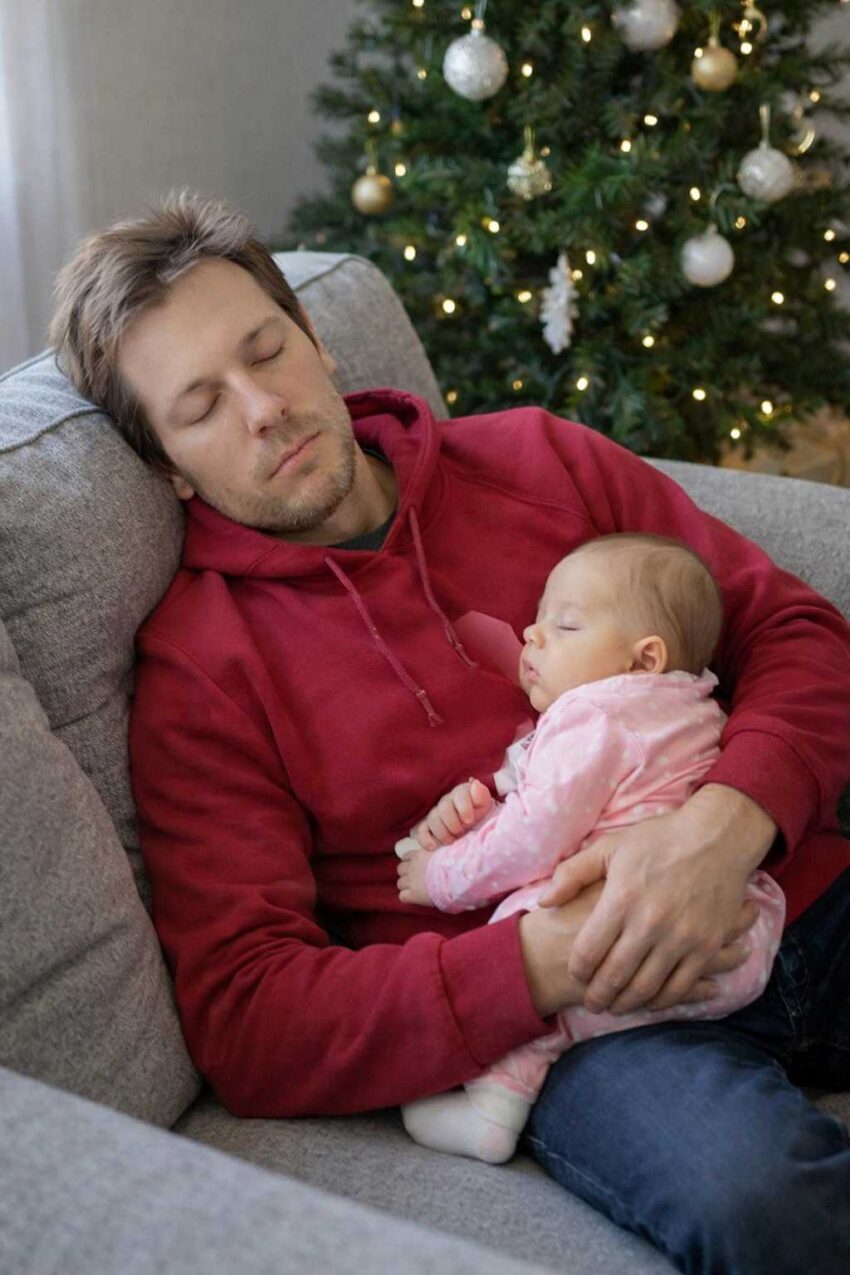
Aaron was asleep on the couch.
In his arms was a newborn baby.
My mind refused to understand what I was seeing. The baby was real—tiny, bundled, breathing softly against his chest. She couldn’t have been more than a few days old.
The only explanation my heart could form was the one that shattered it.
The baby stirred. Aaron woke instantly and looked at me, panic flooding his face.
“Lena—wait,” he said. “Please let me explain.”
“Whose baby is that?” I asked, my voice barely steady.
“I… I found her,” he said.
“Where?”
“On the porch.”
I didn’t answer. I opened the security app on my phone and scrolled back through the footage.
There it was.
A young woman knocking. Aaron opening the door immediately. No surprise. No hesitation. He accepted the baby calmly.
I showed him the screen.
“You didn’t find her,” I said. “You were expecting her.”
He nodded slowly. “I lied. And I’m sorry.”
“Is she yours?”
“No. Never. I swear.”
Then he told me everything.
A month earlier, he had met a pregnant young woman outside a gas station. She was cold, exhausted, scared. Her name was Rose. She had no family nearby and nowhere safe to go.
He helped her. He gave her food. He offered her my grandmother’s unused apartment—small, unfinished, but warm. He checked on her without pressure.
When she went into labor early, she gave birth at a clinic. She kept the baby for two days.
Then she called Aaron and said she couldn’t do it alone. She wanted her daughter to have a family.
“I didn’t tell you because I was afraid,” he said quietly. “Afraid of hurting you. Afraid of giving you hope.”
The process was legal. Temporary guardianship. Time to decide together.
The next day, I met Rose. She was young, shaking, brave in a quiet way.
“I love her,” she told me. “I just can’t be what she needs right now.”
“You already are,” I said.
She stayed involved. She got help. Five months later, the adoption became official.
We named our daughter Clara.
She is almost two now. She laughs loudly. She fills our home with noise and warmth and life.
Every Christmas, we hang her stocking.
Because sometimes love doesn’t arrive the way you imagine.
Sometimes it comes quietly, wrapped in trust, waiting just beyond your door.