They cut down my trees for a better view. So, I shut down the only road that led to their front doors. That is the short version, the kind you tell at a bar when someone says, “No way you actually did that.” The long version starts on a Tuesday that felt so normal it almost hurts to remember. I was halfway through a turkey sandwich at my desk when my sister Mara called me.
Mara does not call during work hours unless something is bleeding, on fire, or legally complicated. I answered with my mouth still full and said, “Hey, what’s up?” And all I heard was wind and her breathing like she had been running. You need to come home right now. There is a tone people use when they’re trying not to panic. That was her voice.
Tight, controlled, failing. What happened? Just come home, Eli. I did not even shut my computer down properly. I grabbed my keys, mumbled something to my manager about a family emergency, and drove faster than I should have on a two-lane county road that already makes me nervous in the rain. It was clear that day, blue sky, bright birds probably chirping somewhere.
Meanwhile, my stomach was folding in on itself like bad origami. When I turned on a pine hollow road, I knew before I saw it. There is a way a landscape feels wrong when something old has been removed. Like when someone takes a picture off the wall and you can still see the cleaner paint underneath. The six sycamores along the eastern edge of my property were gone.
Not trimmed, not damaged by a storm. Gone. 40-year-old trees, tall, thick, the kind that lean just slightly toward the sun like they have been listening their whole lives. My dad planted three of them when I was a kid. The other three came later, but they grew into a single wall of green that framed my house and blocked the ridge above me from staring straight down into my backyard.
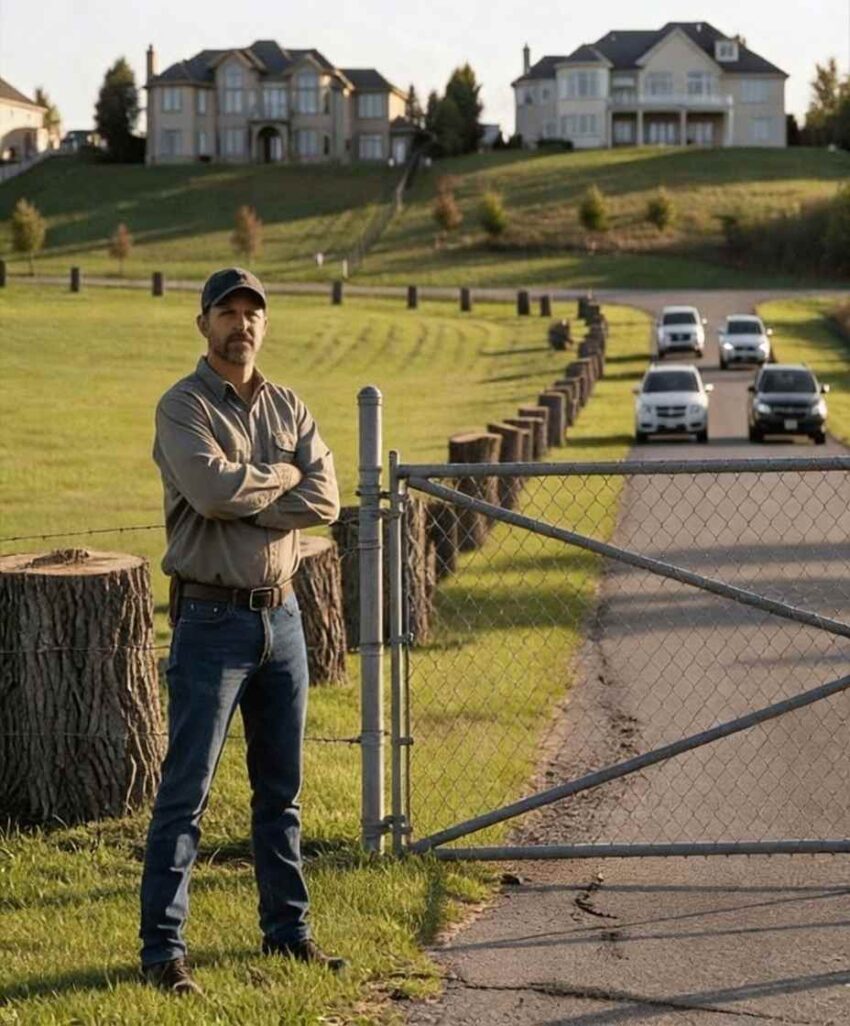
Now, there were six clean stumps in a row. Flat cuts, professional, efficient. The branches had already been hauled off. Even the sawdust had been mostly cleared, like someone wanted to erase the evidence, but ran out of time. Mara was standing near the fence line with her arms crossed, jaw-tight. She did not say I’m sorry or this is awful.
She just shook her head and said I tried to stop them. What do you mean you tried to stop them? She told me two trucks pulled up late morning company logo on the side. Guys in hard hats and orange shirts. She walked over and asked what they were doing. One of them said just following the work order, ma’am. She said whose work order? They said Cedar Ridge Estates HOA. I blinked at her.
That is the gated community up on the ridge. 5 years old stone entrance sign, little fountain that runs even during drought restrictions. Big houses, bigger opinions. We are not in Cedar Ridge, I said. Exactly, she said. There was a business card tucked under my windshield wiper. Summit tree and land management. I called the number with hands that were steadier than I felt.
A guy answered on the second ring, voice cheerful like he was booking a haircut. Summit Tree, this is Brad. Brad, why did your crew cut down six sycamores on my property this morning? There was a pause, paper shuffling. We had a work order from Cedar Ridge Estates HOA for lot boundary clearing along the south overlook. That is not their land. That is mine.
Another pause. Longer this time, sir. The HOA president signed off on it. They indicated the trees were encroaching on common property and obstructing the community view corridor. View corridor. I almost laughed like my trees were a bureaucratic inconvenience. Well, Brad, I am not part of Cedar Ridge and those trees were planted decades before that community even existed. Silence then.
You’re not part of Cedar Ridge? No. Okay, let me make some calls and I will get back to you. I hung up and stood there staring at the ridge. You could see the rooftops from my yard if you craned your neck. Big windows facing west. I had always figured the folks up there like their sunsets uninterrupted. Apparently, they like them a little too much.
About 2 hours later, my phone rang again. Different number. This is Daniel Whitmore, president of Cedar Ridge Estates HOA. Of course it is, I thought. Mr. Whitmore, I said. He sounded smooth, confident. The kind of guy who wears loafers without socks and thinks it is a personality trait. It has come to my attention there was some confusion regarding the tree removal this morning.
He said we believe those trees were situated on community land. They were not. Yes. Well, we are reviewing the survey now. If a mistake was made, the association is prepared to reimburse you for the removal costs. I let that sit there for a second. You mean the cost of cutting down 40-year-old trees? He cleared his throat.
We can discuss reasonable compensation. Reasonable? I looked at the stumps again, my dad’s hands covered in dirt, telling me to hold the sapling straight, my mom bringing lemonade out to the yard. Summer evenings when the leaves would rattle like soft applause. Reasonable, Mr. Whitmore, I said slowly. There is something else you should know, but I think I need to confirm a few details first.
Of course, I did not tell him that the only road leading into Cedar Ridge cuts across the southern corner of my property. I did not tell him that when the developer built that road 20 years ago, he shook hands with the previous owner, a retired mechanic named Walter Jennings, and agreed on a verbal easement that was never recorded.
Walter passed away 3 years before I bought the land from his estate. And verbal agreements, as it turns out, do not survive probate unless someone puts them in writing. Instead, I just said, “Thank you for your time, Mr. Whitmore,” and hung up. That night, I sat at my kitchen table with a stack of closing documents and an old survey map, tracing property lines with my finger while Marlo watched me like I was about to do something either brilliant or deeply stupid.
“Maybe both,” she said. I smiled a little. By morning, I had a surveyor scheduled, and by Tuesday afternoon, I knew exactly where my land ended and where their convenience began. The surveyor showed up Thursday morning in a dusty white truck with a tripod, a GPS unit, and the quiet energy of a man who has seen neighbors turn into enemies over 3 in of dirt. His name was Carl.
Late 50s, sunburned neck, permanent squint. He walked the property with me in slow, deliberate steps, checking old markers, tapping metal stakes into the ground, spray painting bright orange lines that felt strangely satisfying to watch. You thinking about building something? He asked. Something like that, I said.
By noon, there it was in fluorescent certainty. The southern corner of my property extended 15 ft past the edge of the asphalt road that led up to Cedar Ridge Estates. Not just a sliver, either. A real measurable chunk. Enough to matter. Carl pulled off his gloves and looked at me. You know they’ve been using this for a while, right? 5 years.
You planning on changing that? I stared up at the ridge again, sunlight glinting off oversized windows. A landscaper trimming hedges with military precision. Yeah, I said. I think I am. He shrugged like a man who bills by the hour and does not judge. That afternoon, I made three calls. One to a fencing company, one to a local attorney, and one to the county records office.
The attorney, a woman named Denise Carter, did not laugh when I explained the situation. That alone made me trust her. So, let me get this straight. She said, “They removed mature trees from your property without verified boundary confirmation based on an unrecorded assumption, and now they want to reimburse you for the cutting fee. That’s about the size of it.
” And you believe there is no recorded easement granting them access across your southern boundary? I know there isn’t. I checked the deed twice. She was quiet for a moment. Technically speaking, if there is no recorded easement and no prescriptive easement established through a longer statutory period, you have the right to restrict access to your land.
What is the statutory period in this state? 20 years of continuous adverse use. They’ve had five, then they do not yet have a legal claim. But Eli, she added carefully, blocking access to an entire residential community will escalate this quickly. I looked at the six stumps lined up like headstones. Good, I said.
The fencing company worked fast. Maybe too fast. Word travels in small counties, especially when money is involved. By Monday morning, steel posts were sunk deep into the ground, chain link stretched tight, and a heavyduty gate installed squarely across the asphalt where it crossed onto my property. It was not subtle, 8 ft tall, industrial, the kind of fence you see around construction sites and impound lots.
I stood there as they bolted the lock into place. The metallic click echoed more than I expected. You sure about this? The crew lead asked. Not even a little, I said. But do it anyway. They left around 3:00 in the afternoon. For about an hour, nothing happened. Then, right around 4:30, the first SUV rolled down the hill.
A silver Range Rover with tinted windows. It slowed, stopped in front of the fence, then idled. I could see the driver’s silhouette, phone already pressed to his ear. 5 minutes later, another car pulled up behind him. Then another. Within 20 minutes, there was a line of luxury vehicles backed up along the ridge road like a high-end parking lot with nowhere to go.
My phone started vibrating in my pocket before the sun dipped behind the trees that were no longer there. Unknown number. I let it ring twice before answering. What the hell do you think you’re doing? Daniel Whitmore did not sound smooth anymore. standing on my property. I said, “You cannot block the only access road to Cedar Ridge.” “Actually, I can.
There is no recorded easement. This is outrageous. People are trying to get home.” I glanced at the small convoy of frustration beyond the fence. “That must be inconvenient. You’re being petty.” I felt something shift in my chest at that word. “Petty would have been a complaint letter, Daniel.
This is called property rights.” There was a sharp exhale on the other end. We are prepared to compensate you fairly for the misunderstanding regarding the trees. You mean the trees you cut down without verifying ownership? It was an honest mistake. 640year-old trees is not a typo. Silence again. He recalibrated. If you do not remove that fence immediately, we will pursue legal action.
I already spoke to my attorney. I suggest you do the same. He hung up. That night, social media did what social media does. Someone in Cedar Ridge posted a photo of the fence in the neighborhood group. By dinnertime, it had spilled into the county community page. Half the comments called me a hero. The other half called me unstable.
Mara scrolled through them while sitting at my kitchen counter eating takeout Chinese. “You’re trending,” she said. “Fantastic. Maybe I’ll start a podcast.” Underneath the sarcasm, though, I felt something else creeping in. Not guilt, not exactly, but awareness. There were families up there, kids, people who had nothing to do with the decision to cut my trees.
They were collateral damage in a fight they did not start, but neither did I. Tuesday morning, I woke up to three voicemails. One from Daniel, one from a woman who introduced herself as vice president of the HOA, and one from someone who did not leave a name, but suggested I was endangering emergency services access. That one made me pause.
I called Denise. Can they argue public safety? They can try, she said. But unless there is a recorded easement or an emergency order from a judge, you are within your rights. That said, if this drags out, a court could impose a temporary access arrangement. So, I have leverage, but it’s on a clock. Exactly.
By Wednesday afternoon, the tone changed. Daniel called again, slower this time. Measured. Eli, we’ve consulted council, and it appears there is no recorded easement on file. I waited. However, he continued, “The association maintains that the prior owner granted verbal permission for access.
” Walter Jennings died 3 years before I bought the property. Verbal agreements don’t transfer with ghosts. That line hit harder than I intended. He did not respond right away. What would it take to resolve this? He finally asked. There it was. Not a threat, a question. I leaned back in my chair and looked out at the empty stretch where my trees used to sway.
First, you replace all six sycamores. Mature, professionally planted, guaranteed to survive. That’s significant. So, were they? He exhald slowly. All right. What else? A formal written apology from the HOA acknowledging the error and the property violation. We can draft something. And I said, if you want continued access across my land, we do it properly. Recorded easement.
Market rate compensation. What are you suggesting? $2,000 a month. He actually laughed at that. That’s absurd, is it? You’ve been using that land for free for 5 years. Consider it retroactive gratitude. We are not paying you $24,000 a year to use a strip of asphalt. Then you can build a new road. There it was. The silence that stretches long enough for someone to picture the cost of earthmoving equipment.
Engineering permits. Environmental review. Probably six figures. Easy. We need to take this to the board, he said finally. Of course you do. By Friday evening, the line of cars had thinned. Some residents had started parking near the fence and walking the remaining stretch to their homes.
A few tried to argue with me in person. One man in golf attire accused me of holding the neighborhood hostage. I told him hostage situations usually involve weapons. I was using a padlock. Late that night, Daniel called again. The board has agreed to your terms and principle, he said. tree replacement, written apology, and a recorded easement with a monthly access fee.
In principle, we would like to negotiate the amount. I smiled even though he could not see it. Then we are making progress. And that is where things got complicated in a way I did not expect. When Daniel said complicated, I figured he meant numbers. I was wrong. The following Monday, I got a knock on my door around 7:00 in the evening, right when the sky turns that deep orange that makes you forget you’re mad at the world for a minute.
I opened it, expecting another angry homeowner. Instead, it was a woman in her early 40s, hair pulled back, eyes tired in a way that had nothing to do with traffic. “Hi,” she said softly. “My name’s Rachel Kim. I live in Cedar Ridge on Alder Crest Lane.” I nodded but didn’t invite her in. “Not yet.
I’m not here to yell at you, she added quickly. I just I wanted to talk. We stood on my porch with the sound of crickets filling the space where my trees used to rustle. She glanced at the stumps, then back at me. My son has asthma, she said. Last week, an ambulance had trouble getting through because of the traffic backup.
He’s okay, but it scared me. There it was. The human cost. I had tried not to stare at too long. I didn’t cut those trees, she continued. Most of us didn’t even know it was happening. The board makes decisions and sends emails after the fact. They’ve been obsessed with preserving the valley view since the first house sold.
It’s like the view is part of their identity. I let out a breath I didn’t know I was holding. I’m not trying to hurt your kid, I said. I’m trying to make sure people don’t treat my land like it’s community property. I know. And honestly, what they did was wrong, but this whole thing is turning neighbors into enemies. People are fighting in the streets over something they didn’t vote on.
She looked up toward the ridge where porch lights were flickering on one by one. Maybe there’s a way to fix it without burning everything down. After she left, I sat on the porch a long time watching headlights approached the fence. Pause. Reverse. Listening to the quiet where leaves used to whisper. I had leverage. Yes, I had legal ground.
But what did I actually want? Justice, money, respect? Probably all three. The next morning, Daniel called again. His voice had lost its edge. It sounded tired. The board met last night, he said. There’s division. Some residents are furious with us. Others are threatening to sue the HOA for mismanagement. That’s not my problem, I said, but without heat.
No, it isn’t. But it could become yours if this spirals. I thought about Rachel. About the ambulance. Here’s what I want, I said slowly. Full replacement of the six sycamores, not saplings. Mature trees at least 15 ft tall. Professionally planted with a three-year survival guarantee. Agreed. A recorded easement drafted by my attorney, not yours.
Access limited strictly to the existing roadway footprint. No expansion without my written consent. He hesitated and said, “All right. $2,000 a month in access fees adjusted for inflation every 5 years.” There was a long pause. The board countered with 1,200. I shook my head even though he couldn’t see it. Daniel, building a new road would cost you at least 200 grand, probably more once environmental impact studies kick in. I’m asking 24 a year.
That’s not greed. That’s math. You’re enjoying this, aren’t you? No, I said honestly. I’m not. I’m just done being overlooked. Silence again, then a quiet exhale. 1,800 a month. Final offer. I let the quiet stretch. I could hear papers shifting on his end. Someone whispering in the background. 1,800 trees replaced.
Written apology delivered to every homeowner. And the HOA covers all legal and recording fees. Done. He said almost before I finished. We drafted the agreement over the next 2 weeks. Denise was meticulous. Every clause was clear, every boundary precise. The easement was recorded with the county. Official binding. The day they planted the new trees.
I stood off to the side with my arms crossed while a landscaping crew maneuvered massive root balls into freshly dug holes. The trunks were thick, leaves full and green. Not 40 years old, but not babies either. Rachel walked down the hill and stood beside me. They’re beautiful, she said. They are. I agreed.
Daniel showed up too. No loafers this time. Work boots. He handed me a folder. The apology letter signed by the full board. I opened it. It was direct. No corporate fluff. They acknowledged the mistake, the unauthorized removal, the failure to verify property lines. It wasn’t perfect, but it was real enough. He cleared his throat.
For what it’s worth, Eli, we should have handled this differently from the start. Yeah, I said. You should have. He nodded once. No argument. When they finally cut the lock off the temporary gate and removed the fence panel blocking the road, cars rolled through slowly, almost cautiously, like they were passing through a checkpoint between two countries that had just signed a treaty.
That first month, a check for $1,800 arrived right on time. And every month after that, people ask me sometimes if I feel bad, if I went too far, if shutting down an entire neighborhood over six trees was excessive. Maybe it was. But here’s the thing about living downhill from wealth and influence.
You get used to being invisible. Decisions get made above you, literally and figuratively. Trees get labeled view obstructions. Land gets treated like a suggestion instead of a boundary. I didn’t block that road because I hate my neighbors. I blocked it because respect should not be optional.
The new sycamores are growing in well. When the wind moves through them, it doesn’t sound exactly like it used to. Different rhythm, younger leaves. But it’s something. Sometimes I catch myself looking up at the ridge, wondering if they resent me every time they write that monthly check, or if maybe they learn something, too. Rachel and I talk now and then.
Her son is doing fine. She told me the HOA elections are coming up and a few board members might not survive the vote. As for Daniel, he weighs when he drives by. It’s a small thing, but it’s something. So, here’s my question for you. If someone cut down something that mattered to you, not just financially, but personally, how far would you go to make it right? Would you settle quietly, or would you lock the gate and make them notice? I’m curious where you land on this.
Was I protecting my property or just feeding my pride?