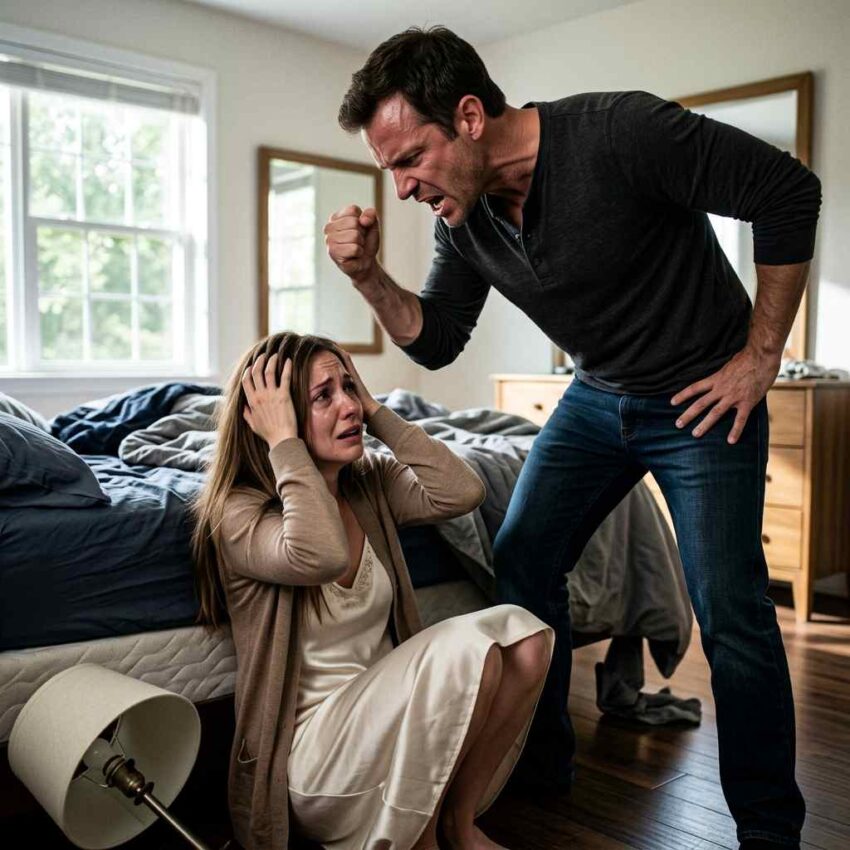
The first thing Dr. Elena Brooks noticed was that the woman on the gurney did not look like someone who had simply slipped on a staircase.
Her name, according to the chart, was Claire Bennett, thirty-two, brought into the emergency department of St. Vincent Medical Center in Indianapolis just after midnight. Her husband, Daniel Bennett, stood beside her bed in jeans and a gray sweatshirt, one hand gripping the rail, the other rubbing at his forehead as if exhaustion itself were proof of innocence.
“She fell,” he said for the third time. “We were arguing, she got dizzy, and she missed the step.”
Claire lay very still. One eye was swollen nearly shut. There was a fading yellow bruise at her jawline, a fresh purple mark at the edge of her ribs, and older injuries beneath newer ones, a pattern Elena had seen enough times to recognize without wanting to. Claire’s blood pressure was low. Her left wrist was sprained. There was a concussion, possibly two cracked ribs. None of it fit Daniel’s neat little sentence.
“When did she fall?” Elena asked.
“Maybe an hour ago.”
Elena nodded, but she was already noting the hesitation. “And these bruises on her upper arms?”
Daniel’s expression tightened for only a second. “I caught her before she hit the floor.”
Claire made a faint sound then, not a word, just a rough breath dragged through pain. Elena stepped closer. “Claire? Can you hear me?”
Her eyelids fluttered. Daniel leaned in too quickly. “Baby, tell them what happened.”
Elena turned to him. “I need space to examine her.”
He did not move.
It was a tiny moment, the kind most people would miss, but Elena didn’t. Men who were frightened stepped back. Men who were trying to manage a scene held their ground.
A nurse entered with imaging forms. Elena took them without looking away from Daniel. “Sir, radiology only allows staff during scans. You can wait in the family area.”
Daniel smiled then, but there was no warmth in it. “I’d rather stay with my wife.”
Claire’s fingers twitched against the blanket.
Elena lowered her voice. “That wasn’t a request.”
For a long second, the room seemed to narrow around them. Then Daniel exhaled sharply, lifted his hands in surrender, and backed toward the curtain. “Fine. I’m just trying to help.”
After he left, Elena pulled the curtain closed and crouched beside the bed. Claire’s good eye opened halfway, unfocused at first, then suddenly alert in the frightened way of someone surfacing into danger before fully waking.
“You’re safe for this moment,” Elena said quietly. “Your husband cannot hear you. Did you fall?”
Claire stared at her. Her throat moved. No sound came out.
Elena waited.
At last, a tear slid into Claire’s hairline. Her lips trembled, and she gave the smallest shake of her head.
Then, in a voice so weak Elena had to lean close to catch it, Claire whispered, “Please don’t let him take me home.”
Elena had learned long ago that the most important thing to do after a confession like that was not to rush the patient with too many questions. Fear could close a person up as quickly as pain. She kept her voice steady and practical.
“You do not have to leave with him tonight,” she said. “But I need to know whether you are in immediate danger.”
Claire swallowed with visible effort. “If he knows I told you, yes.”
That was enough.
Within minutes, Elena followed hospital protocol. She documented the injuries carefully, asked a nurse to bring in a social worker, and flagged security without creating a scene. In Indiana, Elena could not make every decision for Claire, but she could build a wall of procedure around her and buy time. Sometimes time saved lives.
The social worker, Monica Reyes, arrived with soft shoes, tired eyes, and the kind of calm that made people speak. She sat beside Claire and explained options: a private room under restricted access, a domestic violence advocate, emergency shelter placement, police involvement if Claire chose it. At each word, Claire’s face shifted between hope and terror, as if every possible exit had a shadow attached.
“He always says no one will believe me,” Claire said. “He says I look unstable. That if I ever tell anyone, he’ll tell them I drink too much, that I bruise easily, that I’m dramatic.”
Monica did not interrupt.
Claire stared at the ceiling. “He works in commercial real estate. He knows people. He donates to charities. He sends flowers when he hurts me badly enough.” Her mouth tightened. “He likes witnesses for the good parts.”
Elena finished entering notes into the chart. Older healed fractures. Bruises in varying stages. Wrist grab marks. She had seen this script too many times: the respectable husband, the disoriented wife, the staircase, the cabinet corner, the bathroom slip.
Outside the room, Daniel began asking the desk nurse why his wife was taking so long. His tone was controlled, but even through the closed door, the impatience cut through.
Monica leaned closer. “Claire, I need an honest answer. If we discharge you with him, do you think he could kill you?”
Claire’s breathing changed. That was answer enough, but after several seconds she whispered, “I think he didn’t mean to tonight. I think he just lost control.” She shut her eye. “And that scares me more.”
Elena exchanged a look with Monica.
Hospital security moved Daniel to a consultation room under the pretense of paperwork. He protested, then argued, then turned charming again, asking for coffee, asking whether his wife had said something “confused.” Elena did not deal with him directly after that. She knew the type. Every conversation with a man like Daniel was an audition, and he believed every room was his.
At 2:40 a.m., a police officer arrived to take an informational report, not a formal complaint. Claire almost refused to speak. Then Monica placed a card in her hand from a local shelter called Rosebridge House, and Claire suddenly looked like someone standing at the edge of a bridge she had never imagined crossing.
“I have a sister in Ohio,” Claire said quietly. “We stopped talking because Daniel said she was poison. But before we got married, she told me if I ever needed help, I could call.”
“Do you remember the number?” Monica asked.
Claire nodded.
The call went to voicemail the first time. Claire nearly broke apart at that. Then, ten minutes later, her phone buzzed from the belongings bag security had retrieved. Monica answered on speaker only after Claire agreed.
A woman’s voice came through sharp with sleep and alarm. “Claire?”
Claire burst into tears so suddenly that Elena looked away to give her privacy. “Megan,” she said. “I’m sorry. I’m so sorry.”
“Where are you?”
“At the hospital.”
Silence. Then: “Did he do this again?”
Claire covered her mouth.
Megan’s voice hardened in an instant. “Tell me where you are. I’m leaving now.”
Daniel must have sensed something shifting, because while the call was still active he pushed past the consultation room door and strode toward the nurses’ station. Security intercepted him, but not before he raised his voice loud enough for the hallway to hear.
“What is going on? Why won’t anyone let me see my wife?”
Heads turned. The performance had begun.
Claire froze.
Monica took the phone off speaker and squeezed Claire’s hand. “Listen to me. He wants you afraid and ashamed. Those are the only tools he has left in this building.”
Outside, Daniel was saying all the right things for the wrong reasons. “She’s had a rough year. She gets confused after she hits her head. I’m just trying to take care of her.”
Elena stepped into the hall then, chart in hand, every word measured. “Mr. Bennett, your wife is receiving treatment. You need to lower your voice.”
His eyes met hers, and for the first time the mask slipped. She saw not panic, not grief, but rage—cold, focused, offended rage that anyone had interrupted his control.
He smiled a second later for the benefit of the audience. “Of course, Doctor.”
But Claire had seen his face too, reflected in the small glass pane of the room door.
And something inside her changed.
When Officer Liam Parker returned with the formal report form and asked one final time whether she wanted to make a statement, Claire wiped her face, took the pen in her shaking hand, and said, “Yes. I want everything written down.”
The arrest did not happen that night, at least not in the dramatic way Claire had once imagined justice might look. Real life was slower, more procedural, and in some ways more frightening because of it.
Officer Parker took her statement in detail. Elena documented every injury. Monica arranged for Claire to be discharged under confidential status and transferred before dawn to Rosebridge House, where Daniel would not be given the address. By the time Claire’s sister Megan arrived from Columbus, her eyes swollen from crying and four hours of driving, Claire was already in a wheelchair near the service exit with a paper bag of medications in her lap and a hospital blanket over her knees.
Megan knelt beside her and touched her hand like Claire might vanish. “You should’ve called me the first time.”
Claire gave a broken laugh. “I know.”
“No,” Megan said, tears running freely now. “I mean before the first time.”
That sentence stayed with Claire for months.
The criminal case moved unevenly. Daniel hired an attorney almost immediately and tried to frame everything as a misunderstanding fueled by stress, alcohol, and marital conflict. But he had not counted on the hospital records, the photographs, the pattern of injuries, and one detail that proved harder to explain away: neighbors had heard shouting on multiple occasions, and one woman across the street had saved home security footage from the previous winter showing Claire running onto the porch without a coat while Daniel dragged her back inside by the arm.
The prosecutor, Andrea Cole, was careful not to promise outcomes. “He may plead,” she told Claire. “He may fight. Either way, the evidence matters.”
Claire had to relearn ordinary life in fragments. At the shelter she slept with the light on for two weeks. Sudden footsteps in hallways made her stomach seize. She apologized for everything: taking too long in the shower, speaking too softly, crying in the middle of lunch. One of the counselors finally said, “You don’t have to earn safety here,” and Claire went back to her room and cried harder than she had on the night she left.
She found part-time work first, then full-time work three months later at a dental office in Dayton, where Megan lived. She changed her number. She filed for divorce. Daniel sent messages through attorneys, then through mutual acquaintances, then through a handwritten letter that began with I forgive you for what you’ve done to us. Her attorney advised her not to respond. She did not.
The plea hearing came in October, nearly seven months after the hospital night. Daniel stood in a dark suit, clean-shaven, composed, looking like a man attending a business conference. Claire sat two rows back beside Megan and kept both feet flat on the floor to stop them trembling.
He pleaded guilty to domestic battery and felony strangulation from an earlier documented assault included after further investigation. The sentence was not as long as some people would have wanted. Claire herself did not know what amount of prison time could ever equal all those nights. But there was a restraining order, mandated counseling, supervised conditions after release, and, most importantly, a conviction that said in public language what Daniel had spent years denying in private.
When the hearing ended, he turned once, as if expecting her to look away.
She didn’t.
The final twist came two weeks later, quiet as a closing door. Claire received a message from Andrea Cole’s office: another woman had come forward after hearing about the plea agreement in local coverage. Daniel had assaulted her years before he met Claire. She had never reported it. Now she had.
Claire sat with the phone in her hand for a long time, staring out Megan’s kitchen window at a backyard lined with bare November trees. The news did not comfort her. It did not heal anything. But it rearranged one last lie. Daniel had always told her she caused his anger, her weakness invited it, her failures triggered it.
Now, for the first time, she saw the truth with complete clarity.
It had never begun with her.
Months later, on a cold Sunday morning, Claire drove alone to a grocery store and stood in the parking lot longer than necessary, keys in hand, face lifted to the pale winter sun. No one was waiting to check her phone. No one would question the receipt, the delay, the expression on her face. It was not a dramatic moment. No music. No speech. Just an ordinary errand in an ordinary life.
But when she walked through those automatic doors, she felt something stronger than relief.
She felt like a witness to her own survival.