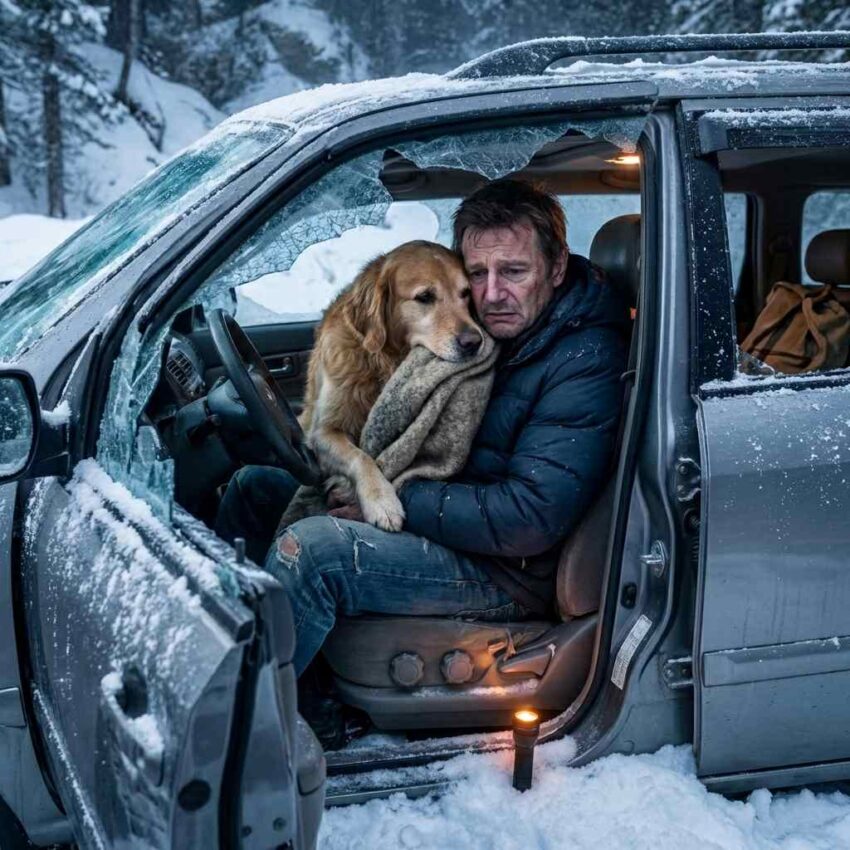
There are nights that don’t just pass—they settle into your bones, linger in the quiet spaces of your life, and resurface years later when you least expect them. The night Marcus Hale almost died at the bottom of that frozen ravine was one of those nights. People in his world would later retell it in pieces—some swearing it was luck, others calling it instinct, a few lowering their voices to suggest something else entirely—but none of them had been there in the dark with him, with the cold pressing in like a living thing, with the silence so deep it almost sounded like a whisper.
Marcus wasn’t the kind of man people imagined needing saving. At six-foot-four, broad-shouldered, with a beard that had gone more salt than pepper over the years, he looked like someone carved out of the same stubborn material as the mountains he rode through. In his motorcycle club, they called him “Atlas,” partly because he carried more than his share—on the road, in fights, in life—and partly because he never complained about it. If anything, he seemed to expect the weight. But even the strongest men have fault lines, and Marcus had been cracked wide open long before his truck ever went over that embankment.
It happened on a road he’d driven a hundred times, a narrow stretch that curved along the side of a ridge where the guardrails had never been quite enough to inspire confidence. That evening, the sky had already begun to turn the dull, heavy gray that usually warned of snow, though the storm itself hadn’t fully arrived. The radio had been on, low enough to ignore, while his thoughts drifted somewhere far from the road. That had become a habit over the past two years—drifting. Not quite thinking, not quite feeling, just existing in the space between.
He didn’t remember the exact moment he lost control. Later, he would piece it together from the skid marks and the angle of the crash, but in his mind, it always came back as a blur—a sudden slide, the tires failing to grip, the sickening realization that the truck wasn’t responding anymore. Metal screamed as it struck rock, glass exploded inward, and then the world tipped, rolled, and dropped out from under him.
When the truck finally came to rest, crumpled and half-buried in snow at the bottom of the ravine, everything went black.
He didn’t know how long he was out. Time doesn’t behave normally in those moments; it stretches and collapses in ways that make later recollection unreliable. But eventually, something dragged him back—pain, most likely, sharp and insistent. When he opened his eyes, the first thing he noticed was the cold. Not just the kind that makes you shiver, but the kind that feels invasive, like it’s working its way inside you, claiming territory.
The windshield was gone, or at least mostly gone, and the wind tore through the cabin in long, howling bursts that carried bits of snow with it. His breath came out in short, visible clouds, each one thinner than the last. He tried to move, and that’s when the pain in his leg hit him properly, a blinding, nauseating surge that made him gasp. He looked down and saw the dashboard crushed inward, pinning his right leg at an angle that didn’t belong to any living thing.
“Damn it…” he muttered, though the words came out weak, barely audible over the wind.
He reached for his phone, but it wasn’t where it should have been. He searched blindly, his fingers brushing against broken plastic, shards of glass, something sticky that he realized with distant clarity was his own blood. The phone was gone—thrown clear, most likely, or buried somewhere out of reach.
Above him, the ridge loomed, a dark outline against a sky that had now fully surrendered to night. No lights. No passing cars. No sound except the wind and the faint creak of the truck settling into the snow.
Marcus had spent enough time in harsh conditions to understand what that meant. The temperature was dropping fast. He was injured. He was alone.
And he wasn’t getting out of that truck on his own.
For a while, he tried anyway. It was instinct more than strategy, the stubborn refusal to accept the obvious. He pushed against the steering wheel, braced his arms, tried to free his leg. Each attempt ended the same way—with a fresh wave of pain and no progress. Eventually, he slumped back, breathing hard, his strength already beginning to fade.
It was then, in that forced stillness, that the other weight—the one he had been carrying for two years—pressed in on him.
Her name had been Eliza.
Seven years old, with a laugh that seemed too big for her small frame and a habit of asking questions he never quite knew how to answer. She had loved bright colors, stray animals, and stories about faraway places. And then, without warning, she had gotten sick. The kind of sick that didn’t give you time to prepare, that turned hospitals into second homes and hope into something fragile and exhausting.
He had sat beside her bed for days that blurred into nights, holding her hand, telling her she was going to be okay even when the doctors’ faces told a different story. He had promised her things—small things, like taking her to the beach again, and bigger things he couldn’t even remember now, only the feeling of needing to say them.
When she died, something inside him had gone quiet. Not shattered, not dramatically broken—just… gone. Like a light that had been switched off in a room he didn’t know how to leave.
The club had tried to pull him back. They showed up, checked in, dragged him out on rides, filled the silence with noise and motion. But grief isn’t something you outrun, no matter how fast you go. Eventually, they stopped pushing as hard, and he slipped into a kind of routine that looked like living from the outside but felt like something else entirely.
Sitting there in the wreckage, with the cold tightening its grip and the darkness closing in, Marcus felt that same emptiness spreading again, only now it carried a strange sense of familiarity.
“So this is it, huh…” he murmured, his voice barely more than breath.
The idea didn’t scare him as much as it should have. In fact, there was a moment—brief but undeniable—when he stopped fighting. When the thought of letting go, of finally being done with the weight, felt almost like relief.
His eyes drifted shut.
And then he heard it.
At first, it was faint, almost lost in the wind—a soft crunch, like something moving through the snow. He might have imagined it, except it came again, closer this time.
Marcus forced his eyes open.
A shape moved just beyond the shattered frame of the window, large enough to cast a shifting shadow against the pale snow. For a second, his mind, sluggish from cold and exhaustion, tried to make it into something familiar, something explainable.
Then a nose—wet, dark, very real—pushed through the broken edge of the glass.
“A dog?” he rasped, the word sounding strange even to him.
The animal hesitated for only a moment, sniffing the air, taking in the scent of blood, metal, and something else—fear, maybe, or something deeper. It was a big dog, its fur thick and uneven, colored in shades of gold and dirt, like it had been living rough for a while. One ear stood up sharply, alert, while the other flopped to the side in a way that would have been almost comical under different circumstances.
“Hey… buddy…” Marcus managed, though he had no idea why he said it.
The dog didn’t run.
Instead, it turned, disappearing briefly into the darkness. Marcus felt a flicker of disappointment, irrational but sharp. Of course it would leave. That’s what animals did—they survived.
But then it came back.
Clenched in its jaws was something thick and dark—a wool blanket that must have been thrown from the truck bed during the crash. The dog dragged it through the snow with determined, almost stubborn effort, its paws slipping slightly on the icy ground but never quite losing traction.
Marcus watched, his thoughts slow and disjointed, as the animal maneuvered the blanket through the broken window, tugging and pulling until it finally covered his shoulders. The sudden barrier against the wind was immediate, imperfect but significant.
“Good… dog…” he murmured, though the words felt inadequate.
The dog wasn’t finished.
With a movement that seemed both awkward and deliberate, it climbed into the mangled cabin, curling its large body against his chest, pressing close enough that he could feel the steady warmth radiating through its fur. It wasn’t just heat—it was presence, solid and undeniable.
For the first time since he had woken up, Marcus felt something shift.
Time passed in fragments after that. He would drift, slipping toward that dangerous edge where sleep becomes something else, only to be pulled back by a sharp bark or the insistent press of a wet nose against his face. The dog refused to let him disappear. Each time he began to let go, it reacted—nudging, licking, even pawing at him with surprising force.
“Alright… alright…” he would mumble, barely aware of his own voice.
At some point, he started talking to it, though he couldn’t later remember what he said. Maybe he spoke about Eliza. Maybe he just filled the silence because the alternative felt too final.
Above them, the storm moved in, covering the ravine in a deeper layer of snow, further burying the wreckage from view. Hours stretched on, the cold pressing in from all sides, held back only by that stubborn, living source of heat.
When morning finally came, it did so quietly, the sky lightening just enough to reveal the world in shades of pale gray and white.
And then, faint but unmistakable, came the sound.
Engines.
Motorcycles.
Marcus’s club had noticed he hadn’t made it back. They had started searching, riding the roads he was known to take, scanning the edges, calling his name into the wind.
But from where he lay, hidden beneath snow and shadow, they might as well have been miles away.
The dog heard it too.
Its ears perked up, its body going still in a way that suggested sudden focus. It lifted its head, listening, then looked down toward the floor of the truck.
There, half-buried under debris, was a thin silver chain. It had snapped during the crash, the small charm attached to it—a tiny ring, worn smooth with age—resting against the metal floor.
Marcus saw it and felt something tighten in his chest. It had been Eliza’s. He had worn it every day since… since everything.
The dog moved carefully, almost gently, picking up the chain between its teeth. For a moment, it hesitated, glancing at Marcus as if making a decision.
“Go…” he whispered, though he wasn’t sure if he meant it or if he was just imagining the understanding in the animal’s eyes.
Then it was gone, leaping out of the truck, scrambling up the steep embankment with a determination that seemed far beyond instinct.
Marcus listened, straining to hear over the wind, his heart pounding weakly.
Up above, the engines grew louder.
And then, suddenly, they stopped.
What happened next was pieced together later, told to him by the men who had been there. The dog had appeared in the middle of the road, blocking their path, refusing to move even as the lead rider skidded to a stop inches away. It had dropped the chain at their feet, howling in a way that made the hair on the back of their necks stand up.
One of them—Derek, who had known Marcus the longest—recognized the charm immediately.
“Eliza’s ring,” he had said, his voice going tight. “He’s close.”
They followed the dog to the edge, peering down into the ravine until they finally spotted the wreckage, half-hidden beneath snow.
The rescue that followed was frantic, chaotic, driven by urgency and fear. Ropes were thrown, men climbed down, voices shouted directions and reassurances.
When they reached Marcus, he was barely conscious, his skin cold, his breathing shallow.
But he was alive.
Later, in the hospital, the doctors would tell him that it had been close—too close. Another hour, maybe less, and hypothermia would have taken him.
“Whatever kept you warm,” one of them said, shaking his head slightly, “that’s what saved you.”
Marcus didn’t need to ask what that had been.
The dog stayed.
No one knew where it had come from. It had no collar, no chip, no one claiming it. It simply remained at the hospital, waiting, as if it had nowhere else to be.
When Marcus was finally discharged, there was no question of what would happen next.
“You’re coming home with me,” he said, his voice still rough but steadier than it had been in a long time.
He named the dog Rusty at first, though the name never quite fit. The dog answered to it, but there was something about the way it reacted—almost like it was tolerating the label rather than recognizing it.
It wasn’t until months later, on a quiet afternoon in the attic, that everything changed again.
Marcus had finally worked up the nerve to go through Eliza’s things. He had avoided it for as long as he could, the thought of opening those boxes feeling like reopening a wound that had never fully healed.
He sat on the floor, dust drifting in the slanted light, and began to sort through the memories—small clothes, toys, drawings filled with bright, uneven colors.
He smiled at some of them, his chest aching in that familiar way, until he reached a sketchbook.
The last page made his hands tremble.
Drawn in crayon was a dog—large, golden, with one ear standing up and the other flopping down. On its chest was a small, white star-shaped patch.
Marcus felt the air leave his lungs.
Below the drawing, in uneven, childish handwriting, were the words:
“Dear God, please send my daddy a best friend named Barnaby. Tell him to keep Daddy warm so he won’t be lonely.”
For a long time, Marcus just stared at it, his mind struggling to reconcile what he was seeing with what he knew.
Slowly, almost reluctantly, he turned his head.
The dog was there, sitting a few feet away, watching him. One ear up. One ear down. And on its chest, unmistakable in the afternoon light, was that small, white star.
“Barnaby…” Marcus whispered.
The dog’s ears perked, its tail thumping softly against the floor. It stood, crossed the small distance between them, and pressed its head against his chest with a familiar, grounding weight.
And just like that, something inside Marcus—something that had been frozen for years—began, finally, to thaw.
He wrapped his arms around the dog, holding on as if letting go would mean losing everything all over again. The tears came then, not sharp and breaking like before, but steady, almost relieving, like something that had been held back too long finally finding its way out.
For the first time since Eliza had died, the grief didn’t feel like an ending.
It felt like something that had changed shape.
Lesson:
Love does not disappear with loss; it transforms, finding unexpected ways to return to us when we need it most. Sometimes, what saves us isn’t strength or survival instinct, but the quiet persistence of connection—something that refuses to let us give up, even when we’ve already started to let go.