Diamond
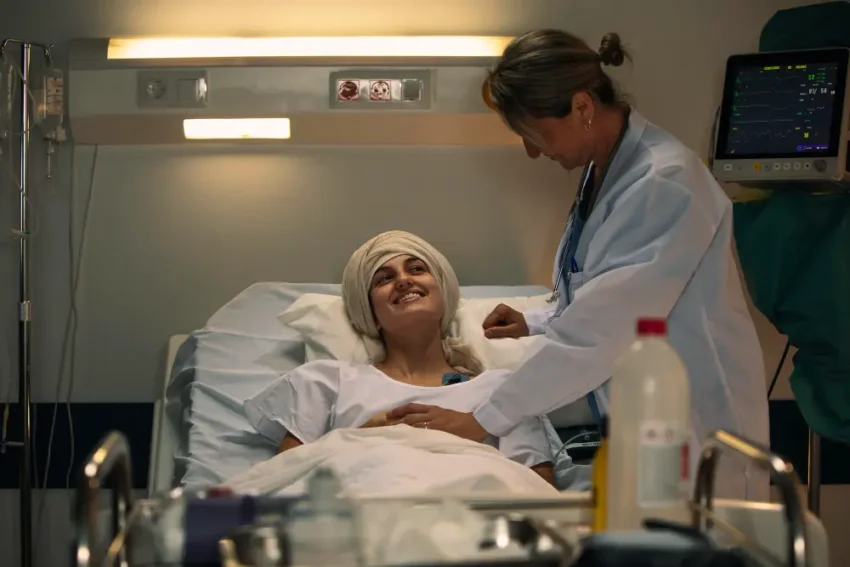
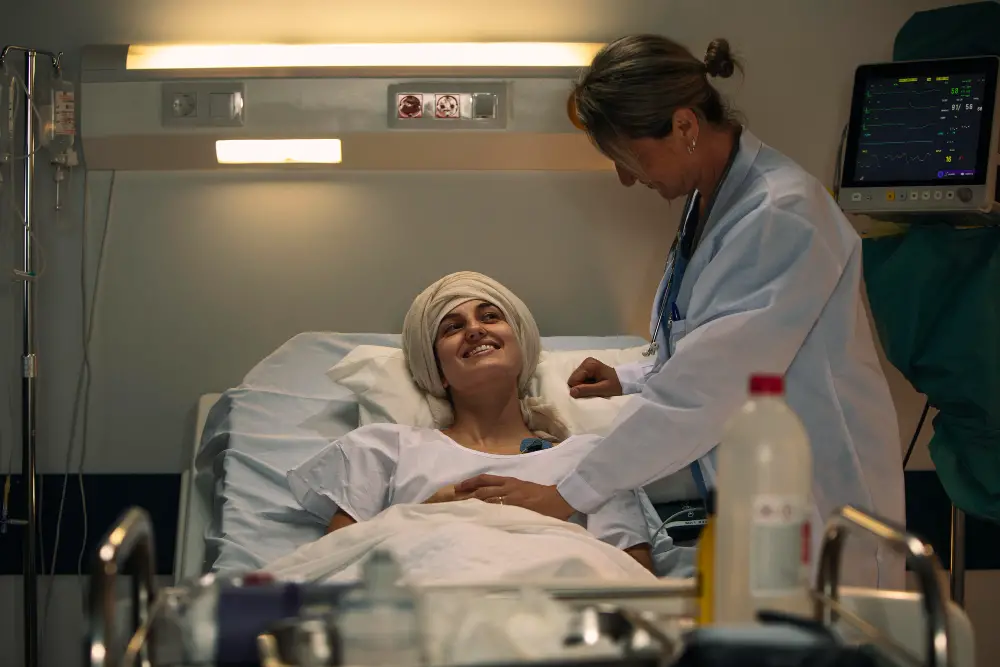
The smell of disinfectant was the first thing I registered. Then the low hum of an air conditioner, the flat beeping of a monitor somewhere to my right, and the particular quality of light that comes through hospital ceiling panels, white and shadowless and indifferent.
I turned my head slowly, the way you do when your body is reminding you that it recently went through something serious. The chair beside the bed was empty. Tidy, undisturbed, as though no one had sat there in days. During seven years of marriage, Brad had always been the kind of man who made a point of his devotion to me in public, who told the story of our relationship at dinner parties in a way that cast him as the hero. He should have been in that chair. He should have been there when I came back.
The room held nothing. No flowers. No card. No sign that anyone had been watching over me while I fought my way back from wherever I had been for a week.
I noticed the folded piece of paper on the nightstand.
Even before I reached for it, something in my chest understood what it was. The body sometimes knows things before the mind will admit them. My hands shook as I unfolded it.
Brad’s handwriting. The rushed, slanted script I had spent seven years deciphering on grocery lists and sticky notes.
Pay for the hospital yourself. You are just a burden.
The lines that followed were worse. He was tired of carrying me. I was a drag on his success, an obstacle he had finally decided to remove. He was not coming back. I should not look for him.
The paper slipped from my fingers and fell to the floor.
I had given that man everything. I had abandoned a promising career as a graphic designer to support his. I had kept his household and managed his calendar and charmed the investors he was too disheveled to charm himself. I had nursed him through a cancer scare in 2018 without once complaining about what it cost me, and I had done it while he came home late and dismissed my opinions and told me, in moments of cruelty he later attributed to stress, that I was not enough.
And I had believed him. That was the part I would spend the longest time forgiving myself for.
I lay in that hospital bed at New York Presbyterian and cried until I had nothing left. Seven years of misplaced devotion pouring out of me while the monitor beeped its steady indifference.
I was still staring at the ceiling when I heard the footsteps.
They were different from a nurse’s tread, unhurried, deliberate, the sound of expensive shoes on linoleum. A man I did not recognize entered my room. He was somewhere in his sixties, silver-haired, wearing a dark suit cut with the understated precision of old money. What struck me most was his expression: not pity, not condescension, but a kind of grave respect.
He glanced at the note on the floor and something moved behind his eyes before he controlled it.
“My name is Arthur,” he said. “I have been looking for you for a very long time.”
His name, I would learn, was Arthur Pemberton, and for more than a decade he had served as personal assistant to a man named William Vance, one of the most significant figures in American business, owner of a conglomerate that operated across four continents. William Vance had spent the last years of his life searching for his daughter, who had vanished in an accident seven years earlier and whose memory had apparently been stolen from her by the collision and, Arthur now told me, by the man who found her afterward.
“The accident was not an accident,” Arthur said. He sat in the empty chair and said it plainly, without theater, the way you say things that are simply true and terrible. “You were deliberately separated from your family. And Brad knew who you were. He recognized you in the hospital from old photographs. He took advantage of your amnesia to make you believe you had no one.”
The room seemed to tilt slightly.
I thought about all the times I had asked Brad about my past, and how he had answered with a particular gentleness that I had mistaken for tenderness, telling me there was nothing to find, that I had come from nothing, that he was all I had. I had believed him because I had no alternative architecture to place against his version of events. He had built the walls of my understanding, and I had lived inside them.
Arthur showed me photographs on a tablet. A woman who was unmistakably me, younger, standing beside a distinguished gray-haired man in front of an estate in the Hamptons. He told me my father had died three years earlier of heart failure, still searching. He told me my real name was Victoria Vance, and that by the terms of my father’s estate, I was his sole heir.
I asked him why he had not found me sooner.
“Your mail at the Sterling apartment was filtered,” he said. “The correspondence never reached you. We did not know where you were until recently.”
My phone buzzed on the nightstand.
Brad’s name on the cracked screen.
Arthur watched me. “Answer it,” he said. “Listen.”
I answered. Brad’s voice came through without greeting, without inquiry into whether I was alive or conscious or in pain. He was coming with a lawyer. He wanted the divorce finalized. I had no financial claims. I was never to contact him or appear at his workplace. He had never really loved me. He was glad to be free.
He hung up.
I sat with the phone in my hand.
Arthur waited.
When I spoke again, my voice was steadier than I expected. “He is going to regret this,” I said.
“Yes,” Arthur said. He said it the way a man says something he has known for a while.
“Not in the way he is picturing,” I said. “Not because he will miss me. Because I am going to show him exactly what he discarded.”
Arthur smiled. It was not a gentle smile.
I left the hospital that afternoon in the back of a black car, watching Manhattan slide past the windows, and I let myself feel the full weight of what I had lost and what I was about to inherit. They were not the same size. The loss was enormous and real and would require years to fully metabolize. But the inheritance was something that still had not resolved itself into a coherent fact in my mind. I kept turning it over: William Vance’s daughter. Victoria. An empire. A father who had searched for me until he died.
The car passed through gates into a neighborhood I recognized from magazines, and then up a long drive toward a house that, as I looked at it, began to produce fragments of memory from somewhere very deep. A lawn I had run across. A fountain I had stood beside as a child. Not complete memories, not a film but a set of still images arriving one at a time.
The staff were lined up outside. They bowed when I stepped from the car.
“Welcome back, Miss Victoria,” they said.
That night, Arthur told me the rest.
While I had been unconscious in the hospital, he had ordered toxicological testing as a precaution. He had been trying to locate me for months, and when he finally traced me to the hospital, the attending physician’s notes had struck him as incomplete. A woman in her thirties, no prior organ dysfunction, no obvious cause for the coma. Something had felt wrong to him in the way things feel wrong to people who have spent long careers watching the mechanisms behind surfaces.
The results came back two days later. Arsenic in the blood, accumulated in quantities consistent with months of regular small doses. Not an illness. Not stress. A deliberate campaign, measured and sustained, designed to produce a decline that would look organic, that a doctor treating a woman for vague and worsening symptoms would have no particular reason to question.
He showed me the evidence without softening it.
Surveillance photographs: Jessica outside a supplier that serviced industrial accounts, purchasing compounds with no domestic use. Security camera footage, captured by cameras in my apartment that I had not known existed, showing Brad adding a white powder to my tea on a Tuesday evening with the unhurried calm of a man performing a task he had performed many times before. Jessica, on a separate occasion weeks later, doing the same while I was in another room.
And the insurance policy, which was perhaps the simplest document and the most damning: five million dollars, taken out six months earlier in my name, with Brad listed as sole beneficiary. The filing date was three weeks after he had begun increasing the dosage.
That was the price of my life to him. Not even a round number.
I sat in my father’s study with the evidence spread across the mahogany desk and I understood something with a completeness that I had not felt since waking up. Not grief this time. Not the oceanic devastation of the hospital room. Something colder and more precise. I had been hunted by people I had loved, and the hunting had been methodical, and they had come very close to succeeding.
“We are not going to the police yet,” I told Arthur. “First I want him to understand exactly what he threw away.”
I spent three months preparing.
I moved through those months with an intensity I had never previously associated with myself, though I was beginning to understand that much of what I had previously associated with myself was a construction Brad had participated in, a slow narrowing of what I was permitted to be. The woman who had disappeared into his household was not a complete person. She was a partial person, edited down to fit a space he needed filled.
I studied financial markets and corporate structure with a tutor from the London School of Economics who had no patience for imprecision. I rebuilt my physical strength with a severity that felt necessary, not vanity but armor. A voice coach from the Royal Shakespeare Company helped me excise the nervous tremor I had developed somewhere in the middle of my marriage, the unconscious habit of softening every statement into something provisional, something that could be walked back without consequence.
In Paris, I had my hair cut and changed. The honey-blonde Preston had loved because it made me look accommodating was gone. What replaced it was darker, more precise, framing a face I was beginning to recognize as my own.
I looked in the mirror in my suite at the Plaza Athénée and met, possibly for the first time, the person I actually was.
Then I went to work.
Sterling Tech, the company Brad had spent years building his identity around, was facing a supply chain crisis. The microchips for his flagship product were stranded in Taiwan, and he was in a bidding war for a midsize logistics firm called Trident Cargo, which would give him control over his own supply chain and save his next earnings report.
I bought Trident Cargo through a shell company, outbidding him by whatever premium was required, and paid no particular attention to the cost.
Sterling Tech’s stock dropped eight percent on the news.
The Met Gala was in May. Preston was a co-chair, which was precisely the kind of social currency he had spent years accumulating and which currently represented the most visible piece of the life he had built. I donated five million dollars to the Costume Institute and received my table the following afternoon.
I arrived alone in a Schiaparelli gown of liquid gold and wearing the Hart Diamond, a forty-carat yellow stone that had not been seen publicly since 1950. The photographers recognized the dress before they recognized the face. Then someone zoomed in, and the name moved through the crowd in a whisper that became something louder.
Brad was at the top of the grand staircase with his new companion.
I ascended without hurrying and stopped two feet from him in the continuous strobe of cameras. He had the expression of a man who has seen something he cannot immediately file into an existing category.
I looked at him with the expression I had spent three months developing, the one that conveyed not triumph and not anger but simple indifference, the mild disengagement of someone who has finished thinking about a problem and moved to more interesting ones.
“Hello, Brad,” I said. “Nice tux.”
I walked past him and into the museum. My gold train brushed his shoe.
He found out the following morning what the gown had been announcing. Aurora Group, the holding company through which I controlled the Hart estate, had been quietly acquiring Sterling Tech shares for weeks through instruments he had no way to trace back to me. By the time he and his counsel understood what was happening, I held commitments representing fifty-one percent of his company’s voting stock and had called an emergency shareholder meeting for the coming Friday, with a single agenda item: removal of the CEO for gross negligence and fiduciary irresponsibility.
He arrived at my offices at 432 Park Avenue with five lawyers and a red tie and the confidence of a man who had never once been genuinely challenged by someone he had underestimated. I sat at the head of the table in a white suit and did not stand when they entered. I gestured to the empty chairs.
But before the boardroom, I gave him his moment of triumph.
I had returned to the hospital the morning of the scheduled meeting, dressed deliberately in the worn clothes of my old life: the ill-fitting jeans, the thrift store coat, the tired posture of the woman Brad expected to find. I needed him compliant and careless going into what came next. Arrogance makes people sloppy, and I intended to benefit from every dropped guard.
He arrived with Jessica on his arm. She was carrying a bag I recognized, an expensive designer piece I had admired in a store window the previous year but declined to buy because we were saving for the future. My stolen savings had purchased it, apparently.
Brad threw the divorce papers into my lap without greeting. He said everything he had been rehearsing: that I had never contributed anything, that I had been a weight on him, that I should sign and disappear and never come near his life again. Jessica added flourishes. The performance had the confidence of people who believed the scene was already written in their favor.
I signed.
Every stroke of the pen was a private promise.
“Just remind me of one thing,” I said, as they moved toward the door. “It was you who asked me to leave. You who sent me away. Remember that when you come looking for me later.”
Brad laughed and walked out.
Forty minutes later, I was in the conference room at 432 Park Avenue in a white suit, and the doors opened.
I had documentation for everything. The company jet deployed for four million in personal vacations per year. The friends on the payroll disguised as consultants. The corporate funds used to pay his divorce lawyers, which was embezzlement with a paper trail clear enough that Joyce Halloway, his counsel, went visibly pale when she saw the printout. The text messages placing him on a yacht in St. Barts during the week he was supposed to be finalizing the Trident acquisition.
And the Aurora Group’s current shareholding position: fifty-one percent of his company’s voting stock, committed and confirmed.
I walked him through it document by document, calmly, without performance, and I watched Preston Sterling become, for the first time in my experience of him, genuinely small. Not angry-small, not wounded-small. The specific smallness of a person who has just seen the full scale of something they had failed to anticipate.
He tried the jovial executive posture first, offering a non-voting board seat as though I had come seeking his approval. Then the wounded partner, invoking shared history, the early years before the money, the studio apartment. Then the threat of litigation, which died in the room almost as he was uttering it, because his own lawyers had by then seen the binder and were communicating volumes through their expressions.
“You have two options,” I said, when the documents were all on the glass table. “Resign effective immediately, sign over your voting rights to the Hart Trust, and keep your freedom. Or decline, and I deliver this to the district attorney within the hour.”
“If I resign I have nothing,” he said. His voice had gone very quiet.
“You will have your freedom,” I said. “Which is more than you planned to leave me with.”
He signed at 4:58 on a Friday afternoon. I watched from the window as he emerged onto Park Avenue below, stood briefly without his entourage, and hailed a yellow cab. It occurred to me that it was probably the first yellow cab he had taken in a decade.
Then I called Arthur and told him to contact the police.
The criminal case built itself from the evidence we handed the district attorney, and it built quickly. The surveillance footage was unambiguous. The toxicology reports were unambiguous. The insurance policy was unambiguous. Brad and Jessica were arrested within days, arraigned, and held without bail pending trial.
I testified on the fifth day of proceedings. I described my marriage with the careful precision of someone who has thought a great deal about how to say true things without reaching for drama, and I described waking from the coma to find the note, and what the note had done to me, and what I had learned in the weeks that followed.
The surveillance footage was shown to the jury on the seventh day. Several of them visibly recoiled.
The verdict came back in under four hours. Guilty on all counts: attempted first-degree murder, insurance fraud, aggravated theft. The judge, a severe woman who had heard many cases and retained the capacity to be genuinely appalled by this one, sentenced Brad to twenty years without parole for the first ten, and Jessica to fifteen years with parole possible after eight, noting her cooperation with investigators and her genuine remorse in mitigation.
I left the courthouse into warm afternoon sunlight and stood for a moment on the steps, feeling the particular quality of air that follows the closing of something.
The anger was gone. I noticed its absence the way you notice a headache when it lifts.
What I had not expected was the aftermath that followed justice, the long, quiet work of figuring out what you are when the fight is over. I had defined myself by my marriage for seven years, and then briefly by my rage, and then by the preparation for what I had just accomplished. The chapter had closed. The question of what came next was not rhetorical.
I established the foundation that year. It began simply, a shelter and legal aid service for women navigating high-conflict divorces with men who had resources they did not. It grew, as things grow when they are needed, into something larger: professional training, psychological support, a community of women who had been through versions of what I had been through and who understood, without needing it explained, what it costs to be told repeatedly that you are not enough.
The work did something for me that the revenge had not. Revenge had been clarifying, necessary, a matter of accounting. But the foundation gave me back the version of myself that had existed before Brad had gotten to it, the one who was genuinely interested in other people, who had capacity to give, who was not simply managing her wounds.
Brad had a sister. I learned this from a young woman named Sarah Thompson who came to my office unannounced one afternoon, sitting across from me with quiet contained guilt, explaining that she had known about the affair with Jessica and had said nothing because Brad had threatened her livelihood.
I told her she was not responsible for his choices. I told her she had been his victim as well.
I offered her a position at the foundation, where she would do her work as a nurse among women who needed exactly what she had to give. She accepted. She became, across the months that followed, something I had not had in a very long time: a genuine friend.
When Jessica gave birth in prison, the baby was placed in state custody. I learned of it through Sarah, who told me with the careful neutrality of someone not wanting to steer my decision.
I sat with the information for several days.
Then I called my lawyers and asked them to begin the process of applying for temporary guardianship.
My lawyer’s hesitation was understandable. This was the daughter of the woman who had tried to kill me. But the child had not tried to kill anyone. She had simply been born into an impossible situation, and someone was going to raise her, and I thought the someone might as well be me.
I visited Jessica in prison to make the offer in person. She looked at me across the visitation table as though she could not parse what she was seeing.
“I am not doing this for you,” I told her. “I am doing it for the child. And if you object, I will respect that. But I thought you might prefer someone you know.”
Jessica cried. She thanked me in ways that went on too long and that I let finish without comment.
Lily came to me two months later, carried in by a social worker in a pink blanket, with large curious eyes that assessed the world with an openness that made me feel, briefly, ashamed of almost everything I had ever felt sorry for myself about. Infants have no irony. They simply look at you and wait for you to be the thing they need.
“Welcome home, Lily,” I said, which was not quite accurate since I was not sure yet what home meant for either of us, but which felt necessary to say.
She became, unexpectedly and almost immediately, the most important fact in my daily life. Not the company, not the foundation, not the work of rebuilding my identity from its recovered roots. The small and demanding reality of another person who needed feeding and comforting and who could not yet be told, in language, that things were going to be all right. I had to simply demonstrate it, morning after morning, until she believed it. That practice did something for me that I had not anticipated. It moved me out of my own narrative and into someone else’s, which was, I think, what I needed most.
Brad died in his third year of imprisonment. The cancer had moved quickly once it announced itself, and he had perhaps a week when his lawyer’s letter reached me requesting a visit.
Arthur advised against it. I went anyway, the following day.
He was in the prison infirmary, diminished in the way the very ill are diminished, as though the body has already begun the process of returning itself to the world. He had lost the arrogance entirely, which had always been the loudest thing about him, and what remained without it was something I might once have recognized.
He told me the whole truth, which I had already known through other means but which still required something from me to receive. He had recognized me in the hospital seven years ago from company photographs. He had known exactly who I was. The original plan had been to marry me and, when my family found me and restored the inheritance, to divorce me and take half. When no one found me, the plan had evolved into something worse.
“You were the only good thing I ever had,” he said. “And I destroyed you deliberately.”
“You tried to,” I said. “It did not take.”
He asked whether I had forgiven him.
I thought about the question with the honesty it deserved.
“I forgave enough to live without the weight of it,” I said. “That is all forgiveness actually is. It is not a statement about what you did. It is a decision about what I carry.”
He cried then, not the performative grief of the courtroom but something quieter and more private. I held his hand until he fell asleep.
He died three days later. I attended the small funeral with Sarah, and I thought about the particular sadness of a life that contained all the ingredients of something good and chose differently.
Five years on, I stood in a large auditorium in Los Angeles on a Friday afternoon and looked out at several hundred women who had come to hear me speak. Sarah was in the front row with Lily, now seven, on her lap. Jessica was beside them, recently released on parole, working steadily at the difficult, incremental project of becoming someone her daughter could be proud of.
I told my story without drama. The coma, the note, the empty chair. The man in the suit who came to tell me I had been a diamond the whole time. The months of preparation. The boardroom, the trial, the verdict, the slow interior work of rebuilding.
I told it because I had learned that the telling mattered. Not the revenge, which had been necessary but not sufficient. Not the justice, which had been real and deserved and which I did not minimize. But the afterward, the choice to transform a wound into a purpose, the discovery that you can take the worst thing that ever happened to you and make it do something useful in the world. That part was what the women in those seats needed to hear. I knew because I had been one of them.
“You are not defined by the worst thing that happened to you,” I said near the end. “You are not defined by who betrayed you, or what they took, or what they told you you were worth. You are defined by what you choose to do when you get back up.”
Afterward, a woman in her late thirties found me at the edge of the stage. She looked the way I had looked the morning I left the hospital in Jersey with three garbage bags. That specific kind of exhaustion that comes from spending too long in a situation you did not deserve.
I shook her hand and held it for an extra moment.
“Come see me,” I said. “We have people who can help.”
She nodded, and in her face I saw the beginning of something unclenching, some small belief that the situation might not be permanent, that the person on the other side of it was still there and still had something to contribute.
That evening, I sat on the sofa in my apartment with Lily asleep against my side, her small weight a fact I had come to rely on. Sarah had gone home. The city was lit below the windows.
I turned Arthur’s message over in my mind, the one he had sent after the lecture. Your father would have been incredibly proud of you.
I thought about William Vance, who had spent his last years searching for a daughter he never found, and what it costs to love someone you cannot protect. I hoped, in whatever way such hopes are meaningful, that somewhere in whatever comes after a life, he knew how the story ended.
I had begun in that hospital room believing I had nothing. A week in a coma. A note on a nightstand. Three garbage bags on a sidewalk in the rain.
I had my name back now. I had my history and the father who had loved me and the house where I had been a child and fragments of memory that were still arriving, slowly, years later. I had the work, which was real and growing and which was making a measurable difference in the lives of women who deserved better than what the world had given them. I had Lily asleep against my side and Sarah’s friendship and Arthur’s quiet, steadfast loyalty. And I had myself, finally, wholly, without the constant negotiation of what I was permitted to be.
Brad had called me a diamond once, near the end, as a kind of confession. He was right, but not in the way he had originally meant the word.
I was not a diamond because of my father’s wealth or my father’s name. I was not one because of the inheritance or the company or the gold gown or the forty-carat stone I had worn into a room to make a point. I was a diamond because of what the process had required. The pressure. The darkness. The long time underground without light or air or any reason to believe that what I was becoming would ever be seen. That process had been excruciating, and I would not have chosen it, but I had come through it harder and clearer and more completely myself than I had been before it began.
No one would be throwing me away again.
I already knew my own value, and I had learned it the only way it is ever truly learned: by surviving the people who tried to convince me otherwise.