Load-Bearing
I am a structural engineer. I calculate how much weight a thing can hold before it fails.
I know the exact point where load exceeds capacity and something that looked perfectly solid just gives. I know what the numbers look like right before a beam buckles, right before a foundation settles, right before the thing you built your calculations around turns out to have been wrong from the start. I know the difference between a controlled failure and a collapse.
I should have known.
When the envelope came back three days after I mailed it, I was standing in my apartment in Los Angeles, ten stories above Culver City, and my other hand was already finding the steel T-square in the side pocket of my bag. Six inches of cold metal. Exact right angles. Something that doesn’t change its mind about you.
The envelope was the same cream cardstock I had chosen after two hours in a stationery shop in Pasadena, running my thumb across sample after sample. One hundred percent cotton. Crane and Co. I had wanted my parents to feel its quality before they read a word. I had wanted them to think: she’s doing well out there.
Someone had opened it. Removed the invitation. Put something else inside.
A torn piece of notebook paper. My mother’s handwriting, the same handwriting that used to sign my permission slips.
Six words: Don’t bother. We won’t come.
I am an engineer. I run the numbers before I build. And some part of me had run the numbers before I mailed that envelope and had known. The structural analysis was not good. This bridge had never held a single pound of weight. There was no evidence, zero, to suggest it would hold now.
But the eleven-year-old in me, the one who still kept hoping, had convinced me to mail it anyway.
Here is what you need to understand about the Langston family of Bartlesville, Oklahoma.
There are two daughters. One of them is the right one.
Shelby is the right one. Shelby stayed. Shelby married Cole Prentiss at twenty-one in the First Baptist Fellowship Hall with a tiered cake my mother spent three weeks planning. Shelby lives ten minutes from the ranch. Shelby has two children and my mother babysits every Thursday. Shelby is blonde and small and laughs like wind chimes and has never once been told she is a disgrace to this family.
I am the other one.
The first time I understood the math, I was eleven.
The whole family was going to Disney World. My parents had been saving all year. The night before we left, my mother came into my room while I was packing, sat on the edge of my bed, put her hand on my knee the way you do before you say something kind.
We only have four tickets, sweetheart. And Shelby really, really wants to go.
Four people. Four tickets. Dad. Mom. Shelby. And the space where I used to be.
I stayed with Nana June. She made chicken and dumplings and let me watch whatever I wanted and took a Polaroid of me on the front porch. I smiled for it — my mouth did, anyway. Eyes of a girl who had already done the math.
Somewhere in Shelby’s room, there is still a photo album from that trip. Matching Mickey ears. Castle at sunset. Shelby on my father’s shoulders.
There is no album from my week with Nana June.
After Disney, the pattern got easier to see, or maybe I just got better at reading blueprints.
Shelby’s dance recital: front row, both parents, flowers afterward.
My science fair win, regional qualifier: a text from my mother that said, That’s great, Han. No period. No exclamation point. Five words, thumbed out between whatever she was actually doing.
Shelby’s first car at seventeen: a red bow on the hood, my father beaming like a man who had done something right.
My full scholarship to UCLA, engineering program: my mother at the kitchen table, lips pressed into a line I now recognize as fear, saying That piece of paper won’t keep you warm at night, Harper.
When I was sixteen, I worked the drive-through at Dairy Queen for four months and saved $220 and bought my mother two tickets to see Reba McEntire at the BOK Center in Tulsa. Her favorite singer. The one she hummed while making biscuits. I wrapped them in tissue paper and watched her open them on Mother’s Day morning.
She took Shelby.
You understand, honey. You’re the responsible one.
Responsible. The word they give you instead of chosen. I learned it like a middle name. Harper Responsible Langston. The daughter who would understand. Who would stay quiet. Who would keep offering and keep being passed over and keep understanding, because that was her structural role in this family: to bear the load so everyone else could stand comfortably on top of her.
I left Bartlesville the day after graduation. Packed two suitcases. My father stood at the front door with his arms at his sides like fence posts. No hug.
Don’t come back asking for money.
I didn’t. Not once in ten years.
I arrived in Los Angeles with eight hundred dollars and a suitcase that smelled like Oklahoma hay and the particular brand of dryer sheets my mother bought in bulk. Engineering school was eighty-five percent men. Nobody tells you that before you show up. Nobody tells you that the first week, a guy in your statics class will look at your calculations and say, who helped you with this? And when you say nobody, he’ll laugh like you told a joke.
I was not loud.
I was precise.
There is a particular comfort in numbers. A beam either holds or it doesn’t. No ambiguity. No you understand, honey. No favoritism. Steel doesn’t care if you’re the right daughter or the wrong one. It cares about yield strength and cross-sectional area and whether you did the math correctly.
I always did the math correctly.
Graduated 2019, summa cum laude. No one came. I rented a gown, walked across the stage, shook the dean’s hand, and took a selfie in the parking lot with my cap tilted because I couldn’t get it to sit straight. Then I went to Target and bought a six-inch steel T-square — the good kind, the kind that costs forty dollars and lasts a lifetime — and I held it in the bag on the bus ride home and thought: this is my diploma. The real one. The one I bought for myself.
I called home on holidays. Thanksgiving. Christmas. Mother’s Day. My father’s birthday. My mother would talk about Shelby — Shelby’s pregnancy, Shelby’s new kitchen, the funny thing Levi said at church. I’d listen. Sometimes I’d try to tell her about a project — we were reinforcing a 1920s theater in Silver Lake, beautiful old bones, and I was proud of the solution we’d found — and she’d say that’s nice, honey, the way you say that’s nice to a child showing you a crayon drawing, and then Shelby would call on the other line.
My father and I exchanged weather reports like two strangers waiting for the same bus.
Hot out there?
Yep.
Hot here too.
Three years of this.
Then I met James.
A documentary crew came to a construction site in Koreatown where we were doing a seismic evaluation. James was the cinematographer. He asked me to explain what I was doing in a way his editor would understand.
I make sure buildings don’t fall down, I said.
That’s the shortest interview I’ve ever done, he said. He was smiling.
First date: a pho restaurant in Little Saigon. Plastic chairs. I told him about the Disney trip. I don’t know why. I hadn’t told anyone in Los Angeles about it. But James asked about my family and instead of the usual they’re fine, they’re in Oklahoma, I opened my mouth and the Disney trip came out like a splinter working its way to the surface after seventeen years.
He didn’t say that’s terrible. He didn’t say I’m sorry.
He was quiet for a moment, chopsticks still.
Then he said: so you never got the photo album.
Five words. And I knew he understood — not just the anger, which anyone can understand, but the specific shape of the absence. The empty page where the photos should have been.
James proposed in October 2025, on the roof of a building I’d retrofitted two years earlier. He got down on one knee next to a seismic joint I’d designed.
I said yes before he finished the sentence.
Then I did the thing I had promised myself I wouldn’t do.
I sent the invitation.
The bridge failed.
My phone buzzed. Shelby. A photo: my invitation, shredded into confetti on the kitchen counter, the red-checked tablecloth visible underneath. My mother’s coffee mug in the frame, half-full. She had done this during her morning coffee. Routine.
Shelby’s text: Mom says don’t embarrass yourself. Be too nice paper lol.
Lol.
I called my father. He picked up. I could hear the ranch behind him — wind, a gate creaking.
Did you want to come? I asked.
Silence. The kind that carries the weight of something a man has decided not to say.
It’s complicated, Harper.
Complicated is the door that men like my father use to exit conversations they can’t handle. I will not disagree with your mother. I will not stand between you and her. I will not choose.
Okay.
I called my mother. She answered on the first ring, voice in the register she uses for church committees.
Oh, you’re calling about that little card?
That little card.
Two hours in a stationery shop. Eleven dollars per envelope. A lifetime of hoping, compressed into cream and gold ink.
That little card.
Mom, I’m getting married. I want you there.
Honey.
She stretched the word like taffy.
I am not flying across the country for some wedding I wasn’t consulted about. You made your choices. You chose that city. You chose that boy.
That boy. James Park. Thirty-one years old, college-educated, calls his mother every Sunday, lights up every room he walks into. That boy, because his grandmother came from Seoul and not Stuttgart.
His name is James.
I know what his name is. That is not the point. You left this family. A real wedding is what Shelby had. Family. Church. People who know you.
There was so much to say that the words jammed in the doorway.
So nothing came out.
I have to go, she said. Bible study at six. I’ll pray for you.
She hung up.
And then my sister called to explain to me, very patiently, in a voice pitched to sound concerned, who I was to this family.
You left, Harper. You built this whole whatever out there. But you don’t get to leave and then demand a standing ovation. I’m the one who’s here. I’m the one who takes Levi to the dentist and helps Mom with the garden. I’m here and you’re in some apartment in L.A. planning a wedding nobody asked for.
Structurally speaking, she wasn’t wrong that I had left. She was wrong about everything else.
But I had run the calculations. Any force I applied would be wasted. This structure was never designed to hold this kind of load.
Good night, Shelby.
I sat on the floor. Not dramatically, just the way you sit when your legs decide they’re done. My phone still bright in my hand. Shelby’s name at the top. Duration: four minutes and twelve seconds.
James came home at ten. He found me on the floor and read the geometry of my body the way I read the geometry of a building under stress. He sat down next to me, back against the cabinets, took my phone, turned off the screen, set it face-down on the tile between us.
We sat there, two people on a kitchen floor in Los Angeles, 1,300 miles from a ranch in Oklahoma where my invitation was confetti and my name was a problem to be prayed about.
After a while I said, structurally speaking, I just ran out of reinforcement.
James put his hand on mine. Didn’t squeeze. Just placed it there, the way you place a temporary support under a beam that’s starting to bow.
The next morning I told him I wanted to cancel the wedding.
He was making coffee. French press. He heats the water to exactly two hundred degrees. Times the steep at four minutes. There is precision in him that I love because it is the only kind of warmth I know how to fully trust.
I think we should cancel.
His hand didn’t move. His eyes recalibrated.
Okay, he said. Can you tell me why?
What I wanted to say was: how can I stand at an altar and promise someone forever when the people who were supposed to love me first didn’t even want to sit in a folding chair and watch?
What came out was something about not being able to build on top of it.
And then the words stopped.
The construction language, the load-bearing terminology, the structural metaphors I have wrapped around my entire interior life since I was eleven years old — it was gone. I opened my mouth and there was no blueprint. No calculation.
That was the part that frightened me. Not the crying that came later. The moment I lost my language.
Because my language is how I hold myself together. It is the structure inside the structure.
And when it went quiet, I understood for the first time that I was not in a controlled demolition.
I was in a collapse.
Two weeks of going through the motions. Work. Home. Eating when food appeared in front of me. Nina covering two of my projects without being asked.
On a Wednesday, nine days after the envelope, I was running a lateral load calculation for a parking structure in Glendale. Routine. I got the soil classification wrong. Not a small error — I used Type D instead of Type E, which changes the seismic design category, which means every calculation downstream was built on a wrong foundation.
Nina caught it. She pulled me into the conference room.
Type E, Harper. You know this. You’ve never gotten that wrong.
I know.
She sat on the edge of the table and looked at me the way she looks at a structural drawing that doesn’t add up.
Tell me.
I told her.
She was quiet for a while. Then she said: my parents didn’t come to my naturalization ceremony. Federal courthouse in downtown L.A. My mother said: that’s American nonsense. You are Igbo. A piece of paper does not change your blood.
She uncrossed her arms.
I cried for a week. I almost didn’t go. But I went anyway. And the judge who swore me in shook my hand and said, welcome home.
She looked at me.
Sometimes home is where you’re welcome, Harper. Not where you’re from.
It didn’t fix anything. A sentence doesn’t fix a structural failure. You need actual reinforcement, actual labor, actual time.
But it was the first thing in nine days that landed somewhere solid.
On a Saturday morning, there was a knock at the door at eleven. I was on the couch in James’s sweatshirt, which I’d been wearing for two days because it smelled like him and required no decisions.
Mrs. Eunice Park stood in the hallway. Sixty-two years old, retired dry cleaner, hands that had pressed ten thousand shirts and still had the grip strength to prove it. She was holding a large ceramic pot with both hands and a bag of banchan containers hanging from her elbow and an expression that made it clear she had not come to ask how I was feeling.
Have you eaten today?
No. Not yet.
She walked past me into the kitchen.
She set the pot on the stove, turned the burner to medium, and laid out the banchan with the efficiency of a woman who has fed people through every kind of crisis and does not require a conversation to begin doing so. Kimchi. Pickled radish. Seasoned spinach. Tiny dried anchovies.
Sit.
I sat.
She served the jjigae in a bowl she’d brought from her own kitchen. Set it in front of me with a spoon and two napkins and a look that said eat more clearly than the word.
I ate. The broth was hot and red and burned my tongue slightly, and that small pain was the first sensation in three days that wasn’t grief.
She didn’t speak until I’d finished half the bowl. Then: James told me. Not all of it. Enough.
When I came to America, she said, I was twenty-five. One suitcase. My parents said I was throwing away my family. My mother said: you are dead to us.
She adjusted a banchan dish a quarter inch. Precision.
I didn’t see my mother for fourteen years. When she finally came, she walked through my house and looked at the photos on the wall and she started to cry. She said, you survived without me.
Mrs. Park looked at me.
I said: I didn’t survive without you, Umma. I survived because of the people who showed up when you didn’t.
The kitchen was quiet. The jjigae bubbled on the stove, low and steady.
Then she put her hand over mine and said:
Family is not blood, Harper. Family is who sets the table when you can’t feed yourself.
I looked at the bowl she had driven forty-five minutes from Torrance to serve me. At the table she had set because I couldn’t set it myself.
The math was simple. Even without my language, I could do this math.
After lunch, she pulled out a photo album. Burgundy cover, slightly bent at the corners. Page after page of the Park family — James at five in a tiny tuxedo, Mrs. Park at his college graduation holding a bouquet almost bigger than she was. A lifetime of recorded moments.
Then she turned to a page near the back.
There I was.
A Fourth of July barbecue. I was standing by the grill, holding corn on the cob, laughing at something with my head tilted back. I hadn’t known anyone was taking a picture. I didn’t know I was being recorded.
But there I was, in someone’s family album, between James’s cousin’s graduation photo and his brother’s engagement dinner.
I had been in a family this whole time. I just hadn’t recognized it because it didn’t look like the one I’d been trying to get back into.
Mrs. Park closed the album.
You belong in this book, Harper. You have for a long time.
She left at three. Hugged me at the door — short, firm, the kind that says enough now, you’ll be fine — and told me to return the pot next Thursday.
Not a suggestion. A schedule.
That night I stood on the balcony. Los Angeles spread below in ten million lit directions.
James came up behind me. We were quiet in the way we’re quiet when neither of us needs to fill the space.
I keep checking my phone, I said.
For what?
I was waiting for the call from Bartlesville. The voicemail from my father. The text from my mother that said we changed our minds.
I was still waiting for four tickets to Disney World, standing on a balcony in Los Angeles, twenty-seven years later.
I set the phone face-down on the railing.
I’m done building bridges to people who aren’t standing on the other side.
James looked at me.
We’re getting married. I don’t care if nobody from Bartlesville comes. I’m done waiting for them to choose me. I choose us.
He put his arm around me and we stood there, looking at the city that had held me when my family wouldn’t.
For the first time in weeks, I was standing on something that didn’t shake.
The venue came about because of a man named Warren Aldridge, sixty-eight, retired, who owned a property on a cliff in Malibu worth approximately forty million dollars. I knew this because Mercer and Associates had done the seismic retrofit on that property in 2021 and I was the lead engineer. The house sat cantilevered over the Pacific in a way that looked reckless but was, if you checked the math, exactly right.
I had checked the math for four months.
Warren had stayed in touch since. Annual emails. Occasionally coffee. When I mentioned the engagement, he’d asked about the venue and I’d said we were still figuring it out, budget was tight.
The call came three weeks after the balcony.
Harper, use the estate.
I can’t accept —
You reinforced the foundation of my house. Literally. You’re the reason that building is still standing on that cliff. The least I can do is let you stand on it for one day. Stop calculating and say yes.
I said yes.
Not because of the forty million dollars. Because a man I had built something for offered me the thing I had built. Structurally speaking, that was the right kind of foundation for a marriage.
The dress fitting was Nina’s doing. She found a sample sale in Beverly Hills and informed me, in her non-negotiable register, that we were going. Mrs. Park drove up from Torrance.
The saleswoman kept asking about the bride’s mother.
She’s not available, I said.
Nina looked at Mrs. Park. Mrs. Park looked at Nina. Something passed between them — a small alliance, wordless.
Mrs. Park said: We are here. That is enough.
The saleswoman adjusted and did not ask again.
I tried on four dresses. The fourth was right. Silk crepe. No beading. No lace. No embellishments that needed explanation. It fell straight from the shoulders and moved when I moved and was quiet the way I am quiet — not because it had nothing to say, but because it didn’t need to say it loudly.
Nina said, Oh my God, and covered her mouth with both hands.
Mrs. Park pressed her handkerchief to her eyes. Then she put it away, straightened her spine, and said:
You look like a bride who knows exactly who she is.
I looked in the mirror.
For one clean, uncomplicated moment, I did not see the wrong daughter, or the girl on the porch, or the woman on the kitchen floor.
I saw Harper in a wedding dress, standing up straight.
That night I sat at the kitchen table and wrote my vows. The language came back. The structural metaphors, the precision, all of it. I wrote and rewrote and crossed out and started over until I had something that felt true.
In engineering, perfect and true are different standards. Perfect means no flaws. True means the thing does what it was designed to do.
When I finished, I picked up my phone. My thumb, by twenty-eight years of reflex, scrolled to L.
Lorraine Langston.
I held it there.
Three seconds.
Then I scrolled up to E.
Eunice Park.
She answered on the second ring.
I wrote my vows, I said. Can I read them to you?
A pause. A small breath.
Read it. Slower than you think you should.
I read.
She listened.
When I finished, she said: perfect.
Then softer: your mother should hear this.
She won’t.
I know. That is her loss. Read it again.
I read it again. Slower.
And the woman on the other end of the phone, who had come to America with three hundred dollars and built everything from there, listened to every word like it was the most important thing she would hear all day.
April came faster than I was ready for.
But then again, I had spent twenty-eight years getting ready.
I woke to the sound of the Pacific Ocean on the morning of the wedding. James had left the guest suite before dawn — tradition, he’d said, even though neither of us was particularly traditional. The bed was empty on his side.
On the nightstand, where my phone usually sat, there were two things.
My T-square. Six inches of steel, slightly bent at one corner from the night it hit the drywall. James had pulled it out of the wall that morning, spackled the hole without comment, and kept it in his camera bag for weeks.
And a note in his loose, crooked handwriting: Something borrowed. Something steel.
I held it against my chest, then set it on the dresser next to my vows and went to get married.
Mrs. Park arrived at eight sharp. Nina came with a curling iron and a YouTube tutorial she had watched three times. The first attempt at my hair was structurally unsound — lopsided in a way that defied her master’s degree.
Mrs. Park observed from across the room without mercy.
The hair does not agree with your degree.
Real laughter, from the belly, the kind that makes your eyes water.
Nina recurled the left side. It was still slightly uneven.
I didn’t care. Real things are never perfectly symmetrical.
When the dress was on, Mrs. Park reached into her purse and pulled out a silk pouch. Inside, a silver hairpin shaped like a crane with wings extended.
My mother gave this to me at Incheon Airport the day I left Korea. She had said I was dead to her. But she pressed this into my hand at the last moment and said, come back.
She looked at me.
I want you to wear it today.
I bent my head. She slid the pin into my hair above my left ear, her fingers lingering, adjusting, making sure it was secure the way a mother checks that everything is in place before she lets go.
There.
Then, in a voice that almost cracked but did not, because she was Eunice Park:
Not yet. Mascara.
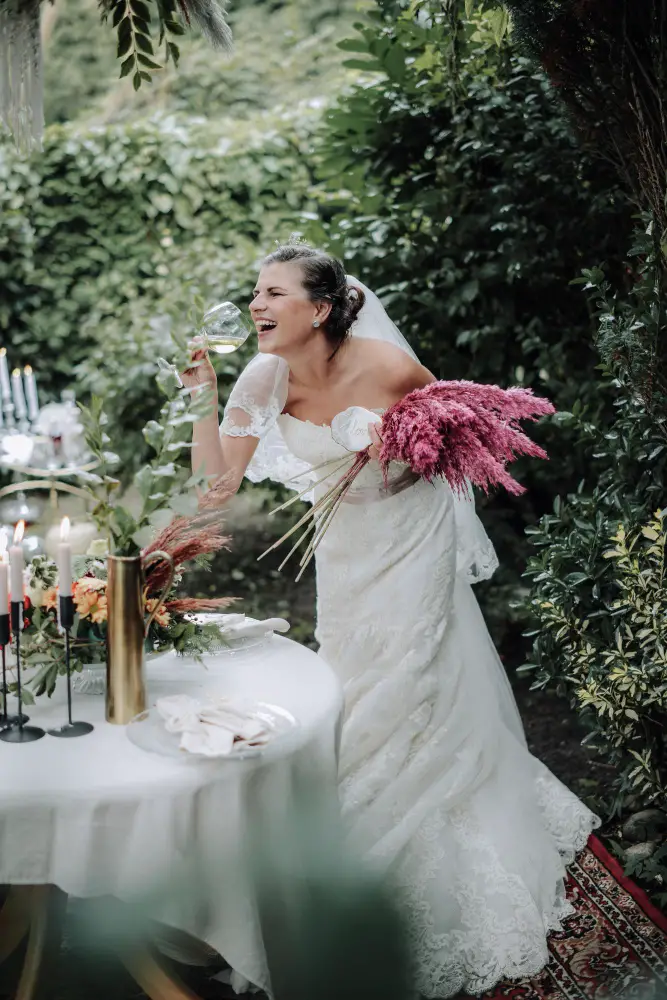
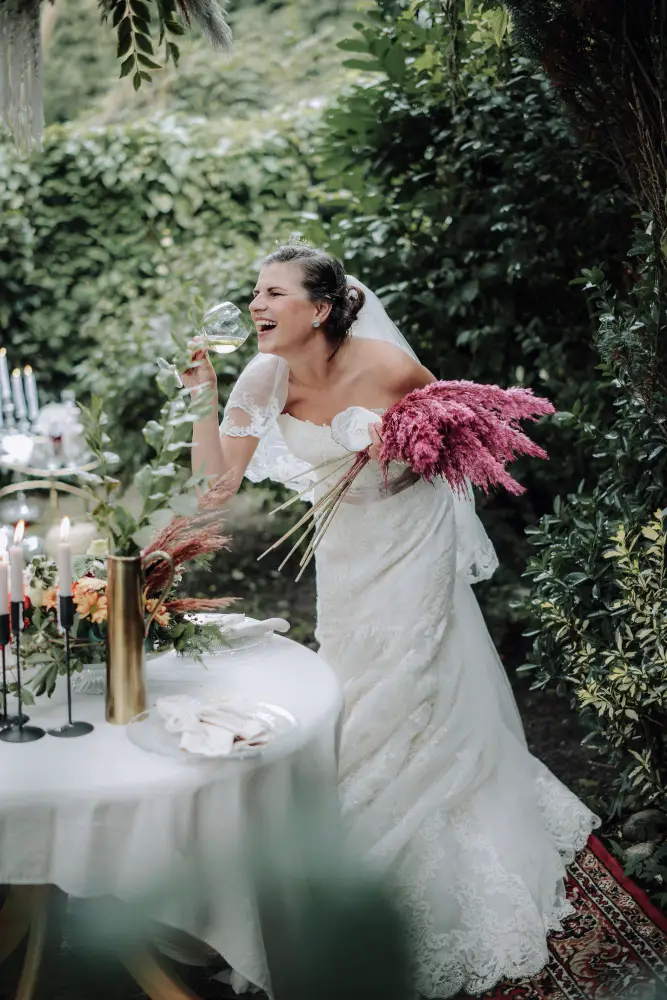
At ten-thirty, I stood at the far end of a stone path along the cliff’s edge.
A wooden arch wrapped in Oklahoma wildflowers — Indian blanket, black-eyed Susan, coneflower. The flowers I used to pick on the side of the county road when I was eight, walking home from the bus stop because nobody was coming to get me. I had wanted them because they were mine. Not Lorraine’s, not Shelby’s, not Bartlesville’s. Mine.
Eighty-five people sat in white folding chairs on a cliff above the Pacific.
James stood at the end of the path in a dark suit, no tie, his eyes already wet.
There was no one beside me.
No father. No mother.
I want you to understand the difference between walking alone because no one showed up and walking alone because you decided that the person who delivers you to the altar should be the same person who got you this far.
That person was me.
I walked alone.
The ocean moved on both sides of the cliff. The wildflowers trembled in the wind off the water. Somewhere behind me, at some point I did not consciously register, eighty-five people rose.
Not because tradition told them to.
Because something in the sight of a woman walking alone toward the person who stayed made them want to be on their feet.
James spoke first. Warm, specific, funny.
He said he had met me when I was arguing with a piece of rebar about spacing.
You were losing, he said. And I thought, I want to know this woman.
The guests laughed. Mrs. Park shook her head.
Then it was my turn.
The ocean moved behind him. The wildflowers trembled. Eighty-five people went quiet.
I opened my mouth.
And for one terrible, beautiful moment — nothing.
Everything I had ever wanted to say to anyone jammed behind my chest at once.
Then I found it. My phrase. The one I had lost in a dark apartment and found again on a balcony.
Structurally speaking, James —
My voice cracked. I stopped. Breathed.
The ocean filled the silence.
Structurally speaking, you are the only foundation I have ever stood on that didn’t shift.
The sound that moved through the crowd was not a gasp. It was softer. An inhale that traveled from the front row backward, like a wave pulling away from shore.
Mrs. Park pressed her handkerchief to her mouth.
James’s chin dropped, and a tear fell straight down onto our joined fingers.
I did not cry.
I smiled. Wide and real, the kind that starts somewhere in the chest and arrives at the face without asking permission.
Because for the first time in twenty-eight years, I was not asking anyone to confirm that I was enough.
I knew.
I knew it the way I know a weld is true — not because someone told me, but because I had tested it and the numbers came back clean.
The arch of wildflowers held.
The cliff held.
The Pacific moved far below us, indifferent and vast, the way it had been moving for ten thousand years before any of us arrived at this edge, and the way it would move long after we were gone.
And I stood on solid ground.
For the first time.
For the first time in my life, I stood on ground that had been built to hold me.