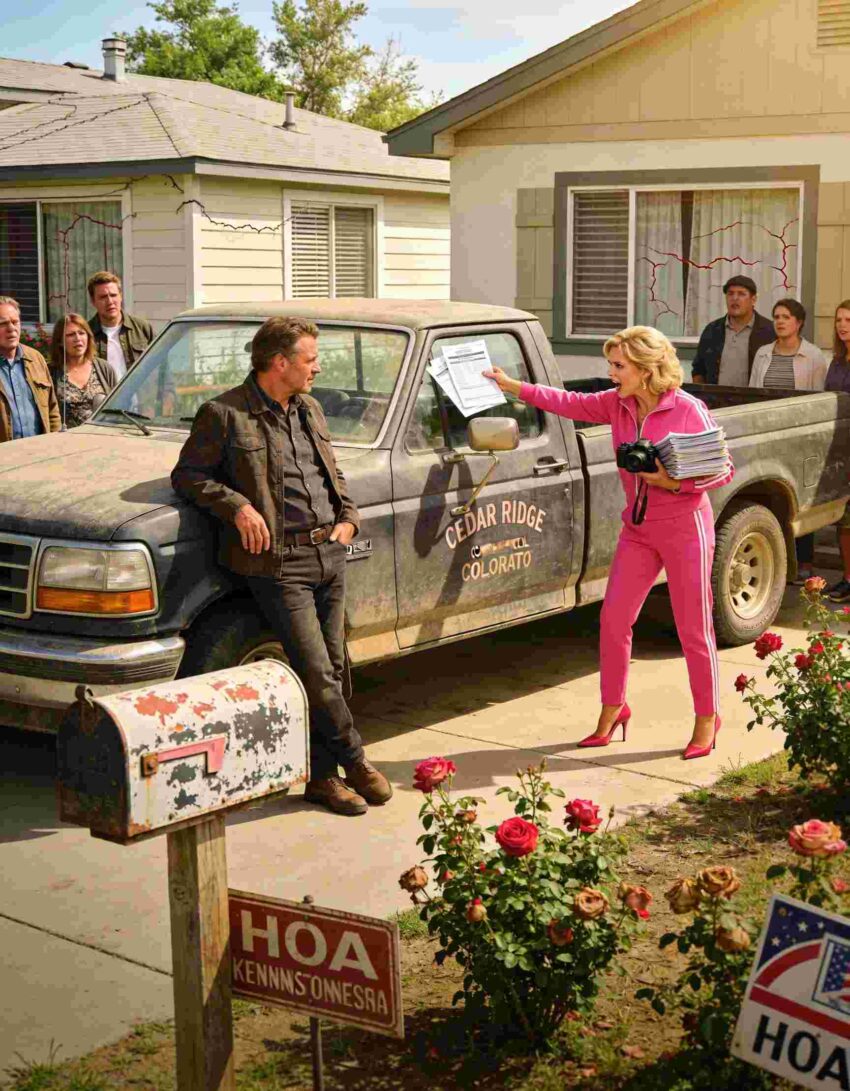
My HOA Queen Fined Me $2,300—Then Learned I Owned Her Rental and Her Secrets All Along
PART 1: The Pink Tracksuit Queen
The first thing I saw when I pulled into Cedar Ridge Estates was not the mountains.
It should have been.
After twelve hundred miles of diesel smoke, gas-station coffee, stale beef jerky, and the kind of lonely highway silence that makes a grown man start talking to his dashboard, I should have noticed the Colorado peaks first. They rose behind the neighborhood like a painted movie backdrop, blue and silver under the August sun, the kind of view real estate agents put on postcards and call “a lifestyle.”
But instead, the first thing I saw was a woman in a bright pink tracksuit walking straight toward my truck like she had been waiting for me since sunrise.
Her heels clicked against the driveway.
Click.
Click.
Click.
I had not even turned off the engine.
My old pickup, a faded blue Ford with a half-peeled Albuquerque Property Group logo still ghosted across the driver-side door, coughed once, rattled, and settled into the kind of rough idle that made people either nostalgic or suspicious. I was still gripping the steering wheel, trying to convince my lower back it had survived the trip, when the woman slapped a white envelope under my windshield wiper.
Hard.
Like she was serving me divorce papers.
I rolled down the window.
“Can I help you?”
She turned toward me slowly, with a smile that had no warmth in it at all.
“You must be Mr. Caldwell.”
She said my name like it tasted bad.
I looked at the envelope. Then at her. The tracksuit was expensive, the sunglasses were enormous, and her blond hair was arranged in a helmet-like shape that could probably survive hail. She had a clipboard tucked under one arm and a stack of papers in the other.
“And you are?”
“Brenda Kensington,” she said. “President of the Cedar Ridge Estates Homeowners Association.”
Of course she was.
I killed the engine.
The quiet that followed felt staged. Curtains moved in the houses across the street. A set of blinds snapped shut. Somewhere down the block, a lawn sprinkler ticked back and forth over grass that looked too green to be natural.
Brenda lifted her clipboard.
“I’m issuing a notice of violation.”
“For what?”
She looked at my truck the way a restaurant inspector looks at a rat.
“Commercial vehicles are prohibited from being parked in driveways. The logo on your door is visible from the street. That’s a covenant violation.”
I laughed once because I thought she was joking.
She was not.
“That company laid me off three months ago,” I said. “The logo is just paint.”
“Visible branding is visible branding.”
“Lady, I just drove halfway across the country.”
She clicked her pen. “That’s not relevant.”
I opened the envelope.
Five hundred dollars.
For the truck.
Before I could form a full sentence, she pulled another sheet from the stack.
“Additionally, the rose bushes along the front walk are unapproved landscaping.”
I stared at her.
“You mean my aunt’s roses?”
“They are not listed in the approved exterior plant schedule.”
“They’ve been there for thirty years.”
“That may be true, but nonconforming landscaping remains nonconforming.”
Another sheet.
“Mailbox paint degradation.”
Another.
“Oil staining on driveway.”
Another.
“Visible moving debris.”
I looked past her at the porch, where three cardboard boxes sat stacked beside a roll of moving blankets.
“You mean my stuff?”
“I mean visible moving debris.”
By the time Brenda finished reading, I had $2,300 in fines and forty-eight hours to pay before the HOA would begin “escalated enforcement action.”
Her words, not mine.
The entire time, she smiled.
That was the part I remember most clearly. Not the fine. Not the heat. Not the mountain air that smelled like pine and asphalt. The smile.
It was the smile of a woman who had done this many times and enjoyed every second of it.
I climbed out of the truck slowly. My knees popped. My shirt clung to my back. I had slept four hours in a motel outside Pueblo, and I was running on caffeine, grief, and whatever stubbornness God gives men after the rest of their life catches fire.
“Ms. Kensington,” I said, keeping my voice calm, “I inherited this property from my aunt Clara. I’m going to need a copy of the HOA covenants, meeting minutes, fine schedule, and financial reports.”
That did it.
Her smile stayed in place, but her eyes changed.
Just for half a second.
A flicker.
“What did you say?”
“I said I need the governing documents and financials.”
“HOA financials are confidential.”
“No, they’re not.”
Her pen stopped moving.
“I spent twenty years managing commercial properties,” I said. “I’ve dealt with HOAs, condo boards, special districts, maintenance trusts, and every kind of petty tyrant with a name badge. Members have a right to inspect records.”
The neighbor across the street, an elderly woman with white hair and a blue cardigan, was standing behind her storm door. When Brenda glanced over, the woman disappeared so fast it was like somebody yanked her backward.
That was when I realized this was not about roses.
It was not about my truck.
It was not about the chipped mailbox.
This neighborhood was afraid.
Brenda stepped closer. Her perfume was sharp and floral, the kind that announces itself before the person enters a room.
“Mr. Caldwell,” she said softly, “Cedar Ridge Estates has standards. People move here because we protect those standards. Your aunt had difficulty understanding that. I sincerely hope you do not repeat her mistakes.”
My chest tightened.
My aunt Clara had been dead less than three months.
She had raised four children after her husband died in Korea. She had worked nights at a truck stop and still found time to knit blankets for every stray dog in Cedar Ridge County. She had sent me birthday cards until I was forty-six years old, always with twenty dollars taped inside and the words “Don’t spend it all on foolishness.”
And this woman was standing in Clara’s driveway, using her memory like a warning label.
I folded the fines and slid them back into the envelope.
“I’ll review these.”
“You have forty-eight hours.”
“I heard you.”
“And Mr. Caldwell?”
I looked at her.
“That truck needs to be gone by morning.”
She turned and walked away, heels clicking, clipboard pressed to her chest like a judge’s gavel.
I watched her cross the street to a white SUV parked along the curb. A man sat inside, broad-shouldered, shaved head, mirrored sunglasses, one arm hanging out the window. He wore a black polo with a shiny badge clipped to the front.
Not a real badge.
I knew real security credentials. I had hired real security teams.
That thing looked like it came from a Halloween store.
The man gave me a little two-finger salute as Brenda climbed into the passenger seat.
Then they drove away.
I stood in the driveway of the house my aunt had left me and looked around Cedar Ridge Estates.
Fifty homes. Quiet streets. Flagpoles. Bird feeders. Little porches with rocking chairs. The kind of place people work thirty years to afford. The kind of place that should feel safe.
But every curtain was still.
Every door was closed.
Nobody waved.
I carried my first box inside.
The house smelled like old wood, lemon cleaner, and Clara’s cinnamon candles. Her recliner still sat by the front window. Her crocheted blanket hung over one arm. On the kitchen counter, someone had left a stack of mail, a church bulletin, and a coffee mug that said “Don’t Mess With Grandma.”
I stood there longer than I should have.
Three months earlier, I had been in Albuquerque, managing a portfolio of commercial buildings for a company that rewarded twenty years of loyalty with a cardboard box and a security guard walking me to the door.
Two weeks after that, my ex-wife informed me she was keeping the house and moving in a guy named Starlight who sold dream catchers at flea markets and referred to himself as an “energy consultant.”
So when the lawyer called about Aunt Clara’s house in Colorado, it felt like the last rope thrown to a drowning man.
I thought I was coming here to start over.
I had no idea I was walking into a war.
That night, after unloading half the truck and eating cold pizza over the kitchen sink, I heard a soft thump against the front door.
I opened it.
Another certified letter.
This one had been shoved through the mail slot.
The fines had increased to $2,800.
“Administrative review fee.”
“Compliance processing fee.”
“Emergency inspection surcharge.”
There were photographs of my property taken from every angle. My truck. The roses. The mailbox. The porch. Even the back gate.
Someone had been on the property while I was inside.
At the bottom of the letter, in bold letters, it said:
Failure to pay may result in lien placement and foreclosure proceedings within thirty days.
I read that line twice.
Then I looked out the window at the dark street.
A white SUV rolled slowly past the house.
Its headlights were off.
I smiled for the first time all day.
Because Brenda Kensington had made one serious mistake.
She thought I was scared.
PART 2: The Fine Print
The next morning, I drove to the county recorder’s office before Brenda could come back with a marching band and another stack of fines.
The county building sat near downtown Cedar Ridge, between a courthouse with cracked stone steps and a diner advertising “Best Green Chili Burger in Colorado.” Inside, the recorder’s office smelled like dust, toner, and government patience. Fluorescent lights buzzed overhead. A woman behind the counter handed me a visitor badge and pointed me toward a row of public computers that looked older than my truck.
For most people, property records are boring.
For me, they are a map.
Every lien, easement, covenant, plat amendment, and recorded declaration tells a story. Sometimes it tells you who owns what. Sometimes it tells you who forgot to file paperwork. Sometimes, if you are lucky, it tells you exactly where the bodies are buried.
I started with the original Cedar Ridge Estates HOA documents.
Recorded in 1984.
Twenty-three pages.
Not two hundred. Not a binder. Twenty-three pages.
The rules were basic: lawns maintained, no abandoned vehicles, no livestock except household pets, no exterior neon paint, no fences over six feet, no permanent commercial signage.
There was nothing about rose bushes.
Nothing about mailbox chips.
Nothing about moving boxes.
Nothing about “visual serenity,” whatever Brenda thought that meant.
Then I found the first interesting thing.
A grandfather clause.
Any landscaping, exterior fixtures, and structural features existing before 1995 were exempt from later architectural review unless they created a safety hazard.
Aunt Clara’s roses had been planted in 1989.
Untouchable.
I printed the page.
Then I pulled meeting minutes.
That was when the smell got worse.
Not the office smell.
The paperwork smell.
The kind of smell you get when numbers do not match and people hope nobody knows how to read them.
Cedar Ridge Estates collected $185 a month from fifty homes.
That was $9,250 a month.
$111,000 a year.
For a small subdivision with no clubhouse, no gates, no private roads, and one community pool that, based on what I had seen driving in, looked like it had been maintained by raccoons.
The annual budget listed $45,000 for landscaping.
But the neighborhood had patchy lawns, cracked common-area edging, and shrubs trimmed like somebody lost a fight with a hedge clipper.
The pool maintenance contract was $900 a month.
The pool water, visible through the fence near the entrance, was green enough to qualify as soup.
Legal fees: $18,000 a year.
For what?
Mailbox wars?
I kept digging.
The landscaping vendor was Kensington Outdoor Solutions.
Brenda’s last name.
The pool company was Ridge Shield Maintenance.
Registered agent: Jason Pike.
I remembered the fake badge in the white SUV.
Legal consulting went to a woman named Denise Harrow.
A quick search showed she shared a college sorority connection with Brenda.
By noon, I had a folder of printed records thick enough to change the way a neighborhood breathed.
When I walked out of the county building, my phone rang.
Unknown number.
I answered.
“Mr. Caldwell?”
“Yes.”
“This is Paula from the Cedar Ridge municipal code office. We received a complaint that you’re storing an abandoned commercial vehicle at a residential address.”
I looked across the parking lot at my truck.
It had passed emissions six months earlier and had a current registration sticker.
“Would you like to inspect it?” I asked.
There was a pause.
“That would probably be best.”
An hour later, a city inspector named Rob arrived at my house, took one look at the truck, sighed, and rubbed the bridge of his nose.
“This thing runs?”
I started the engine.
The Ford coughed, growled, and settled into its ugly but loyal rumble.
Rob raised both hands.
“Works for me.”
He took a photo of the license plate and gave me an apologetic look.
“Anonymous complaint,” he said.
“Let me guess. Woman in a pink tracksuit?”
He did not smile, but his mouth twitched.
“We get a few calls from this neighborhood.”
“A few?”
“Document everything, Mr. Caldwell.”
That was the second time in twenty-four hours someone had said that without me asking.
I started that afternoon.
I installed two security cameras I had brought from Albuquerque. One facing the driveway. One covering the front porch. Then I placed a small motion camera inside the kitchen window facing the street. By sunset, the house had eyes.
Around six, as I was replacing a burned-out porch bulb, the elderly woman from across the street stepped carefully onto her front lawn.
She was tiny, maybe five feet tall, with white hair pinned back and the posture of someone who had spent her life telling children to sit up straight. She held a manila folder against her chest.
“You’re David,” she said.
“Yes, ma’am.”
“I’m Martha Wilkes. I taught seventh-grade English for thirty-eight years, and I know a bully when I see one.”
That was how Martha entered my life.
She crossed the street slowly, looked both ways like she expected Brenda to pop out from behind a mailbox, and handed me the folder.
“You’re stirring things up,” she said. “Good. Somebody needs to.”
Inside the folder were notes.
Years of notes.
Martha had recorded dates, fines, board meetings, neighbor complaints, property transfers, legal threats, and suspicious vendor payments. Her handwriting was neat and sharp. Every page had tabs. Every tab had meaning.
Fifteen families had sold their homes after receiving aggressive HOA fines.
In nearly every case, the home sold below market value.
In nearly every case, the buyer was connected to one of Brenda’s real estate contacts.
Mr. Jenkins, a widower and Vietnam veteran, fined over a flagpole.
The Martinez family, fined for a children’s sandbox visible from the side street.
Pastor Sarah, fined for “excessive temporary parking” after church volunteers dropped off groceries for a sick neighbor.
Clara Caldwell, my aunt, fined repeatedly for landscaping, exterior décor, mailbox condition, driveway discoloration, and “failure to maintain harmonious appearance.”
I stopped reading.
“How bad was it for Clara?”
Martha’s eyes softened.
“She fought longer than anyone.”
Something moved behind my ribs.
“She told me the HOA was giving her trouble,” I said. “I thought it was old-lady drama.”
“She tried to get financial records,” Martha said. “She asked questions at meetings. Brenda humiliated her in front of people. Sent letters. Threatened liens. Your aunt would sit on that porch and pretend she wasn’t scared, but I saw her hands shaking.”
The August air suddenly felt too hot.
“The heart attack,” I said.
Martha looked down.
“I’m not a doctor. But stress can kill a person, David.”
Across the street, a curtain moved in Brenda’s house.
Not her house.
That was the funny thing.
I had seen the address in the property records that morning. Brenda Kensington did not own the large corner house where she lived. It was held under a small family trust.
Clara’s trust.
My aunt had owned it as a rental.
Which meant I owned it now.
Brenda had been fining me from a house she rented from the estate she had helped torment.
I asked Martha, “Does Brenda know who owns her rental?”
Martha blinked.
Then she smiled for the first time.
“Oh,” she said. “That is delicious.”
I spent the next two days building the case.
Not filing complaints yet.
Not making noise.
Just building.
A property fight is like poker. The loudest person at the table usually has the weakest hand. Brenda was loud. I wanted to know exactly what cards she was hiding before I turned mine over.
She made that difficult by escalating like a cartoon villain with access to office supplies.
On Thursday morning, the state licensing board called and asked why I was running an unlicensed property management business from a residential address.
I was not.
The complaint included my old company logo, my new address, and an allegation that “clients” had been seen entering the house.
No clients had been there.
I explained. Sent proof. The complaint died before lunch.
That night at 2:13 a.m., my driveway camera lit up.
A figure in a dark hoodie walked across my lawn.
Not Brenda.
Jason Pike.
Fake security badge guy.
He looked up and down the street, then spray-painted something across my mailbox. After that, he placed a paper bag on my porch, stepped back, and laughed.
In the morning, I found the mailbox covered in black squiggles and the porch bag filled with dog crap.
I watched the footage twice.
Then I saved three copies.
At nine, Brenda arrived with two new violation notices.
“Mailbox vandalism,” she said. “Unsightly waste on porch.”
I stood in the doorway drinking coffee from Clara’s “Don’t Mess With Grandma” mug.
“You got here fast.”
“We perform regular inspections.”
“Did Jason enjoy his walk last night?”
The smile slipped.
“What?”
I turned my phone around and played the video.
Jason’s hoodie. Jason’s shoes. Jason’s face when he looked at the camera.
Brenda’s mouth tightened.
“That footage is unlawfully obtained.”
“It’s my porch.”
“You’re creating a hostile environment.”
“You sent a man to put dog crap on my porch.”
“I have no idea what you’re talking about.”
I leaned against the doorframe.
“Brenda, I’ve managed properties for twenty years. I’ve seen kickback schemes, fake invoices, rigged board votes, forged vendor contracts, illegal fines, selective enforcement, intimidation, and one board treasurer who tried to hide $80,000 under ‘seasonal mulch.’ You are not original.”
For the first time, Brenda looked less angry than afraid.
Then she recovered.
“You have no idea who you’re dealing with.”
“No,” I said. “But I’m learning.”
She shoved the violation papers at me.
I let them fall to the porch.
That afternoon, three neighbors came by.
Frank, the retired mechanic who lived two doors down and had arms like old bridge cables. He had rebuilt tanks in Vietnam and still kept his garage cleaner than most operating rooms.
Elena Martinez, a paralegal and single mom whose kids’ sandbox had apparently endangered community harmony.
Pastor Sarah Bell, who wore jeans, cowboy boots, and the calm expression of someone who had heard every confession and still believed in grace.
They came separately, but for the same reason.
Martha had told them I had records.
By sundown, five of us were seated at Clara’s kitchen table with coffee, legal pads, and a growing understanding that Brenda’s little HOA kingdom was built on fear, paperwork, and other people’s money.
Elena flipped through the bylaws.
“She called an emergency HOA meeting for tomorrow?”
“Twenty-four hours notice,” I said.
“Bylaws require seventy-two.”
“Unless there’s an immediate safety threat,” Pastor Sarah said.
Frank snorted. “What’s the threat? Dave’s roses staging a coup?”
I looked at the meeting notice Brenda had taped to every mailbox on the block.
Emergency Board Session: Enforcement Action Regarding 214 Juniper Lane.
My house.
My aunt’s house.
Clara’s house.
They were going for foreclosure.
PART 3: Clara’s Last Weapon
Brenda held the emergency HOA meeting in her living room, which told me everything I needed to know.
A legitimate board uses a community room, library, church basement, or at least a garage with folding chairs. Brenda used her own living room because she wanted people to feel like they had been summoned to court.
She sat behind a massive desk facing twelve folding chairs.
Jason stood near the hallway with his fake badge clipped to his belt.
Two board members sat on Brenda’s left. Both looked miserable. The third board member had apparently refused to come. That mattered.
No quorum.
No vote.
No foreclosure authorization.
But Brenda began anyway.
“This emergency session of the Cedar Ridge Estates Homeowners Association Board is now called to order,” she announced.
Martha, sitting beside me, raised one finger.
“No, it isn’t.”
Brenda stared at her.
“Excuse me?”
“No quorum,” Martha said. “Article Four, Section Three. Three voting board members required. You have two.”
“This is an emergency enforcement matter.”
“No emergency exception removes quorum requirements.”
Brenda’s face flushed.
“Martha, you are not on the board.”
“No,” Martha said, “but I can read.”
A few neighbors coughed to hide laughter.
Brenda slapped a folder shut.
“Mr. Caldwell has brought instability into this community. He has refused to comply with basic standards, parked a commercial vehicle in plain view, maintained unauthorized landscaping, created conflict with board leadership, and engaged in harassment.”
I raised my hand.
“Is this the part where I ask questions?”
“This is not a hearing.”
“Then what is it?”
“It is a board session.”
“With no board.”
Jason took a step forward.
Frank stood up.
Jason stopped.
Frank did not say anything. He did not have to. He just stood there like a man who knew exactly how many ways a wrench could end a conversation.
Brenda pointed at me.
“You are disruptive.”
I opened my folder.
“Funny. The 2025 HOA budget claims $50,000 for landscaping and common-area maintenance. County vendor filings show Kensington Outdoor Solutions received $12,000 in actual service payments. Where did the rest go?”
The room changed.
It was subtle, but real.
A shift of air.
One board member looked down. The other looked at Brenda.
Brenda’s lips parted.
“That information is inaccurate.”
“I have copies.”
“You have no authority to review association finances.”
“Every homeowner does.”
“You are not recognized as a member in good standing due to unpaid fines.”
“Illegal fines don’t remove statutory rights.”
Elena smiled beside me.
Brenda saw the smile and hated it.
“This meeting is adjourned,” Brenda snapped.
Martha stood.
“It was never convened.”
Jason left first. Fast. Out the back door.
That was also interesting.
Back home, Elena stayed late with me at Clara’s kitchen table. She had brought her laptop and a paralegal’s love of digging where people told her not to dig.
By midnight, she had connected names, addresses, business registrations, and payment records into a web that all led back to Brenda.
Kensington Outdoor Solutions belonged to Brenda’s cousin, Tyler, who was twenty-four and advertised lawn mowing on a social media page with four reviews, two of them from relatives.
Ridge Shield Maintenance belonged to Jason Pike, whose official experience in pool maintenance appeared to be one online certificate and several YouTube subscriptions.
Denise Harrow, the HOA’s legal consultant, had once shared a sorority chapter with Brenda and was not listed as counsel of record in any meaningful HOA litigation.
It was not management.
It was extraction.
A slow bleed.
Fines created pressure. Pressure pushed people to sell. Cheap sales benefited connected buyers. HOA dues funded inflated contracts. Inflated contracts sent money to Brenda’s circle.
A small neighborhood had been turned into a private ATM.
At 1:30 a.m., after Elena left, I went upstairs to Clara’s attic.
I do not know why.
Maybe grief has its own compass.
The attic was hot and cramped, filled with the archaeology of a long life: Christmas decorations, tax boxes, old quilts, dusty lamps, a cracked suitcase, jars of buttons, and a plastic tub labeled “recipes.”
That label made me smile.
Clara guarded recipes like national secrets. Her cornbread could make church ladies jealous. Her peach cobbler once caused two uncles to stop speaking for an entire Thanksgiving because one got a bigger corner piece.
I opened the tub.
Inside were index cards, newspaper clippings, handwritten notes, and a small metal recipe box with flowers painted on the lid.
I found the cornbread recipe first.
Then, tucked behind it, an envelope.
David, it said.
My hands went still.
I sat back on a wooden beam and opened it carefully.
Inside was a safe deposit key and a letter in Clara’s handwriting.
David,
If you are reading this, then I am either gone or Brenda has finally pushed too hard. I tried to stop her the proper way. I asked questions. I requested records. I went to meetings. She laughed at me, then she punished me.
She is stealing from all of us. Not just money. Peace. Dignity. Homes.
I kept proof because I knew one day someone would need it. You always had a stubborn streak. Use it now.
Make her pay.
Love,
Aunt Clara
I sat in that attic until sweat ran down my neck and the paper blurred in my hands.
The next morning, I went to the bank.
The safe deposit box contained five years of evidence.
Bank statements.
Copies of checks.
Recorded conversations on flash drives.
Printed emails.
Forged rule amendments with signatures that did not match county filings.
A spreadsheet showing HOA payments routed through vendors tied to Brenda, Jason, and relatives.
And then there was the gas royalty file.
That one took me a moment to understand.
Clara’s property sat over a small natural gas deposit connected to an old mineral rights agreement. It was not Texas oil money, but it produced around $20,000 a year in royalties.
The payments were supposed to go to Clara.
Instead, for at least two years, they had been redirected through an account Brenda controlled under the claim that the funds were being held for “community impact management.”
That was theft.
Not HOA nonsense.
Not neighbor drama.
Theft.
I copied everything.
Then I called the Cedar Ridge Police Department.
Officer Davis came by first.
He was in his late forties, with tired eyes and the careful manner of a man who had learned not to laugh at rich neighborhood disputes because sometimes they turned into real crimes.
I showed him the vandalism video, the letters, the illegal fines, Clara’s records, and the royalty payments.
He leaned back in Clara’s kitchen chair.
“Mr. Caldwell,” he said, “I’m going to give you two pieces of advice. First, do not confront her alone.”
“Second?”
“Document everything.”
“You’re the third person to tell me that.”
“That should tell you something.”
He took copies and said he would pass the financial material to the appropriate unit.
Two days later, Detective Hayes from financial crimes called.
Three days after that, Agent Miller from the FBI contacted me because some HOA notices and fine demands had crossed state lines through mail and electronic payment systems. Mail fraud. Wire fraud. Bank activity. Forged documents.
Brenda Kensington had built a local kingdom.
But she had used federal roads to move the money.
That changed everything.
And Brenda knew something was wrong.
Her tactics became frantic.
She posted on the neighborhood message board that I was “a dangerous outsider from Albuquerque” with “possible gang connections.” That would have been funny if it were not so ugly. I was a laid-off property manager with acid reflux and a bad knee.
She told neighbors I had blackmailed Clara for the house.
She filed a police report claiming I threatened her in front of witnesses.
My cameras showed I had been at home alone at the time she claimed the threat occurred.
Officer Davis called me after reviewing the footage.
“I’m not laughing,” he said, clearly laughing. “But I’m also not filing that report.”
Then Brenda turned on the people helping me.
Martha received a $750 fine for an “unapproved bird feeding structure.”
It was a bird feeder.
Frank received a notice about his American flag being “excessive in scale.”
Pastor Sarah received a cease-and-desist letter over church volunteers parking briefly on Sundays.
Elena found violation notices taped to her kids’ bicycles.
Then Martha’s car window was smashed.
Then Elena found a note on her porch.
Back off or you’re next.
That one changed the temperature.
We were sitting in my kitchen when Elena showed it to me. Her face was pale, but her jaw was set.
“I have kids,” she said.
“I know.”
“I’m not quitting.”
“I know that too.”
Frank looked at the note, then toward the window.
“Jason,” he said.
“Probably,” I said.
Pastor Sarah folded her hands.
“Desperate people get careless.”
That night, Agent Miller called.
“Brenda’s lawyer has withdrawn,” he said.
“Already?”
“Apparently he became uncomfortable after receiving a records request from federal investigators.”
“That sounds contagious.”
“It often is.”
Then he asked me a question.
“If she approaches you to settle this privately, would you be willing to record the conversation?”
I looked around Clara’s kitchen.
At the mug.
At the recipes.
At the window overlooking the roses Brenda wanted destroyed.
“Yes,” I said. “I would.”
I did not have to wait long.
Brenda came to my door at 11:47 p.m. the following Friday.
No pink tracksuit this time.
She wore black slacks, a cream blouse, and the strained face of someone whose mirror had stopped lying.
I already had the recorder on.
Agent Miller had given me clear instructions. Colorado’s recording laws allowed one-party consent, but he wanted everything clean, everything voluntary, everything unmistakable.
I opened the door but did not invite her in.
“Late for an inspection,” I said.
She looked past me into the house.
“We need to talk.”
“About the roses?”
“Don’t be smug.”
“I’m tired. Smug takes energy.”
She pulled an envelope from her purse.
Thick.
Cash has a particular weight. A particular posture. You can tell when an envelope is not full of paper.
“What is that?” I asked.
“Sixty thousand dollars.”
I let silence do its job.
She swallowed.
“You take this, withdraw your complaints, pay your fines, and stop encouraging people to harass the board.”
“The board?”
“Me.”
There she was.
Not the president.
Not the protector of standards.
Just Brenda.
“You’re offering me cash to stop cooperating with investigators?”
“I’m offering you a settlement.”
“For what?”
“For your inconvenience.”
I leaned one shoulder against the doorframe.
“My aunt’s royalty payments?”
Her eyes flashed.
“She was confused.”
“Clara was sharper at eighty than most people are at forty.”
“I borrowed funds.”
“From a dead woman?”
“They were being managed for the benefit of the community.”
“By your boyfriend’s pool company?”
“He is not my boyfriend.”
“Sure.”
Her voice dropped.
“These people need someone to run things, David. They complain. They resist. They don’t understand property values. They need standards. I provided a service.”
“With stolen money.”
“With leadership.”
“You fined families until they sold cheap.”
“That is an outrageous accusation.”
“Did you?”
She said nothing.
“Did you?”
Brenda’s fingers tightened around the envelope.
“Some people are not suited for communities like this.”
There it was.
The whole rotten heart of it.
Not the money.
Not the fake fines.
The belief that she had the right to decide who belonged.
I looked at the envelope.
“Keep it.”
“You’re making a mistake.”
“No,” I said. “You did that before I got here.”
Her face twisted.
“You think they’ll thank you? These people? They’ll turn on you the second dues go up or the pool closes. You’ll see. They’re sheep.”
I stepped back.
“Goodnight, Brenda.”
She leaned close.
“You have no idea how ugly this can get.”
I smiled.
“Actually, I think we’re about to find out.”
I closed the door.
Then I sent the recording to Agent Miller.
PART 4: The Meeting That Burned the Kingdom Down
The annual HOA meeting was scheduled for the first Saturday in October.
By then, Cedar Ridge Estates no longer felt asleep.
It felt awake and holding its breath.
For years, people had stayed quiet because Brenda made examples out of anyone who spoke. But fear has a shelf life. Once one person stands up and survives, others begin to remember they have legs.
Martha began knocking on doors with meeting notices and copies of the bylaws.
Elena helped homeowners request their account histories.
Pastor Sarah hosted coffee after Sunday service for anyone who needed help understanding liens and fines.
Frank fixed Martha’s car window and installed a motion light over Elena’s porch without asking for a dime.
I spent my nights organizing evidence.
Charts.
Timelines.
Vendor connections.
Recorded statements.
Illegal amendments.
Royalty diversions.
Fine patterns.
Sales records.
Everything had to be simple enough for angry homeowners to understand and clean enough for investigators to use.
By 7:00 a.m. on meeting day, the Cedar Ridge community center parking lot was already full.
The community center was not much: a low brick building beside the pool, with a faded flag out front and a bulletin board advertising yoga, a blood drive, and a missing orange cat named Biscuit. But that morning, it looked like the center of the universe.
People came with coffee thermoses, folders, lawn chairs, and expressions I had not seen before.
Not fear.
Not exactly courage either.
Something in between.
The moment before a storm breaks.
A local reporter from the Cedar Ridge Gazette sat near the front, pen ready. Channel 7 had sent a camera crew after someone tipped them off that a suburban HOA meeting might involve federal investigators, missing money, and a president accused of stealing from elderly residents.
Nothing attracts local news like polite neighborhoods behaving badly.
Brenda arrived late.
Of course she did.
She came through the doors at 8:17 in a navy blazer, pearls, and full battle makeup. Jason followed behind her, along with two cousins and the remaining loyal board members. She carried a leather binder and wore the expression of a woman walking into a room she believed she still owned.
She moved toward the front table.
Martha was already standing there.
“No,” Martha said.
Brenda stopped.
The room went quiet.
“As the current board president, I will call this meeting to order,” Brenda said.
Martha held up the bylaws.
“Annual meetings are chaired by the secretary until officer elections are confirmed when the current board is subject to a removal motion.”
“That is not applicable.”
“It became applicable when thirty-two homeowners signed the petition.”
Murmurs moved through the room.
Brenda looked toward her board.
One of them would not meet her eyes.
I almost felt sorry for him.
Almost.
Brenda pointed at me.
“This is his doing.”
I stood from my chair.
“No,” I said. “This is yours.”
The room shifted again.
Martha called the meeting to order.
Her voice did not shake.
The first motion was to allow homeowners to speak.
Passed.
The second was to suspend new enforcement actions pending financial review.
Passed.
Then Martha looked at me.
“Mr. Caldwell has requested time to present records relevant to association finances.”
Brenda shot to her feet.
“This is defamation.”
Elena stood too.
“No, Brenda. This is evidence.”
I walked to the front with my laptop.
My palms were damp. My heart was pounding hard enough that I could feel it in my throat. I had handled angry tenants, furious landlords, insurance adjusters, contractors who lied through their teeth, and corporate executives who thought yelling made math change.
But this was different.
This was Clara’s neighborhood.
These were people who had been bullied in their own homes.
I plugged into the projector.
The screen flickered.
I began with a photograph of Clara.
Not evidence.
Not numbers.
Her.
Aunt Clara stood in her garden wearing a straw hat, holding pruning shears, smiling like she knew a secret. The roses behind her were red and wild and beautiful.
“My aunt Clara lived here for thirty-one years,” I said. “She loved this neighborhood. She believed rules could help people live together. But she also believed rules become weapons when bad people hold them.”
The room was silent.
“Before she died, Clara collected records. She believed HOA funds were being misused. She believed homeowners were being targeted with illegal fines. She believed vendor contracts were being used to move association money into private hands.”
Brenda laughed sharply.
“This is disgusting.”
I clicked to the first chart.
Budgeted landscaping: $45,000.
Documented vendor work: $12,000.
Vendor ownership: Brenda’s cousin.
Gasps.
I clicked again.
Pool maintenance: $900 monthly.
Vendor: Ridge Shield Maintenance.
Registered agent: Jason Pike.
Photo of the pool, green and cloudy.
Someone muttered, “We paid nine hundred a month for that?”
Click.
Legal consulting: $18,000 annually.
Vendor connection: Denise Harrow.
No board authorization records.
Click.
Fine patterns.
Fifteen families.
Aggressive violations.
Lien threats.
Below-market sales.
Connected buyers.
Mrs. Carter, a widow in the second row, began crying. Her daughter put an arm around her.
“They fined me for my porch rail,” Mrs. Carter said. “After Harold died. I couldn’t keep up.”
Martha handed her tissues.
Brenda stood again.
“These are lies. This man is not even from here. He has manipulated vulnerable residents and produced forged documents.”
I looked at her.
“I expected you to say that.”
Then I played Clara’s first recording.
Her voice filled the community center.
Thin but clear.
“Brenda, I am asking for the financial records.”
Then Brenda’s voice, unmistakable.
“You are asking for things you do not understand, Clara. People like you should be grateful someone competent is protecting this neighborhood.”
A wave of anger moved through the room.
I played another clip.
Brenda again.
“Homeowners panic when they hear the word lien. Use that. Most will pay or sell before they fight.”
Someone shouted, “Are you kidding me?”
Jason stared at the floor.
I clicked to the royalty file.
“Clara’s property generated natural gas royalties. Those payments were redirected without authorization.”
Brenda’s face went gray.
“That is estate business,” she snapped.
“It is theft,” I said.
Then I played the final recording.
The midnight bribe.
Brenda’s voice echoed from the speakers.
“I borrowed funds.”
Then:
“These people need someone to run things.”
Then:
“They’re sheep.”
The room exploded.
People stood. Chairs scraped. Voices rose from every direction.
“She called us sheep?”
“She stole from Clara!”
“What about my fines?”
“What about the Martinez house?”
“What about Jenkins?”
Brenda tried to shout over them, but for once, nobody listened.
Jason moved toward the exit.
Frank stepped into his path.
“Leaving early?” Frank asked.
Jason changed direction and sat down.
Detective Hayes entered from the side door with two uniformed officers. Agent Miller stood near the back, calm and unreadable.
Brenda saw them.
For the first time since I had met her, she looked completely lost.
Detective Hayes walked to the front.
“Ladies and gentlemen,” he said, “I cannot discuss an active investigation in detail. But I can confirm that financial crimes investigators, federal authorities, and state regulators are reviewing evidence related to Cedar Ridge Estates HOA management. We advise the membership to preserve all records.”
Brenda pointed at me.
“He set me up.”
Agent Miller spoke from the back.
“No, Ms. Kensington. You talked.”
That line did what all my charts could not.
It ended her.
The removal vote came next.
Unanimous.
Even her loyal board members voted yes.
Brenda Kensington was removed as HOA president.
The board was dissolved pending new elections.
A temporary homeowner committee was appointed to stabilize records and suspend enforcement.
Martha was named interim secretary.
Elena became compliance review chair.
Pastor Sarah led homeowner outreach.
Frank took facilities.
And somehow, despite my best attempt to avoid responsibility, I was named interim financial chair.
When the vote passed, Brenda began screaming.
About lawsuits.
About slander.
About property values.
About outsiders.
About how nobody understood what she had sacrificed.
Two officers escorted her out while she shouted that Cedar Ridge would collapse without her.
Jason followed silently, eyes down, fake badge gone.
Outside, Channel 7 cameras caught Brenda trying to cover her face with the same leather binder she had carried in like a crown.
By noon, the story was online.
By dinner, it had been shared across Colorado.
By Monday, I had messages from HOA residents in three states asking how to inspect financial records.
I did not answer most of them right away.
That evening, I walked back to Clara’s house alone.
The roses were glowing in the sunset.
For the first time since arriving, I heard children laughing down the street.
No one pulled them inside.
No blinds snapped shut.
No white SUV rolled past with its headlights off.
Martha came out onto her porch and lifted one hand.
I lifted mine back.
Cedar Ridge was not free yet.
But the gate was open.
PART 5: Clara’s Garden
Justice does not arrive like it does in movies.
There is no single dramatic slam of a judge’s gavel followed by music and sunlight.
Real justice arrives in paperwork.
Subpoenas.
Interviews.
Audits.
Insurance claims.
Forensic accounting.
Meetings where everyone drinks bad coffee and argues over missing invoices.
After Brenda was removed, the neighborhood entered what Frank called “the cleanup phase,” which made it sound like we were repairing an engine instead of digging through years of financial abuse.
The legitimate management company we hired found problems everywhere.
Bank reconciliations that had not been done properly in years.
Vendor contracts with no competitive bids.
Fine notices issued under rules that were never legally adopted.
Lien threats drafted but not approved.
Reserve funds drained and relabeled.
Checks written to companies with no proof of completed work.
It was worse than we thought.
That became a phrase around Cedar Ridge.
Every week, someone would discover a new mess and say it.
Worse than we thought.
The pool?
Worse than we thought.
The insurance policy?
Worse than we thought.
The reserve account?
Much worse than we thought.
But the people were better than I expected.
That mattered more.
Homeowners who had barely spoken in years started showing up on Saturdays. Frank organized volunteers to repaint the pool fence. Pastor Sarah coordinated meals for elderly residents. Elena helped families challenge old fines. Martha started a community history project and interviewed longtime residents at her dining room table with a tape recorder and lemon cookies.
Kids rode bikes in the street again.
Not recklessly.
Not loudly.
Just normally.
That was the miracle.
Normal.
Six months after the annual meeting, Brenda Kensington stood in a county courtroom wearing a gray suit and the expression of someone still waiting for the world to admit she was right.
She had pleaded down some charges but not enough to save herself.
Embezzlement.
Fraud.
Forgery.
Theft related to diverted royalty payments.
Jason Pike took a deal and testified about the fake maintenance contracts, the vandalism, and the intimidation. He got two years.
Brenda got five.
When the judge sentenced her, she tried to speak about community standards.
The judge interrupted.
“Ms. Kensington, this case is not about standards. It is about stealing from people who trusted you.”
For once, Brenda had no reply.
The recovery process took longer.
Insurance covered part of the loss. Civil settlements recovered more. Some vendors returned money rather than face deeper investigation. By the end of the first year, Cedar Ridge recovered $320,000.
Not everything.
But enough.
Enough to clean the pool properly.
Enough to repair the common areas.
Enough to create a hardship fund for residents facing medical or financial emergencies.
Enough to build a playground where the old cracked shuffleboard court used to be.
Enough to reduce HOA dues from $185 to $90 a month.
The first summer after Brenda went to prison, we held a neighborhood barbecue by the pool.
Someone brought ribs. Someone brought potato salad. Someone’s uncle brought a smoker big enough to qualify as a vehicle. Kids jumped into clean blue water while adults sat under folding tents and acted like they had invented happiness.
Martha wore a sunhat and bossed everybody around.
Frank burned the first tray of burgers and blamed the grill.
Elena’s kids drew chalk roses on the sidewalk.
Pastor Sarah gave a short blessing that did not feel churchy so much as grateful.
I stood near the fence holding a paper plate and watched Cedar Ridge breathe.
Martha came up beside me.
“You look like you’re thinking too hard.”
“I’m trying not to.”
“Men your age always say that before doing something dramatic.”
“I am not dramatic.”
She looked at me.
“You played a bribery tape at an HOA meeting in front of a news crew.”
“That was situational.”
She laughed.
Then she turned toward Clara’s old house.
“She would’ve liked this.”
I looked at the roses.
“Yeah.”
“She was proud of you, you know.”
I swallowed.
“She barely saw me the last few years.”
“That does not change pride.”
A week later, we voted to turn Clara’s rose bushes into the beginning of a community garden.
Not by removing them.
By expanding them.
The patch along the front walk became a shared space with herbs, flowers, tomatoes, and a small bench. Frank built raised beds. Elena’s kids painted garden stones. Pastor Sarah organized volunteers. Martha wrote the plaque.
It read:
Clara Caldwell’s Garden
For every neighbor who stood up, spoke out, and helped Cedar Ridge grow again.
I stood in front of that plaque longer than I meant to.
The house Clara left me had saved me.
But her evidence had saved the neighborhood.
And, in a strange way, Brenda had given me something too.
A mission.
After everything settled, I started Caldwell Property Solutions.
At first, it was just me helping nearby HOA members read bylaws and request records. Then a condo board in Denver called. Then a retirement community outside Fort Collins. Then a subdivision in Arizona where the treasurer had been “borrowing” reserve funds for six years.
By the end of my first year, I had helped communities recover or protect $1.8 million.
I was not rich.
But I was useful.
After losing my job, my marriage, and most of my pride, useful felt like wealth.
Cedar Ridge changed in smaller ways too.
The HOA still had rules.
Lawns still had to be mowed. Fences still needed approval. Nobody was allowed to paint a house neon orange and call it self-expression.
But rules became tools again, not weapons.
Board meetings were posted properly.
Financials were shared.
Contracts required bids.
Fines required review.
Hardship cases were handled by actual humans instead of Brenda’s automatic punishment machine.
And once a year, at the annual meeting, Martha would stand up and remind everyone that democracy was not a crockpot.
“You cannot set it and walk away,” she would say. “You have to stir it, or something burns.”
Nobody argued with Martha.
Not even me.
Two years after I arrived in Cedar Ridge, I was sitting on Clara’s porch at dusk, drinking iced tea from her old mug, when a pickup slowed in front of the house.
For half a second, my body remembered.
White SUV.
Headlights off.
Violation notices.
Then the pickup stopped, and a young couple climbed out.
They had a little girl between them, maybe five years old, holding a stuffed rabbit by one ear.
The man waved.
“Mr. Caldwell?”
“That’s me.”
“We just moved in on Aspen Court. Martha said you’re the person to ask before we build a small playhouse in the backyard.”
I smiled.
“What kind of playhouse?”
The little girl held up a crayon drawing.
It was crooked, purple, and had a flag on top.
“Beautiful,” I said. “Let’s make sure the paperwork is easy.”
The parents looked relieved.
That was when I knew Cedar Ridge had truly changed.
Not because Brenda was gone.
Not because the money was recovered.
Not because the pool was blue or the dues were lower.
Because new people could ask a normal question without fear.
After they left, fireflies started blinking over the garden.
I had never paid much attention to fireflies before. In Albuquerque, we had sunsets that looked like God had spilled copper over the sky, but not many fireflies. Here, they moved through Clara’s roses like tiny lanterns.
I thought about the day I arrived.
The pink tracksuit.
The fines.
The threat.
The way every curtain closed.
I thought about how close I came to paying just to make it stop.
That is the dirty secret about bullies.
They do not need to beat everyone.
They just need to make resistance feel more expensive than surrender.
Brenda understood that.
Clara understood something else.
She understood that one stubborn person with proof can become a spark.
I did not save Cedar Ridge by being brave.
Not at first.
At first, I was angry.
Then I was curious.
Then I was grieving.
The bravery came later, after Martha crossed the street with her folder, after Elena refused to quit, after Frank stood up in Brenda’s living room, after Pastor Sarah reminded us that peace without justice is just silence with better manners.
People later asked if I ever regretted not taking Brenda’s $60,000.
I understood the question.
Sixty grand would have helped. I was unemployed when I arrived. My savings were thin. My divorce had left teeth marks. My truck needed work. My future looked like a road at night with no headlights.
But every time I imagined taking that envelope, I saw Clara’s handwriting.
Make her pay.
Not because revenge is holy.
It is not.
Revenge can rot a person from the inside.
But accountability?
Accountability can clean a wound.
Brenda did not fall because I hated her.
She fell because Cedar Ridge finally stopped protecting the lie that kept her powerful.
That is what I tell people now when they call me about their own HOA nightmares.
Start with documents.
Read the covenants.
Request financials.
Talk to neighbors.
Record legally.
Do not fight alone.
Do not assume loud people are strong.
And never, ever mistake a clipboard for authority.
Sometimes the person fining your mailbox is just terrified you will open the books.
As for Brenda, I heard she was released after serving part of her sentence. She moved out of Colorado. Jason disappeared from Cedar Ridge entirely. The rental house Brenda had occupied was cleaned, repaired, and leased to a retired nurse who planted lavender along the side fence and paid on time every month.
The old mailbox?
I repainted it myself.
Dark green.
Approved color.
Mostly because Martha insisted.
The roses are still there.
Every spring, they come back wild and red, climbing higher than Brenda ever allowed anything to grow. Kids cut blooms for Mother’s Day. Neighbors take photos. Bees crowd the petals like they own the place.
Sometimes I stand in the garden and imagine Clara sitting on the porch, watching all of it with that sharp little smile of hers.
I imagine her saying, “Took you long enough, David.”
And she would be right.
It did take me long enough.
Long enough to lose a job.
Long enough to lose a marriage.
Long enough to drive twelve hundred miles in a dying truck toward a house I thought was just shelter.
But Cedar Ridge was never just shelter.
It was a test.
A warning.
A second chance wrapped in violation notices.
The day Brenda Kensington slapped that first fine on my windshield, she thought she was teaching me who owned the neighborhood.
She was.
Just not in the way she meant.
Because the neighborhood belonged to Martha, who kept notes when everyone else looked away.
It belonged to Elena, who protected her children and still stood up.
It belonged to Frank, who understood that quiet strength is still strength.
It belonged to Pastor Sarah, who knew mercy did not mean letting wolves guard the sheep.
It belonged to Clara, whose roses outlived every fine Brenda ever wrote.
And eventually, maybe, it belonged to me too.
Not because I inherited a house.
Because I finally understood what my aunt had left inside it.
Not just a deed.
Not just evidence.
A responsibility.
So when people ask me what I would do if another Brenda came knocking with a clipboard, heels clicking, smile sharp enough to cut glass, and a fresh fine ready to ruin somebody’s life, I always give the same answer.
I would invite the neighbors.
I would make coffee.
I would open the bylaws.
And then I would start reading out loud.
PART 6: The Man in the Charcoal Suit
For almost three years, Cedar Ridge Estates behaved like a normal neighborhood.
That may not sound dramatic, but anyone who has lived under a crooked HOA board will understand what a miracle that was.
Normal meant garbage cans rolled to the curb on Tuesday morning and brought back by dinner.
Normal meant kids left bikes in the wrong place without their parents receiving a threatening letter written in fake legal language.
Normal meant Martha could hang a wreath on her door in April because she liked the yellow ribbon, not because it met a seasonal decoration schedule approved by three angry retirees and a clipboard.
Normal meant a man could sit on his own porch without wondering who was taking pictures from a white SUV.
I learned to appreciate normal.
I learned it the way a man appreciates air after nearly drowning.
Cedar Ridge still had board meetings. We still had budgets, maintenance schedules, architectural requests, and the usual small-town drama about fence stains, barking dogs, and whether the new playground mulch smelled “too chemical.”
But arguments ended with votes now.
Not threats.
Not liens.
Not Brenda Kensington standing in front of a room like a suburban dictator in pearls.
The neighborhood healed in practical ways first.
The pool stayed blue.
The garden grew.
The dues stayed low.
The hardship fund helped Mrs. Carter replace her furnace after it died in January, helped Elena cover a medical bill when her youngest broke an arm falling out of a tree, and helped Frank after his garage roof lost a fight with a spring hailstorm.
People argued about whether the money should be spent that way.
Good.
Healthy neighborhoods argue.
Sick ones whisper.
By the third year, I had stopped expecting disaster every time a strange car slowed in front of my house.
That was my mistake.
Disaster rarely announces itself in a white SUV twice.
Sometimes it comes in a black Mercedes.
Sometimes it wears a charcoal suit.
Sometimes it smiles better than Brenda ever did.
His name was Graham Voss.
I first saw him on a Tuesday afternoon in September, standing at the edge of Clara’s Garden with polished shoes sunk half an inch into the soil.
That alone made me dislike him.
A man who walks into a garden in expensive dress shoes either has no respect for dirt or has never done honest work near any.
He was tall, maybe fifty, with silver hair combed back, a leather folio tucked under one arm, and the kind of tan people get from golf courses instead of sunlight. Two younger people stood behind him, both holding tablets. One woman, one man, both dressed like they had been printed out by the same corporate machine.
I was trimming dead blooms from Clara’s roses when I heard Martha’s voice across the street.
“Sir, can I help you?”
That tone made me look up.
Martha used that voice on three kinds of people: rude children, dishonest adults, and anyone who said “irregardless.”
Graham turned toward her with a smile wide enough to park in.
“You must be Mrs. Wilkes.”
“No,” Martha said. “I must not.”
His smile faltered just a little.
That made me like Martha even more than I already did.
“I apologize,” he said. “I was told Martha Wilkes lived across the street.”
“She does. She also asks strangers to identify themselves before they start standing in memorial gardens.”
I wiped my hands on a rag and walked over.
“David Caldwell,” I said.
Graham’s eyes shifted to me.
Not surprised.
Interested.
Like he had been waiting.
“Mr. Caldwell. Of course. I’ve heard quite a bit about you.”
“Then you have the advantage.”
He held out a business card.
I did not take it right away.
Another thing I learned in property management: a business card is often a tiny flag planted by someone who wants you to believe they already own the ground beneath your feet.
Finally, I took it.
Graham Voss
Managing Partner
Voss Community Development Group
Under that was a Denver address, a phone number, and a slogan printed in silver:
Building Tomorrow’s Neighborhoods Today.
I looked at the garden.
Then at him.
“We already have one.”
“So I see,” he said, still smiling. “And a charming one at that.”
Martha stepped beside me.
“Charming is what people say before they tear something down.”
Graham chuckled like she had made a cute joke.
That was his second mistake.
People underestimated Martha because she was small, old, and carried lemon cookies to board meetings.
Brenda had made that mistake too.
It did not end well for Brenda.
“I assure you,” Graham said, “we’re only here to explore opportunities.”
“Opportunities for whom?” I asked.
“For Cedar Ridge,” he said. “For homeowners. For the broader community.”
There it was.
The broader community.
Whenever someone says they want to help the broader community, check your wallet, your deed, and your water rights.
Graham gestured toward the cracked sidewalk beyond the garden.
“This neighborhood sits in a rapidly appreciating corridor. You’re close to highway access, schools, open space, and proposed transit expansion. With the right vision, Cedar Ridge could become something extraordinary.”
“It already is,” Martha said.
His eyes slid to her.
“Yes. Of course. I mean economically extraordinary.”
I laughed once.
I could not help it.
Graham looked back at me.
“Something funny?”
“Just heard that word before.”
“Economically?”
“Vision.”
His smile tightened.
A truck rolled by slowly. Frank was behind the wheel, heading home from the hardware store. He saw the suits, saw me, saw Martha, and pulled to the curb.
Frank moved slowly now. His knees had gotten worse, and he complained about stairs like they had personally betrayed him. But when he stepped out of that truck, he still looked like a man built out of spare bridge parts.
“You folks lost?” he asked.
Graham extended the smile toward him.
“Not at all. We’re with Voss Community Development Group.”
Frank looked at me.
“That supposed to mean something?”
“Not yet,” I said.
The woman with the tablet spoke for the first time.
“We’re conducting preliminary neighborhood engagement.”
Martha raised her eyebrows.
“That sentence needs a shower.”
The young woman blinked.
Graham cleared his throat.
“We’ve been in communication with several property owners in Cedar Ridge. Our company is exploring voluntary purchase offers for homes in the area.”
That got my attention.
“How many?”
“I can’t disclose private discussions.”
“Then discuss public ones.”
He looked around, weighing how much to say.
“Enough to suggest interest.”
Frank crossed his arms.
“You buying houses?”
“We’re creating options.”
“No,” Frank said. “You’re buying houses.”
Graham’s smile faded another inch.
“Our goal is to assemble parcels for a thoughtful redevelopment proposal.”
“Redevelopment,” Martha said.
The word fell into the garden like a dead bird.
Graham nodded.
“Townhomes. Senior-friendly units. Mixed green space. Possibly a small retail component. A coffee shop, maybe a wellness center. Nothing final.”
“Clara’s roses final?” I asked.
He glanced toward them.
“Any mature landscaping of historical value would certainly be considered.”
Considered.
Not preserved.
Not protected.
Considered.
That was when I understood the shape of it.
Cedar Ridge had survived Brenda, cleaned up its books, lowered dues, improved common areas, and become exactly the kind of place developers love to circle.
We had value now.
And value attracts people who know how to dress greed in better clothes.
Graham put his business card back into his folio even though I already had one.
A little theatrical.
A little polished.
A little rehearsed.
“We’re not here to force anything,” he said. “We simply believe many residents may welcome a generous offer. Aging homeowners often prefer liquidity to maintenance burdens. Younger families may want to move into larger homes. Everyone has a price.”
Martha’s face went still.
“Oh, honey,” she said. “You have been talking to the wrong kind of people.”
Graham smiled again, but this time his eyes did not join in.
“We’ll be hosting an informational session next Thursday at the Marriott conference room downtown. All residents are invited.”
“This is an HOA matter,” I said.
“No, Mr. Caldwell. It’s a private property matter.”
“Then why are you standing in the community garden?”
He looked down at his shoes.
For the first time, he noticed the soil.
“Beautiful afternoon,” he said.
“Sure.”
He turned to leave, then paused.
“One more thing. I understand your aunt was quite attached to this neighborhood.”
My grip tightened around the pruning shears.
Martha noticed.
Frank noticed.
Graham noticed too.
That was why he said it.
“I’m sure she would want Cedar Ridge to move forward,” he continued.
I stepped closer.
“You don’t get to use Clara.”
“I meant no offense.”
“Yes, you did.”
The two assistants froze.
Graham held my gaze.
Then, slowly, he smiled.
Not the public smile.
The real one.
The one underneath.
“Mr. Caldwell,” he said, “people who stand in the way of progress often discover progress has excellent lawyers.”
Frank took one step forward.
I lifted my hand slightly.
Not because I was afraid for Graham.
Because I was afraid Frank would enjoy himself too much.
Graham gave a polite nod, turned, and walked back toward the Mercedes.
His assistants followed.
Martha watched them go.
“I miss Brenda,” Frank said.
I stared at him.
“What?”
“At least she was stupid enough to put things in writing.”
Martha sighed.
“Men like that put things in writing too. They just use smaller print.”
I looked down at Graham’s card.
Voss Community Development Group.
Building Tomorrow’s Neighborhoods Today.
The ink caught the sunlight like a warning.
That night, Cedar Ridge’s message board lit up for the first time in years.
Not with fines.
Not with complaints.
With questions.
Did anybody else get a purchase offer?
Who is Voss?
Are they buying the lots by the entrance?
Can they force us to sell?
What happens to the HOA if they own enough homes?
Then Elena called.
Her voice was tight.
“David, you need to see something.”
“What?”
“My neighbor on Aspen Court got an offer letter.”
“How much?”
“Thirty percent over market.”
“That’s aggressive.”
“That’s not the problem.”
“What’s the problem?”
“The letter says Voss already has conditional agreements on eighteen homes.”
I sat up straight.
Cedar Ridge had fifty homes.
Eighteen was not control.
But it was a start.
And if those eighteen owners gave Voss voting rights through purchase contracts or proxies, the HOA could be captured without most people understanding it had happened.
That was the thing about neighborhoods.
You do not always need to buy the whole place.
Sometimes you just buy enough votes to change the rules.
I looked out my kitchen window at Clara’s roses, dark against the porch light.
Brenda had tried to own Cedar Ridge through fear.
Graham Voss was trying to own it through math.
And math, in the wrong hands, can be a weapon too.
PART 7: The Proxy Trap
The informational session at the Marriott had pastries.
That was how I knew it was dangerous.
Honest meetings have stale coffee, folding chairs, and somebody trying to fix a microphone with tape.
Meetings with pastries want something from you.
Graham Voss had rented a ballroom with navy tablecloths, bottled water, printed brochures, and a screen showing digital renderings of a neighborhood that looked like Cedar Ridge after somebody removed all the soul and replaced it with beige luxury.
Cedar Ridge Commons, the brochure said.
A Modern Village for Modern Living.
There were pictures of smiling people walking dogs on sidewalks too clean to be real. Young couples drank coffee beneath fake string lights. Seniors sat on benches beside trees that had clearly never dropped leaves, sap, or bird mess on anything. Children ran through a playground with equipment so shiny it looked dangerous.
The houses were gone.
All of them.
Clara’s Garden was gone too.
In its place, according to the rendering, stood a “central wellness plaza.”
I stood in front of that picture for a long moment.
Martha came up beside me.
“Wellness plaza,” she said. “That’s what people call a garden after they kill it.”
Frank was already eating a pastry.
“You hate this,” I said.
“I hate him,” Frank said. “Pastry didn’t do anything.”
Elena arrived with a folder tucked under one arm and her oldest son behind her, now tall enough to look over most adults. Pastor Sarah came in with three elderly homeowners who looked nervous but determined.
The room filled quickly.
More people than I expected.
Too many.
Some came angry.
Some came curious.
Some came because thirty percent over market value was not easy to ignore when your retirement account was thin, your roof was old, and property taxes kept climbing.
That was the part I had to keep reminding myself.
Not everyone who listened to Graham was a traitor.
Some were tired.
Some were scared.
Some had medical bills.
Some had kids in college.
Some had buried spouses and were trying to maintain houses built for families they no longer had.
Greed is easy to fight when it looks like greed.
It is harder when it shows up disguised as relief.
Graham began exactly on time.
He walked to the front in another perfect suit and thanked everyone for coming. He introduced his team. He spoke about growth, sustainability, accessibility, market trends, and community evolution.
He never once said demolition.
That word was hiding behind every slide.
But he never said it.
He said transition.
He said renewal.
He said opportunity.
He said legacy.
When someone asked if existing homes would be preserved, he said, “Where feasible.”
When someone asked what happened to homeowners who did not sell, he said, “No one is being forced.”
When someone asked about construction impacts, he said, “We would coordinate respectfully.”
Respectfully.
A dangerous word from a man with renderings.
Then he clicked to a slide labeled Homeowner Benefits.
Cash purchase offers.
Flexible move-out timelines.
Relocation assistance.
Reduced maintenance burden.
Potential early-signer bonus.
That last one caused murmurs.
Frank leaned toward me.
“Early-signer bonus means hurry up before you read.”
I nodded.
Then Graham said the sentence I had been waiting for.
“To facilitate productive planning, Voss Community Development Group is also asking supportive homeowners to sign a limited proxy allowing us to represent their interests during upcoming HOA discussions.”
Elena whispered, “There it is.”
The proxy trap.
A proxy sounds harmless if you do not know better.
It sounds like convenience.
Can’t attend a meeting? Let someone vote for you.
But enough proxies in the hands of one developer can change everything.
Board elections.
Covenant amendments.
Common area transfers.
Maintenance decisions.
Special assessments.
Architectural standards.
A neighborhood can wake up one morning and realize it has been outvoted by paperwork signed at a hotel table beside a plate of blueberry muffins.
Graham continued.
“This proxy is limited and revocable.”
I raised my hand.
He saw me.
His face said he had hoped I would wait.
I did not.
“Limited to what?”
He smiled.
“Relevant HOA matters.”
“That is not a limit.”
“Our counsel drafted the language carefully.”
“I’m sure they did. Carefully for whom?”
A few people turned.
Graham rested both hands on the podium.
“Mr. Caldwell, we welcome questions, but I’d ask that you respect the format.”
“Gladly. Show the proxy on the screen.”
His smile froze.
“I don’t believe that’s necessary.”
“It is if you’re asking people to sign it.”
A murmur moved through the room.
Martha stood.
“I second the request.”
“This is not a board meeting,” Graham said.
“No,” Martha said. “That means we don’t have to follow your agenda.”
A few people laughed.
Graham looked toward one of his assistants.
She hesitated.
Then he nodded.
The proxy appeared on the screen.
Small print.
Very small print.
Elena was already walking down the aisle.
“Zoom in,” she said.
The assistant looked at Graham.
He nodded again.
The text enlarged.
I read fast.
Old habit.
Limited proxy, my foot.
The document allowed Voss or its designated representative to vote on “all matters reasonably related to redevelopment, association governance, assessment structure, common area conveyance, covenant modernization, board composition, and enforcement policy.”
All matters.
Board composition.
Common area conveyance.
Covenant modernization.
That was not a proxy.
That was a loaded gun with a signature line.
Mrs. Carter raised her hand.
“I was told it only allowed them to update me if I missed meetings.”
Graham turned toward her smoothly.
“It allows us to advocate for your interests.”
“My interests?” she asked. “Or yours?”
The room shifted.
Graham felt it.
So did I.
He leaned forward slightly.
“Friends, I understand change creates discomfort. But Cedar Ridge faces real challenges. Aging infrastructure. Increasing insurance costs. Future maintenance obligations. The question is whether homeowners want to plan proactively or wait until costs become unmanageable.”
That landed.
Because it was partly true.
Good manipulation often contains a little truth, like poison mixed into coffee.
Our infrastructure was aging.
Insurance was rising.
The pool would need major work someday.
Some residents did fear future assessments.
Graham knew exactly which nerves to press.
He clicked to another slide.
Projected HOA Costs: 5-Year Outlook.
The numbers were ugly.
Too ugly.
Dues rising to $300.
Special assessments of $12,000 per home.
Pool closure risk.
Common area liability.
People gasped.
I stared at the numbers.
Something was wrong.
Not with the fear.
With the math.
I stood again.
“Where did you get those projections?”
“Our analysts prepared them.”
“Based on what records?”
“Publicly available information and market models.”
“Our reserve study is not public.”
Graham paused.
Just barely.
But enough.
Elena looked at me.
Martha looked at me.
Frank stopped chewing.
I took one step toward the aisle.
“Those numbers include our pool pump replacement schedule, perimeter fence estimate, and drainage reserve categories.”
Graham’s expression went blank in that professional way lawyers love.
“I can’t speak to every input.”
“I can. Those categories are from our internal reserve study.”
A cold feeling moved through me.
Only board members and the management company had that document.
It had not been posted publicly because it included vendor bids, account projections, and internal notes.
I looked around the room.
“Who gave Voss our reserve study?”
Silence.
Graham closed his laptop.
“I think this conversation is becoming unproductive.”
“No,” Martha said. “It is becoming specific.”
A man near the back stood up.
His name was Ron Beasley. He lived on Pine Court, wore golf shirts year-round, and had complained more than once that the post-Brenda board had become “too emotional.”
He cleared his throat.
“I shared some documents.”
The room turned.
Ron lifted his chin.
“As a homeowner, I had a right to consult outside experts.”
“You were on the finance subcommittee,” Elena said.
“I was helping evaluate options.”
“You signed confidentiality terms for vendor bids,” I said.
Ron pointed at me.
“That is exactly the problem. You people act like this neighborhood belongs to a little inner circle.”
Martha’s eyes narrowed.
“You people?”
Ron flushed.
“You know what I mean.”
“I often do,” Martha said. “And I rarely enjoy it.”
Graham stepped in quickly.
“Mr. Beasley approached us as a concerned homeowner. That is normal. Responsible, even.”
“Did you pay him?” I asked.
Ron’s face changed.
There it was.
Not proof.
But enough to smell smoke.
Graham’s voice hardened.
“That is an offensive question.”
“Then answer it.”
“I will not dignify it.”
“That usually means yes.”
The room broke into arguments.
Some shouted at Ron.
Some shouted at me.
Some shouted questions at Graham.
One elderly man yelled, “What happens if I already signed?”
That cut through everything.
Graham looked toward the exit.
He had lost the room.
Not completely.
But enough.
“Anyone who has questions may speak with our team privately,” he said. “We will not continue in a hostile environment.”
Frank muttered, “Man brought a bulldozer brochure to a neighborhood meeting and got surprised by hostility.”
Graham and his team packed quickly.
Too quickly.
As people crowded the tables, Elena moved beside me.
“This is worse than purchase offers.”
“I know.”
“They’re going for control.”
“I know.”
Martha came over with a brochure folded in half like she wanted to strangle it.
“I counted at least seven people who said they signed something.”
“Could be more,” I said.
Pastor Sarah joined us.
“People are frightened.”
“Of Voss?”
“Of losing the offer,” she said. “Of missing the lifeboat.”
That was the problem.
To some residents, Graham did not look like a threat.
He looked like rescue.
And who can blame a drowning person for reaching toward a hand?
Even if the hand belongs to someone who pushed them into the water.
That night, we held an emergency board work session in Clara’s kitchen.
Not official business.
No votes.
Just planning.
Martha brought cookies.
Frank brought a box of old files from the maintenance shed.
Elena brought a copy of the proxy one homeowner had given her.
Pastor Sarah brought a list of residents who were anxious, elderly, recently widowed, or financially vulnerable.
I brought the reserve study.
The numbers on Graham’s slide matched too closely to be coincidence.
But they had been twisted.
The pool estimate had been doubled.
The insurance projection used worst-case coastal disaster modeling, which made no sense for our inland Colorado neighborhood.
The fence replacement had been listed as immediate even though our reserve schedule placed it six years out.
The special assessment figure assumed every project happened in the same fiscal year with no reserves applied.
It was fear math.
Technically formatted.
Emotionally fraudulent.
Ron Beasley had likely handed them enough to build it.
But something else bothered me.
“Why now?” I asked.
Elena looked up.
“Because property values are up.”
“No. That’s part of it. But Voss is moving fast. Too fast. Big purchase offers, hotel session, proxies, redevelopment renderings already done. They didn’t start last week.”
Martha tapped one finger against her teacup.
“Someone prepared them.”
“Yes.”
Frank opened the maintenance box.
“Found something.”
He pulled out an old folder.
The tab said Land Use Correspondence.
Inside were letters from twelve years earlier, when Brenda was still president.
Most were boring.
Utility easements.
Drainage questions.
A county road widening proposal that never happened.
Then I found one letter on thick cream paper.
Voss Community Development Group.
My stomach tightened.
The date was nine years before Graham stood in Clara’s Garden.
The letter was addressed to Brenda Kensington, HOA President.
Dear Ms. Kensington,
Thank you for your continued cooperation regarding potential long-term redevelopment concepts for Cedar Ridge Estates…
I stopped reading.
The room went quiet.
Martha leaned closer.
“Continued cooperation?”
I turned the page.
There were references to “parcel assembly,” “homeowner pressure points,” “association governance obstacles,” and “future acquisition timing.”
Then one sentence jumped off the page.
As discussed, selective enforcement may increase turnover among noncompliant or financially vulnerable owners, allowing friendly acquisition partners to obtain key parcels over time.
Nobody spoke.
Even Frank looked pale.
Brenda had not just been stealing.
She had been preparing Cedar Ridge for someone else.
All those fines.
All those liens.
All those families pushed out.
Maybe money had been only part of it.
Maybe Brenda’s kingdom had always been the first stage of Graham’s plan.
Martha sat slowly.
“Oh, Clara,” she whispered.
I picked up the next document.
A handwritten note in Brenda’s sharp, slanted script.
G.V. says wait until values recover. Need 25+ parcels or proxy control. Clara is problem. D.C. no local ties?
D.C.
David Caldwell.
Me.
I stared at those initials until the room seemed to tilt.
Brenda had known about me before I arrived.
Maybe not much.
Maybe just that Clara had a nephew.
Maybe just enough to dismiss me as a man with no local ties, no money, no support, and no reason to fight.
A man who would sell.
A man who would leave.
I thought about Brenda standing in my driveway that first day, slapping the envelope under my windshield wiper before I had even turned off the engine.
It had not been random.
It had not been petty.
It had been strategy.
She had been trying to break me before I could understand what I had inherited.
Frank said what we were all thinking.
“Well,” he muttered, “that explains the pink tracksuit from hell.”
Martha did not smile.
Neither did I.
Outside, Clara’s roses moved in the night wind.
I had thought we burned Brenda’s kingdom down.
But we had only found the front gate.
Behind it stood Graham Voss, clean shoes and all.
PART 8: Old Ghosts, New Money
The next morning, I drove to the county planning office.
It was the same building where I had first pulled Cedar Ridge’s records years earlier, but this time I was not an exhausted man with a truck full of boxes and a pocket full of fines.
This time I knew exactly what to ask for.
Developers leave footprints.
Not always obvious ones.
They use shell companies, consultants, environmental studies, traffic inquiries, preliminary sketches, and innocent-sounding requests for zoning clarification. A bad developer hides the knife. A smart one hides the hand that bought it.
Graham was smart.
But smart people are often arrogant enough to believe everyone else is slow.
I started with land use inquiries around Cedar Ridge.
Then utility capacity requests.
Then parcel ownership changes.
Then LLC filings.
By noon, the map began to bleed.
Homes around the edge of Cedar Ridge had been purchased over the past seven years by companies with names so bland they almost glowed.
Front Range Residential Holdings.
Juniper Lane Partners.
Aspen Family Trust.
CR Renewal LLC.
Pineview Asset Group.
Different addresses.
Different registered agents.
But several traced back to the same law office in Denver.
One used the same mailing suite as Voss Community Development Group.
Another had a manager who had worked for Graham ten years earlier.
Five houses.
Then eight.
Then eleven.
Not eighteen, as Graham had implied.
But enough to matter.
Enough to seed fear.
Enough to create momentum.
Enough to pretend the future had already voted.
I printed everything.
The woman at the county desk watched the printer spit out page after page.
“HOA trouble?” she asked.
“You have no idea.”
She looked at my stack.
“In this county, I usually do.”
Back home, we called a neighborhood meeting.
Not at the Marriott.
Not with pastries.
At the community center, with folding chairs, cheap coffee, and Frank’s homemade sign taped to the door:
CEDAR RIDGE HOMEOWNERS MEETING
NO DEVELOPERS
NO PROXIES
NO NONSENSE
Martha made him change “nonsense” from another word.
People came tense.
Some defensive.
Some embarrassed.
Some angry that we were “interfering with private decisions.”
I understood that.
A house is not just a memory box.
It is an asset.
For many people, it is the largest asset they will ever own. When someone offers thirty percent over market, you listen. When someone tells you the neighborhood may collapse under future costs, you worry. When someone waves cash in front of your fear, the hand starts to look friendly.
I stood at the front, but I did not start with accusations.
I started with the proxy.
Elena explained it line by line.
Not dramatically.
Not emotionally.
Like a paralegal with a sharp pencil and no patience for traps.
“This section allows Voss to vote for board candidates,” she said.
Murmurs.
“This section allows Voss to support covenant amendments.”
More murmurs.
“This section allows Voss to vote on common area conveyance, which means the sale, transfer, or restructuring of shared property.”
Mrs. Carter raised her hand.
“I signed because the young man said it only showed interest.”
Elena’s expression softened.
“You can revoke it.”
“How?”
“We have forms.”
That changed the room.
Fear shrinks when given instructions.
Pastor Sarah and Martha passed out revocation templates.
Frank stood by the door like a retired tank.
I showed the county records next.
The shell companies.
The old Voss-Brenda letter.
The note mentioning Clara.
The selective enforcement strategy.
People did not gasp this time.
The sound was worse.
Silence.
A heavy, ashamed silence.
Because many people in that room remembered families who had sold under pressure.
They remembered Mr. Jenkins packing his garage alone after the flagpole fight.
They remembered the Martinez family crying over a sandbox.
They remembered Clara sitting on her porch with trembling hands.
They remembered looking away.
That is the hardest part of surviving a bully.
The day comes when everyone has to admit what they saw and did not stop.
Ron Beasley stood near the back.
He looked smaller than he had at the Marriott.
I had expected him to defend himself.
He surprised me.
“They gave me ten thousand dollars,” he said.
The room turned.
His wife closed her eyes.
Ron swallowed.
“They called it a consulting stipend. Said I was helping evaluate homeowner sentiment. I gave them the reserve study. I didn’t think it was illegal.”
Elena said, “You knew it was wrong.”
He looked at the floor.
“Yes.”
Nobody shouted.
That almost made it worse.
Ron rubbed his face.
“I thought the neighborhood was heading toward another mess. I thought maybe selling was smarter. Graham said David and the board were hiding future costs.”
“We posted the reserve summary,” Martha said.
“Not the whole thing.”
“Because vendor bids are confidential during negotiations,” Elena snapped.
“I know that now.”
Frank grunted.
“You knew it then.”
Ron did not argue.
His wife started crying softly.
Pastor Sarah walked over and sat beside her.
That was Sarah.
She could hold someone accountable and still hand their wife a tissue.
Ron looked at me.
“I’m sorry.”
I wanted to say something cutting.
I had several options ready.
But Clara’s Garden was visible through the community center window, and I thought about what accountability actually meant.
Not humiliation.
Not revenge.
A wound cleaned too roughly can become another injury.
“Put it in writing,” I said. “Everything Graham told you. Every payment. Every document you shared. Every person you spoke to.”
Ron nodded.
“I will.”
“And return the money.”
He winced.
Then nodded again.
That night, seven homeowners revoked proxies.
By Friday, fourteen had.
By Monday, twenty-two.
Some had never signed, but sent notices anyway, just to make their position clear.
Voss responded with letters from attorneys.
Cease and desist.
Tortious interference.
Defamation.
Bad faith obstruction of private transactions.
The phrases came dressed in expensive punctuation.
I had seen enough legal threat letters to know the difference between a warning shot and a smoke bomb.
This was smoke.
Still, smoke can make people cough.
Graham’s next move was uglier.
A website appeared.
FutureCedarRidge.com
It showed crumbling sidewalks, faded paint, old fences, the pool before renovations, and one photo of Martha’s house taken at an angle that made it look neglected even though Martha maintained that place like a museum with better cookies.
The headline read:
CEDAR RIDGE DESERVES BETTER THAN FEAR.
There were anonymous testimonials.
“I feel bullied by current board loyalists.”
“Some residents are blocking progress for personal reasons.”
“Many seniors want freedom from rising dues.”
And then there was a photo of me.
Not from a board meeting.
Not from the garden.
From years earlier in Albuquerque, walking out of my old office with a cardboard box after I was laid off.
My stomach went cold.
The caption:
Former property manager David Caldwell has a history of professional instability and now controls Cedar Ridge finances.
Controls.
Not volunteers.
Not serves.
Controls.
That word was no accident.
My phone started ringing.
Elena.
Martha.
Then an unknown number.
I answered.
“Mr. Caldwell,” Graham said.
I walked out onto Clara’s porch.
The evening air smelled like rain.
“Graham.”
“I assume you’ve seen the website.”
“Subtle.”
“I didn’t create the facts, David.”
“You created the frame.”
“Same thing in public life.”
I looked toward the garden.
“What do you want?”
“I want you to stop poisoning residents against voluntary offers.”
“You want proxy control.”
“I want a rational process.”
“No. You want Cedar Ridge broken into pieces small enough to buy.”
He sighed.
“You’re sentimental. I understand. Your aunt, the roses, the little plaque. It’s a compelling story. But stories don’t stop demographic shifts.”
“Neither do suits.”
“No,” he said. “Money does.”
There was the real Graham again.
“Here is my offer,” he continued. “I’ll buy your property for forty percent over market. You step down from the board, publicly state that homeowners should evaluate offers individually, and we both move on.”
I almost laughed.
“You think this is about my house?”
“I think everything is about price. Some prices are financial. Some are emotional. Some are reputational.”
“Is that a threat?”
“It is an observation.”
The first fat drops of rain hit the porch railing.
“You used Brenda,” I said.
Silence.
Then he said, “Brenda Kensington was a useful idiot.”
The casual cruelty of it hit harder than I expected.
Not because I felt sorry for Brenda.
Because it confirmed what we had suspected.
“All those fines,” I said. “All those families.”
“Brenda wanted power. I wanted optionality. Our interests briefly aligned.”
“Optionality?”
“It’s a business term.”
“It’s a coward’s term.”
His voice cooled.
“You are standing in front of a train because you think the tracks remember your aunt.”
“No,” I said. “I’m standing in front of a train because the engineer is drunk.”
Another pause.
Then Graham chuckled.
“You’re good. I’ll give you that. But good doesn’t always win.”
“No,” I said. “But documented does.”
I hung up.
The rain came hard after that, drumming on Clara’s roof, soaking the garden, washing dust from the street.
I stood there until my shirt was damp.
Then I walked inside and wrote down every word of the call.
Document everything.
Some lessons stay useful.
PART 9: The Vote That Almost Broke Us
The special meeting was scheduled for November 14.
That date burned itself into my mind.
By then, Cedar Ridge had split into three camps.
The first camp wanted to fight Voss completely.
No sales.
No proxies.
No redevelopment.
No compromise.
Martha, Frank, Elena, Pastor Sarah, and most of the old Brenda resistance were there.
The second camp wanted to listen.
Not surrender.
Listen.
They were not villains. They were people with mortgages, medical bills, aging roofs, and adult children who kept saying, “Mom, maybe it’s time to cash out.”
The third camp stayed quiet.
Quiet people decide more elections than loud people admit.
Graham knew that.
He targeted them.
Mailers arrived twice a week.
Then daily.
Phone calls.
Private meetings.
“Neighborhood valuation reports.”
“Personal equity assessments.”
“Senior transition consultations.”
Voss hosted lunches.
Real lunches this time.
Not pastries.
Steakhouse lunches.
Gift cards appeared in envelopes.
A few residents denied receiving them until Elena reminded everyone that undisclosed inducements tied to HOA votes might interest the state attorney general.
Then memories improved.
Our attorney sent warnings.
Their attorneys sent bigger warnings.
Reporters called.
A Denver station ran a segment with drone footage of Cedar Ridge and a split-screen image of me beside Graham Voss. They called it “a fight over the future of suburban living.”
That made Frank furious.
“Suburban living?” he barked at the television. “It’s houses. People live in them. This ain’t anthropology.”
At the center of the storm was a proposed covenant amendment submitted by three homeowners connected to Voss-owned properties.
It sounded harmless:
Modernization of Association Governance and Common Area Flexibility Amendment.
The title alone should have been illegal.
Buried inside were provisions allowing bulk voting agreements, common area redevelopment negotiations, and board authority to enter preliminary planning partnerships with outside developers.
In plain English: give Voss a path.
They needed sixty-seven percent approval.
Thirty-four homes.
They had maybe twenty.
Maybe.
It was too close.
The night before the vote, I found Martha in Clara’s Garden.
It was cold enough that her breath showed. She wore a thick coat and a knitted hat with a pom-pom that made her look like a tiny revolutionary snowman.
“You should be inside,” I said.
“So should you.”
“I live here.”
“I am supervising the roses.”
“They’re asleep.”
“Then they won’t object.”
I stood beside her.
For a while, neither of us spoke.
The neighborhood was quiet in that November way, when even the trees seem to be listening.
Martha finally said, “We might lose.”
“I know.”
“I hate that.”
“Me too.”
She looked toward the plaque.
“Clara knew we might lose too. She fought anyway.”
I nodded.
Martha’s voice softened.
“I’ve been thinking about Mr. Jenkins.”
The Vietnam veteran with the flagpole.
He had sold and moved away before I arrived.
“What about him?”
“I never apologized.”
“For what?”
“For watching.”
The words hung there.
Martha Wilkes, who had kept notes, saved evidence, crossed the street when no one else would, and helped take down Brenda, still carried guilt for the years before she acted.
That is how bullies keep winning even after they lose.
They leave people blaming themselves for surviving.
“You helped stop her,” I said.
“Eventually.”
“That counts.”
“Does it?”
“Yes.”
She wiped at one eye, angry with herself for needing to.
“I was afraid, David. That’s the truth. I dressed it up as caution. Called it prudence. Told myself someone younger, richer, stronger would do something.”
“So did everyone.”
“Not Clara.”
“No,” I said. “Not Clara.”
Martha looked at me.
“If we lose tomorrow, promise me you won’t let them turn her garden into a wellness plaza without making them bleed in court.”
I smiled despite myself.
“That may be the most Martha thing you’ve ever said.”
“I am serious.”
“So am I.”
She nodded once.
“Good.”
The meeting filled beyond capacity.
People stood along walls.
Reporters waited outside because we had voted to keep the meeting homeowners-only.
Graham did not attend.
He did not need to.
His proxies did.
That bothered me most.
Empty chairs holding power.
Elena checked revocations at the door.
Our attorney sat beside the board secretary.
A parliamentarian from the management company watched procedures like a hawk.
No shortcuts.
No mistakes.
No Brenda-style chaos.
Democracy, properly done, is slower than fear.
The amendment discussion lasted two hours.
Supporters spoke first.
Ron Beasley, trying to make amends, surprised everyone by speaking against it. He admitted taking Voss money. He admitted sharing documents. He apologized publicly.
Some people accepted it.
Some did not.
That was fair.
Mrs. Alvarez on Pine Court spoke in favor of considering redevelopment.
Her husband had Parkinson’s. Their house had stairs. Their daughter lived in Arizona. She cried while she talked.
“I love Cedar Ridge,” she said. “But love does not carry groceries up my steps. Love does not pay for a new roof.”
Nobody mocked her.
Nobody should have.
Pastor Sarah answered with care.
“This vote is not about whether anyone may sell. You may sell. That is your right. This vote is about whether we hand association power to outside interests before we understand the consequences.”
A younger homeowner named Tyler stood up.
“My house value jumped because of these offers. Why are we stopping people from making money?”
Elena said, “No one is stopping sales. We are stopping governance capture.”
Tyler rolled his eyes.
“That sounds like something from a podcast.”
Martha stood.
“No, young man. It sounds like something from experience.”
Then Graham’s attorney stood as a proxy representative.
He was slick.
Not Graham slick.
Courtroom slick.
He argued that opponents were fearmongering, that redevelopment could benefit everyone, that refusing to modernize would expose Cedar Ridge to future financial strain, and that the amendment only opened a conversation.
Only.
That word again.
Only sign this.
Only vote once.
Only give us the keys.
Only trust us.
When my turn came, I carried no charts.
No projector.
No dramatic recordings.
Just a folder.
I looked at the room and realized I was tired.
Not sleepy.
Soul tired.
Tired of men in suits explaining why ordinary people should surrender slowly and call it opportunity.
Tired of fear wearing different costumes.
Tired of Clara having to save us from the grave again.
I opened the folder.
“This is the first violation notice Brenda ever gave me,” I said.
People leaned in.
“Five hundred dollars for a ghost logo on my truck. Then roses. Then mailbox paint. Then moving boxes. It felt ridiculous because it was ridiculous. But later we learned it was also strategy.”
I held up the old Voss letter.
“Nine years ago, Voss Community Development discussed selective enforcement as a way to increase turnover among vulnerable homeowners. Not community improvement. Turnover. Not standards. Pressure.”
Graham’s attorney objected.
“This document is not authenticated.”
Our attorney replied, “This is not a court.”
Martha murmured, “And thank God for that.”
I continued.
“Some of you want to sell. I respect that. Some of you need to sell. I respect that too. A home should not be a prison built out of memories and unpaid repair bills. But this amendment is not a sale. It is a transfer of power.”
I looked at Mrs. Alvarez.
“You deserve options. Real ones. Honest ones. Not fear math. Not proxy traps. Not a developer using our own documents against us.”
Then I looked at the quiet people.
The ones who decide things.
“Cedar Ridge survived Brenda because neighbors finally spoke to each other instead of letting one person define reality. That is all I am asking tonight. Do not let Graham Voss define our future in language he wrote for himself.”
I put the folder down.
“If we need senior-accessible housing options, let’s study them. If we need reserve changes, let’s vote on them. If we need to help people sell safely, let’s create a transparent process. But don’t hand this neighborhood to a man who saw our fear and called it optionality.”
The room was silent.
Then Frank stood.
He did not like public speaking.
He hated microphones.
He once told me he would rather replace a transmission during a hailstorm than give a toast.
But he stood.
“My wife died in our house,” he said.
The room changed.
Frank rarely spoke about Linda.
“Cancer. Twelve years ago. Brenda fined me because the grass went brown while I was driving her to chemo. I paid because I didn’t have fight left.”
His jaw worked.
“After David came, I got some fight back. Not because he’s special.”
“Thanks,” I said.
A few people laughed softly.
Frank ignored me.
“Because people stopped being alone. That’s what this is about. Alone, we take bad deals. Alone, we sign things. Alone, we believe the man with the folder. Together, we ask what’s in it.”
He sat down.
That did more than my speech.
The vote took forty minutes.
Ballots.
Proxy verification.
Revocation checks.
Ownership confirmation.
The kind of dull process that keeps wolves out.
When the secretary read the result, I held my breath.
In favor: 28.
Opposed: 22.
For one sick second, Voss supporters smiled.
Then the attorney spoke.
“The amendment fails. It required thirty-four affirmative votes.”
The room erupted.
Not in celebration exactly.
In release.
Mrs. Alvarez cried.
This time Pastor Sarah went to her too.
Because defeating the amendment did not fix her stairs.
That mattered.
We could not become people who celebrated winning while ignoring why others were tempted to lose.
Outside, reporters shouted questions.
Inside, Martha hugged Elena.
Frank pretended he had something in his eye.
I walked out through the side door into the cold.
Clara’s Garden was dark across the street.
The roses were bare for winter, thorny and sleeping.
My phone buzzed.
Unknown number.
I already knew.
I answered.
Graham said nothing for a moment.
Then, “Congratulations.”
“You sound sincere.”
“I’m many things, David. Sincere is sometimes one of them.”
“You lost.”
“No. I paused.”
“That sounds expensive.”
“Less expensive than quitting.”
I looked toward the community center windows, bright with neighbors still talking.
“You know what Brenda never understood?” I said.
“What’s that?”
“The more you push people, the more they learn where their feet are.”
Graham laughed softly.
“You enjoy speeches.”
“Only when villains call.”
His voice lowered.
“You think you protected them tonight. But you also denied some people life-changing money. Remember that when the roof assessments come.”
Then he hung up.
I stood in the cold with the phone in my hand.
Because he was wrong.
And he was not wrong enough.
That is the thing about complicated fights.
You can beat the bad guy and still inherit the problem he used as bait.
The next morning, Cedar Ridge woke up divided.
The amendment had failed.
The neighborhood had survived.
But survival was not enough anymore.
We had to offer something better than no.
Because no stops a bulldozer.
It does not build a ramp for Mrs. Alvarez.
It does not replace a roof.
It does not pay a medical bill.
It does not help an aging neighbor stay home safely.
Clara had taught me to fight.
Now Cedar Ridge had to learn how to care.
PART 10: Clara’s Second Gift
The idea came from Mrs. Alvarez.
Not from me.
Not from Martha.
Not from any board committee with a long agenda and bad coffee.
It came three weeks after the failed vote, when I found her sitting alone in Clara’s Garden, wrapped in a red coat, staring at the bare rose canes.
I was carrying a box of donated canned goods to Pastor Sarah’s car for the winter pantry drive.
“Mrs. Alvarez?” I said. “You okay?”
She patted the bench beside her.
That meant no.
I sat.
For a while, we watched a squirrel attempt a crime against a bird feeder.
Finally she said, “I voted yes.”
“I know.”
“You’re not angry?”
“I was angry at the amendment.”
“That is a polite answer.”
“It’s the true one.”
She nodded slowly.
“My husband cannot use the upstairs anymore. We sleep in the living room now. My daughter wants us closer to her. I don’t want to leave. But I don’t want to become a burden either.”
“You’re not a burden.”
“People always say that right before someone becomes one.”
I had no answer.
She looked toward Clara’s plaque.
“Your aunt helped me once.”
That surprised me.
“When?”
“Years ago. Before Brenda got so bad. My husband lost work for three months. Clara brought groceries. Said she bought too much by accident.” Mrs. Alvarez smiled faintly. “She was a terrible liar.”
“Best kind.”
“She told me homes are not valuable because of walls. They are valuable because someone would notice if you didn’t turn on the lights.”
The sentence settled into me.
Someone would notice.
That night, I pulled Clara’s estate files again.
Not the HOA evidence.
The personal stuff.
Bank records.
Trust documents.
Old letters.
Rental agreements.
Mineral rights records.
After Brenda’s theft had been prosecuted, the gas royalties had returned to Clara’s estate, then to me. I had kept the money separate at first because it felt strange spending anything tied to what Brenda had stolen.
By then, the account had grown.
Not rich-man money.
But enough.
Enough to matter.
I called Martha the next morning.
Then Elena.
Then Pastor Sarah.
Then Frank, who answered with, “Somebody better be dead.”
“You always answer the phone like that?”
“At my age, it saves time.”
We met in my kitchen.
I put the royalty statements on the table.
“I want to create a fund,” I said.
Martha adjusted her glasses.
“What kind?”
“Accessibility upgrades. Emergency repairs. Aging-in-place support. Not charity exactly. Grants, low-interest loans, volunteer labor coordination. For Cedar Ridge homeowners who need help staying safe in their homes.”
Pastor Sarah smiled.
Elena leaned forward.
“Where does the money come from?”
I tapped the file.
“Clara.”
Frank stared at the statement.
“That’s a lot of ramp lumber.”
“It won’t solve everything,” I said. “But it starts something.”
Martha was quiet.
Too quiet.
I looked at her.
“What?”
“She left you that money.”
“She left me responsibility.”
Martha’s eyes shone.
“Stubborn boy.”
“Learned from the best.”
We called it Clara’s Neighbor Fund.
Not the HOA.
That was important.
The HOA had rules, elections, liability, budgets, and people who would argue for three meetings over whether a ramp railing should be cedar or composite.
The fund needed flexibility.
We set it up separately as a nonprofit with proper accounting, conflict rules, a small advisory board, and more transparency than anyone probably wanted. Elena handled the paperwork. Pastor Sarah found contractors willing to discount labor. Frank organized volunteers. Martha wrote the mission statement and made everyone cry during the first reading, then pretended she had not.
Our first project was Mrs. Alvarez.
A ramp to the back door.
A stair lift.
Bathroom grab bars.
A widened doorway.
A contractor donated labor for the grab bars. Frank and two younger neighbors built the ramp. Elena’s son, now built like a linebacker, carried lumber and tried not to look proud when Frank complimented his measuring.
When it was done, Mrs. Alvarez’s husband rolled his walker down the ramp, reached the bottom, and cried so hard no one knew where to look.
Martha solved that by yelling at everyone to eat.
That became the pattern.
Help first.
Awkward emotions second.
Food third.
By spring, the fund had repaired three roofs, installed two ramps, replaced one furnace, and helped a young family avoid foreclosure after a medical emergency.
Something shifted after that.
The people who had supported Voss did not all become our biggest fans.
Life is not that clean.
Some still sold.
A few sold to Voss.
That was their right.
But they sold with attorneys now.
They revoked proxies.
They refused gag clauses.
They asked for clean closings and no HOA voting assignments before transfer.
Graham still bought houses.
But he could not buy silence as easily.
That summer, he tried one final move.
He proposed donating $100,000 to Clara’s Neighbor Fund in exchange for a “community cooperation agreement.”
I read the email twice.
Then I forwarded it to Elena with the subject line:
Nice snake. New hat.
She called immediately.
“We’re rejecting it.”
“Yes.”
“Publicly?”
“Oh yes.”
At the next meeting, I read the offer aloud.
Some people gasped at the amount.
I understood that too.
A hundred thousand dollars could help a lot of people.
Then Martha stood.
“Money with a hook is not a gift. It is fishing.”
The vote to reject was unanimous.
Even Ron Beasley voted no.
Especially Ron Beasley.
Afterward, Graham stopped calling.
Not completely.
Men like Graham never fully vanish.
They own patience the way other people own coats.
But he slowed down.
Voss shifted attention to a commercial parcel near the highway. A year later, Cedar Ridge Commons appeared in a different location, smaller and uglier, with no wellness plaza that I could see.
I drove past it once.
It had a coffee shop, a yoga studio, and townhomes packed so close together the balconies looked like they were trying to eavesdrop on each other.
Maybe people were happy there.
I hope they were.
Not every new thing is bad.
Not every developer is a villain.
But a future built by tricking people out of their present is not progress.
It is theft with renderings.
Five years after I first pulled into Cedar Ridge, we held another barbecue by the pool.
Bigger this time.
The neighborhood had changed.
Not frozen.
Changed.
Two houses had been remodeled for multigenerational families.
One empty lot near the entrance became a small orchard after the county denied a weird storage-unit proposal.
The pool had a lift chair now.
The playground had shade sails.
Clara’s Garden had expanded again, with a stone path wide enough for wheelchairs and strollers.
Mrs. Alvarez’s husband sat under a tent playing checkers with Frank and accusing him of cheating.
Frank was cheating.
Badly.
Martha had finally allowed someone else to bring cookies, though she stood nearby giving instructions like a general overseeing artillery.
Elena was on the board officially now, elected by the largest margin in Cedar Ridge history.
Pastor Sarah had moved two streets over after her church reassigned her, because she said Cedar Ridge had become “too interesting to leave unsupervised.”
And me?
I was still in Clara’s house.
The Ford finally died that winter.
Not dramatically.
It simply refused to start one morning, as if the old truck had decided it had carried me far enough.
Frank helped me tow it behind his garage.
We stood there looking at it.
“Fixable?” I asked.
Frank scratched his chin.
“Everything is fixable.”
“Worth fixing?”
“That is a different question.”
I sold it for parts.
But I kept the driver-side door.
The one with the faded Albuquerque Property Group logo still ghosted in the paint.
It hangs now inside my garage above the workbench.
Martha calls it ugly.
She is not wrong.
But I keep it because that old logo was the first thing Brenda fined me for.
A ghost brand from a dead job.
A mark from a life that had fallen apart.
Back then, I thought it was proof I had failed.
Now I see it differently.
Sometimes the thing people mock is the map showing how far you came.
At the barbecue, a little boy ran up to me holding a paper plate with two hot dogs and no bun.
“Mr. David, my mom says you know the rules.”
“That depends.”
“Can we paint our fence blue?”
“What kind of blue?”
He thought hard.
“Dragon blue.”
“Ah. That’s serious.”
His mother hurried over, embarrassed.
“Sorry. He’s been asking everyone.”
I crouched down.
“Here’s the rule. We look at the guidelines, we talk to your neighbors, and we try not to make Martha faint.”
The boy looked over at Martha.
“She faints?”
“Only for bad paint colors.”
He nodded solemnly.
“I’ll pick a good dragon blue.”
His mother smiled.
Not afraid.
Just amused.
That still felt like victory.
Later, as the sun lowered behind the mountains, I walked to Clara’s Garden alone.
The roses were wild that year.
Red, stubborn, climbing everything we gave them and several things we did not.
I touched one bloom carefully, avoiding the thorns.
People like to say thorns protect roses.
I think that gives thorns too much credit.
Roses grow because that is what roses do.
The thorns are just the price of reaching for them carelessly.
I thought about Brenda.
Then Graham.
Then Clara.
For a long time, I believed Cedar Ridge had been saved by evidence.
Documents.
Recordings.
Budgets.
Letters.
And yes, evidence mattered.
It matters more than anger.
More than suspicion.
More than speeches.
But evidence was not what saved us.
People did.
Martha crossing the street.
Elena reading the small print.
Frank standing up when Jason moved.
Pastor Sarah sitting beside people even when they were wrong.
Ron telling the truth after helping the lie.
Mrs. Alvarez reminding us that winning a vote is not the same as caring for the people who almost voted against you.
And Clara.
Always Clara.
A woman who planted roses before anyone thought to regulate them.
A woman who kept proof in a recipe box.
A woman who understood that a neighborhood is not protected by rules alone.
It is protected by people willing to notice.
The mountains turned purple.
Fireflies blinked in the garden.
Behind me, someone laughed near the pool.
Someone else called for more ice.
Martha yelled that Frank was not allowed near the grill unsupervised.
Normal.
Beautiful, loud, imperfect normal.
I sat on the bench beneath Clara’s plaque and looked at the house she had left me.
I had arrived there broke, angry, divorced, unemployed, and convinced I was starting over because I had nothing left.
I was wrong.
Starting over is not what happens when you have nothing.
Starting over is what happens when you finally stop pretending the old life can still hold you.
Clara gave me shelter.
Then she gave me a fight.
Then she gave me a purpose.
And, years later, through a fund built from money Brenda tried to steal, she gave Cedar Ridge a way to become more than defended.
She gave it a way to become generous.
That is harder than fighting.
Fighting gives you an enemy.
Generosity gives you responsibility.
Enemies are easier.
Responsibility stays for dinner.
My phone buzzed.
A text from Elena.
Board packet draft attached. Please review before Martha edits it into a weapon.
I smiled.
Then another text came through.
Unknown number.
For a moment, I felt the old tension return.
White SUV.
Charcoal suit.
Pink tracksuit.
Clipboard.
Threat.
I opened it.
The message was short.
Mr. Caldwell, my name is Anna Jenkins. My father was Robert Jenkins, who used to live in Cedar Ridge. He passed away last month. I found your name in his papers. There was a note that said: “If Cedar Ridge ever became good again, tell Clara’s nephew thank you.” I thought you should know.
I read it once.
Then again.
The garden blurred.
Robert Jenkins.
The man with the flagpole.
The veteran who Brenda had pushed out before I arrived.
The man Martha still carried in her guilt.
I sat there for a long time with the phone in my hand.
Then I walked across the street to Martha’s house.
She opened the door with a dish towel over one shoulder.
“What now?”
I handed her the phone.
She read the message.
Her mouth trembled.
“Oh,” she said.
Just that.
Oh.
Then she sat down hard in the porch chair.
I sat beside her.
Neither of us spoke for a while.
Finally she whispered, “He knew?”
“Seems like it.”
“I should have done more.”
“We all should have.”
She looked at me sharply.
“You weren’t here.”
“No,” I said. “But I’ve had plenty of other chances in life to do the right thing sooner.”
That quieted her.
The sky darkened.
Across the street, Clara’s Garden glowed under the little solar lights Elena’s kids had installed.
Martha wiped her eyes with the dish towel and pretended she had not.
“What are you going to do?” she asked.
“About what?”
“About the message.”
I looked at the garden.
“Invite Anna Jenkins.”
Martha nodded.
“For what?”
“Flag Day.”
Her eyes narrowed.
“That is not for eight months.”
“Then we have time to plan.”
The next Flag Day, Cedar Ridge raised a new flagpole near the community center.
Not oversized.
Not flashy.
Just strong.
At the base, we placed a small plaque.
Robert Jenkins
Neighbor. Veteran. Remembered.
Anna Jenkins came with her two sons.
She cried when Martha gave her a box of her father’s old neighborhood photos that someone had found in the community archive.
Frank raised the flag.
Slowly.
Properly.
Nobody said much.
They did not need to.
Some apologies are too late to repair the damage.
But not too late to become promises.
That afternoon, after everyone left, I stood by the flagpole with Anna.
“My dad hated leaving,” she said.
“I’m sorry.”
“He said the place got mean.”
I nodded.
“It did.”
“But he kept photos.”
“That sounds like love.”
She smiled sadly.
“He kept one of a woman in a straw hat by roses. Clara, I guess.”
“That’s her.”
“He wrote on the back: ‘She fought.’”
I looked toward the garden.
“Yes,” I said. “She did.”
Anna touched the plaque.
“Then I’m glad you kept fighting.”
I did not know what to say to that.
So I said the only thing that felt honest.
“Me too.”
That night, I sat on Clara’s porch with iced tea in the mug that still said Don’t Mess With Grandma.
The neighborhood settled around me.
Sprinklers ticked.
A dog barked once.
Somewhere, a garage door opened.
Small sounds.
Home sounds.
I thought again about the day Brenda slapped that first envelope under my windshield wiper.
She had wanted me gone.
Graham had wanted us divided.
Both of them had misunderstood something simple.
A neighborhood is not weak because people disagree.
A neighborhood is weak when people stop telling each other the truth.
Cedar Ridge told the truth now.
Not perfectly.
Not always kindly.
But often enough.
And when the next stranger came through with a plan, a pitch, a brochure, or a smile too polished to trust, we would do what Clara taught us.
Invite the neighbors.
Make coffee.
Open the bylaws.
Read out loud.
Then ask the one question bullies, thieves, and polished men in charcoal suits hate most:
Who benefits?
Most of the time, that question is enough to start the real story.
THE END