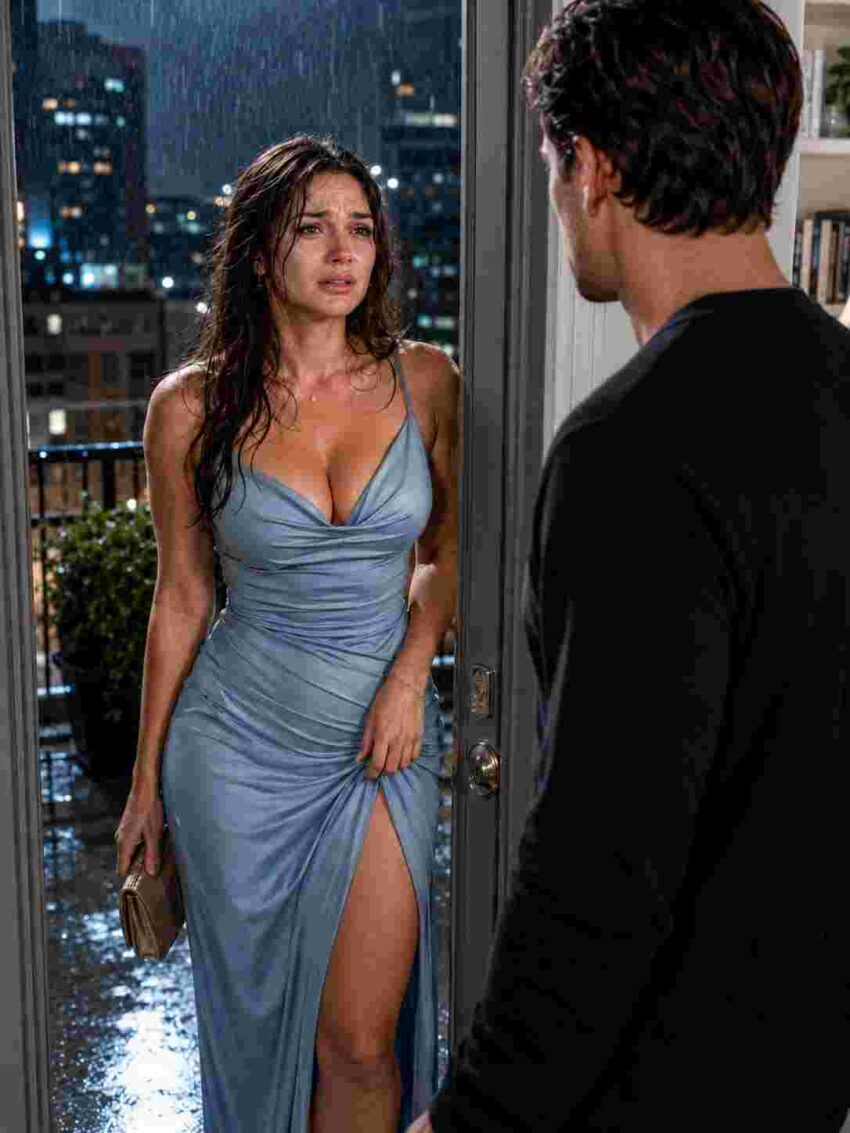
My Neighbor Came Home Crying From a Bad Date… Then Whispered, “I Don’t Want To Be Alone Tonight”…
My Neighbor Came Home Crying From a Bad Date… Then Whispered, “I Don’t Want To Be Alone Tonight”…
At 11:40 on a Tuesday night, my neighbor knocked on my door with mascara running down her cheeks and one broken heel in her hand.
Before I could ask what happened, she whispered, “Please don’t make me go back in there alone.”
I thought she meant her apartment.
I was wrong.
By the end of that week, I would see the security footage, hear the recording from the restaurant bathroom, sit across from a police officer, and learn that the man who humiliated Helena Cross on that “bad date” had never wanted romance.
He wanted access.
And he picked the wrong woman to underestimate.

Part 1
“Smile, sweetheart. You’re lucky I even paid for dinner.”
That was what the man said to Helena Cross five minutes before she showed up at my door looking like someone had shoved her heart through a paper shredder.
I didn’t know that yet.
All I knew was that my neighbor from 2B stood in the hallway outside my apartment at 11:40 p.m., shaking in a dark green dress, one earring missing, mascara streaked under both eyes.
Her lips moved once before any sound came out.
“I don’t want to be alone tonight.”
I was half-asleep in sweatpants, one hand still on the deadbolt, trying to understand why the most put-together woman in our building looked like she had walked home through a storm.
Only it hadn’t rained.
“Helena?” I said. “What happened?”
She shook her head too fast.
“I shouldn’t have come here.” Her voice cracked. “This is stupid. I’m sorry. I’ll go.”
She turned toward her door across the hall.
I stepped out before she could take two steps.
“Don’t.”
She froze.
“Come in.”
For a second, she looked at me like kindness had become a foreign language and she was trying to translate it in real time.
Then she nodded.
My name is Ryan Foster. I was thirty-two, single, and running my own HVAC repair business out of a used Ford truck with a ladder rack, a cracked dashboard, and too many gas station receipts in the cup holder.
Helena Cross lived across from me in apartment 2B.
She was an accountant at First County Bank downtown, the kind of woman who labeled her spice jars, filed her receipts by month, and once told me she liked numbers because “numbers don’t flirt with you, lie to you, or ask for second chances.”
At the time, I thought it was funny.
That night, it didn’t sound funny anymore.
I led her into my kitchen, the same narrow kitchen where I fixed invoices, burned frozen pizza, and kept a jar of spare screws on the windowsill. She sat at the table with her purse clutched in both hands.
Not beside her.
In front of her.
Like a shield.
I noticed the little things first because little things are easier than panic.
Her dress had a wine stain near the hem.
Her wrist was red where someone had grabbed it.
Her phone kept lighting up inside her purse.
Again.
Again.
Again.
She didn’t look at it.
I put the kettle on because people need something warm when the world gets ugly.
“Tea?” I asked.
She nodded.
When I set the mug in front of her, she stared at it like she didn’t know what to do with care that didn’t come with a price tag.
“Bad date?” I asked carefully.
Her laugh came out broken.
“The worst date of my life.”
“Who was he?”
“Bryce Holloway.”
I knew the name.
Everyone in Cedar Ridge knew Bryce Holloway.
He was the kind of small-town golden boy who wore expensive boots to church, shook hands too hard, and talked about “legacy” even though his father’s real estate company had done most of the work for him.
Holloway Homes sponsored the Fourth of July parade, bought ads in the high school football program, and had a table at every charity dinner.
Bryce smiled on billboards beside lakefront houses he couldn’t afford himself.
And apparently, he had taken my neighbor to dinner.
“He talked about his ex for ninety minutes,” Helena said.
I sat across from her.
“Ninety minutes?”
“I checked the time twice because I thought maybe trauma had slowed the clock.”
That almost sounded like the Helena I knew.
Almost.
“She was perfect,” Helena continued. “His ex. Madison. Perfect hair, perfect body, perfect Thanksgiving pies, perfect at pretending his jokes were funny. He told me I had ‘potential’ if I learned how to relax.”
My jaw tightened.
“He said that?”
“He said worse.”
Her phone lit up again.
This time, she flinched.
I looked at it.
The screen showed one name.
Bryce.
“You don’t have to answer that,” I said.
“I know.”
But she didn’t move.
So I reached across the table slowly, giving her time to stop me, and turned the phone face down.
Her shoulders dropped half an inch.
That half inch told me everything.
“What happened after dinner?” I asked.
Helena wrapped both hands around the mug.
“He tried to walk me to my car. I told him I was fine. He said I was being dramatic. Then he asked about my work.”
“At the bank?”
She nodded.
“At first, normal questions. Then specific ones. Client names. Trust accounts. Who handles estate transfers. Whether I knew anything about the Mercer property deed.”
That name landed hard.
The Mercer property was the old farmhouse outside town, forty acres near the highway expansion route. Half the town had whispered about it since Mrs. Mercer died and her grandsons started fighting over the will.
“Why would he ask you that on a date?” I said.
Helena looked at me.
“That’s what I asked.”
“And?”
“He smiled.” Her hand tightened around the mug. “Then he said, ‘Don’t act naïve, sweetheart. Pretty women get invited to dinner for a reason.’”
The kettle clicked behind me, even though the water was already poured.
The kitchen felt too quiet.
“He said that to you?”
“He said I should be grateful he didn’t take me somewhere cheaper.”
She was trying to speak like an accountant giving a report.
Clean facts.
Straight columns.
No emotion.
But her mouth trembled anyway.
Then came the part that changed my night from concern to rage.
“When I tried to leave, he grabbed my wrist.”
I stood up.
Not fast.
Not loud.
But fast enough that her eyes flicked to me.
“Did he hurt you?”
“No,” she said immediately.
Too immediately.
“Helena.”
She looked down at the red mark on her wrist.
“He scared me.”
That was the sentence.
Not “he annoyed me.”
Not “he was rude.”
He scared me.
And something cold moved through my chest.
“Where was this?”
“Outside Mason’s Diner.”
Mason’s sat on Main Street beside the old church, across from the bank, under two security cameras and a broken neon sign that always buzzed in summer.
Good.
Cameras.
“Did anyone see?”
Her face changed.
“I think Patty did.”
“Patty from the diner?”
“She was wiping tables by the window. I saw her look up when he grabbed me.”
“Then we’ll talk to Patty tomorrow.”
Helena shook her head.
“No.”
“No?”
“No, Ryan. Bryce Holloway’s family owns half this town. His father sits on the hospital board. His mother runs the church charity auction. People don’t cross men like that over one bad date.”
I leaned on the counter.
“Grabbing your wrist isn’t a bad date.”
She looked away.
My chest hurt with the effort of staying calm.
“What did he text you?”
“I don’t know.”
“Do you want to know?”
“No.”
But her phone lit up again, face down, buzzing against my kitchen table like an angry insect.
This time, Helena pressed her palms to her eyes.
“I hate that I came here like this.”
“Why?”
“Because I’m thirty years old. I balance million-dollar accounts. I help people untangle estates and trust funds and tax disasters. I don’t fall apart because some arrogant man in a blazer insulted me over meatloaf at a diner.”
“You didn’t fall apart,” I said.
She lowered her hands.
“You came to the safest door you knew.”
Her face did something then.
A small crack.
Not weakness.
Recognition.
Like she had been waiting for someone to call the thing what it was.
Safe.
“I almost went into my apartment,” she whispered. “I stood there with my key in my hand, and it felt too quiet. Like if I went inside, everything he said would get louder.”
“So stay here.”
Her eyes lifted to mine.
“Ryan…”
“On the couch,” I added quickly. “I’ll get the blanket from the closet. You can stay as long as you need.”
She stared at me.
“You’re not going to ask why I knocked on your door instead of calling Priya?”
“Do you want me to?”
“No.”
“Then no.”
For the first time all night, her mouth curved.
Barely.
But it was there.
I got the old wool blanket my grandmother made, the heavy one I saved for winter power outages. I placed it on the couch, turned on the small lamp, and set her tea on the coffee table.
Her phone buzzed again.
This time, she pulled it from her purse with shaking fingers.
One message sat on the screen.
From Bryce.
Don’t make tonight a bigger deal than it was. You embarrassed yourself enough already.
Below it came another.
And if you know what’s good for your job, you’ll forget what I asked you.
Helena went still.
So did I.
“What did he just say?” I asked.
She didn’t answer.
She only handed me the phone.
I read it twice.
Then I looked at the red mark on her wrist.
The bad date was over.
The real story had just started.
Part 2
The next morning, Bryce Holloway walked into Helena’s bank like he owned the building.
He did not know the woman he had threatened the night before had already taken screenshots, backed them up to the cloud, and printed two copies before breakfast.
Helena was quiet the next day.
Too quiet.
She left my apartment before sunrise, folding my grandmother’s blanket with military precision and placing it on the arm of the couch.
On top of it, she left a note.
Thank you for not making me explain myself twice.
That was very Helena.
Grateful, controlled, and already building walls back up before anyone could see where they had cracked.
I drank terrible coffee from my chipped mug and stared at the note longer than I should have.
Then my phone buzzed.
It was Marcus.
Marcus Reed had been my best friend since we were nine, back when we rode bikes through church parking lots and thought gas station nachos counted as dinner.
His text read:
You alive? Mrs. Donnelly said she saw a woman leave your apartment at 6 a.m. This building has better surveillance than the Pentagon.
I typed back:
Not now.
He replied instantly.
That means definitely now.
I ignored him.
At 8:15, I walked across the hall and knocked on Helena’s door.
No answer.
At 8:16, I heard the elevator ding.
She stepped out wearing gray slacks, a white blouse, low heels, and a face so calm it made me nervous.
“Morning,” she said.
“Did you sleep?”
“Some.”
“Did you eat?”
She lifted one eyebrow.
“Are you my neighbor or my mother?”
“Depends. Did you eat?”
That got half a smile.
“I had toast.”
“Toast is not breakfast.”
“It is if you’re emotionally efficient.”
She reached into her tote bag and handed me the blanket.
“I washed it.”
“You didn’t have to.”
“I know. I needed something to do.”
I took it.
Then I noticed the folder under her arm.
Plain manila.
Thick.
“Helena.”
She followed my gaze.
“I printed the messages.”
“Good.”
“And I wrote down everything I remembered while it was fresh.”
“Even better.”
“And I’m going to work.”
That part I didn’t like.
“Maybe you should take the day.”
“I am not letting Bryce Holloway scare me out of my own office.”
There it was.
That steel under the softness.
Helena Cross might have shown up at my door crying, but she was not fragile.
She was the kind of woman who could be hurt and still make a plan before the sun came up.
“I’ll drive you,” I said.
“No.”
“I’m going downtown anyway.”
“You are absolutely not.”
“I have a service call near Mason’s.”
Her eyes narrowed.
“Do you?”
“I can.”
“Ryan.”
“Helena.”
For three seconds, we stood in the hallway like two stubborn people trying to win a silent auction.
Then she sighed.
“Fine. But you are not marching into my bank like a bodyguard from a bad cable movie.”
“Wouldn’t dream of it.”
I drove her in my truck.
She sat beside me, hands folded around the folder in her lap, watching Cedar Ridge wake up through the windshield.
A school bus groaned past us.
The church bell rang nine times even though it was only 8:42, because Pastor Glen still hadn’t fixed the timer.
Two teenage boys in letterman jackets came out of Mason’s Diner with paper cups of coffee they were probably too young to need.
Everything looked normal.
That was the cruel thing about bad nights.
The world kept moving like nothing happened.
In front of First County Bank, Helena unbuckled her seatbelt.
“Thank you,” she said.
“If anything feels wrong, call me.”
“I’m not helpless.”
“I know.”
She paused.
“I mean it, Ryan. Don’t turn this into a rescue fantasy.”
I looked at her.
“I’m not here because I think you’re weak. I’m here because someone strong shouldn’t have to stand alone every second just to prove a point.”
That landed.
I saw it.
Then she opened the truck door.
“I’ll call if I need you.”
She walked into the bank with her head high.
Fifteen minutes later, Bryce Holloway walked in after her.
I saw him from across the street where I was definitely not pretending to check the tire pressure on my truck.
He wore a navy suit, sunglasses, and the relaxed smile of a man who had never once faced consequences that money couldn’t soften.
He held the door for an elderly woman.
He waved at the teller.
Then he disappeared inside.
My phone buzzed.
Helena.
He’s here.
I called her.
She didn’t pick up.
Instead, she sent one more text.
I’m recording.
My stomach dropped.
I wanted to run in.
I didn’t.
Because she had told me not to make her helpless, and I heard her.
So I stood beside my truck on Main Street with a tire gauge in my hand and a heart trying to break my ribs.
Later, she told me what happened.
Bryce came to her desk smiling like last night had been a charming misunderstanding.
“Helena,” he said, loud enough for two coworkers to hear. “You left so quickly. I was worried.”
She looked up from her computer.
“I’m busy.”
“I’ll be quick.”
“I’m not discussing personal matters at work.”
His smile thinned.
“This isn’t personal.”
Then he leaned closer.
That was his mistake.
Because Helena’s phone was already recording inside her open desk drawer.
“I need the Mercer file reviewed before the estate meeting,” he said softly. “You know which numbers matter.”
“I don’t handle that account.”
“But you can access who does.”
“No.”
Bryce laughed under his breath.
“Don’t be difficult because you got emotional last night.”
She kept her voice even.
“You grabbed my wrist and threatened my job.”
“I held your hand.”
“No. You grabbed my wrist.”
“And you showed up looking desperate enough that I thought you understood how this works.”
That sentence would later become the match that burned his perfect reputation to ash.
Helena didn’t react.
Not outwardly.
She reached into her folder and pulled out a printed screenshot.
His face changed when he saw his own text.
Don’t make tonight a bigger deal than it was.
She placed the second screenshot beside it.
And if you know what’s good for your job, you’ll forget what I asked you.
Then she said, very calmly, “Would you like to explain this to my branch manager, or should I let the police hear it first?”
Bryce stared at her.
For the first time, his smile failed.
“You think anyone will believe this little performance?”
Helena stood.
“I don’t need them to believe me.”
She picked up her phone from the drawer.
“I need them to hear you.”
His face went white.
That was when I saw them through the glass.
Bryce backing away from her desk.
Helena standing straight.
Her manager, Denise Carter, walking out of her office with the look of a woman who had just heard enough to ruin somebody’s day.
Bryce left five minutes later.
He shoved through the bank doors and saw me across the street.
Our eyes met.
He recognized me from the building, probably from passing Helena in the hallway, maybe from the night before when he watched her walk away from him toward our apartment complex.
His mouth curled.
Then he walked over.
I stayed where I was.
“You Foster?” he said.
“Depends who’s asking.”
“The handyman from 2A.”
“HVAC technician.”
“Same thing.”
I smiled.
That annoyed him.
“Stay out of things that don’t concern you,” he said.
“Funny. I was going to say the same thing.”
His eyes hardened.
“You don’t know who you’re dealing with.”
“No,” I said. “But I’m learning fast.”
He stepped closer.
Bryce was taller than me by an inch, but men like him always think height is the same thing as power.
It is not.
“You think she came to you because you matter?” he said. “She came to you because she was embarrassed. Women like Helena need someone convenient when they fall apart.”
I looked past him.
At Mason’s Diner.
At the black camera mounted over the front window.
Then back at Bryce.
“You really should stop talking in places with cameras.”
His expression flickered.
Small.
Quick.
But there.
That was the first time I knew for sure.
Bryce Holloway was afraid of what last night had left behind.
And I was going to find it.
Part 3
Patty from Mason’s Diner had the footage before Bryce’s lawyer could ask her to delete it.
That was the thing about small towns.
Rich men owned buildings.
But waitresses knew where the real bodies were buried.
At 10:05 that morning, I walked into Mason’s Diner.
The place smelled like burnt coffee, bacon grease, and maple syrup. A little American flag sat beside the register, stuck in a chipped mug full of pens. The TV above the counter played local news with the sound off.
Patty Long stood behind the counter, pouring coffee for Sheriff Dunn.
Patty was sixty-two, wore red lipstick at breakfast, and had once thrown a drunk mayor’s son out of the diner with a pie server in her hand.
She looked at me.
“Ryan Foster,” she said. “You look like a man about to ask me a question I already know the answer to.”
Sheriff Dunn turned on his stool.
“Morning, Ryan.”
“Sheriff.”
Patty set down the coffee pot.
“This about Helena Cross?”
I didn’t even try to hide my surprise.
She snorted.
“Honey, I’ve worked this window twenty-seven years. I see everything Main Street thinks it’s hiding.”
I lowered my voice.
“Did you see Bryce Holloway grab her last night?”
Patty’s face changed.
The diner noise seemed to drop.
“Yes.”
Sheriff Dunn put his mug down.
“Grabbed her how?”
“By the wrist,” Patty said. “Hard. She pulled away. He leaned in close, said something nasty. She looked scared, but not weak. There’s a difference.”
“Do you have cameras?” I asked.
Patty looked toward the ceiling.
“One over the register. One outside after those boys from Mill Road kept stealing the Halloween pumpkins.”
“Did it catch them?”
“It catches everybody who thinks God isn’t watching.”
Sheriff Dunn stood.
“Patty, pull it.”
Bryce had miscalculated.
He thought Helena was just a quiet accountant.
He forgot quiet people notice details.
He thought I was just the neighbor.
He forgot neighbors have trucks, tools, and flexible schedules.
He thought Patty was just a waitress.
He forgot women who serve coffee in small towns collect more evidence than courthouse clerks.
Twenty minutes later, we stood behind the counter watching security footage on Patty’s office computer.
There was Helena leaving the diner.
There was Bryce following too close.
There was his hand closing around her wrist.
There was Helena jerking back.
There was his face leaning near hers.
No audio.
But the body language was enough.
Then came the part none of us expected.
A second camera angle showed Bryce turning toward the alley after Helena walked away.
He pulled out his phone.
A black SUV rolled slowly past the diner and stopped near the curb.
Bryce leaned into the passenger window.
The sheriff paused the video.
“Who’s that?” I asked.
Patty leaned closer.
“Looks like Carl Mercer.”
That name hit the room hard.
Carl Mercer was one of Mrs. Mercer’s grandsons.
The one contesting the will.
The one everyone said was broke, angry, and convinced his grandmother had left him less land than he deserved.
Sheriff Dunn’s expression went flat.
“Patty, make a copy.”
“Already doing it.”
By noon, Helena had given her recording to Denise Carter at the bank.
By 1:30, Denise had called corporate legal.
By 2:10, First County Bank froze internal access to the Mercer estate file.
By 3:00, Bryce Holloway called Helena seventeen times.
She did not answer once.
At 4:15, someone slid an envelope under her apartment door.
She found it when she came home.
I was in my kitchen when I heard her knock.
Not the desperate knock from the first night.
Three sharp taps.
Controlled.
Angry.
I opened the door.
She stood there holding a white envelope with no name on it.
“What is it?” I asked.
She walked past me into my apartment and placed it on the kitchen table.
Inside was a printed photo of her entering my apartment the night before.
Under it, someone had typed one sentence.
Careful what people think about lonely women.
For a moment, neither of us spoke.
Then Helena laughed.
Not because it was funny.
Because it was so ugly that fear had no place to stand.
“He’s threatening my reputation now,” she said.
I picked up the photo.
The angle was from the parking lot.
Someone had watched our building.
My hands went cold.
“Helena.”
“I know.”
“We call the sheriff.”
“Yes.”
No argument.
No denial.
No “maybe it’s nothing.”
That was when I understood the shift.
Bryce had scared her the first night.
Now he had offended her.
There was a difference.
Sheriff Dunn arrived twenty minutes later.
He took the envelope with gloves, asked questions, wrote notes, and looked at Helena with the kind of respect men should use before women have to prove they deserve it.
“Do you have any enemies besides Bryce Holloway?” he asked.
Helena gave him a dry look.
“I’m an accountant. Plenty of people dislike accurate numbers.”
Even Sheriff Dunn smiled at that.
Then he asked the important question.
“Do you want to file a report?”
Helena looked at the photo.
Then at the red mark still faint on her wrist.
“Yes.”
One word.
No tremble.
I loved her a little in that moment, though I didn’t have the courage to call it that yet.
Over the next three days, Bryce’s life began to leak secrets.
Not explode.
Leak.
Slowly.
Dangerously.
First, Denise found unusual login attempts on the Mercer file.
Not successful ones.
Attempts.
Someone had tried to use an old employee credential to access estate documents after hours.
Then corporate security matched the IP address to an office inside Holloway Homes.
Bryce claimed it was a coincidence.
Then Patty’s camera footage reached Sheriff Dunn’s desk.
Bryce claimed Helena had misunderstood a friendly touch.
Then Helena’s recording reached the bank’s legal department.
Bryce stopped claiming anything.
On Friday morning, Helena and I sat in a lawyer’s office above the pharmacy on Main Street.
The lawyer’s name was Marjorie Bell.
She was seventy, sharp-eyed, and wore pearls that looked less like jewelry and more like a warning.
Her office smelled like old books and lemon polish.
A framed photo of her graduation from Vanderbilt Law hung near the window. Another showed her standing outside the county courthouse in 1989, smiling beside a group of women lawyers who looked like they had fought for every inch of space they occupied.
Marjorie listened to Helena without interrupting.
She read the texts.
She listened to the recording.
She watched the diner footage.
Then she removed her glasses.
“Mr. Holloway is not just harassing you,” she said. “He appears to be attempting to pressure a bank employee for information related to an active estate dispute.”
Helena sat straighter.
“That’s what I thought.”
“It also appears someone photographed you entering a neighbor’s apartment in an attempt to intimidate you or damage your reputation.”
“Yes.”
Marjorie looked at me.
“You’re the neighbor?”
“Yes, ma’am.”
“Did anything inappropriate happen that night?”
“No.”
Helena’s head turned toward me.
I met Marjorie’s eyes.
“She was scared. I made tea. She slept on my couch. That’s it.”
Marjorie studied me for one second longer.
Then nodded.
“Good. Keep saying it exactly like that. Truth is easy to remember.”
Helena’s mouth tightened.
“He said people would believe what he told them.”
Marjorie smiled.
It was not a warm smile.
It was the kind of smile a lawyer gives when someone has made her day interesting.
“Then we’ll give people something better to believe.”
The following Sunday was Thanksgiving service at First Baptist.
Cedar Ridge did Thanksgiving early at church every year because Pastor Glen said gratitude should not be limited to turkey day, and because the fellowship hall ladies liked any excuse to make sweet potato casserole.
Helena almost didn’t go.
“I don’t want to be stared at,” she told me in the parking lot outside our building.
She wore a navy coat and held her purse like armor again.
I leaned against my truck.
“Then don’t go.”
She looked at me.
“You think I should hide?”
“No. I think you should choose.”
That mattered to her.
I could see it.
After a moment, she opened the passenger door.
“I’m choosing not to let Bryce Holloway take my church, too.”
At First Baptist, the sanctuary smelled like coffee, old hymnals, and someone’s cinnamon perfume. American flags stood near the front beside the Christian flag. Children ran between pews until their mothers hissed them into stillness.
Bryce was there.
Of course he was.
He stood near the entrance with his mother, Diane Holloway, the queen of charity committees and weaponized politeness.
Diane saw Helena and smiled.
A slow, cruel smile.
Then she walked over.
“Helena,” Diane said loudly enough for three women nearby to hear. “How brave of you to come.”
Helena’s fingers tightened on her purse.
I stepped half a pace closer.
Diane’s eyes slid to me.
“And you brought your repairman.”
Helena looked at her.
“My friend.”
Diane’s smile sharpened.
“Is that what we’re calling it now?”
There it was.
The photo.
The threat.
The whisper campaign already beginning.
The old Helena might have gone pale.
This Helena opened her purse, pulled out a folded paper, and handed it to Diane.
Diane frowned.
“What is this?”
“A copy of the police report,” Helena said. “Since your family seems confused about the difference between gossip and evidence.”
The nearby women went silent.
Bryce turned from across the foyer.
Diane’s face changed color.
Helena continued, calm as a bank statement.
“And if anyone receives or shares the photo your son had taken outside my apartment building, my lawyer will consider it part of an intimidation pattern.”
You could hear a bulletin drop.
Diane looked at me.
Then at Helena.
“You little—”
“Careful,” Helena said. “We’re in church.”
For one perfect second, Diane Holloway had no words.
Then Pastor Glen walked up behind her.
“Everything all right here?”
Helena smiled.
“Yes, Pastor. I was just giving Mrs. Holloway some paperwork.”
Bryce left before the first hymn.
His mother stayed, red-faced and silent, while half the church pretended not to stare.
Helena sat beside me in the third pew from the back.
Her hands shook once.
Just once.
Then she folded them in her lap.
After service, Patty from Mason’s Diner hugged her so hard Helena nearly dropped her purse.
“You did good, honey,” Patty whispered.
Helena looked over Patty’s shoulder at Bryce’s empty spot near the door.
“No,” she said quietly. “I’m just getting started.”
And she was.
Because Monday morning, Marjorie Bell received the document that would finish Bryce Holloway.
It came from a witness no one expected.
Madison.
Bryce’s perfect ex-girlfriend.
Part 4
Madison walked into the lawyer’s office with a flash drive, a custody folder, and the exhausted face of a woman who had survived Bryce Holloway before Helena ever met him.
The first thing she said was, “He always picks women he thinks no one will believe.”
Helena and I sat side by side across from Marjorie Bell.
Madison sat beside the window, blonde hair pulled into a messy knot, one hand resting on a thick folder labeled custody papers.
She had the look of someone who had spent years being called dramatic by the man who made her life dramatic.
“I heard what happened at church,” Madison said to Helena. “Patty called me.”
Of course Patty called her.
Patty was basically Cedar Ridge’s emergency broadcast system with pancakes.
Madison placed the flash drive on Marjorie’s desk.
“Bryce tried something similar with me during our custody case.”
“You have a child?” Helena asked.
“A daughter. Emma. Six.”
Her voice softened for half a second, then hardened again.
“When I left Bryce, he told everyone I was unstable. Said I drank. Said I cheated. Said I made up stories for attention. His mother backed him. His father paid the lawyer. I almost lost my daughter because people kept saying, ‘But Bryce is such a good man.’”
Helena’s face went still.
The phrase had weight.
Such a good man.
The world’s favorite camouflage for dangerous ones.
“What’s on the flash drive?” Marjorie asked.
“Recordings. Texts. A copy of the private investigator invoice from when he had me followed. And something about the Mercer property.”
Marjorie sat forward.
Madison looked at Helena.
“I didn’t understand it at the time. Bryce got drunk last spring and bragged that Carl Mercer was going to make him rich once the deed problem was handled.”
Helena’s eyes sharpened.
“What deed problem?”
Madison opened the folder and pulled out a photocopy.
“The old Mercer farmhouse. Bryce said there was a second will. One that left the land to a conservation trust instead of the grandsons. He said Carl needed it to disappear.”
The room went dead silent.
Marjorie took the paper.
“Where did you get this?”
“Bryce’s home office. I copied it before I left because I thought it might help me prove he was hiding money.”
Helena leaned toward the document.
Her accountant brain was already moving.
“If that second will is real, Carl Mercer had motive to suppress it. Bryce had motive to help him. And the bank file—”
“Would show chain of custody for the estate documents,” Marjorie finished.
I looked at Helena.
She looked calm.
Too calm.
Like every insult Bryce had thrown at her was being converted into evidence.
Marjorie made three calls.
One to Sheriff Dunn.
One to First County Bank legal.
One to the county clerk.
By that afternoon, the Mercer estate dispute was no longer small-town gossip.
It was a criminal investigation.
And Bryce Holloway’s billboard smile began peeling off in public.
First, First County Bank issued a statement saying an outside individual had attempted to pressure an employee for restricted information.
They did not name Bryce.
They did not need to.
Then Holloway Homes lost its sponsorship spot in the Christmas parade.
Then the hospital board announced Bryce’s father was “stepping back temporarily” from fundraising duties.
Temporary is a word people use when permanent is too humiliating to say out loud.
Then Madison filed to amend her custody agreement using the new evidence of intimidation and surveillance.
Then Carl Mercer was brought in for questioning.
By Friday, every booth at Mason’s Diner had a theory.
By Saturday, Bryce’s mother stopped going to the grocery store.
By Sunday, the Holloway Homes billboard on Route 9 had been vandalized with one word in black spray paint.
LIAR.
I didn’t do it.
I did admire the spelling.
Two weeks after Helena first knocked on my door, Bryce cornered us outside the bank.
It was cold enough that our breath showed white under the streetlights. Helena had stayed late helping legal review access logs, and I had brought her dinner from Mason’s because Patty insisted “that girl needs real food, not stress and coffee.”
We stepped onto the sidewalk together.
Bryce came out from beside a parked truck.
“You ruined my life,” he said.
Helena didn’t flinch.
“No. I documented it.”
His eyes cut to me.
“And you. The hero neighbor. Bet you loved this. Bet you were waiting for a chance.”
I held the takeout bag in one hand and kept the other visible because Sheriff Dunn had told us men like Bryce wanted any excuse to look like victims.
“Walk away,” I said.
Bryce laughed.
“You think she wants you? She wanted a safe couch. That’s all. You’re furniture with a pulse.”
The words were meant for me.
They hit Helena instead.
Not because she believed them.
Because he had tried one more time to reduce care into shame.
She stepped forward.
“Bryce.”
He looked at her.
“You don’t get to define what I wanted. You don’t get to define what happened. You don’t get to touch me, threaten me, photograph me, insult me, and then act surprised when I keep receipts.”
His jaw flexed.
“You’re nothing but a lonely accountant.”
Helena smiled.
Small.
Cold.
“Exactly. An accountant.”
She pulled a folded page from her coat pocket.
“And lonely accountants are very good at finding missing numbers.”
Bryce stared at it.
“What is that?”
“A copy of the invoice you submitted to Carl Mercer through Holloway Homes for ‘consulting services’ three days before you asked me about the Mercer file.”
His face drained.
Helena continued.
“It matches the amount Carl withdrew from his business account the same morning. First County flagged it after legal reviewed the dates. I’m sure the sheriff will find the timing interesting.”
Bryce took one step back.
For the first time since I had known him, he looked exactly like what he was.
Not powerful.
Not untouchable.
Just caught.
A patrol car turned onto Main Street.
Sheriff Dunn parked at the curb and got out.
“Bryce,” he said. “We need to talk.”
Bryce looked at Helena with pure hatred.
She looked back with complete peace.
That made him angrier than fear ever could have.
“Come on,” Sheriff Dunn said.
Bryce was not dragged away dramatically.
There were no sirens.
No handcuffs on Main Street.
Not yet.
Just a man who had spent years performing power being asked to sit in the back of a patrol car while the entire town watched through diner windows.
Sometimes justice does not need thunder.
Sometimes it just needs witnesses.
Three months later, Bryce Holloway pleaded guilty to harassment and obstruction-related charges connected to the estate investigation. Carl Mercer took a deal. The real Mercer will was validated, and the farmhouse land went to the conservation trust Mrs. Mercer had chosen before anyone tried to rewrite her death for profit.
Holloway Homes lost the highway development bid.
Bryce’s father resigned from the hospital board.
Diane Holloway stopped running the church auction after Marjorie Bell politely informed the committee that intimidation campaigns were poor Christian branding.
Madison received full primary custody of Emma.
Helena kept her job.
Then she got promoted.
First County Bank made her compliance manager for estate accounts because, as Denise Carter said, “Apparently you’re impossible to pressure and excellent with documentation.”
Helena framed that email.
Not visibly.
She kept it inside her desk drawer.
I know because I saw it there one evening when I brought her dinner and found her office door open.
By then, dinner had become our thing.
Not emergency tea.
Not crisis management.
Dinner.
Sometimes at Mason’s.
Sometimes in my apartment, where she corrected my grocery habits and reorganized my cabinet because “Ryan, no adult man needs four open boxes of the same cereal.”
Sometimes in hers, where my grandmother’s wool blanket had taken permanent residence on the back of her couch.
One Friday night in late November, real Thanksgiving week this time, we cooked together in her kitchen.
She made green bean casserole from scratch because she said canned soup was “a choice, not a destiny.”
I burned the rolls.
She said nothing.
Just opened the window and handed me a butter knife like I could scrape redemption off the bottoms.
Outside, the apartment parking lot glittered with frost. Someone had put a small American flag in the planter by the entrance. Mrs. Donnelly from 1C was yelling at her grandson in the driveway because he had parked crooked again.
Normal life.
Beautiful, boring, normal life.
Helena stood at the counter slicing pecan pie, her hair pinned messily, wearing my old Cedar Ridge High sweatshirt.
I watched her for too long.
She noticed because Helena noticed everything.
“What?” she asked.
“Nothing.”
“Ryan.”
“I was thinking about the first night.”
Her hand slowed.
“The bad date?”
“The knock.”
She set down the knife.
“I almost didn’t.”
“I know.”
“I stood outside my own door with my key in my hand,” she said. “And I thought, if I go in there alone, his voice wins for the night.”
“So you knocked on mine.”
“Yes.”
She looked at me.
“I didn’t know it would become all this.”
“All this being police reports, lawyers, estate fraud, church drama, and your promotion?”
“That too.”
I stepped closer.
“And us?”
She smiled.
The real one.
The one I had waited weeks to earn and months to understand.
“Yes,” she said. “And us.”
I wanted to say something smooth.
Something cinematic.
Something worthy of the woman who had turned humiliation into evidence and fear into a case file.
Instead, I said, “I’m glad he was terrible.”
She stared at me.
Then laughed so hard she had to grip the counter.
“That may be the least romantic sentence ever spoken.”
“I meant—”
“I know what you meant.”
She wiped one eye, still laughing.
“I’m glad he was terrible too. Not because he hurt me. Because he revealed himself fast.”
“And knocked on the wrong woman’s life.”
She looked up.
“No, Ryan. He knocked on yours.”
That silenced me.
She reached for my hand.
“I came to your door because I felt safe there. But after that, you never tried to take over my fight. You stood beside me. That mattered more than you know.”
My throat tightened.
“I wanted to protect you.”
“I know.”
“I also wanted to respect you.”
“You did.”
Outside, a car passed slowly through the lot, headlights moving across the kitchen wall.
No fear moved through her face.
No flinch.
No shadow.
Bryce Holloway had taken enough from her for one night, maybe two.
He did not get the rest of her life.
Later, after dinner, after Mrs. Donnelly sent up leftover cranberry sauce nobody asked for, after Marcus texted me “Don’t mess this up” for the fourth time that month, Helena and I sat on her couch under my grandmother’s blanket.
The same blanket from that first night.
The same one I had draped over her when she fell asleep in my apartment with mascara still under her eyes and Bryce’s threats still buzzing on her phone.
She leaned against me.
“You know,” she said, “I made a spreadsheet.”
“Of course you did.”
“Don’t sound so resigned.”
“I’m dating an accountant. Resignation is part of the package.”
She elbowed me lightly.
“It started after the first week. Dates, times, reasons I came over.”
“You made a spreadsheet about visiting my apartment?”
“Yes.”
“Helena.”
“I needed data.”
“For what?”
She looked at me like the answer was obvious.
“To prove I wasn’t only coming over because I was scared.”
I went quiet.
She continued.
“At first, the reasons were practical. Blanket. Tea. Dinner. Thermostat. Decongestant. Bank drama. Police report.”
“And later?”
She smiled.
“Later the reason column just said wanted to.”
Something moved in me.
Something old and guarded and tired of pretending not to want what was right in front of me.
I took her hand.
“What does the data say now?”
She looked at our fingers.
Then at me.
“That I don’t want to be alone tonight.”
I smiled.
“Just tonight?”
Her eyes softened.
“No.”
The room went quiet around us.
Not empty quiet.
Safe quiet.
The kind of quiet that holds.
So I said the thing I should have said sooner.
“Then don’t be.”
She leaned in.
And this time, there was no bad date waiting behind her.
No threat buzzing on the phone.
No man outside deciding what she was worth.
Just Helena Cross, who had been humiliated and threatened and underestimated, sitting in the warm light of her own apartment, choosing exactly what came next.
A month later, Bryce’s billboard came down.
Two months later, Helena spoke at a bank compliance conference in Chicago about employee coercion and estate fraud.
Six months later, Madison brought Emma to Mason’s Diner, and Helena bought the little girl pancakes shaped like a bear.
One year later, Helena and I moved into a small house with a porch, a driveway, a kitchen big enough for two stubborn people, and a ridiculous number of labeled spice jars.
At Thanksgiving, we hosted everyone who had stood with her.
Patty brought pie.
Marjorie brought wine.
Sheriff Dunn brought his wife.
Marcus brought a toast and took too much credit.
And Helena stood in our kitchen, calm and bright and unbreakable, while the people who believed her filled the house with noise.
That night, after everyone left, she found me on the porch.
The air smelled like cold leaves and wood smoke.
Across the street, an American flag moved gently under a neighbor’s porch light.
Helena slipped her hand into mine.
“You know what I learned from all this?” she asked.
“What?”
“That the worst night of your life can still lead you to the right door.”
I looked at her.
Then at the house.
Then at the driveway where my old Ford truck sat beside her sensible sedan.
“Good thing I answered.”
She leaned her head on my shoulder.
“Good thing I knocked.”
And that was the truth.
Some men mistake kindness for weakness.
Some women turn pain into proof.
And sometimes justice starts with one quiet knock at 11:40 on a Tuesday night.
My Neighbor Came Home Crying From a Bad Date… Then…
My Neighbor Came Home Crying From a Bad Date… Then Whispered, “I Don’t Want To Be Alone Tonight”…
My Neighbor Came Home Crying From a Bad Date… Then Whispered, “I Don’t Want To Be Alone Tonight”…
At 11:40 on a Tuesday night, my neighbor knocked on my door with mascara running down her cheeks and one broken heel in her hand.
Before I could ask what happened, she whispered, “Please don’t make me go back in there alone.”
I thought she meant her apartment.
I was wrong.
By the end of that week, I would see the security footage, hear the recording from the restaurant bathroom, sit across from a police officer, and learn that the man who humiliated Helena Cross on that “bad date” had never wanted romance.
He wanted access.
And he picked the wrong woman to underestimate.
Part 1
“Smile, sweetheart. You’re lucky I even paid for dinner.”
That was what the man said to Helena Cross five minutes before she showed up at my door looking like someone had shoved her heart through a paper shredder.
I didn’t know that yet.
All I knew was that my neighbor from 2B stood in the hallway outside my apartment at 11:40 p.m., shaking in a dark green dress, one earring missing, mascara streaked under both eyes.
Her lips moved once before any sound came out.
“I don’t want to be alone tonight.”
I was half-asleep in sweatpants, one hand still on the deadbolt, trying to understand why the most put-together woman in our building looked like she had walked home through a storm.
Only it hadn’t rained.
“Helena?” I said. “What happened?”
She shook her head too fast.
“I shouldn’t have come here.” Her voice cracked. “This is stupid. I’m sorry. I’ll go.”
She turned toward her door across the hall.
I stepped out before she could take two steps.
“Don’t.”
She froze.
“Come in.”
For a second, she looked at me like kindness had become a foreign language and she was trying to translate it in real time.
Then she nodded.
My name is Ryan Foster. I was thirty-two, single, and running my own HVAC repair business out of a used Ford truck with a ladder rack, a cracked dashboard, and too many gas station receipts in the cup holder.
Helena Cross lived across from me in apartment 2B.
She was an accountant at First County Bank downtown, the kind of woman who labeled her spice jars, filed her receipts by month, and once told me she liked numbers because “numbers don’t flirt with you, lie to you, or ask for second chances.”
At the time, I thought it was funny.
That night, it didn’t sound funny anymore.
I led her into my kitchen, the same narrow kitchen where I fixed invoices, burned frozen pizza, and kept a jar of spare screws on the windowsill. She sat at the table with her purse clutched in both hands.
Not beside her.
In front of her.
Like a shield.
I noticed the little things first because little things are easier than panic.
Her dress had a wine stain near the hem.
Her wrist was red where someone had grabbed it.
Her phone kept lighting up inside her purse.
Again.
Again.
Again.
She didn’t look at it.
I put the kettle on because people need something warm when the world gets ugly.
“Tea?” I asked.
She nodded.
When I set the mug in front of her, she stared at it like she didn’t know what to do with care that didn’t come with a price tag.
“Bad date?” I asked carefully.
Her laugh came out broken.
“The worst date of my life.”
“Who was he?”
“Bryce Holloway.”
I knew the name.
Everyone in Cedar Ridge knew Bryce Holloway.
He was the kind of small-town golden boy who wore expensive boots to church, shook hands too hard, and talked about “legacy” even though his father’s real estate company had done most of the work for him.
Holloway Homes sponsored the Fourth of July parade, bought ads in the high school football program, and had a table at every charity dinner.
Bryce smiled on billboards beside lakefront houses he couldn’t afford himself.
And apparently, he had taken my neighbor to dinner.
“He talked about his ex for ninety minutes,” Helena said.
I sat across from her.
“Ninety minutes?”
“I checked the time twice because I thought maybe trauma had slowed the clock.”
That almost sounded like the Helena I knew.
Almost.
“She was perfect,” Helena continued. “His ex. Madison. Perfect hair, perfect body, perfect Thanksgiving pies, perfect at pretending his jokes were funny. He told me I had ‘potential’ if I learned how to relax.”
My jaw tightened.
“He said that?”
“He said worse.”
Her phone lit up again.
This time, she flinched.
I looked at it.
The screen showed one name.
Bryce.
“You don’t have to answer that,” I said.
“I know.”
But she didn’t move.
So I reached across the table slowly, giving her time to stop me, and turned the phone face down.
Her shoulders dropped half an inch.
That half inch told me everything.
“What happened after dinner?” I asked.
Helena wrapped both hands around the mug.
“He tried to walk me to my car. I told him I was fine. He said I was being dramatic. Then he asked about my work.”
“At the bank?”
She nodded.
“At first, normal questions. Then specific ones. Client names. Trust accounts. Who handles estate transfers. Whether I knew anything about the Mercer property deed.”
That name landed hard.
The Mercer property was the old farmhouse outside town, forty acres near the highway expansion route. Half the town had whispered about it since Mrs. Mercer died and her grandsons started fighting over the will.
“Why would he ask you that on a date?” I said.
Helena looked at me.
“That’s what I asked.”
“And?”
“He smiled.” Her hand tightened around the mug. “Then he said, ‘Don’t act naïve, sweetheart. Pretty women get invited to dinner for a reason.’”
The kettle clicked behind me, even though the water was already poured.
The kitchen felt too quiet.
“He said that to you?”
“He said I should be grateful he didn’t take me somewhere cheaper.”
She was trying to speak like an accountant giving a report.
Clean facts.
Straight columns.
No emotion.
But her mouth trembled anyway.
Then came the part that changed my night from concern to rage.
“When I tried to leave, he grabbed my wrist.”
I stood up.
Not fast.
Not loud.
But fast enough that her eyes flicked to me.
“Did he hurt you?”
“No,” she said immediately.
Too immediately.
“Helena.”
She looked down at the red mark on her wrist.
“He scared me.”
That was the sentence.
Not “he annoyed me.”
Not “he was rude.”
He scared me.
And something cold moved through my chest.
“Where was this?”
“Outside Mason’s Diner.”
Mason’s sat on Main Street beside the old church, across from the bank, under two security cameras and a broken neon sign that always buzzed in summer.
Good.
Cameras.
“Did anyone see?”
Her face changed.
“I think Patty did.”
“Patty from the diner?”
“She was wiping tables by the window. I saw her look up when he grabbed me.”
“Then we’ll talk to Patty tomorrow.”
Helena shook her head.
“No.”
“No?”
“No, Ryan. Bryce Holloway’s family owns half this town. His father sits on the hospital board. His mother runs the church charity auction. People don’t cross men like that over one bad date.”
I leaned on the counter.
“Grabbing your wrist isn’t a bad date.”
She looked away.
My chest hurt with the effort of staying calm.
“What did he text you?”
“I don’t know.”
“Do you want to know?”
“No.”
But her phone lit up again, face down, buzzing against my kitchen table like an angry insect.
This time, Helena pressed her palms to her eyes.
“I hate that I came here like this.”
“Why?”
“Because I’m thirty years old. I balance million-dollar accounts. I help people untangle estates and trust funds and tax disasters. I don’t fall apart because some arrogant man in a blazer insulted me over meatloaf at a diner.”
“You didn’t fall apart,” I said.
She lowered her hands.
“You came to the safest door you knew.”
Her face did something then.
A small crack.
Not weakness.
Recognition.
Like she had been waiting for someone to call the thing what it was.
Safe.
“I almost went into my apartment,” she whispered. “I stood there with my key in my hand, and it felt too quiet. Like if I went inside, everything he said would get louder.”
“So stay here.”
Her eyes lifted to mine.
“Ryan…”
“On the couch,” I added quickly. “I’ll get the blanket from the closet. You can stay as long as you need.”
She stared at me.
“You’re not going to ask why I knocked on your door instead of calling Priya?”
“Do you want me to?”
“No.”
“Then no.”
For the first time all night, her mouth curved.
Barely.
But it was there.
I got the old wool blanket my grandmother made, the heavy one I saved for winter power outages. I placed it on the couch, turned on the small lamp, and set her tea on the coffee table.
Her phone buzzed again.
This time, she pulled it from her purse with shaking fingers.
One message sat on the screen.
From Bryce.
Don’t make tonight a bigger deal than it was. You embarrassed yourself enough already.
Below it came another.
And if you know what’s good for your job, you’ll forget what I asked you.
Helena went still.
So did I.
“What did he just say?” I asked.
She didn’t answer.
She only handed me the phone.
I read it twice.
Then I looked at the red mark on her wrist.
The bad date was over.
The real story had just started.
Part 2
The next morning, Bryce Holloway walked into Helena’s bank like he owned the building.
He did not know the woman he had threatened the night before had already taken screenshots, backed them up to the cloud, and printed two copies before breakfast.
Helena was quiet the next day.
Too quiet.
She left my apartment before sunrise, folding my grandmother’s blanket with military precision and placing it on the arm of the couch.
On top of it, she left a note.
Thank you for not making me explain myself twice.
That was very Helena.
Grateful, controlled, and already building walls back up before anyone could see where they had cracked.
I drank terrible coffee from my chipped mug and stared at the note longer than I should have.
Then my phone buzzed.
It was Marcus.
Marcus Reed had been my best friend since we were nine, back when we rode bikes through church parking lots and thought gas station nachos counted as dinner.
His text read:
You alive? Mrs. Donnelly said she saw a woman leave your apartment at 6 a.m. This building has better surveillance than the Pentagon.
I typed back:
Not now.
He replied instantly.
That means definitely now.
I ignored him.
At 8:15, I walked across the hall and knocked on Helena’s door.
No answer.
At 8:16, I heard the elevator ding.
She stepped out wearing gray slacks, a white blouse, low heels, and a face so calm it made me nervous.
“Morning,” she said.
“Did you sleep?”
“Some.”
“Did you eat?”
She lifted one eyebrow.
“Are you my neighbor or my mother?”
“Depends. Did you eat?”
That got half a smile.
“I had toast.”
“Toast is not breakfast.”
“It is if you’re emotionally efficient.”
She reached into her tote bag and handed me the blanket.
“I washed it.”
“You didn’t have to.”
“I know. I needed something to do.”
I took it.
Then I noticed the folder under her arm.
Plain manila.
Thick.
“Helena.”
She followed my gaze.
“I printed the messages.”
“Good.”
“And I wrote down everything I remembered while it was fresh.”
“Even better.”
“And I’m going to work.”
That part I didn’t like.
“Maybe you should take the day.”
“I am not letting Bryce Holloway scare me out of my own office.”
There it was.
That steel under the softness.
Helena Cross might have shown up at my door crying, but she was not fragile.
She was the kind of woman who could be hurt and still make a plan before the sun came up.
“I’ll drive you,” I said.
“No.”
“I’m going downtown anyway.”
“You are absolutely not.”
“I have a service call near Mason’s.”
Her eyes narrowed.
“Do you?”
“I can.”
“Ryan.”
“Helena.”
For three seconds, we stood in the hallway like two stubborn people trying to win a silent auction.
Then she sighed.
“Fine. But you are not marching into my bank like a bodyguard from a bad cable movie.”
“Wouldn’t dream of it.”
I drove her in my truck.
She sat beside me, hands folded around the folder in her lap, watching Cedar Ridge wake up through the windshield.
A school bus groaned past us.
The church bell rang nine times even though it was only 8:42, because Pastor Glen still hadn’t fixed the timer.
Two teenage boys in letterman jackets came out of Mason’s Diner with paper cups of coffee they were probably too young to need.
Everything looked normal.
That was the cruel thing about bad nights.
The world kept moving like nothing happened.
In front of First County Bank, Helena unbuckled her seatbelt.
“Thank you,” she said.
“If anything feels wrong, call me.”
“I’m not helpless.”
“I know.”
She paused.
“I mean it, Ryan. Don’t turn this into a rescue fantasy.”
I looked at her.
“I’m not here because I think you’re weak. I’m here because someone strong shouldn’t have to stand alone every second just to prove a point.”
That landed.
I saw it.
Then she opened the truck door.
“I’ll call if I need you.”
She walked into the bank with her head high.
Fifteen minutes later, Bryce Holloway walked in after her.
I saw him from across the street where I was definitely not pretending to check the tire pressure on my truck.
He wore a navy suit, sunglasses, and the relaxed smile of a man who had never once faced consequences that money couldn’t soften.
He held the door for an elderly woman.
He waved at the teller.
Then he disappeared inside.
My phone buzzed.
Helena.
He’s here.
I called her.
She didn’t pick up.
Instead, she sent one more text.
I’m recording.
My stomach dropped.
I wanted to run in.
I didn’t.
Because she had told me not to make her helpless, and I heard her.
So I stood beside my truck on Main Street with a tire gauge in my hand and a heart trying to break my ribs.
Later, she told me what happened.
Bryce came to her desk smiling like last night had been a charming misunderstanding.
“Helena,” he said, loud enough for two coworkers to hear. “You left so quickly. I was worried.”
She looked up from her computer.
“I’m busy.”
“I’ll be quick.”
“I’m not discussing personal matters at work.”
His smile thinned.
“This isn’t personal.”
Then he leaned closer.
That was his mistake.
Because Helena’s phone was already recording inside her open desk drawer.
“I need the Mercer file reviewed before the estate meeting,” he said softly. “You know which numbers matter.”
“I don’t handle that account.”
“But you can access who does.”
“No.”
Bryce laughed under his breath.
“Don’t be difficult because you got emotional last night.”
She kept her voice even.
“You grabbed my wrist and threatened my job.”
“I held your hand.”
“No. You grabbed my wrist.”
“And you showed up looking desperate enough that I thought you understood how this works.”
That sentence would later become the match that burned his perfect reputation to ash.
Helena didn’t react.
Not outwardly.
She reached into her folder and pulled out a printed screenshot.
His face changed when he saw his own text.
Don’t make tonight a bigger deal than it was.
She placed the second screenshot beside it.
And if you know what’s good for your job, you’ll forget what I asked you.
Then she said, very calmly, “Would you like to explain this to my branch manager, or should I let the police hear it first?”
Bryce stared at her.
For the first time, his smile failed.
“You think anyone will believe this little performance?”
Helena stood.
“I don’t need them to believe me.”
She picked up her phone from the drawer.
“I need them to hear you.”
His face went white.
That was when I saw them through the glass.
Bryce backing away from her desk.
Helena standing straight.
Her manager, Denise Carter, walking out of her office with the look of a woman who had just heard enough to ruin somebody’s day.
Bryce left five minutes later.
He shoved through the bank doors and saw me across the street.
Our eyes met.
He recognized me from the building, probably from passing Helena in the hallway, maybe from the night before when he watched her walk away from him toward our apartment complex.
His mouth curled.
Then he walked over.
I stayed where I was.
“You Foster?” he said.
“Depends who’s asking.”
“The handyman from 2A.”
“HVAC technician.”
“Same thing.”
I smiled.
That annoyed him.
“Stay out of things that don’t concern you,” he said.
“Funny. I was going to say the same thing.”
His eyes hardened.
“You don’t know who you’re dealing with.”
“No,” I said. “But I’m learning fast.”
He stepped closer.
Bryce was taller than me by an inch, but men like him always think height is the same thing as power.
It is not.
“You think she came to you because you matter?” he said. “She came to you because she was embarrassed. Women like Helena need someone convenient when they fall apart.”
I looked past him.
At Mason’s Diner.
At the black camera mounted over the front window.
Then back at Bryce.
“You really should stop talking in places with cameras.”
His expression flickered.
Small.
Quick.
But there.
That was the first time I knew for sure.
Bryce Holloway was afraid of what last night had left behind.
And I was going to find it.
Part 3
Patty from Mason’s Diner had the footage before Bryce’s lawyer could ask her to delete it.
That was the thing about small towns.
Rich men owned buildings.
But waitresses knew where the real bodies were buried.
At 10:05 that morning, I walked into Mason’s Diner.
The place smelled like burnt coffee, bacon grease, and maple syrup. A little American flag sat beside the register, stuck in a chipped mug full of pens. The TV above the counter played local news with the sound off.
Patty Long stood behind the counter, pouring coffee for Sheriff Dunn.
Patty was sixty-two, wore red lipstick at breakfast, and had once thrown a drunk mayor’s son out of the diner with a pie server in her hand.
She looked at me.
“Ryan Foster,” she said. “You look like a man about to ask me a question I already know the answer to.”
Sheriff Dunn turned on his stool.
“Morning, Ryan.”
“Sheriff.”
Patty set down the coffee pot.
“This about Helena Cross?”
I didn’t even try to hide my surprise.
She snorted.
“Honey, I’ve worked this window twenty-seven years. I see everything Main Street thinks it’s hiding.”
I lowered my voice.
“Did you see Bryce Holloway grab her last night?”
Patty’s face changed.
The diner noise seemed to drop.
“Yes.”
Sheriff Dunn put his mug down.
“Grabbed her how?”
“By the wrist,” Patty said. “Hard. She pulled away. He leaned in close, said something nasty. She looked scared, but not weak. There’s a difference.”
“Do you have cameras?” I asked.
Patty looked toward the ceiling.
“One over the register. One outside after those boys from Mill Road kept stealing the Halloween pumpkins.”
“Did it catch them?”
“It catches everybody who thinks God isn’t watching.”
Sheriff Dunn stood.
“Patty, pull it.”
Bryce had miscalculated.
He thought Helena was just a quiet accountant.
He forgot quiet people notice details.
He thought I was just the neighbor.
He forgot neighbors have trucks, tools, and flexible schedules.
He thought Patty was just a waitress.
He forgot women who serve coffee in small towns collect more evidence than courthouse clerks.
Twenty minutes later, we stood behind the counter watching security footage on Patty’s office computer.
There was Helena leaving the diner.
There was Bryce following too close.
There was his hand closing around her wrist.
There was Helena jerking back.
There was his face leaning near hers.
No audio.
But the body language was enough.
Then came the part none of us expected.
A second camera angle showed Bryce turning toward the alley after Helena walked away.
He pulled out his phone.
A black SUV rolled slowly past the diner and stopped near the curb.
Bryce leaned into the passenger window.
The sheriff paused the video.
“Who’s that?” I asked.
Patty leaned closer.
“Looks like Carl Mercer.”
That name hit the room hard.
Carl Mercer was one of Mrs. Mercer’s grandsons.
The one contesting the will.
The one everyone said was broke, angry, and convinced his grandmother had left him less land than he deserved.
Sheriff Dunn’s expression went flat.
“Patty, make a copy.”
“Already doing it.”
By noon, Helena had given her recording to Denise Carter at the bank.
By 1:30, Denise had called corporate legal.
By 2:10, First County Bank froze internal access to the Mercer estate file.
By 3:00, Bryce Holloway called Helena seventeen times.
She did not answer once.
At 4:15, someone slid an envelope under her apartment door.
She found it when she came home.
I was in my kitchen when I heard her knock.
Not the desperate knock from the first night.
Three sharp taps.
Controlled.
Angry.
I opened the door.
She stood there holding a white envelope with no name on it.
“What is it?” I asked.
She walked past me into my apartment and placed it on the kitchen table.
Inside was a printed photo of her entering my apartment the night before.
Under it, someone had typed one sentence.
Careful what people think about lonely women.
For a moment, neither of us spoke.
Then Helena laughed.
Not because it was funny.
Because it was so ugly that fear had no place to stand.
“He’s threatening my reputation now,” she said.
I picked up the photo.
The angle was from the parking lot.
Someone had watched our building.
My hands went cold.
“Helena.”
“I know.”
“We call the sheriff.”
“Yes.”
No argument.
No denial.
No “maybe it’s nothing.”
That was when I understood the shift.
Bryce had scared her the first night.
Now he had offended her.
There was a difference.
Sheriff Dunn arrived twenty minutes later.
He took the envelope with gloves, asked questions, wrote notes, and looked at Helena with the kind of respect men should use before women have to prove they deserve it.
“Do you have any enemies besides Bryce Holloway?” he asked.
Helena gave him a dry look.
“I’m an accountant. Plenty of people dislike accurate numbers.”
Even Sheriff Dunn smiled at that.
Then he asked the important question.
“Do you want to file a report?”
Helena looked at the photo.
Then at the red mark still faint on her wrist.
“Yes.”
One word.
No tremble.
I loved her a little in that moment, though I didn’t have the courage to call it that yet.
Over the next three days, Bryce’s life began to leak secrets.
Not explode.
Leak.
Slowly.
Dangerously.
First, Denise found unusual login attempts on the Mercer file.
Not successful ones.
Attempts.
Someone had tried to use an old employee credential to access estate documents after hours.
Then corporate security matched the IP address to an office inside Holloway Homes.
Bryce claimed it was a coincidence.
Then Patty’s camera footage reached Sheriff Dunn’s desk.
Bryce claimed Helena had misunderstood a friendly touch.
Then Helena’s recording reached the bank’s legal department.
Bryce stopped claiming anything.
On Friday morning, Helena and I sat in a lawyer’s office above the pharmacy on Main Street.
The lawyer’s name was Marjorie Bell.
She was seventy, sharp-eyed, and wore pearls that looked less like jewelry and more like a warning.
Her office smelled like old books and lemon polish.
A framed photo of her graduation from Vanderbilt Law hung near the window. Another showed her standing outside the county courthouse in 1989, smiling beside a group of women lawyers who looked like they had fought for every inch of space they occupied.
Marjorie listened to Helena without interrupting.
She read the texts.
She listened to the recording.
She watched the diner footage.
Then she removed her glasses.
“Mr. Holloway is not just harassing you,” she said. “He appears to be attempting to pressure a bank employee for information related to an active estate dispute.”
Helena sat straighter.
“That’s what I thought.”
“It also appears someone photographed you entering a neighbor’s apartment in an attempt to intimidate you or damage your reputation.”
“Yes.”
Marjorie looked at me.
“You’re the neighbor?”
“Yes, ma’am.”
“Did anything inappropriate happen that night?”
“No.”
Helena’s head turned toward me.
I met Marjorie’s eyes.
“She was scared. I made tea. She slept on my couch. That’s it.”
Marjorie studied me for one second longer.
Then nodded.
“Good. Keep saying it exactly like that. Truth is easy to remember.”
Helena’s mouth tightened.
“He said people would believe what he told them.”
Marjorie smiled.
It was not a warm smile.
It was the kind of smile a lawyer gives when someone has made her day interesting.
“Then we’ll give people something better to believe.”
The following Sunday was Thanksgiving service at First Baptist.
Cedar Ridge did Thanksgiving early at church every year because Pastor Glen said gratitude should not be limited to turkey day, and because the fellowship hall ladies liked any excuse to make sweet potato casserole.
Helena almost didn’t go.
“I don’t want to be stared at,” she told me in the parking lot outside our building.
She wore a navy coat and held her purse like armor again.
I leaned against my truck.
“Then don’t go.”
She looked at me.
“You think I should hide?”
“No. I think you should choose.”
That mattered to her.
I could see it.
After a moment, she opened the passenger door.
“I’m choosing not to let Bryce Holloway take my church, too.”
At First Baptist, the sanctuary smelled like coffee, old hymnals, and someone’s cinnamon perfume. American flags stood near the front beside the Christian flag. Children ran between pews until their mothers hissed them into stillness.
Bryce was there.
Of course he was.
He stood near the entrance with his mother, Diane Holloway, the queen of charity committees and weaponized politeness.
Diane saw Helena and smiled.
A slow, cruel smile.
Then she walked over.
“Helena,” Diane said loudly enough for three women nearby to hear. “How brave of you to come.”
Helena’s fingers tightened on her purse.
I stepped half a pace closer.
Diane’s eyes slid to me.
“And you brought your repairman.”
Helena looked at her.
“My friend.”
Diane’s smile sharpened.
“Is that what we’re calling it now?”
There it was.
The photo.
The threat.
The whisper campaign already beginning.
The old Helena might have gone pale.
This Helena opened her purse, pulled out a folded paper, and handed it to Diane.
Diane frowned.
“What is this?”
“A copy of the police report,” Helena said. “Since your family seems confused about the difference between gossip and evidence.”
The nearby women went silent.
Bryce turned from across the foyer.
Diane’s face changed color.
Helena continued, calm as a bank statement.
“And if anyone receives or shares the photo your son had taken outside my apartment building, my lawyer will consider it part of an intimidation pattern.”
You could hear a bulletin drop.
Diane looked at me.
Then at Helena.
“You little—”
“Careful,” Helena said. “We’re in church.”
For one perfect second, Diane Holloway had no words.
Then Pastor Glen walked up behind her.
“Everything all right here?”
Helena smiled.
“Yes, Pastor. I was just giving Mrs. Holloway some paperwork.”
Bryce left before the first hymn.
His mother stayed, red-faced and silent, while half the church pretended not to stare.
Helena sat beside me in the third pew from the back.
Her hands shook once.
Just once.
Then she folded them in her lap.
After service, Patty from Mason’s Diner hugged her so hard Helena nearly dropped her purse.
“You did good, honey,” Patty whispered.
Helena looked over Patty’s shoulder at Bryce’s empty spot near the door.
“No,” she said quietly. “I’m just getting started.”
And she was.
Because Monday morning, Marjorie Bell received the document that would finish Bryce Holloway.
It came from a witness no one expected.
Madison.
Bryce’s perfect ex-girlfriend.
Part 4
Madison walked into the lawyer’s office with a flash drive, a custody folder, and the exhausted face of a woman who had survived Bryce Holloway before Helena ever met him.
The first thing she said was, “He always picks women he thinks no one will believe.”
Helena and I sat side by side across from Marjorie Bell.
Madison sat beside the window, blonde hair pulled into a messy knot, one hand resting on a thick folder labeled custody papers.
She had the look of someone who had spent years being called dramatic by the man who made her life dramatic.
“I heard what happened at church,” Madison said to Helena. “Patty called me.”
Of course Patty called her.
Patty was basically Cedar Ridge’s emergency broadcast system with pancakes.
Madison placed the flash drive on Marjorie’s desk.
“Bryce tried something similar with me during our custody case.”
“You have a child?” Helena asked.
“A daughter. Emma. Six.”
Her voice softened for half a second, then hardened again.
“When I left Bryce, he told everyone I was unstable. Said I drank. Said I cheated. Said I made up stories for attention. His mother backed him. His father paid the lawyer. I almost lost my daughter because people kept saying, ‘But Bryce is such a good man.’”
Helena’s face went still.
The phrase had weight.
Such a good man.
The world’s favorite camouflage for dangerous ones.
“What’s on the flash drive?” Marjorie asked.
“Recordings. Texts. A copy of the private investigator invoice from when he had me followed. And something about the Mercer property.”
Marjorie sat forward.
Madison looked at Helena.
“I didn’t understand it at the time. Bryce got drunk last spring and bragged that Carl Mercer was going to make him rich once the deed problem was handled.”
Helena’s eyes sharpened.
“What deed problem?”
Madison opened the folder and pulled out a photocopy.
“The old Mercer farmhouse. Bryce said there was a second will. One that left the land to a conservation trust instead of the grandsons. He said Carl needed it to disappear.”
The room went dead silent.
Marjorie took the paper.
“Where did you get this?”
“Bryce’s home office. I copied it before I left because I thought it might help me prove he was hiding money.”
Helena leaned toward the document.
Her accountant brain was already moving.
“If that second will is real, Carl Mercer had motive to suppress it. Bryce had motive to help him. And the bank file—”
“Would show chain of custody for the estate documents,” Marjorie finished.
I looked at Helena.
She looked calm.
Too calm.
Like every insult Bryce had thrown at her was being converted into evidence.
Marjorie made three calls.
One to Sheriff Dunn.
One to First County Bank legal.
One to the county clerk.
By that afternoon, the Mercer estate dispute was no longer small-town gossip.
It was a criminal investigation.
And Bryce Holloway’s billboard smile began peeling off in public.
First, First County Bank issued a statement saying an outside individual had attempted to pressure an employee for restricted information.
They did not name Bryce.
They did not need to.
Then Holloway Homes lost its sponsorship spot in the Christmas parade.
Then the hospital board announced Bryce’s father was “stepping back temporarily” from fundraising duties.
Temporary is a word people use when permanent is too humiliating to say out loud.
Then Madison filed to amend her custody agreement using the new evidence of intimidation and surveillance.
Then Carl Mercer was brought in for questioning.
By Friday, every booth at Mason’s Diner had a theory.
By Saturday, Bryce’s mother stopped going to the grocery store.
By Sunday, the Holloway Homes billboard on Route 9 had been vandalized with one word in black spray paint.
LIAR.
I didn’t do it.
I did admire the spelling.
Two weeks after Helena first knocked on my door, Bryce cornered us outside the bank.
It was cold enough that our breath showed white under the streetlights. Helena had stayed late helping legal review access logs, and I had brought her dinner from Mason’s because Patty insisted “that girl needs real food, not stress and coffee.”
We stepped onto the sidewalk together.
Bryce came out from beside a parked truck.
“You ruined my life,” he said.
Helena didn’t flinch.
“No. I documented it.”
His eyes cut to me.
“And you. The hero neighbor. Bet you loved this. Bet you were waiting for a chance.”
I held the takeout bag in one hand and kept the other visible because Sheriff Dunn had told us men like Bryce wanted any excuse to look like victims.
“Walk away,” I said.
Bryce laughed.
“You think she wants you? She wanted a safe couch. That’s all. You’re furniture with a pulse.”
The words were meant for me.
They hit Helena instead.
Not because she believed them.
Because he had tried one more time to reduce care into shame.
She stepped forward.
“Bryce.”
He looked at her.
“You don’t get to define what I wanted. You don’t get to define what happened. You don’t get to touch me, threaten me, photograph me, insult me, and then act surprised when I keep receipts.”
His jaw flexed.
“You’re nothing but a lonely accountant.”
Helena smiled.
Small.
Cold.
“Exactly. An accountant.”
She pulled a folded page from her coat pocket.
“And lonely accountants are very good at finding missing numbers.”
Bryce stared at it.
“What is that?”
“A copy of the invoice you submitted to Carl Mercer through Holloway Homes for ‘consulting services’ three days before you asked me about the Mercer file.”
His face drained.
Helena continued.
“It matches the amount Carl withdrew from his business account the same morning. First County flagged it after legal reviewed the dates. I’m sure the sheriff will find the timing interesting.”
Bryce took one step back.
For the first time since I had known him, he looked exactly like what he was.
Not powerful.
Not untouchable.
Just caught.
A patrol car turned onto Main Street.
Sheriff Dunn parked at the curb and got out.
“Bryce,” he said. “We need to talk.”
Bryce looked at Helena with pure hatred.
She looked back with complete peace.
That made him angrier than fear ever could have.
“Come on,” Sheriff Dunn said.
Bryce was not dragged away dramatically.
There were no sirens.
No handcuffs on Main Street.
Not yet.
Just a man who had spent years performing power being asked to sit in the back of a patrol car while the entire town watched through diner windows.
Sometimes justice does not need thunder.
Sometimes it just needs witnesses.
Three months later, Bryce Holloway pleaded guilty to harassment and obstruction-related charges connected to the estate investigation. Carl Mercer took a deal. The real Mercer will was validated, and the farmhouse land went to the conservation trust Mrs. Mercer had chosen before anyone tried to rewrite her death for profit.
Holloway Homes lost the highway development bid.
Bryce’s father resigned from the hospital board.
Diane Holloway stopped running the church auction after Marjorie Bell politely informed the committee that intimidation campaigns were poor Christian branding.
Madison received full primary custody of Emma.
Helena kept her job.
Then she got promoted.
First County Bank made her compliance manager for estate accounts because, as Denise Carter said, “Apparently you’re impossible to pressure and excellent with documentation.”
Helena framed that email.
Not visibly.
She kept it inside her desk drawer.
I know because I saw it there one evening when I brought her dinner and found her office door open.
By then, dinner had become our thing.
Not emergency tea.
Not crisis management.
Dinner.
Sometimes at Mason’s.
Sometimes in my apartment, where she corrected my grocery habits and reorganized my cabinet because “Ryan, no adult man needs four open boxes of the same cereal.”
Sometimes in hers, where my grandmother’s wool blanket had taken permanent residence on the back of her couch.
One Friday night in late November, real Thanksgiving week this time, we cooked together in her kitchen.
She made green bean casserole from scratch because she said canned soup was “a choice, not a destiny.”
I burned the rolls.
She said nothing.
Just opened the window and handed me a butter knife like I could scrape redemption off the bottoms.
Outside, the apartment parking lot glittered with frost. Someone had put a small American flag in the planter by the entrance. Mrs. Donnelly from 1C was yelling at her grandson in the driveway because he had parked crooked again.
Normal life.
Beautiful, boring, normal life.
Helena stood at the counter slicing pecan pie, her hair pinned messily, wearing my old Cedar Ridge High sweatshirt.
I watched her for too long.
She noticed because Helena noticed everything.
“What?” she asked.
“Nothing.”
“Ryan.”
“I was thinking about the first night.”
Her hand slowed.
“The bad date?”
“The knock.”
She set down the knife.
“I almost didn’t.”
“I know.”
“I stood outside my own door with my key in my hand,” she said. “And I thought, if I go in there alone, his voice wins for the night.”
“So you knocked on mine.”
“Yes.”
She looked at me.
“I didn’t know it would become all this.”
“All this being police reports, lawyers, estate fraud, church drama, and your promotion?”
“That too.”
I stepped closer.
“And us?”
She smiled.
The real one.
The one I had waited weeks to earn and months to understand.
“Yes,” she said. “And us.”
I wanted to say something smooth.
Something cinematic.
Something worthy of the woman who had turned humiliation into evidence and fear into a case file.
Instead, I said, “I’m glad he was terrible.”
She stared at me.
Then laughed so hard she had to grip the counter.
“That may be the least romantic sentence ever spoken.”
“I meant—”
“I know what you meant.”
She wiped one eye, still laughing.
“I’m glad he was terrible too. Not because he hurt me. Because he revealed himself fast.”
“And knocked on the wrong woman’s life.”
She looked up.
“No, Ryan. He knocked on yours.”
That silenced me.
She reached for my hand.
“I came to your door because I felt safe there. But after that, you never tried to take over my fight. You stood beside me. That mattered more than you know.”
My throat tightened.
“I wanted to protect you.”
“I know.”
“I also wanted to respect you.”
“You did.”
Outside, a car passed slowly through the lot, headlights moving across the kitchen wall.
No fear moved through her face.
No flinch.
No shadow.
Bryce Holloway had taken enough from her for one night, maybe two.
He did not get the rest of her life.
Later, after dinner, after Mrs. Donnelly sent up leftover cranberry sauce nobody asked for, after Marcus texted me “Don’t mess this up” for the fourth time that month, Helena and I sat on her couch under my grandmother’s blanket.
The same blanket from that first night.
The same one I had draped over her when she fell asleep in my apartment with mascara still under her eyes and Bryce’s threats still buzzing on her phone.
She leaned against me.
“You know,” she said, “I made a spreadsheet.”
“Of course you did.”
“Don’t sound so resigned.”
“I’m dating an accountant. Resignation is part of the package.”
She elbowed me lightly.
“It started after the first week. Dates, times, reasons I came over.”
“You made a spreadsheet about visiting my apartment?”
“Yes.”
“Helena.”
“I needed data.”
“For what?”
She looked at me like the answer was obvious.
“To prove I wasn’t only coming over because I was scared.”
I went quiet.
She continued.
“At first, the reasons were practical. Blanket. Tea. Dinner. Thermostat. Decongestant. Bank drama. Police report.”
“And later?”
She smiled.
“Later the reason column just said wanted to.”
Something moved in me.
Something old and guarded and tired of pretending not to want what was right in front of me.
I took her hand.
“What does the data say now?”
She looked at our fingers.
Then at me.
“That I don’t want to be alone tonight.”
I smiled.
“Just tonight?”
Her eyes softened.
“No.”
The room went quiet around us.
Not empty quiet.
Safe quiet.
The kind of quiet that holds.
So I said the thing I should have said sooner.
“Then don’t be.”
She leaned in.
And this time, there was no bad date waiting behind her.
No threat buzzing on the phone.
No man outside deciding what she was worth.
Just Helena Cross, who had been humiliated and threatened and underestimated, sitting in the warm light of her own apartment, choosing exactly what came next.
A month later, Bryce’s billboard came down.
Two months later, Helena spoke at a bank compliance conference in Chicago about employee coercion and estate fraud.
Six months later, Madison brought Emma to Mason’s Diner, and Helena bought the little girl pancakes shaped like a bear.
One year later, Helena and I moved into a small house with a porch, a driveway, a kitchen big enough for two stubborn people, and a ridiculous number of labeled spice jars.
At Thanksgiving, we hosted everyone who had stood with her.
Patty brought pie.
Marjorie brought wine.
Sheriff Dunn brought his wife.
Marcus brought a toast and took too much credit.
And Helena stood in our kitchen, calm and bright and unbreakable, while the people who believed her filled the house with noise.
That night, after everyone left, she found me on the porch.
The air smelled like cold leaves and wood smoke.
Across the street, an American flag moved gently under a neighbor’s porch light.
Helena slipped her hand into mine.
“You know what I learned from all this?” she asked.
“What?”
“That the worst night of your life can still lead you to the right door.”
I looked at her.
Then at the house.
Then at the driveway where my old Ford truck sat beside her sensible sedan.
“Good thing I answered.”
She leaned her head on my shoulder.
“Good thing I knocked.”
And that was the truth.
Some men mistake kindness for weakness.
Some women turn pain into proof.
And sometimes justice starts with one quiet knock at 11:40 on a Tuesday night.