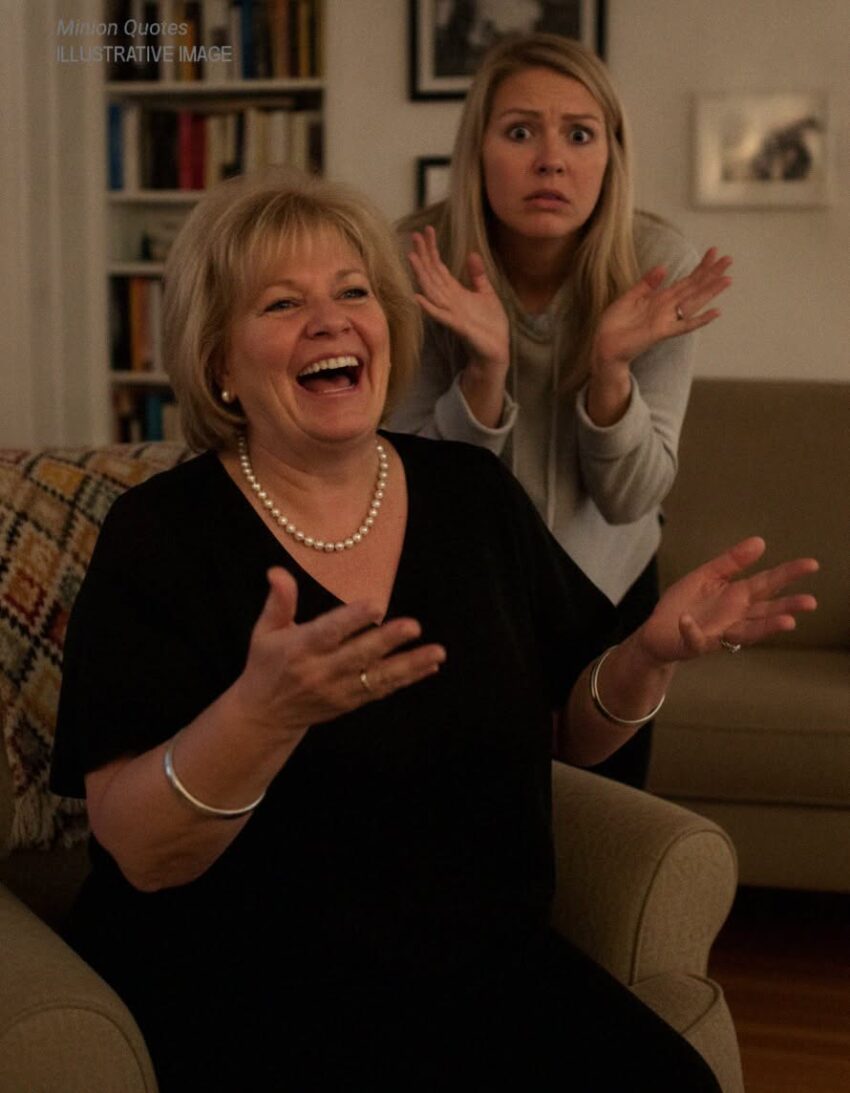
Agnes never called it “their home.” She moved furniture, invited guests, and reminded Gracie that the house belonged to Jason. Then, during a family gathering, one cruel sentence shattered Gracie’s patience and set the stage for a confrontation no one in the room was prepared to face.
For nine years, Jason and I had built a life together piece by piece.
When we first got married, we did not have much.
Our first apartment had thin walls, a tiny kitchen, and a bathroom door that never shut properly.
Still, we were happy there.
We ate dinner on the floor before we could afford a table, argued over paint samples we could not use, and spent late nights talking about the kind of home we wanted one day.
By the time Hope and Oliver came along, that dream had become something real.
Our house was not grand, but it was ours. Jason and I chose it together. We saved for the down payment together. We stayed up after the children were asleep, comparing mortgage rates and going over expenses until the numbers blurred.
I picked the soft cream color for the living room walls, while Jason built the bookshelves along one side. Hope chose yellow curtains for her bedroom, and Oliver insisted on glow-in-the-dark stars above his bed.
Every corner held part of our family.
The only person who refused to see it that way was Jason’s mother, Agnes.
From the beginning, she called it “her son’s home.”
The first time she said it, I barely noticed.
She had walked through the front door carrying a casserole dish and glanced around the entryway with an approving smile.
“This is my son’s home,” she announced, as though she were introducing the place to herself.
I laughed awkwardly and took the dish from her.
“Our home,” Jason corrected from behind me.
Agnes waved one hand.
“Of course, of course.”
I assumed that would be the end of it.
It was not.
Every time she visited, she walked through the front door as if she owned the place, constantly reminding everyone, “This is my son’s home.”
She never said our home. Never once.
At first, I ignored it because I didn’t want to create tension in the family. Agnes had a way of making every disagreement feel like a personal attack.
If I corrected her, even gently, she would sigh, lower her eyes, and say something like, “I suppose a mother is no longer allowed to be proud of her own child.”
Then Jason would get stuck trying to calm everyone down, and I would end up feeling like the unreasonable one.
So I chose peace.
At least, that was what I told myself.
In reality, I was swallowing one insult after another and hoping they would stop hurting.
Over the years, it became more than just words.
Agnes began rearranging my furniture without asking. I would leave the room to make coffee and return to find her dragging an armchair across the carpet.
“What are you doing?” I asked one afternoon.
“The chair looks better near the window,” she replied.
“I put it there for a reason.”
She gave me a patient smile, the kind someone might give a stubborn child.
“Well, this arrangement makes more sense in my son’s home.”
Another time, she moved framed photos from the mantel and replaced them with pictures of Jason as a child. She did not ask. She simply tucked our family photos into a drawer and acted surprised when I found them.
“I thought these would mean more to him,” she explained.
“They all mean something to him,” I said. “These are pictures of his wife and children.”
Agnes shrugged.
She criticized the way I decorated, too.
The cushions were too bright. The dining table was too small. The kitchen needed darker cabinets. The hallway mirror was “an unfortunate choice.”
Once, she stood in the middle of the living room, looked slowly around, and said, “Jason always liked more traditional things.”
Jason, who was sitting beside Oliver on the rug, looked up.
“No, I didn’t.”
Agnes laughed.
“You did before Gracie started choosing everything.”
I stared at her.
“Jason chose the sofa.”
“Did he?” she asked, clearly unconvinced.
Her behavior grew bolder with time.
She invited relatives over without telling me. I would hear the doorbell and find cousins, aunts, or family friends standing on the porch with food in their hands.
“Agnes said we were all gathering here,” one of them would say.
When I confronted her, she acted as if I were being inhospitable.
“They’re family,” she replied. “Why would they need an invitation?”
“Because this is our house,” I said.
She smiled.
“No. This is my son’s home.”
The part that bothered me most was what she said to Hope and Oliver.
One afternoon, I found Oliver eating chocolate cake on the couch. Crumbs covered his shirt and the cushion beneath him.
“Oliver, you know food stays at the table,” I said.
Agnes, seated beside him, lifted her chin.
“Grandma can do whatever she wants here because this is your daddy’s house.”
Hope looked up from the floor.
“Isn’t it Mommy’s house too?”
For one brief second, Agnes looked caught off guard.
Then she smiled at Hope and patted her hair.
“Of course, sweetheart.”
But even then, she did not say it was mine.
Jason corrected her countless times, but she’d just laugh and repeat the same thing the next visit.
“Mom, stop calling it my house,” he told her one evening. “It belongs to both of us.”
Agnes laughed.
“Oh, Jason. Don’t be so serious.”
“I’m serious.”
“And I’m only teasing.”
Except she was not teasing. I could hear it in her voice and see it in the way she looked at me, as though I were temporary furniture she expected her son to replace.
Last weekend, she came over again while several relatives were visiting.
The house was full. Hope and Oliver were playing near the stairs, Jason was speaking with his uncle, and I was carrying a tray of drinks into the living room.
Agnes stood near the fireplace, surrounded by relatives. She looked around the living room with open pride, as though every wall and window reflected her own success.
Then she said, “I love seeing what my son has done with his house.”
The room was quieter than it should have been.
I set the tray down carefully.
“It’s our house, Agnes,” I replied.
Agnes rolled her eyes, smiled, and answered, “Sweetheart, let’s be honest… if he wanted you gone tomorrow, you’d be the one packing.”
No one laughed.
Jason turned toward her, his face tightening.
I could hear my own heartbeat. Years of comments, rearranged furniture, uninvited guests, and quiet humiliation seemed to press down on me all at once.
Something inside me finally snapped.
I looked straight at her and said, “YOU THINK THIS HOUSE BELONGS ONLY TO HIM? FINE… THEN HAVE IT YOUR WAY!”
At that exact moment, I already had a very cruel plan in mind.
For several seconds, nobody moved.
Agnes stared at me with a faint smile still frozen on her face. She looked pleased, as though she had finally pushed me into making a fool of myself in front of the family.
Jason stepped toward me.
“Gracie,” he said carefully, “what do you mean?”
I picked up the tray from the coffee table and carried it into the kitchen.
“I mean exactly what I said.”
Behind me, voices started again, low and uneasy. Someone cleared their throat. One of Jason’s aunts whispered something I could not make out.
Agnes followed me into the kitchen.
“You should calm down,” she said. “There is no reason to create a scene.”
I placed the tray on the counter and turned to face her.
“You told me I could be thrown out of my own home tomorrow.”
“I was making a point.”
“No, you were trying to humiliate me.”
Her expression hardened.
“You are being dramatic.”
Jason entered before I could answer.
“Mom, enough,” he said. “You need to apologize.”
Agnes folded her arms.
“For what? Telling the truth?”
Jason stared at her as if he had never seen her clearly before.
“That was not the truth.”
She scoffed. “You are my son. This is your house.”
“Our house,” he replied. “Gracie’s and mine.”
Agnes rolled her eyes again.
I almost laughed. She had heard those words for years, yet they never seemed to reach her.
“It’s fine,” I said quietly. “She wants it to be your house. From now on, that is how we will treat it.”
Jason looked confused, but I did not explain.
The relatives left earlier than planned. Some hugged me before walking out. Others avoided looking at me. Agnes was the last to go.
At the front door, she glanced over her shoulder.
“When you have calmed down, perhaps we can discuss this like adults.”
I opened the door wider.
“I am very calm.”
Her mouth tightened, and she walked away.
That night, after Hope and Oliver were asleep, Jason found me sitting at the dining table with my laptop open.
“What are you doing?” he asked.
“Checking our records.”
He pulled out the chair beside me.
“You know she was wrong.”
“Do I?”
“Gracie.”
I looked at him.
“You corrected her for years, but nothing changed. She still moved things. She still invited people over. She still told our children that I had less authority than you.”
His face fell.
“I should have done more.”
“Yes,” I said, and my voice cracked. “You should have.”
He lowered his eyes.
I had expected him to defend himself. Instead, he nodded.
“I kept thinking that correcting her was enough,” he admitted. “I thought she would eventually get embarrassed and stop. I did not understand what it was doing to you.”
I closed the laptop.
“It made me feel like a guest in a life I helped build.”
Jason reached for my hand.
“You are not a guest.”
“Then prove it.”
He looked at me for a long moment.
“Tell me how.”
The next morning, we made a list.
If the house belonged only to Jason, then everything connected to it would become his responsibility. Every repair, every phone call, every family gathering, and every interruption from Agnes would go through him.
I stopped answering her messages about the house.
When she texted to say the guest room curtains needed changing, I forwarded the message to Jason.
When she called to announce that she was bringing relatives over for lunch on Sunday, I handed him the phone.
“This is your house,” I said. “You handle it.”
He did.
“Mom, you cannot invite people over without asking both of us.”
Agnes sounded offended even from across the room.
“I am asking you now.”
“No. You are informing me.”
“I don’t see the difference.”
“The difference is that the answer is no.”
She did not come that Sunday.
For two weeks, Jason handled every comment, complaint, and request. I did not interfere. At first, he seemed surprised by how often she contacted us. Then he became exhausted.
One evening, he placed his phone face down on the counter.
“She called six times today.”
“What did she want?”
“She thinks we should replace the dining table before Christmas.”
I continued chopping vegetables.
“What did you tell her?”
“That it is not her decision.”
“And?”
“She said I was letting you control me.”
I stopped and looked at him.
“Now you know.”
He came closer and kissed my forehead.
“I know.”
Still, that was not the cruel part of my plan.
The real moment came the following Saturday.
Agnes arrived just after noon. She had not called first.
Hope opened the door before I could stop her.
“Grandma!”
Agnes walked inside carrying a bag of pastries.
“I thought my grandchildren might like a treat.”
She handed the bag to Hope, then looked around the entryway.
The small table by the wall was gone.
So was the mirror she had criticized. The living room looked different, too. The armchair was back in its original spot, and every childhood photo of Jason had been placed in a box beside the stairs.
Agnes frowned.
“What happened in here?”
“I changed a few things,” I said.
“In Jason’s house?”
“In MY home.”
Her eyes narrowed.
“I thought we settled this.”
“We did.”
Jason came down the stairs holding a folder.
Agnes smiled at him with obvious relief.
“Jason, please explain to your wife that she cannot behave like this.”
He stopped beside me.
“Actually, Mom, we need to explain something to you.”
Her smile faded.
Jason opened the folder and removed several documents.
“When Gracie and I bought this house, her inheritance paid the entire down payment.”
Agnes looked at me.
I said nothing.
Jason continued.
“Her name was the only one on the original mortgage because my credit was damaged after the business I started with Darren failed. I was added to the deed later, after we refinanced.”
Agnes blinked rapidly.
“No.”
“Yes,” he said.
She stared at the papers.
“But you said you bought a house.”
“We bought a house,” Jason replied. “Together. Gracie carried us when I could not qualify. She paid the down payment, covered most of the mortgage for the first three years, and kept this family stable while I rebuilt my career.”
Agnes’ face lost its color.
I finally stepped forward.
“You kept saying this was your son’s house because you assumed he had given it to me. The truth is, without me, he would never have had it.”
Agnes opened her mouth, but no words came out.
The room felt painfully quiet.
Then Oliver appeared at the bottom of the stairs.
“Grandma, is this Mommy’s house too?”
Agnes looked at him, then at Hope, who was still holding the pastry bag.
Her voice came out thin.
“Yes.”
Oliver waited.
Agnes swallowed.
“Yes, it is your mommy’s house too.”
I felt tears sting my eyes, but I did not look away.
Jason placed the documents back in the folder.
“Mom, you will not enter this house again unless you respect my wife. You will not move anything, invite anyone, or undermine her in front of our children. If you cannot accept that, you will not be welcome here.”
Agnes’ eyes filled.
“I never thought I was doing harm.”
“You were told,” I replied. “Many times.”
She looked older then. Not defeated, exactly, but shaken by the truth she had refused to see.
After a long silence, she placed her purse on the floor.
“I owe you an apology.”
I waited.
She faced me fully.
“Gracie, I treated you as though you were temporary. I acted as if your work, your money, and your place in this family mattered less than Jason’s. I was wrong.”
The apology did not erase nine years, but it was the first honest thing she had given me.
“Thank you,” I said. “Trust will take longer.”
She nodded.
“I understand.”
When she left, she did not call it her son’s home.
She stood on the porch, looked back at Jason, the children, and me, and said, “Thank you for letting me visit your home.”
For the first time, the word “your” included me.
So here is the real question: When someone has spent years making you feel like a guest in the home you helped build, is an apology enough to repair the damage, or should respect have been given long before the truth forced it out?