PART 1 – THE CHECK
I remember that afternoon of December 23rd as clearly as if it were yesterday.
The sky over Aurora, Colorado, was a dull gray, snow falling lightly like scattered fragments of broken memories. I, Adrien Westfall, thirty-two years old, a literature teacher living in Aurora in the United States, was behind the wheel of my beat‑up old Subaru, driving nearly six hours north toward Lander, Wyoming.
That day, I drove the long distance to the little log cabin where my grandmother, Sylvia Westfall, had lived alone for the past eight years, ever since my grandfather Dennis passed away. Highway 287 stretched out white and endless in front of me, flanked by snow‑covered pine forests. Every now and then, a herd of deer would suddenly dart across my headlights, making my heart skip a beat.
I hadn’t visited Grandma in almost four months. Four months filled with lesson plans, students, grading papers, faculty meetings, and then those late nights alone in my tiny apartment in Aurora, staring out the window at the falling snow, feeling utterly empty inside.
Until the phone call five days earlier.
“Adrien, my dear grandson, you have to come home for Christmas. You hear me?”
Her voice over the phone was still warm, but there was a slight tremble at the end of the sentence.
“This Christmas, I have a special gift I want to give the whole family. Everyone has to be here. No one can be missing. Do you understand?”
My heart pounded as I listened. It wasn’t because of the gift. I just wanted to hug her, to smell the burning pine in the fireplace, the scent of baked apple pie, the smell of childhood. Grandma Sylvia was the only person left in the world who made me feel like I still had a real home.
The car climbed higher into the mountains. The icy air seeped through the cracks around the windows. I played Judy Garland’s “Have Yourself a Merry Little Christmas” at low volume so it wouldn’t drown out the frantic beating of my heart. The closer I got to Lander, the more I felt like the excited ten‑year‑old I once was.
And then the cabin appeared.
It was exactly as I remembered: a tiny two‑story log house with a red‑shingled roof covered in a thin sparkling layer of frost, the chimney releasing delicate wisps of white smoke against the gray sky. The little Christmas tree on the porch was decorated by Grandma with handmade wooden ornaments and warm golden lights. From a distance, it looked like a glowing matchbox in the middle of a lonely winter.
I parked the car, my heart racing. The front door was slightly ajar, golden light spilling out. I stepped onto the creaking wooden porch steps under a thin blanket of snow, carrying my bag of gifts, wanting nothing more than to rush inside.
“Grandma, I’m home,” I called softly, pushing the door open.
The smell of pine, onion‑braised meat, and cinnamon cookies washed over me so strongly I almost cried.
There she was, sitting in the old armchair by the fireplace, her thin hands resting on her lap, wearing the same brown wool sweater she’d had since I was a child. Her hair was completely white now, but her eyes still sparkled like emeralds. She smiled, the wrinkles at the corners of her eyes softening.
“Adrien, my grandson is home.”
I dropped to my knees in front of her chair and hugged her tightly. She was so tiny I could feel every rib beneath the thick sweater. The faint scent of lavender from her neck brought back memories of afternoons when she used to brush my hair as a little boy.
“I’m sorry it’s been so long,” I whispered, my nose stinging with tears.
“It’s all right. I can wait,” she said, stroking my hair with a hand that was cold yet strangely warm. “Sit down, dear. Let me pour you some tea. It was a long, cold drive, wasn’t it?”
The dining table was already set: a pristine white tablecloth, red candles, the silver cutlery Grandpa had bought back in 1980, and a clay pot of steaming carrot‑beef stew. Every detail showed she had been preparing since morning, maybe even since the day before. She had done it all alone.
I placed my Christmas gift bag on the table and pulled out a forest‑green sweater and a thick sheep’s‑wool scarf.
“Merry Christmas, Grandma.” I smiled, a little embarrassed.
She opened them, her eyes lighting up, and hugged the sweater to her chest like a child.
“They’re beautiful. I’ll wear it tonight.”
She kissed my forehead.
“Thank you, my dear grandson.”
We were still joyfully catching up after four months apart when the sound of a car in the yard startled me.
Mom, Dad, and Zach had arrived.
The door burst open and cold wind rushed in. My dad, Raymond, walked in first wearing an expensive fur‑lined coat, his face already scowling.
“Mom.”
My mother, Teresa, followed, stomping the snow off her boots and muttering something about the terrible roads.
My twenty‑nine‑year‑old brother, Zach, had earbuds in, eyes glued to his phone. He gave Grandma a curt greeting and flopped onto the sofa.
They hadn’t brought any gifts. Not even a flower. Not a real hug.
Ten minutes later, Uncle Albert, Aunt Joanna, and their daughter Payton arrived. Uncle Albert complained about the cold the moment he stepped inside. Aunt Joanna glanced around the cabin as if it were dirty. Payton took selfies in front of the Christmas tree without even saying hello to Grandma.
The atmosphere turned heavy from the very first minute. No one smiled genuinely. No one asked how Grandma was doing. They just sat there waiting for dinner, waiting to leave.
It broke my heart for her.
Grandma kept smiling, slowly moving around to pour water and serve extra meat into everyone’s bowls. But I could see the loneliness in her eyes.
Dinner began. The clinking of silverware, the sound of chewing, dull conversation about gas prices, the new iPhone, Uncle Albert’s upcoming vacation somewhere down south. No one mentioned Grandpa, who had passed away years earlier. No one asked if Grandma was healthy, if the roof still leaked, if the Wyoming winter was too cold for her.
Then Grandma stood up.
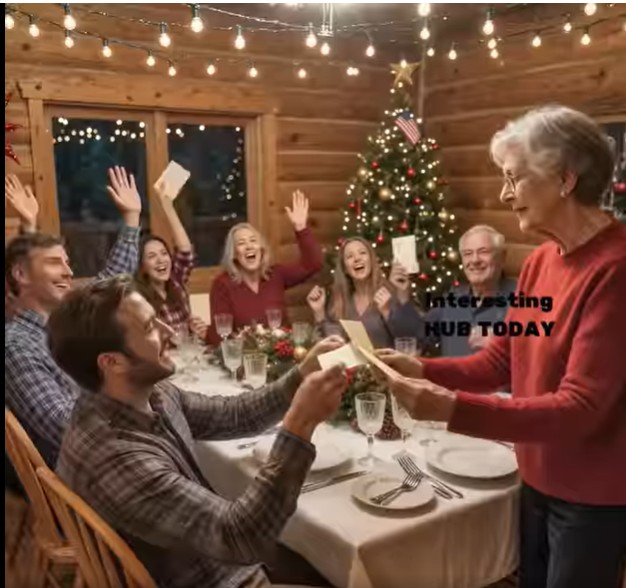
Everyone fell silent as they watched her carry a thick stack of white envelopes, walking slowly around the table as if performing a ritual. She placed one envelope in each person’s hand.
“Dad, Mom, Uncle Albert, Aunt Joanna, Zach, Payton, and finally Adrien. Here are your Christmas gifts,” she said, her voice soft but clear.
People exchanged confused looks. A few whispers rose.
“What is this?” Zach leaned toward Payton, curiosity mixed with mockery in his voice.
I held the envelope, feeling the thick, smooth paper beneath my fingers, my heart pounding like a war drum. I opened it slowly, gently peeling back the glue, and slid out the paper inside.
It was a check from First National Bank of Wyoming.
Pay to the order of: Adrien James Westfall.
Amount: $5,000,000.00.
The numbers and letters were printed clearly, professionally, without a single smudge. I looked up abruptly, my breath catching in my throat as if someone had punched me in the chest.
The others opened their envelopes almost simultaneously. The chaotic rustling of paper filled the room, followed by three seconds of complete silence—three seconds that felt like the whole world had stopped spinning.
Every pair of eyes was fixed on the check in their hands. The quiet was so complete I could hear my own heartbeat.
Then suddenly, everyone burst into laughter, like a bomb exploding at the dinner table.
“Oh my gosh, Grandma!” Zach was the first to lose it. He clutched his stomach and laughed so hard tears streamed down his face, waving his check like a cheap paper fan.
“Five million dollars? Where did you print these, Grandma?” he shouted between laughs. “They look so professional. Did you use Uncle Albert’s color printer? Or did you secretly hack a bank?”
He shrieked with laughter, lightly punching Payton’s shoulder, his voice high‑pitched with excitement and mockery, as if this were the funniest joke of the year.
Payton laughed along, her shrill giggle ringing like breaking glass, her face flushed with shallow delight. She held her check up in front of her and snapped a photo with her phone right there at the table, the flash blinding everyone.
“Grandma gave us pretend million‑dollar checks for Christmas—iconic,” she said between laughs, fingers flying across the screen to post it on her Instagram story. Her eyes gleamed with shallow amusement.
“Oh my gosh, five million dollars. Grandma, are you a secret billionaire? I’m totally posting this. My friends are going to lose their minds.”
She waved the check in Grandma’s face like it was a cheap toy, completely oblivious to the seriousness in Grandma’s eyes.
Aunt Joanna’s laugh was more sarcastic, sharp and grating like shattering glass, her face wrinkled around the mouth with obvious skepticism and contempt. She held the check between two fingers, lifting it close to her eyes as if inspecting counterfeit money, then turned to Grandma with a biting tone.
“Mom, come on. Stop joking. You still have to ask Adrien for money to fix the roof, and now you suddenly have a fortune to give each of us five million dollars?” She scoffed. “Give it up, Mom. What kind of strange joke is this? Do you think we’re kids?”
She shook her head, glancing at Uncle Albert for support, her expression red from trying to suppress laughter, but dripping with mockery, as if Grandma were a confused old woman putting on a clown show.
My father didn’t laugh loudly, but he shook his head, his scowl full of irritation and disappointment. He glanced at the check, then tore it into four pieces without hesitation, the sharp ripping sound cutting through everyone else’s laughter. He tossed the scraps onto the table. They fluttered down like paper snow.
“What kind of joke is this, Mom? I drove six hours to have Christmas dinner, not to watch this nonsense. Did you think we’d find it funny?”
His face flushed with anger, eyes avoiding Grandma’s, as if he were embarrassed for her. But deep down, it was obvious he had hoped for something real, not what he assumed was a worthless piece of paper.
My mother was quieter, but her face went pale with shock before settling into an awkward smile. She turned the check over a few times, blinking in disbelief, then whispered to Dad:
“Raymond, she’s probably just joking… but it does look pretty professional.”
She didn’t tear hers up, but she didn’t keep it carefully either. She simply set it down on the table like something unnecessary, her expression a mixture of confusion and disappointment.
I alone remained silent in the chaos.
I sat there, the check still untouched in my hand, my thumb gently tracing the words five million dollars. My heart was pounding wildly, my breathing rapid, as if my entire body were trembling with an unnamed premonition.
I looked at Grandma.
She stood there, hands clasped tightly in front of her stomach, back slightly bent with age, but her eyes burning brightly as they looked straight into mine. She wasn’t smiling. She offered no explanation. There was not the slightest hint of a joke in her gaze—only a chilling seriousness and a deep, aching sadness I had never seen before, as if she were looking straight through my soul and into the chaotic future that was about to unfold.
Dinner ended amid mocking laughter and shredded pieces of checks fluttering down onto the wooden floor like confetti from a cruel joke. One by one, everyone hurried out as if the cabin had suddenly become too cramped, too cold, too shabby for them.
I stood there, the check still intact in my hand, watching Grandma quietly clear the dishes.
The wind howled across the snowy yard. Car doors slammed. Engines roared to life and then faded away down the narrow trail.
Only the two of us remained.
“Grandma,” I called softly, my voice cracking. “Can I stay a few more days? I took an extra week off from teaching. I… I want to be with you.”
She paused, turned, and looked at me. For the first time that evening, a real light flickered in her old eyes like a flame suddenly fanned back to life.
“Really, dear?”
She smiled—the first genuine smile of the whole night.
“Of course you can stay. This house… it’s been a long time since anyone stayed past Christmas.”
I nodded, a weight lifting from my chest.
When the sound of the last car finally disappeared, the cabin seemed to let out a long, relieved breath.
The noisy crowd was gone, leaving behind the familiar quiet I loved so much it hurt: the crackle of logs in the fireplace, the low bubbling of the old copper kettle on the wood stove, the soft whistle of wind through the window cracks. All of it soothed my mind in a way nothing else ever could.
The house belonged to just the two of us again.
PART 2 – THE LAST WINTER AND THE CHECK CLEARS
The next morning, daylight came late because of the heavy snow. I woke early, made coffee, and quietly started cleaning up. Grandma sat at the kitchen table with a steaming cup of tea, watching me wash the leftover dishes from the night before. Hot soapy steam rose in clouds. The faint smell of last night’s stew still lingered.
I washed slowly, as if trying to stretch every minute.
“Let me do it,” she said.
I shook my head and smiled.
“No, today let me take care of you.”
When the kitchen was done, I went outside to shovel snow. It had fallen all night, blanketing the porch steps, the walkway, even the rose bushes Grandma had planted when Grandpa was still alive. I grabbed the long‑handled snow shovel and dug in hard. Snow flew in powdery bursts.
Grandma stood on the porch in the green sweater I’d given her, holding her second cup of tea, eyes shining as she watched.
“You’re so strong,” she praised. “Your grandpa used to clear the snow just like that every winter morning.”
I laughed, my breath coming out in white puffs.
When the yard was finished, I restacked the firewood along the side of the house—the dry pine logs she had split herself last fall. My hands grew rough from the cold, but my heart was warm. She brought out Grandpa’s old wool mittens and insisted I wear them.
“Don’t let your hands freeze, grandson.”
I checked the roof. Snow had piled nearly half a meter thick in places. I climbed the ladder and pushed it down in heavy slabs. Grandma stood below, anxiously looking up, handing me a towel to wipe the sweat, even though the air was icy.
“Come down, dear. It’s dangerous.”
“I’m fine, Grandma. I’m used to it,” I called down, laughing. My voice echoed in the crisp air.
At noon, I fixed the squeaky kitchen door hinge, oiled it, tightened the screws. She sat beside me, passing me each tiny screw, then brewed a pot of hot ginger tea and set it next to me. The sharp ginger scent filled my nose and brought back memories of every childhood cold when she made me drink it.
In the afternoon, the living room light started flickering. I stood on a chair to replace the bulb. Grandma held the ladder with trembling hands but still smiled.
“Be careful, you little old man,” she teased.
That night, the kitchen sink pipe froze. I took her old hair dryer, sat on the floor, and blew warm air onto the copper pipe. She sat beside me and pressed a still‑warm slice of apple pie into my hand.
“Eat this. Keep your belly warm.”
Every moment moved slowly, strangely peaceful. The little cabin seemed to open its arms wide and wrap us both inside. No more mocking laughter, no more judgmental glances. Only the glow of the fireplace and love that didn’t need many words.
Evenings were the most beautiful.
We pulled our two armchairs closer to the fire. Grandma toasted bread on a long iron fork, slathering it with melted butter and wild honey. I simmered vegetable soup from the garden—carrots, potatoes, onions she had stored in the root cellar since autumn. Some nights she baked apple pie. The scent of cinnamon and baked apples filled the house, sweet enough to break your heart.
We ate dinner at the small wooden table right beside the fireplace. No chandelier needed, just the dancing firelight.
Then she began telling stories.
“When you were tiny, you used to run around this yard like a squirrel,” she said, eyes crinkling. “Once you fell face‑first into the snow and wailed. I had to rush out, pick you up, wipe your nose, and I could barely stop laughing.”
I laughed out loud.
“I remember I used to pretend I was an astronaut and wear a frying pan as a helmet.”
She laughed in her raspy voice, eyes glistening.
“Then your grandpa took you fishing at the old lake. You both came back soaked to the bone but proudly holding the tiniest perch, showing it off to the whole neighborhood. Your grandpa said, ‘This boy is going to do great things. Mark my words.’”
I fell silent, throat tight. Grandpa had been gone eight years, yet every time she spoke of him, he came back to life inside these walls.
“What I remember most is standing on the porch every winter, listening for the sound of a car,” she said softly, her voice trembling like it might dissolve into the cold wind. “Sometimes it was just a neighbor, but I’d still run out to look. I know the sound of your engine so well. I can tell from far away when it’s you coming home.”
She placed her thin, warm hand on my shoulder. That light touch was enough to make my heart ache.
“Now that you’re here, this house feels warm again.”
Sometimes she sat staring into the flames, her gaze distant, as if touching memories I could never reach. I knew she was thinking something deep, but she would only squeeze my shoulder gently and fall quiet again. No explanation, no complaints, just a whisper soft as glowing embers:
“Having you here makes me so happy.”
I noticed how much weaker she had become. The last time I visited, she could still climb the ladder to pick apples. Now her steps were slow. She had to steady herself against the wall walking from the kitchen to the living room. Her kind eyes sometimes clouded with