As the boarding door was about to close, business class had settled into its familiar atmosphere of quiet luxury.
Soft leather seats, warm lighting, and the gentle clink of glassware created a space reserved for comfort and privilege.
Passengers adjusted noise-canceling headphones, skimmed glossy magazines, or typed confidently on slim laptops.
Everyone was ready to enjoy what their expensive tickets promised.
At the entrance of the aisle stood Eleanor Whitmore.
She was eighty-five years old, petite, slightly bent with age, holding a small, well-worn carry-on.
Her silver hair was neatly pinned back, her beige coat clean but clearly old.
Her shoes were sensible and scuffed from years of use.
Her hands trembled lightly, yet her eyes remained sharp, filled with nervous anticipation and something deeper.
She followed the flight attendant slowly down the aisle.
“Here is your seat, ma’am,” the attendant said kindly, pointing to a window seat midway through the cabin.
“If you need anything at all, just let me know.”
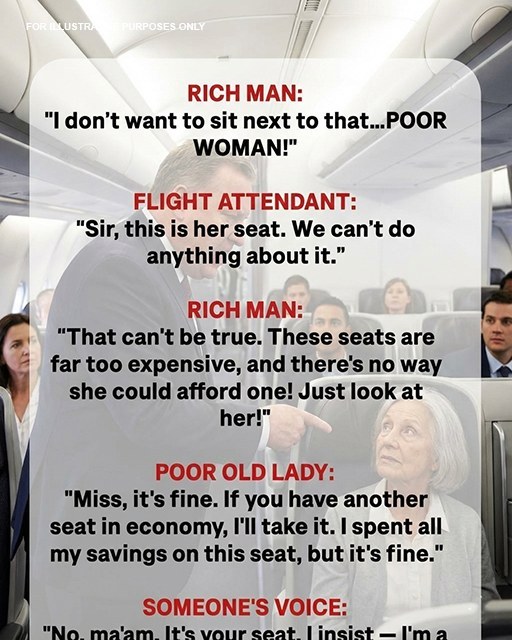
Before Eleanor could respond, an irritated voice cut through the calm.
“Absolutely not.”
The man seated beside the window straightened in his chair.
He looked to be in his early fifties, dressed in a perfectly tailored suit, an expensive watch glinting on his wrist.
“I’m not sitting next to her,” he said loudly, waving dismissively toward Eleanor.
The attendant paused, surprised.
“Sir?”
“This must be a mistake,” he snapped.
“Business class costs a fortune. Someone like her doesn’t belong here. Just look at her.”
Eleanor felt her cheeks burn.
She lowered her gaze, suddenly aware of every wrinkle in her coat and every mark on her shoes.
She had chosen her best outfit, yet now it felt painfully inadequate.
“Sir, this is her assigned seat,” the attendant replied calmly.
“Her boarding pass confirms it.”
“That’s impossible,” he argued.
“She should be in economy. I didn’t pay this much to be uncomfortable for five hours.”
Nearby passengers began to stare.
Whispers spread through the cabin, curiosity turning into judgment.
Eleanor felt their eyes measuring her worth.
“I’m sorry,” she whispered.
“I didn’t mean to cause trouble.”
“You have nothing to apologize for,” the attendant said firmly.
The man crossed his arms.
“I want her moved.”
More crew members arrived, trying to calm the situation.
Some passengers sided with the man.
“She probably upgraded by mistake,” someone muttered.
“They should fix it before takeoff,” another agreed.
The humiliation pressed heavily on Eleanor’s chest.
She clutched her bag, hands shaking.
“It’s alright,” she said softly to the attendant.
“If there’s a seat in economy, I’ll take it. I spent my savings on this ticket, but peace matters more.”
The attendant’s expression hardened.
“No,” she said.
“You paid for this seat. You will stay right here.”
Turning to the man, she added,
“If this behavior continues, airport security will be contacted.”
After a tense silence, the man leaned back.
“Fine,” he muttered.
Eleanor sat down, heart racing.
As the plane began moving, her bag slipped from her lap, spilling its contents onto the floor.
Before she could react, the man bent down to help her.
“Here you go,” he said, handing her a wallet and glasses.
Then he paused.
In his hand was a gold locket set with deep red stones.
“Well… this is something,” he said quietly.
“Do you know what this is?”
“It’s my locket,” Eleanor replied, taking it back.
“These are real rubies,” he said, surprised.
“I’m Leonard Price. I work with antique jewelry. This piece is worth far more than a plane ticket.”
“It’s not valuable because of money,” Eleanor answered gently.
Leonard hesitated.
“I owe you an apology. I judged you unfairly.”
“Thank you,” she said simply.
She told him the story of the locket.
Her father, a WWII pilot, gave it to her mother before leaving for duty.
He never returned.
Inside were two photos: a young couple in love, and a baby wrapped in a blanket.
“That’s my son,” she said softly.
She explained the adoption, the hardest decision of her life.
Years later, she found him through a DNA test.
They exchanged one message… then silence.
“Then why are you on this flight?” Leonard asked.
She smiled gently.
“He’s the pilot,” she said.
“Today is his birthday. Being close to him is enough.”
Unnoticed, a flight attendant had overheard everything and quietly entered the cockpit.
As the plane prepared to land, the intercom clicked on.
“Ladies and gentlemen, we’ll be arriving at JFK shortly,” the pilot announced.
After a pause, his voice trembled slightly.
“I’d also like to welcome someone very special onboard today.
My birth mother is flying with us for the first time.
Mom, please wait for me after we land.”
Gasps filled the cabin.
Tears streamed down Eleanor’s face.
Once the plane stopped, the cockpit door opened.
The pilot walked straight toward her, ignoring protocol.
“Mom,” he said, holding her tightly.
The cabin erupted in applause.
“You did the right thing,” he whispered.
“Thank you for loving me enough to let me go.”
Leonard watched in silence, deeply humbled.
That day, many passengers learned a lesson they would never forget.
A person’s worth is never defined by appearance.
And kindness costs nothing.