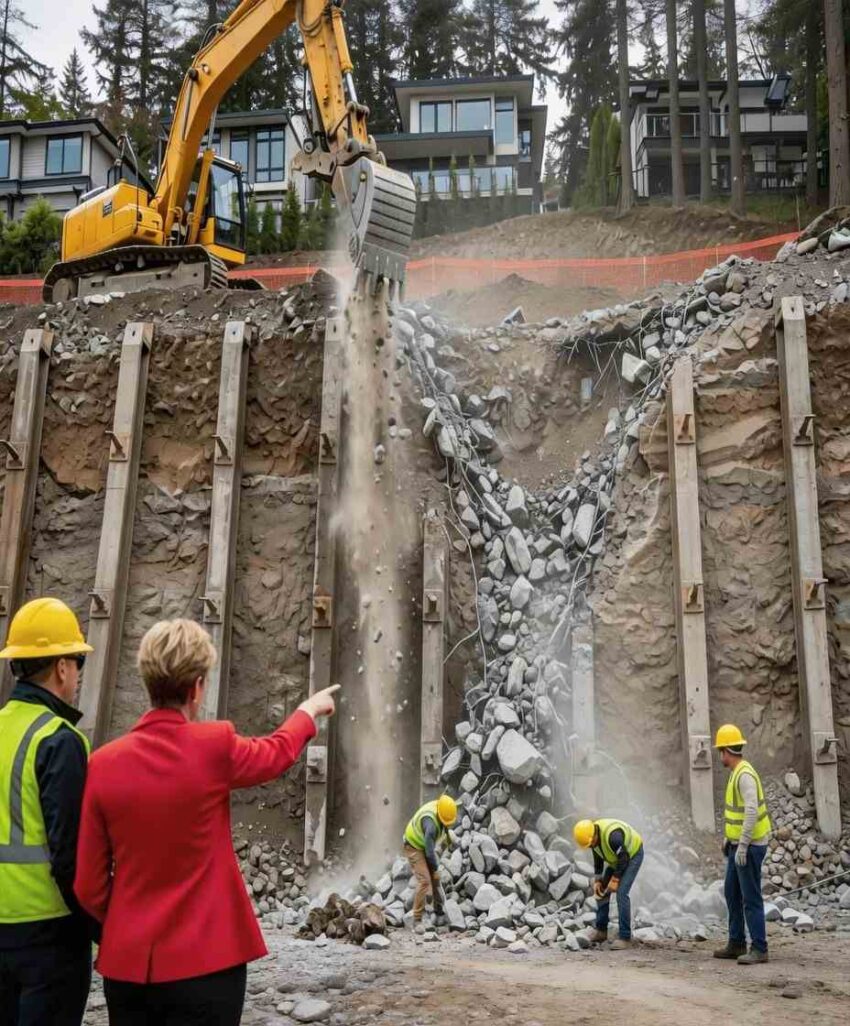
The day my neighbor ordered me to tear down the retaining wall that had been holding an entire hillside in place for 20 years. I remember standing there with the letter in my hand, thinking, “Well, this is either going to be very funny or very expensive.” Turns out it became both.
Now, before you picture some dramatic Hollywood feud between neighbors, you should know I’m not the kind of guy who looks for trouble. My name’s Luke Harper. I’m 47 years old and I’ve been running a small landscaping business outside Eugene, Oregon since the late 90s. Dirt, rock, drainage, grading, that’s been my world for most of my life.
Not glamorous work, but it pays the bills and it teaches you a lot about how land behaves when gravity and water decide to have a conversation. And if there’s one thing I’ve learned after 30 years of digging holes and fixing other people’s mistakes, it’s that hillsides always win. My house sits on one.
Back in 2002, when my wife and I bought the place, it was basically the only property we could afford that had enough space for our kids and a small shop for my equipment. The house itself wasn’t anything special. An old cedar place built sometime in the late ‘7s, but the lot had character, steep character. Picture a slope that drops about 8 ft from my backyard down to the three homes behind me.
When we first moved in, the ground was soft clay and loose soil. And during the first heavy winter rain, the whole back section started slowly creeping downhill. Nothing dramatic at first, just little signs, cracks in the soil, a fence leaning a few inches more each week. But when you work in landscaping, you learn to read land like a mechanic listens to an engine.
And that hillside was whispering trouble. So, I did what any guy in my line of work would do. I built a retaining wall. It wasn’t fancy, not even close. I used old railroad ties I bought from a salvage yard outside town. Heavy, ugly timbers that smelled like creassot and history. The wall ran about 35 ft across the back of my yard and stood roughly 8 ft tall.
Not pretty, but solid. Behind it sat somewhere around 180 cubic yards of compacted soil. That wall wasn’t decoration. It was the only thing stopping the hill from visiting the neighbors below. Once it was finished, the difference was immediate. My yard leveled out nicely, and the three houses down the slope ended up with flat backyards and dry basement.
In fact, one of those neighbors, an older guy named Carl Jensen, used to joke that my wall was the best insurance policy he never had to pay for. For almost two decades, nobody complained about it. Not once. Carl and his wife lived directly behind us for years. sweet people, the kind who bring over zucchini bread and wave when they mow their lawn.
The other two houses changed owners once or twice over the years, but nobody ever had an issue with the wall. Most people understood something simple. It wasn’t pretty, but it worked. Then last spring, everything changed. Carl sold his place and moved to Arizona after his wife passed. And about a month later, a moving truck showed up at the house behind mine.
outstepped a woman in designer sunglasses, crisp white sneakers that had clearly never touched mud, and the kind of confident walk that tells you she’s used to giving orders. Her name was Vanessa Caldwell. I didn’t know it yet, but Vanessa had just become the new president of our neighborhood HOA.
Now, normally, I don’t care much about HOA stuff. Our little subdivision is small, maybe a dozen homes. And for the most part, the association only exists to manage shared road maintenance and keep people from turning their yards into junkyards. Nothing too dramatic. But Vanessa was different. You could tell from day one she had plans.
The first time we spoke was actually pretty friendly. I was out back trimming some shrubs when she walked up to the fence line. “Hi there,” she said with a bright smile. “You must be Luke.” “I’m Vanessa. I just moved into Carl’s old place. I wiped my hands on my jeans and walked over.
Welcome to the neighborhood, I told her. Carl was a good guy. You’ll like it here. She nodded politely, but I noticed her eyes drifting toward the retaining wall behind me. That wall had a way of doing that to people. She tilted her head slightly. So, that structure, she said, “Retaining wall?” I replied, “Right,” she said slowly. “Is that permanent?” I chuckled a little.
Well, unless gravity takes a vacation. Yeah. She didn’t laugh. Instead, she gave a tight little smile and said, “Internesting.” That was the end of the conversation. At the time, I didn’t think much about it, but about 3 weeks later, I opened my mailbox and found a certified letter. The return address said Caldwell Design Interiors.
Inside was a neatly typed document on expensive looking paper. It read like something written by someone who had spent a lot of time telling people what their home should look like. According to the letter, “My retaining wall was, and I quote, visually inconsistent with the aesthetic standards of the community.” Apparently, Vanessa had recently installed a new infinity style pool in her backyard, a project that, judging by the contractor trucks I’d seen, probably cost more than my entire landscaping business. And from her pool deck, she
could see the top portion of my wall. She described it in the letter as an eyesore. Her solution was simple. I had 30 days to remove the structure and replace it with ornamental stone that met HOA design guidelines. If I failed to comply, the association would begin issuing daily fines of $200 until the issue was resolved.
I read the letter twice. Then I leaned back in my chair and laughed. Not because it was funny exactly, but because sometimes when something is that ridiculous, laughter is the only reasonable response. Still, I figured there had to be some misunderstanding. So that evening, I walked down the slope and knocked on Vanessa’s door.
She answered, wearing yoga clothes and holding a glass of sparkling water, the sunset reflecting off the perfectly smooth surface of her new pool behind her. “Yes,” she said. I held up the letter. “Hey, Vanessa, I just got this in the mail. thought maybe we should talk about it. Her expression didn’t change.
“Oh, good,” she said calmly. “I was hoping you’d come by, and that’s when I realized something important. This wasn’t a misunderstanding. This was the beginning of a fight.” Vanessa stepped aside and motioned for me to come out to the back patio. Now, I’ll admit, the pool was impressive. A long, narrow infinity edge that looked like it just poured straight into the trees below.
The tile was this deep, dark blue, the kind you see in fancy resorts. and the water reflected the sky like a mirror. And right at the far end, if you looked up the slope, you could see the top edge of my railroad tie wall, about 2 feet of it. Vanessa noticed me looking. “You see what I mean?” she said, sipping her drink. I shrugged.
“I see a wall that’s been holding that hillside in place for 20 years.” She gave a soft little laugh like I just missed the point entirely. No, Luke. What I see is something that looks like it belongs behind a tractor barn, not in a residential neighborhood. I leaned on the railing and looked down at the slope.
From where we stood, the drop was obvious. The soil between our yards was steep and soft, the kind of ground that gets heavy when it rains. “You ever lived on a hillside before?” I asked. “A few properties?” “Yes.” “I mean one like this,” I said, pointing toward the slope. clay soil, winter rain, downhill houses. She waved her hand dismissively.
I’m sure it served its purpose at some point, but that doesn’t change the fact that it’s visually offensive. The HOA guidelines are very clear about maintaining property value. Now, that part made me smile because property value was exactly why the wall existed. I said, “You realize that wall is the reason your backyard is flat right now?” She raised an eyebrow. “I doubt that.
It’s holding back about 180 yards of soil. Another little laugh. Luke, I design high-end homes for a living. I think I understand landscaping. And there it was. That tone, the one that says conversation over. She walked over to the pool’s edge and gestured toward the horizon. I invested a lot into creating this view, she said.
And right now it ends with a pile of railroad ties. I let the silence sit there a moment. You’re asking me to remove the structure that’s holding up your backyard. No, she said smoothly. I’m asking you to replace it with something attractive. Stone walls cost money. That’s the cost of maintaining standards. And if I don’t, she turned toward me and gave a professional smile.
Then the association will proceed with fines. $200 a day every day until the wall was gone. I nodded slowly. All right, I said. I’ll look into it. She smiled like she just solved a problem. Wonderful. I’m glad we understand each other. I walked back up the hill that evening thinking about something my old boss used to say when we were building retaining systems.
He’d say, “Luke, dirt doesn’t care about opinions. Dirt only listens to gravity.” The next morning, I went digging through my garage filing cabinets. One thing about working construction most of your life, you keep paperwork. Sure enough, buried in an old binder was the original property survey from when we bought the house in 2002.
I spread it across the workbench and traced the lot lines with my finger. The retaining wall sat entirely on my side. Not an inch crossed into anyone else’s property. Next, I found the building permit from the county. Stamped, approved, signed off by a structural engineer. So, technically speaking, the wall was legal, permitted, and fully on my land.
But I already knew something Vanessa probably didn’t. Itch. Disputes don’t always follow logic. They follow paperwork. So, I decided to get more. I called a soil engineer I’d worked with before, a guy named David Morales, who specialized in slope stability. He came out a few days later with a clipboard, a transit level, and that look engineers get when they see a problem forming in slow motion.
We walked the property together. He measured the grade, poked around in the soil, and spent a good 20 minutes examining the retaining wall itself. Finally, he stood up, brushed dirt off his hands, and looked down the hill toward Vanessa’s yard. “Who built this?” he asked. I did, he nodded once. Good work. That felt nice to hear.
Then he said something that mattered more. You ever remove it? Nope. Good, he said again. Because if this wall disappears, that slope fails. How fast? He tilted his head toward the sky. When the rain shows up in Oregon, rain always shows up. I hired him to write a formal report. Cost me $3,200. A week later, I had a professional engineering document that basically said in very polite technical language, “If the retaining wall is removed, slope failure is highly likely, resulting in soil movement toward the downhill properties.” In
plain English, the hill would slide. I copied the report, attached the survey, the permit paperwork, and wrote Vanessa a short letter. I kept the tone respectful, explained the engineering assessment, pointed out that the structure was on my land and legally permitted. Then I added one simple sentence.
If the wall is removed, the hillside may collapse onto the lower properties. I mailed the packet certified. Figured that would be the end of it. Two weeks passed. Then another letter showed up. This one came from a law office in Portland. The message was short and very lawyerish. Your retaining wall remains non-compliant with HOA aesthetic standards.
The association requests its removal within 30 days. At the bottom, there was a line that stuck with me. Property ownership does not exempt residents from community design rules. I stared at that sentence for a long time. Then I called my attorney. His name’s Greg Foster. Good guy. Dry sense of humor.
The kind of lawyer who looks like he’d rather be fishing. I dropped the paperwork on his desk. He read through everything slowly, occasionally making little noises like, “Huh?” And, “Well, that’s interesting.” Finally, he leaned back in his chair. So, he said, “They want the wall gone.” Apparently, you warn them. Sent the engineer report. He nodded again.
Then he smiled. Not a big smile. The kind of smile that usually means something mischievous is forming. Luke, he said, “Give them exactly what they want.” I blinked. You serious? Oh, absolutely. But the hill is not your legal responsibility if they demanded removal after being warned. He tapped the engineer report, especially with documentation like this.
I felt a slow grin creeping onto my face. So, what do I do? Simple, Greg said. Get their request in writing. Technically, we already had it from their lawyer. But Greg wanted something clearer, something undeniable. So I sent one final message to the HOA board asking them to confirm that the retaining wall should be removed to meet aesthetic guidelines.
3 days later the email arrived approved by the board president Vanessa Caldwell. The message said the retaining wall should be removed or replaced to comply with HOA standards. I printed it out, put it in a folder with the engineer report. Then I rented an excavator. September 15th was a warm Saturday morning.
Clear sky, dry ground, perfect day for demolition. When the rental company dropped off the machine in my driveway, a few neighbors wandered over to watch. Carl’s old friend Marty from two houses down leaned on the fence and asked, “What’s going on, Luke?” “It improvement project,” I said. He chuckled. Never heard those words end well.
By midm morning, I climbed into the excavator cab and fired it up. The engine growled to life and I started pulling out the railroad ties. Each one came loose with a heavy crack of soil breaking apart behind it. 20 years of packed earth slowly relaxing as the structure disappeared piece by piece. About an hour into the work, I noticed someone standing down by the pool.
Vanessa, she had a glass of wine in one hand and sunglasses on, watching like someone observing a renovation show. When I lifted one of the big timbers out and tossed it onto the pile, she raised her glass toward me like we were celebrating. So I waved back. 6 hours later, the wall was gone. The hillside sat there exposed, a steep face of damp clay and loose dirt where the structure used to be.
I shut down the excavator and stood there for a moment looking at it. The slope looked quiet, but I knew what it was. A loaded spring. And Oregon’s rainy season was only a week away. After the last railroad tie came out of the ground, I shut off the excavator and just sat there in the cab for a minute, listening to the engine tick as it cooled down.
The hillside looked calm, almost innocent. But when you’ve worked with soil long enough, you know, calm doesn’t mean stable. It just means the clock has started. A couple of the neighbors wandered over that afternoon while I was stacking the old timbers in a pile. Marty leaned against the fence again, scratching his beard while he looked at the exposed slope.
You sure about this, Luke? He asked. I shrugged. Not my call. He looked down the hill toward Vanessa’s place. She wanted it gone that bad. Yep. He shook his head slowly. Well, I guess we’ll see what happens when winter shows up in Oregon. Winter doesn’t exactly knock on the door politely. It just arrives. About a week later, the weather forecast started talking about the first real storm system of the season.
Nothing unusual for us. Just a big Pacific front rolling in with steady rain. But rain on a hillside is like adding oil to a machine that already wants to move. On the evening of September 23rd, the clouds rolled in thick and low. The air smelled like wet leaves and cedar bark, the kind of scent that tells you the dry season is officially over.
By midnight, the rain was coming down steady. By morning, it was pouring. I spent most of that day in my garage sharpening mower blades and organizing tools while the storm drumed against the roof. Every once in a while, I’d glance out the back window toward the slope. You could already see the soil getting darker as it soaked up water.
The forecast said the storm would last 2 days, 48 hours of rain, about 6 in total. Not recordbreaking, but more than enough. That night, I went to bed around 10:00, the sound of rain steady against the windows. My wife asked if I thought the hill would hold. I told her the honest answer. I don’t know because the truth is slope failures aren’t always dramatic.
Sometimes they happen slowly and sometimes they wait until the middle of the night. Around 2:00 in the morning, I woke up to a sound that didn’t belong to rain. At first, it was faint, a low rumble, deep and heavy, like distant thunder rolling under the ground. Then it got louder. If you’ve ever stood near a freight train when it passes, you know that vibration you feel in your chest before you even see the train. That’s what it sounded like.
Except this train was made of mud. I jumped out of bed and rushed to the back window. For a split second, everything looked normal. Then the hillside moved. Not a little shift. The entire face of the slope suddenly sagged and collapsed downward like someone had kicked the legs out from under it.
soil, roots, rocks, a massive brown wave sliding straight toward the houses below. The sound was unbelievable. Trees cracking, mud roaring, wood snapping. Within seconds, the dirt slammed into the back of Vanessa’s yard. Her infinity pool disappeared under a surge of thick clay and debris. The water erupting upward like someone had dropped a truck into it.
The pool fence folded like aluminum foil and vanished under the slide. Lights flickered in the houses downhill as the mud spread outward. It was over in maybe 15 seconds, just long enough to leave a scar across the entire slope. I stood there staring through the rain, heart pounding, watching muddy water spill over the edge of her pool deck. Behind me, my wife said quietly, “Was that the hill?” “Yeah,” I said.
“That was the hill.” Within minutes, lights started coming on in the neighborhood. Doors opening, people shouting over the ring. I grabbed a jacket and walked down the slope with a flashlight. The damage was impressive. Vanessa’s pool was half full of mud. The deep blue tile completely buried under 4 ft of brown sludge.
The infinity edge that used to spill water over the horizon now looked like a chocolate milkshake. Her pool equipment shed had taken a direct hit from the slide. Electrical boxes sparked quietly in the rain. Two houses farther down the slope had it worse. The mud had pushed against their back foundations, forcing water through basement windows and cracking sections of concrete.
People were standing in their yards in pajamas and raincoats, staring at the mess like survivors after a shipwreck. Vanessa came running out onto her patio. When she saw the pool, she froze. For a moment, she just stood there, rain soaking her hair and clothes, staring at what used to be the centerpiece of her backyard.
Then she spotted me and the screaming started. You did this. Her voice cut through the rain like a siren. She stormed up the muddy slope toward me, slipping twice before she reached the fence line. You destroyed my property. I didn’t raise my voice. Vanessa, I said calmly. You asked for the wall to be removed. Her face went red. That wall caused this.
No, I said gravity did. She pointed at the hillside. [music] You knew this would happen. I warned you it might. I pulled my phone out and opened the photos I’d taken of the engineering report. [music] You remember this document? She slapped the phone away from her face. This isn’t over, she snapped. No, I agreed quietly.
[music] It probably isn’t. The next few days were chaos. Insurance adjusters [music] showed up. Contractors started inspecting foundations. Mud removal trucks rolled in. By the [music] time everything was tallied, for families had filed claims totaling around $140,000 [music] in damages.
Vanessa’s pool alone was estimated at close to 90,000 to repair. She called me three times [music] during that week. The first call was pure rage. The second was threats about lawsuits. The third was quieter, [music] more controlled. That’s usually when people realized the paperwork matters because my attorney had already sent a letter.
In that letter, Greg laid everything out very [music] clearly. The retaining wall had been structurally sound. Its removal had been requested by the HOA president despite [music] a written engineering warning about potential slope failure. And now the hillside had done exactly what the engineer predicted. But the letter didn’t stop there.
Greg added one more paragraph. Since the wall had originally been installed to protect the downhill properties, I was willing to rebuild it. However, the cost of reconstruction would be $12,800 plus a 10-year maintenance agreement for annual inspection and drainage service, $850 per year, paid by the HOA. There was also a clause Greg insisted on including if the maintenance payment was more than 30 days late.
I reserved the right to remove the retaining wall again. 3 weeks later, Vanessa resigned as HOA president. The new board approved the contract without much debate. By November, my crew and I rebuilt the wall exactly where it had been. Same design, same ugly railroad ties, solid as ever. These days, the hillside sits quiet again.
Every October, the HOA sends me a check for the maintenance agreement. And yes, Vanessa still lives in that house. Sometimes I see her out by the pool, which they eventually repaired. She doesn’t wave anymore, but every time that check arrives in the mail, I can’t help smiling a little because that wall she hated so much is now the thing protecting her backyard.