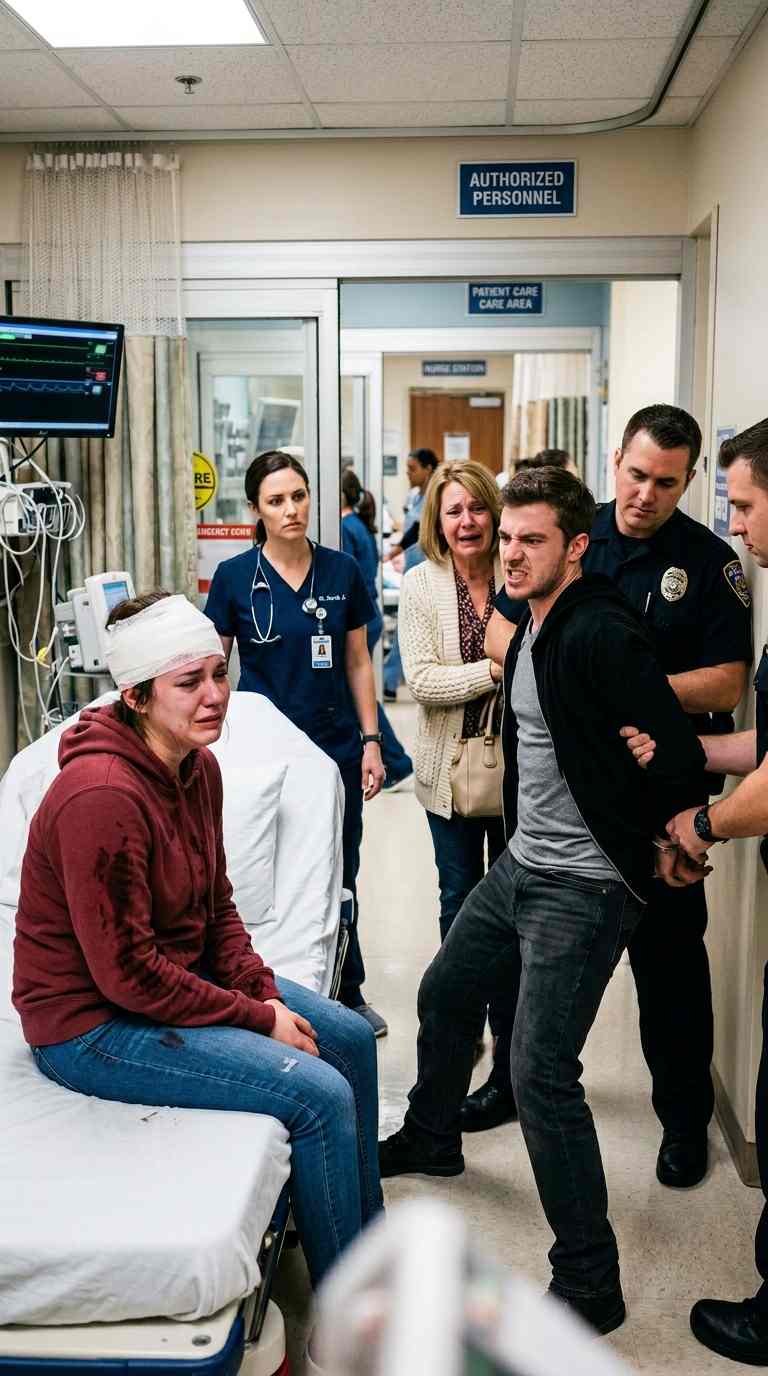
By the time the triage nurse called my name, the blood on my shirt had turned stiff and brown around the collar.
“Emily Carter?”
I stood too fast and the waiting room tilted. My mother rose with me, one hand fluttering at my elbow as if she had been the one holding pressure to my scalp all the way from our house in Dayton, Ohio. She had not. She had spent the drive repeating the same line in a tight, shaky voice.
“Logan didn’t mean to. You know your brother. He gets upset, then it’s over. We are not reporting this.”
Not reporting this.
As if my split scalp and the warm blood sliding down my neck were a misunderstanding.
Inside the exam room, a physician’s assistant cut away the sticky hair near the wound and hissed under her breath. “That’s deep.”
Mom stepped in before I could answer. “He tripped. They were arguing and he tripped.”
The PA gave her a flat look, then left to get the doctor.
I sat on the paper-covered table, hands trembling in my lap. The room smelled like antiseptic and bleach. My head pulsed with every heartbeat. In the bright fluorescent light, the whole evening replayed too clearly: Logan’s face red and wild, the shattered picture frame on the floor, my own voice snapping back for once, and then his hand fisting in the back of my hoodie and driving me sideways into the hallway wall hard enough to make the family photos jump.
I remembered the crack. I remembered dropping to my knees.
I remembered Mom screaming his name, but not because I was bleeding.
Because he had finally done something no one could explain away.
The doctor came in a minute later, a woman in navy scrubs with silver hair pulled into a severe knot. Her badge said Dr. Hannah Reeves. She examined the wound without wasting words, irrigated it, then injected numbing medicine that made me flinch so hard my fingers clawed the paper sheet.
“You’re going to need staples,” she said.
Mom tried again. “Doctor, it was an accident. My son would never—”
Dr. Reeves looked up then, really looked at me. Not at my mother, not at the chart. At me.
There was something steady in her expression that made my throat tighten.
“He didn’t mean to,” Mom said again, weaker this time. “Please. Don’t make this bigger than it is.”
Dr. Reeves cleaned the blood from my temple, met my eyes, and said quietly, “We’re not covering for him this time.”
My breath caught.
I had not spoken. I had not nodded. I had barely let myself think the words.
But before I could even move, she stepped back, pulled the curtain partly closed, and told the nurse at the station, clear enough for both of us to hear, “Call hospital security and notify the police. Possible domestic assault.”
Mom went white.
I felt the room drop into a silence so sharp it seemed to ring.
Then she turned to me, and for the first time that night, she looked afraid of what would happen next.
The police arrived before the staples were finished.
Two officers came into the room after security spoke to my mother in the hallway. One was a broad-shouldered Black man in his forties with a calm, unreadable face. The other was a younger Latina officer with a yellow legal pad tucked under her arm. Their badges read Officer Marcus Bell and Officer Elena Ruiz.
Dr. Reeves did not leave when they entered. She stood by the counter, arms folded, as if daring anyone to call this a family misunderstanding in front of her.
Officer Bell spoke first. “Emily, I know this is not easy, but I need you to tell me exactly what happened.”
My mouth went dry. For a second I heard my mother in the hallway, arguing in a frantic whisper with someone from security.
Don’t report it. He didn’t mean to. Think about your brother’s future.
I stared at the wrinkled blanket over my knees. “We got into an argument.”
“About what?” Ruiz asked, not unkindly.
“My car keys.”
The stupidity of it almost made me laugh. Logan was twenty-four, unemployed for the third time in two years, and furious that I would not let him borrow my car after he had come home smelling like beer the night before. He had demanded the keys. I had said no. Mom had started pleading with both of us to calm down. Logan had knocked a framed photo off the entry table with the back of his hand. Glass shattered. I told him to get away from me.
Then he did the thing he always did right before he lost control: he went suddenly still.
“He grabbed my hoodie,” I said. “He shoved me into the wall.”
“Once?” Bell asked.
I swallowed. “Hard enough to split my head open.”
Ruiz wrote quickly. Bell watched my face. “Has he hurt you before?”
The truth sat there, huge and ugly. Not like this, I wanted to say. Not this bad. But the doctor’s eyes were still on me, and I understood that this was the moment everything either stayed buried or finally came out.
“Yes,” I said.
The word changed the room.
I told them about the bruises on my upper arm last winter that Mom said looked worse than they were. About Logan pinning me against the kitchen counter in June because I had hidden his wallet after he tore through my bedroom looking for cash. About the hole he punched in my door at seventeen. About how our father left when Logan was fifteen and after that the house seemed to reorganize itself around Logan’s moods, his drinking, his apologies, his promises, his explosions.
Ruiz stopped writing once to ask, “Did your mother witness any of those incidents?”
“Most of them.”
Bell nodded slowly, the kind of nod that meant he had heard the same story in a hundred different versions. “Do you feel safe going home tonight?”
“No.”
The answer came fast, before guilt could catch it.
My mother came back into the room then, eyes red, handbag clutched to her chest. “Emily, you do not need to answer that. You can stay with me. Logan is gone. He left.”
Bell turned toward her. “Ma’am, please don’t interrupt.”
She ignored him and looked at me instead. “He panicked. That’s all. He knows he messed up. Do you understand what happens if they arrest him? You are his sister.”
I felt something cold settle into place inside me. All night I had been dizzy, bleeding, scared, half lost in pain. But hearing that—he knows he messed up, you are his sister—cut through everything.
“And I’m your daughter,” I said.
The silence afterward was worse than if I had screamed it.
Mom blinked at me as though I had broken some sacred rule. Then her face hardened, not with anger exactly but with the defensive desperation of someone whose whole life depends on not seeing clearly.
“You always push him,” she said. “You know how he gets.”
Dr. Reeves moved before I did. “That’s enough. She is the patient. You can wait outside.”
Mom opened her mouth, but Bell stepped between us. “Now.”
She left in a brittle storm of perfume and humiliation.
I started shaking only after the door closed. Ruiz handed me a cup of water. Bell asked whether I had somewhere else to stay. I said maybe with my coworker, Nina Alvarez, if I could reach her. Dr. Reeves said the hospital social worker would help arrange it and discuss an emergency protective order.
The words sounded unreal. Protective order. Domestic assault. Statement. Evidence photographs.
But when Ruiz gently asked if they could photograph my injuries, I said yes.
When Bell asked if Logan had a firearm, I said yes, locked in the hall closet, top shelf.
When he asked whether I wanted to press charges, my chest tightened so hard I could barely breathe.
Then I pictured the hallway wall. The family photos rattling. My mother telling me not to make it bigger than it was while blood ran into my eye.
“Yes,” I said.
This time the word did not shake.
Officer Bell spoke into his radio. Officer Ruiz tore a page from her pad and gave me a case number. Dr. Reeves signed something in my chart. Outside the room, I heard the quickening rhythm of footsteps, radios, a door opening, a voice calling for another unit.
The machine had started moving.
And somewhere out in the city, my brother was still loose, maybe driving, maybe drinking, maybe furious enough to come back home before the police got there.
For the first time all night, I was not just afraid of what had happened.
I was afraid of what Logan would do when he realized I had not protected him.
Nina answered on the second ring.
“Em? Why are you calling me this late?”
I did not mean to cry, but her voice cracked something open. I pressed the heel of my hand against my good eye and forced the words out. “I’m at Mercy General. Logan assaulted me. The police are involved. I can’t go home.”
There was no pause, no awkward question, no careful disbelief.
“I’m coming,” she said. “Text me the room number.”
The social worker, Karen Patel, met me just after midnight with a folder, a soft cardigan, and the practical tone of someone who had spent years building order out of other people’s worst nights. She explained the emergency protective order, the victim advocate hotline, the next steps if Logan was arrested, and how to document any prior threats or injuries I could remember. She also asked whether I wanted help retrieving essentials from the house later with a police escort.
That made it real in a new way. Not just tonight. Not just stitches and statements.
Leaving.
Officer Ruiz returned before discharge to tell me they had gone to the house. Logan was not there, but they had spoken to my mother and secured the firearm. An alert had been entered for his vehicle, a gray Ford F-150. Because of my visible injuries, my statement, the doctor’s report, and the prior history I disclosed, there was enough for an arrest once they found him.
“Will he know it was me?” I asked.
Ruiz gave me a look that was honest rather than comforting. “Yes.”
Nina arrived in scrubs and sneakers, dark curls shoved into a messy knot, still wearing her hospital ID from the pediatric clinic across town. She took one look at the staples hidden under the bandage in my hair and swore under her breath in Spanish. Then she wrapped her arms around me so carefully it nearly hurt worse than the injury.
Not physically. Somewhere deeper.
At two in the morning, I sat in her passenger seat with a discharge packet in my lap and watched the hospital slide away in the side mirror. My phone buzzed six times before I turned it face down.
Three texts from Mom.
One from Logan.
Two from an unknown number that turned out to be my aunt in Indianapolis, already saying family should handle family.
At Nina’s apartment, I showered with one hand braced on the tile wall and pink water threading down the drain. She gave me an old college sweatshirt and put clean sheets on the couch even though I said the recliner was fine. I barely slept. Every creak in the building sounded like someone outside the door. At 5:12 a.m., I checked my phone and read Logan’s message.
You really called the cops over an accident?
Ten minutes later another came.
After everything I’ve been dealing with, you do this to me?
No apology. No denial. Just the same gravity field he had always tried to pull us into, where his suffering bent every fact around itself.
Karen had told me not to respond, so I took screenshots and emailed them to myself.
At 9:40 a.m., Officer Bell called. They had picked Logan up at a gas station off Interstate 75, two counties south. He had spent the night driving. He was being booked on felony domestic violence and assault charges because of the severity of the injury and prior documented intimidation. There would be a hearing. I might be asked to testify. A no-contact order would be requested immediately.
I thanked him and sat on the edge of Nina’s couch staring at the blank television screen.
I had imagined that hearing he was arrested would feel victorious, or devastating, or at least dramatic. Instead it felt like stepping off a carnival ride and realizing the ground under you had been shaking for years.
Mom called three times before noon. I answered on the fourth.
“How could you let them take him?” she asked instead of hello.
I looked out Nina’s apartment window at a parking lot shimmering in pale winter sun. “I didn’t let them do anything. He assaulted me.”
“He is your brother.”
“And I was bleeding on the floor.”
She started crying then, not softly. The full, outraged grief of someone mourning consequences she had spent years inviting in by denying they existed. She said lawyers were expensive. She said Logan was not a monster. She said I had embarrassed the family. She said people make mistakes.
I listened until she was done.
Then I said, quietly and clearly, “I’m not coming back to that house while he’s there. And if you keep defending him, I’m done answering your calls too.”
She inhaled sharply. I think she expected me to fold the way I always had, to soften when she sounded wounded, to help her preserve the version of us she preferred. But there was a bandage on my scalp and dried blood still caught under one fingernail, and the truth had become too physical to push away.
When she realized I meant it, her voice changed. Not warmer. Just smaller.
“Emily…”
I ended the call.
That afternoon, with Karen on speaker and Nina beside me at the kitchen table, I started writing everything down in chronological order: the winter bruises, the counter, the broken door, the names of neighbors who might have heard shouting, the date Dad left, the pattern of Logan’s drinking, the excuses, the apologies, the way Mom always positioned herself between event and consequence like she could negotiate with reality.
By evening I had a temporary protective order, a list of legal aid contacts, and a plan to collect my things with police present on Saturday.
It was not closure. It was paperwork, fear, logistics, and a pounding headache under fresh staples.
But it was also the first day no one had succeeded in telling me that what happened to me was smaller than it was.
And in the life I had been living, that counted as the beginning of something almost unimaginable:
not revenge, not healing, not even peace yet—
just the plain, solid fact that this time, the truth had stayed standing.