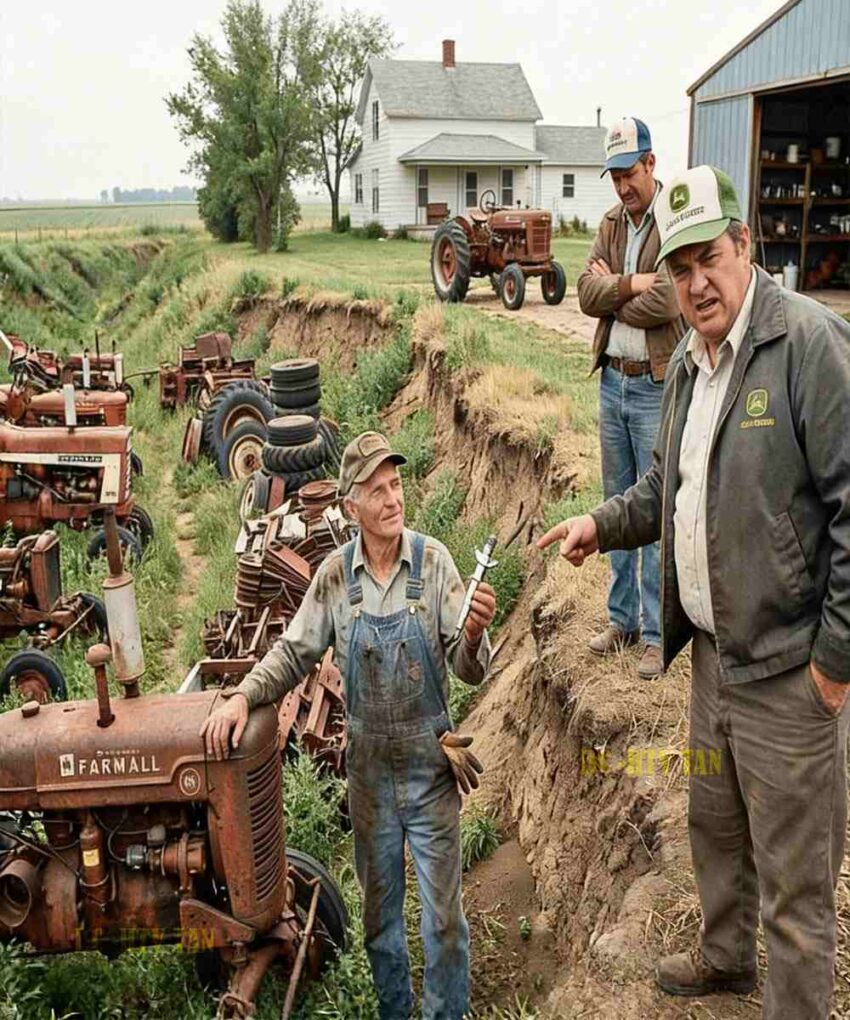
Every farmer in Harden County, Iowa, had a place where he put things that were too broken to fix and too heavy to haul away. A fence corner, a tree line, the back of the barn where the weeds grew high enough to hide what was there. It’s one of the quiet embarrassments of farming, the accumulation of failure.
A plow blade that cracked, a hydraulic cylinder that blew, an engine block that seized because someone forgot to check the oil on the wrong day. These things don’t disappear when they stop working. They sit where they die, rusting slowly, sinking into the ground, becoming part of the landscape like tombstones for machines that gave everything they had.
Most farmers hated looking at their dead equipment. It reminded them of bad seasons, bad luck, bad decisions. So they pushed it out of sight, or they hauled it to a ravine, or they called the scrap man who came through twice a year with a flatbed and paid $8 a ton for anything made of iron. But there was one farmer in Harden County who didn’t hate his dead equipment. He loved it.
He collected it. He cataloged it. He organized it with a precision that would have impressed a librarian. And for 20 years, everybody laughed at him for it. This is the story of Roy Hassel and the junkyard that saved a county. Harden County sits in the heart of central Iowa. Rich, flat black soil prairie that grows corn and soybeans the way other places grow weeds.
In 1966, the county had about 600 active farms, two grain elevators, a feed mill, a bank, a co-op, and a John Deere dealership in Eldora, run by a man named Merl Gustoson, who believed that the only good equipment was new equipment, and the only good farmer was the one writing the check. Roy Hassel was 53 years old and had farmed 240 acres on the east side of the county since 1937, the year he took over from his father, who’d taken over from his father, who’d homesteaded the land in 1879.
Three generations of hassles on the same ground, 240 acres. Never more, never less. The farm had one unusual feature, a ravine, a deep, steep-sided gully that ran for about 300 yards along the north boundary of the property, carved by a creek that had long since changed course.
The ravine was maybe 40 ft wide and 20 ft deep, too steep to plant, too rocky to graze, too irregular to do anything useful with. It was, by any farmer’s estimation, wasted ground. Royy’s father had used it as a dump. When a piece of equipment died, it went into the ravine. By the time Roy took over the farm, there were already a dozen pieces of machinery down there.
A horsedrawn cultivator from the 1910s, two farm all regular tractors from the 30s, a threshing machine frame, various plows and harrows, iron ghosts of his father’s farming life. Most men would have called the scrap dealer and cleared it out. Roy did the opposite. He started adding to it, not randomly, not carelessly. Roy Hassel had a system.
It started in ‘ 66 with a neighbor named Carl Hinton who’d bought a new John Deere 420 and wanted to get rid of his old Farmall 460. The 460 had a cracked block unusable as a tractor. Carl was going to pay the scrap man to haul it away. Don’t scrap it, Roy said. Bring it to my place. I’ll take it. Carl looked at him like he’d offered to adopt a dead cat. Roy, that tractor’s junk.
The blocks cracked. It’s not worth fixing. I don’t want to fix it. I want the parts. The hydraulic pumps good. The PTO shaft is good. The rear end’s good. The gauges, the seat, the steering column, the fuel injector, the water pump, all good. One cracked block doesn’t make a tractor worthless.
It makes 90% of the tractor worth saving. Carl shrugged. Hauling the farm all to Roy’s ravine was easier than waiting for the scrap man. He delivered it the next Saturday. Roy spent that weekend taking the 460 apart. Not smashing it with a sledgehammer, disassembling it carefully with wrenches and a shop manual.
He pulled every salvageable part, cleaned it, labeled it with a grease pencil on a strip of masking tape. Make, model, part name, condition, and stored it in his barn. The hydraulic pump went on a shelf. The PTO shaft hung on a wall hook. The fuel injector went in a coffee can labeled IH460 injectors.
The water pump went in a box labeled IH Water Pumps 30460 series. The empty carcass of the tractor frame cracked block sheet metal went into the ravine organized the frame on one side the sheet metal stacked flat the block standing upright next to two other blocks from his father’s tractors and that was how it started.
Word spread not through any effort by Roy. He wasn’t the kind of man who advertised it spread the way everything spreads in farm country. One neighbor told another who told another who mentioned it at the co-op. Roy hassles taking dead equipment. Anything you don’t want, bring it to him. He’s got a ravine. Within 2 years, farmers from across the township were bringing their broken, obsolete, worn out machinery to Royy’s farm. A combine header with bent teeth.
A grain drill with a seized gearbox. A manure spreader with a rotted floor. Two more tractors. A farm. small H with a blown head gasket and an Oliver 70 with a cracked manifold. A hay balor that had been sitting behind a barn for 12 years. Three plows with broken shares. An entire set of cultivator shovels from a field cultivator that nobody made parts for anymore. Roy took everything.
He said yes to every piece that arrived. and he spent his evenings and weekends, the hours other farmers spent watching television or sitting on the porch in his barn, disassembling, cleaning, labeling, and storing. By 1970, Royy’s barn had 412 parts on its shelves, hooks, and floor racks. He knew this because he kept a ledger, a spiral notebook with lined pages where he recorded every part by date of acquisition, source, machine, condition, and location in the barn.
412 parts organized by brand, model, and function, cross-referenced in a notebook that Roy updated every time he added or removed a piece. His wife, Dela, thought he’d lost his mind. Roy, she said one evening, watching him label a set of farm all brake shoes with strips of masking tape. We have a barn full of tractor parts and a ravine full of dead machines.
The neighbors already call this place the junkyard. When are you going to stop? When I run out of room, Roy said, “The ravine is getting full. Then I’ll start another row.” Now, let me tell you how the county reacted because the reaction is half the story. Merl Gustiffson, the John Deere dealer in Eldora, was the first to make it personal.
Merl was a salesman to his core, a man who believed that the American farmer’s job was to buy equipment, and the American dealer’s job was to sell it. Every used part that Roy pulled from a dead tractor was a new part that Merl didn’t sell. Every farmer who drove to Royy’s barn instead of Merl’s showroom was a customer lost.
Merl didn’t say this directly. Why? He said it the way small town businessmen say things sideways at the co-op. Loud enough for the right ears. Roy Hassel’s running a junkyard out there. Merl told the Saturday morning crowd at the co-op counter. I drove past yesterday and counted.
I counted 14 dead tractors, six combines, and what looked like the entire undercarriage of a 40-year-old threshing machine. It’s an eyesore. It’s a safety hazard and it’s bad for every equipment dealer in the county because every farmer who puts a used hydraulic pump on his tractor instead of buying new is a farmer who’s cheating the system.
Cheating the system was a strong phrase in farm country. It was an accusation, a suggestion that Roy was doing something dishonest by saving farmers money on parts. The co-op crowd murmured. Some nodded. A few defended Roy quietly. He’s not hurting anyone, Merl. But most stayed silent. Nobody wanted to cross the JD dealer. Merl controlled the service department, and every farmer in the county needed his service department at least twice a year. The county got involved in 73.
A complaint was filed anonymously, though everyone assumed it came from Merl’s direction about the unlicensed salvage operation on Royy’s property. The county zoning officer, a man named Dale Lungquist, drove out to inspect. Dale stood at the edge of the ravine and looked down at what was by that point approximately 30 pieces of dead equipment arranged in loose rows, plus the growing inventory in the barn.

Roy Dale said, “I’ve got a complaint that you’re running a commercial salvage yard without a permit. I’m not running a commercial anything.” Roy said, “I’m a farmer with a ravine full of equipment that other farmers gave me. I don’t buy it. I don’t advertise it. If someone needs a part and I’ve got it, I give it to them or trade for something I need.
That’s not commerce. That’s neighborly.” Dale looked at the ravine. Looked at Roy. Looked at the barn with its organized shelves visible through the open door. You’ve got more parts in that barn than most dealers, Dale said. I’ve got more parts than Merl Gustiffson, that’s for sure. But Merl charges 300% markup. I charge nothing.
What? Dale wrote something on his clipboard, nodded, and drove away. The complaint was filed as no violation found. The junkyard stayed, but the name stuck. Roy Hassel was the junkyard farmer. His ravine was the junkyard. His barn was the junk shop. When people gave directions past Royy’s place, they said, “Turn left at the junkyard.
” When Royy’s name came up at the co-op, someone always said, “You mean the junkyard man?” Roy never objected. He never defended himself. He just kept collecting, disassembling, labeling, and storing. By 1978, his notebook listed 1847 parts. The ravine held over 50 pieces of dead equipment. The barn was full, so Roy had built a second storage shed, a simple pole building with a dirt floor and more shelves to handle the overflow.
He’d also started specializing. He noticed that international harvester parts, farm all tractors, IH combines, IH implements were the most requested because IH equipment was the most common in central Iowa. So he began actively seeking out dead IH machines. When he heard about a farmer scrapping a farm all, Roy was the first call.
He’d drive his truck over, look at the machine, and almost always take it home. Not for the tractor, for the parts inside it. By 80, Royy’s collection included parts for every major farmall model from the 1940s through the 70s. the HM SuperM 300, 400, 460, 560, 650, 706, 806, 1066. He had John Deere parts, too, and Oliver and Alice Chalmer’s and Massie Ferguson, but Farmall was his specialty.
Farmall was his library and nobody cared because in 1980 you could still drive to Merl Gustiffson’s dealership in Eldora and buy a new fuel injector for a Farmall706 for $68. Why would you drive to Royy’s barn and dig through a coffee can when you could get a new part from Merurl? The answer arrived in 1982 and it arrived with the force of a tornado.
You know the story. The farm crisis. Interest rates hit 21.5%. Corn prices collapsed. Land values dropped 60%. Debt that had seemed manageable at 9% interest became catastrophic at 20. What bo to scuttle mortg between 82 and 87 300,000 American farms defaulted on their loans but there’s a piece of the farm crisis that doesn’t get told enough the part about parts When the crisis hit, the first thing farmers stopped buying was new equipment.
Tractor sales in Iowa dropped 40% between 80 and 83. Combined sales dropped 55%. Implement sales fell off a cliff. The farmers who were surviving. The ones who hadn’t been foreclosed on yet were doing it by stretching every piece of equipment they had as far as it would go. As one Iowa farmer told a reporter in 84, “All our tractors are getting a lot of age on them, but we’ll keep them a few more years.
You can put a lot of repairs into a machine for what it costs to buy.” That’s the sentence that changed Roy Hassel’s life. Because when farmers stop buying new equipment, they start fixing old equipment. And when they start fixing old equipment, they need parts. Merl Gustiffson’s dealership was dying.
New tractor sales went from 22 units in 79 to four in 83 to zero in 85. Zero. Not a single new tractor sold in Harden County in 1985. Merl survived on parts and service, but even that was shrinking. Farmers were deferring maintenance, doing their own repairs, buying aftermarket instead of genuine. In August of 85, Merl Gustiffson closed the John Deere dealership.
28 years in business. Gone. The showroom was empty. The service bay was padlocked. The parts counter, the counter where Merl had stood and mocked Roy Hassel’s junkyard for 15 years was bare. And suddenly, every farmer in Harden County who needed a part for a tractor that was 10, 15, 20 years old had nowhere to go.
The nearest remaining dealer was in Marshall Town, 45 minutes each way. And even Marshall Town didn’t stock parts for older models. They stocked parts for the machines they currently sold, which were machines nobody was buying. You know where they went instead? The first farmer showed up at Royy’s barn on a Tuesday morning in September of 85.
Jean Brewer, his farm, all 706 had a failed fuel injector, the same part that would have cost $68 at Merl’s counter if Merl’s counter still existed. Jean needed the tractor running for harvest. Harvest was two weeks away. Roy, Jean said, standing in the barn doorway, hat in his hands, looking at the shelves of labeled parts the way a man looks at a pharmacy when he’s sick.
I need a fuel injector for a 706. Merl is closed. Marshall Town doesn’t have one. They said four to 6 weeks on order. Roy walked to the back of the barn, second shelf, third row. He reached into a coffee can labeled IH76 injectors and pulled out two. Both clean, both tested, both ready. Take your pick, Roy said. How much? How much you got? Not much.
Then it’s not much. Jean Brewer paid Roy $12 for a fuel injector that would have cost 68 new. He drove home, installed it in an hour, and his 706 was running by supper time. That was Tuesday. By Friday, three more farmers had come to Royy’s barn. By the end of September, 11.
By Christmas of 85, Roy Hassel had supplied parts to 37 farmers across Harden County and two neighboring counties. fuel injectors, hydraulic pumps, PTO shafts, water pumps, alternators, starter motors, brake shoes, steering cylinders, gauge clusters, seat springs, exhaust manifolds, parts that were unavailable at any dealer within a 100 miles, pulled from machines that had been sitting in Royy’s ravine for years, cleaned and tested in Royy’s barn, and sold for whatever the farmer could afford.
The notebook tells the story. Royy’s ledger for 85 shows 142 parts distributed 63 Farmall 31 John Deere 22 Oliver 14 Alice Chalmer’s 12 Massie Ferguson Total income from part sales that year $4,800. Average price per part $33.80. Compare that to Merl Gustiffson’s dealer prices. The same parts new would have cost an average of $150 each.
Roy was saving farmers 70% and he was the only source for many of the parts because the manufacturers had stopped producing them years ago. Roy wasn’t getting rich. $33 a part 142 parts. That’s not wealth. That’s survival money. Roy was still farming his 240 acres, still growing corn and beans, still living modestly, but the parts income covered his property taxes and then some, which was more than a lot of his neighbors could say in 85.
What Roy was getting was something more valuable than money. He was getting proven right. Let me tell you about the moment it became personal. For March of 86, a pickup truck pulled into Royy’s driveway that Roy recognized but never expected to see there. A blue Ford with the faded outline of a logo on the door.
A logo that had been peeled off but left a ghost. The logo said Gustiffson implement John Deere sales and service. Merl Gustiffson got out of the truck. Roy was in the barn rebuilding a water pump for a farm. All 560. He looked up, saw Merl, and set down his wrench. He didn’t say anything. He didn’t need to.
The fact that Merl Gustiffson was standing in the barn he’d mocked for 20 years said everything. Merl looked around at the shelves, at the labeled parts, at the coffee cans and cardboard boxes, each one marked with a make, model, and part name. at the cleanliness and the organization and the system that Roy had spent two decades building while Merl had spent two decades laughing at.
“I need a steering cylinder for a 4020,” Merl said quietly. He was farming his own ground now. The land behind the closed dealership, he’d kept a John Deere 4020 for his own use. The steering cylinder had blown, and the nearest dealer who stalked the part was in De Moine, and even De Moine wanted $185 for it.
And Merl Gustiffson, the man who’d sold parts at 300% markup for 28 years, couldn’t afford $185 for a steering cylinder. Roy didn’t smile. He didn’t gloat. He walked to the second shed, pulled a tarp off a shelf, and produced a steering cylinder for a John Deere 4020. Clean, tested, ready. “How much?” Merl asked. ” $20.
” Merl reached for his wallet. His hands were shaking. “Not from cold. It was March in Iowa, but it wasn’t that cold.” His hands were shaking because he was buying a used part from the man he’d called the junkyard farmer in the barn. He’d called an eyesore. on the farm he tried to get the county to shut down. Roy took the $20 bill, folded it, and put it in his front pocket. Merl.
Roy said, “I want you to know something. I never collected this stuff to prove you wrong. I collected it because I knew I knew in ‘ 66, the same way I know what the weather’s going to do when the wind shifts, that someday someone would need what everyone else threw away. I didn’t know when. I didn’t know who, but I knew it would happen. He paused.
The thing about junk is that it’s only junk until you need it. Then it’s the most valuable thing in the room. Merl didn’t say anything. He took the steering cylinder, put it in his truck, and drove away. Roy went back to rebuilding the water pump. They never discussed it again. But Merl never called Royy’s farm a junkyard again either.
And when someone at the co-op used the word old habits die hard in farm country, Merl would go quiet and look at his coffee and say nothing. Let me tell you about the years that followed because the crisis didn’t end in ‘ 86. It got worse before it got better. And Royy’s barn got busier. 86 through 88 were the peak years were the peak years where the Roy distributed over 200 parts a year.
Farmers drove from three counties away. Some came with specific part numbers written on scraps of paper. Some came with the broken part in hand, hoping Roy had a match. Some came with nothing but a description. It’s the thing on the left side of the engine that connects to the thing that goes to the hydraulics.
And Roy, who had memorized his inventory the way a librarian memorizes a collection, would nod, walk to a specific shelf, and produce the exact part. He never turned anyone away. If a farmer couldn’t pay, Roy traded labor for parts, grain for parts, fence work for parts. One farmer paid for a complete set of break shoes for a farm, all 806 with three laying hens. Roy accepted.
Dela was happy about the hens at least. By 1988, the crisis was easing. Corn prices recovered slight. A drought in 88 actually helped. It raised commodity prices. Some farmers started buying equipment again cautiously. A new implement dealer opened in Iowa Falls, 20 mi north, carrying a limited line of KIH. But Royy’s barn didn’t slow down because something had changed in Harden County.
Something that went deeper than the crisis. Farmers had learned what Roy had always known, that used parts, properly salvaged and tested, were not just cheaper than new parts. They were often better. A fuel injector from a 1967 farm, all that had run for 10,000 hours and still worked, was in Roy’s view, a proven part.
Battle tested, reliable, with its weak points already exposed. A new injector from a box was an unknown. It might last 20,000 hours or it might fail in 200. You didn’t know until it was in the machine. Roy had been saying this since ‘ 66. Nobody listened until the crisis forced them to. Now they listened.
By 1990, Royy’s operation had grown beyond what he’d imagined. The barn held over 3,000 cataloged parts. The second shed held another 1,500. The ravine held 78 equipment carcasses arranged in rows by manufacturer Farmall on the north side, John Deere on the south, everything else in the middle. The notebook had been replaced by a set of notebooks, 12 volumes, cross-indexed, covering every part Roy had acquired, distributed, or still held.
His son, Dennis, had joined the operation in 87, the same year he graduated from high school. Dennis had grown up sorting parts the way other boys grew up, sorting baseball cards. He knew the difference between a Farmall 560 hydraulic pump and a 706 pump by feel. The weight, the fitting size, the shape of the housing.
He was 19 years old, and he could identify more tractor parts by touch than most mechanics could identify by looking. Together, Roy and Dennis turned the junkyard into something the county had never seen, a salvage operation that ran on knowledge instead of money. They didn’t have a computer. They didn’t have a storefront. They didn’t even have a phone listing until 92 when Dela finally insisted they put an ad in the county directory.
Hassle Farm Equipment Salvage used parts for all makes. Fair prices. That ad generated more calls than Roy expected and not just from farmers. A tractor collector in Minnesota called looking for a dashboard cluster for a 1949 Farmall. M. Roy had two. An agricultural museum in Nebraska needed a PTO assembly for a display tractor.
Roy shipped one free of charge. A vocational school in De Moines asked if they could bring students to Roiy’s barn to learn about equipment disassembly and parts identification. Roy said yes and spent a Saturday showing 23 VOTE students how to take apart a farm all 460 without damaging a single reusable component. The students were astonished.
They’d been trained on new equipment, computer diagnostics, electronic fuel injection, GPSG guided systems. Roy’s barn was a museum of mechanical engineering where every problem had a physical solution, and every fix required understanding how the machine worked from the inside out. Your generation fixes machines by replacing modules, Roy told the students.
My generation fixes machines by understanding them. There’s a difference. A module is a black box. You don’t know what’s inside. You just swap it. A part is a thing you can hold, measure, clean, test, and reuse. When you understand parts, you understand machines. When you understand machines, you don’t need a dealer to tell you what’s wrong.
Let me tell you about the end, because every story needs one. And this one’s ending is as quiet as the man who lived it. Roy Hassel died in 2003 at the age of 90. He’d farmed 240 acres for 66 years and collected salvage equipment for 37 of them. He’d never borrowed money for equipment. He’d never bought a new tractor.
He’d driven a succession of used farmalls, each one assembled partly from parts he’d pulled from machines in the ravine for his entire farming life. Dennis took over the farm and the salvage operation. By 2003, the inventory had grown to over 6,000 cataloged parts. The ravine held nearly a 100 equipment carcasses. The operation was known across central Iowa, not as a junkyard anymore, but as a salvage yard, a parts source, a place where farmers went when nobody else could help.
In 2008, the De Moines Register ran a feature story about Dennis and the salvage yard. The headline read, “The farm that saves farms, how one Iowa family’s junkyard became the Midwest’s last resort for tractor parts.” The story mentioned Roy. It mentioned the ravine. It mentioned Merl Gustiffson and the closed dealership in the crisis and the farmers who came with empty hands and left with the parts that kept their equipment running.
And it mentioned the coffee cans, the labeled coffee cans on the barn shelves, each one containing small parts sorted by make and model. Each label written in Royy’s neat hand with a grease pencil on masking tape. The reporter counted the cans. There were over 400. She opened one at random. IH560 thermostat housings.
Inside were six thermostat housings. each one clean, each one tested, each one waiting for the day someone needed it. The reporter asked Dennis what his father would have thought about the article. He’d have thought it was a waste of newspaper ink, Dennis said. He didn’t collect parts for attention.
He collected them because he couldn’t stand watching good iron go to waste. Every piece of metal that went to the scrap man was a piece of metal that some farmer someday was going to wish he had. Dad just made sure it was here when they needed it. The reporter asked one more question. What’s the most valuable thing in the barn? Dennis thought about it.
Then he walked to the original shelf. Shelf one, row one. The first shelf Roy had organized in 196. He pulled down a coffee can labeled IH460 injectors. The first can Roy had ever labeled from the first tractor he’d ever salvaged Carl Hinton’s farm. All 460 with the cracked block that can still had one injector in it. The last one. This Dennis said holding it up.
Not because of what it’s worth, because it’s where it all started. But one man looked at a dead tractor and saw parts instead of junk. That’s the whole story. The salvage yard is still running. Dennis’s son, Kyle, the third generation, joined in 2016. The ravine is full. The barn is full. The second shed is full.
They’ve built a third building. The notebooks have been transferred to a computer, but Dennis keeps the originals in a fireproof cabinet in the farmhouse. 12 volumes of Royy’s handwriting. A complete record of 37 years of saving what everyone else threw away. And every week, a farmer drives up the lane, parks beside the ravine that everyone used to call the junkyard, walks into the barn, and asks for a part that nobody else in the state of Iowa can provide.
The answer is almost always yes, because Roy Hassel spent 20 years collecting what everyone laughed at. He spent 20 years being called the junkyard farmer, the junkyard man, the guy with the eyesore on the North 40. He spent 20 years filling coffee cans with parts that had no value until the day they had all the value in the world. The dealer laughed.
The county complained. The neighbors shook their heads. But the barn is still full. The parts are still labeled. And the farmers are still coming. That’s what happens when a man sees treasure where everyone else sees.