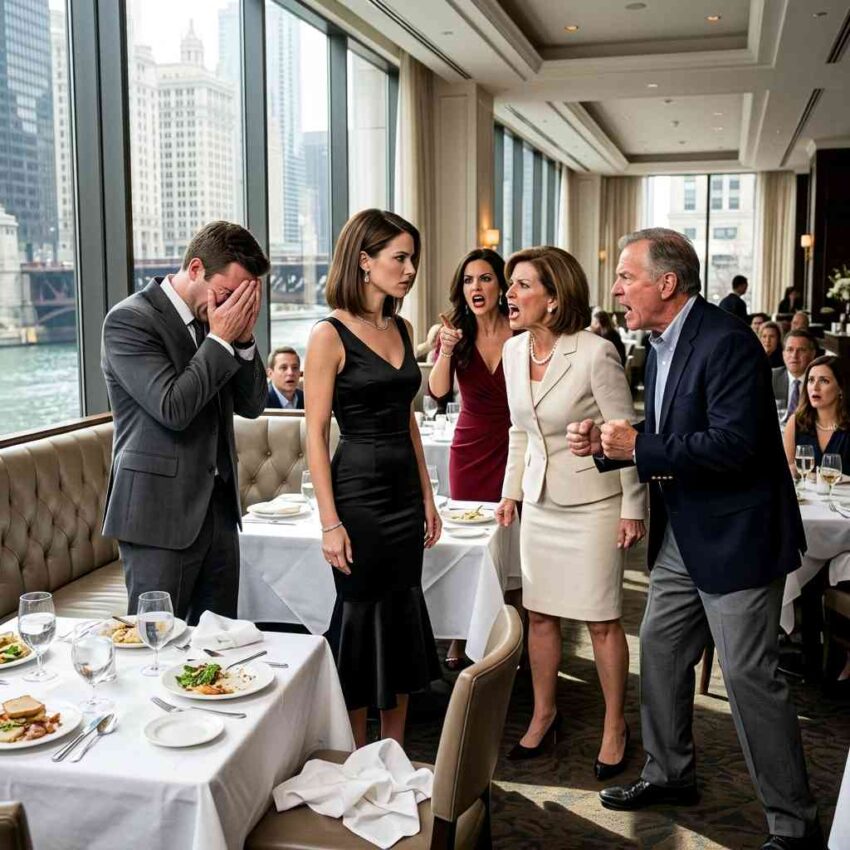
By the time the Parker family arrived at Marlowe House, I had already spent six hours on-site, but none of them knew that. To them, I was still just Ethan’s wife, the woman they treated like unpaid staff at every family gathering. His mother, Diane, had a way of handing me tasks without ever asking. His sister, Vanessa, liked to smile while cutting me down. And his father, Richard, barely looked at me unless he needed something refilled.
That night, they swept into the private dining room in downtown Chicago as if they owned the place.
“Claire, can you check whether they have my sparkling water brand?” Diane asked before she even sat down.
Vanessa slid her designer coat into my arms. “And hang this up carefully. It wrinkles.”
Ethan didn’t stop them. He adjusted his cufflinks, glanced at me, and said, “Can you also make sure Dad gets the corner seat? You know how he is.”
I took the coat. I moved the chair. I smiled at the server who recognized me and quickly looked away, understanding the arrangement. For eight months, I had kept my acquisition of Marlowe House quiet—silent partner on paper, controlling owner in practice after buying out a struggling hospitality group with money I had earned long before I met Ethan. Only my attorney, the general manager, and the head chef knew the full details. I had not told Ethan because I wanted one clean look at who he and his family were when they believed I had nothing to offer them.
By appetizers, I had my answer.
Diane sent back her lobster bisque for being “too warm.” Richard snapped at a busser for pouring wine before he tasted it. Vanessa laughed when she saw me speaking softly with one of the servers.
“Oh my God,” she said, loud enough for the whole table. “Claire’s making friends with the staff again. You always look so natural doing service.”
Ethan chuckled. “She likes staying busy.”
I looked at him for a second too long. He noticed, then looked away.
The dinner grew more extravagant by the minute: dry-aged ribeye, Alaskan king crab, reserve Napa cabernet, desserts no one finished. Richard ordered a second bottle just because the first had “opened up nicely.” Diane declared this was the only restaurant in the city “still worth proper money.”
When the leather bill folder finally arrived, Richard reached for it with the smug generosity of a man expecting praise for spending lavishly. He opened it, frowned, then blinked. The receipt was blank except for one line:
Please wait. The owner will address your table personally.
Vanessa laughed. “What is this, theater?”
Before anyone could say more, I stepped out of the side service corridor, no longer in my plain wrap dress and cardigan but in the black silk gown I had left in the office upstairs, the one tailored on Oak Street and impossible to mistake for anything modest. My heels clicked across the floor. The room went still.
Diane stared first at the dress, then at me. Ethan rose halfway from his chair.
I stopped at the head of the table and smiled.
“Good evening,” I said. “Everything is on the house… except for you.”
No one spoke for a full three seconds, which in that room felt longer than a prayer.
Richard recovered first, because men like him always mistook shock for authority. “What exactly is this supposed to mean?”
I folded my hands lightly in front of me. “It means your dinner tonight was complimentary. The wine, the tasting additions, the private room, the chef’s off-menu courses. Consider it a farewell courtesy from ownership.”
Vanessa let out a brittle laugh. “Ownership? Claire, stop.”
Diane looked from my face to Ethan’s, searching for the joke she assumed must be hiding there. “Ethan?”
He looked pale. “Claire… what are you talking about?”
I turned to the doorway. “Marcus?”
Our general manager stepped in immediately, immaculate in his navy suit. He carried a slim folder and the calm expression of a man who had rehearsed discretion for weeks. “Good evening, Ms. Bennett.”
Not Mrs. Parker. Not Claire. Ms. Bennett.
I saw the exact moment Diane understood this was real.
Marcus placed the folder in front of Richard, though his eyes remained on me. Inside were the restaurant’s ownership records, licensing filings, and the hospitality group restructuring agreement bearing my signature. Claire Bennett. Majority owner. Final controlling interest transferred eight months earlier.
Richard flipped through the documents and his face changed color. “This is absurd.”
“It’s legal,” I said. “Thoroughly.”
Vanessa reached across, scanning pages with widening eyes. “Since when do you have this kind of money?”
“Since before I met Ethan.”
That landed harder than anything else I had said.
Because in the Parkers’ version of my life, I had always been the lesser one. The woman from Ohio who “got lucky” marrying into a polished Chicago family. The wife who had left finance consulting after burnout and supposedly drifted into vague freelance work. What none of them had ever bothered to learn was that the boutique advisory firm I co-founded at twenty-nine had been acquired three years later. I kept my surname professionally, invested quietly, bought distressed businesses selectively, and stopped discussing money with people who measured human worth by how loudly it was displayed.
Ethan found his voice. “You bought this place and never told me?”
I met his stare. “You never asked what I actually did. You only asked whether I was free to host your parents, pick up dry cleaning, and rearrange my schedule around yours.”
“That is not fair.”
“Isn’t it?”
Diane leaned back in her chair, visibly rattled but still reaching for superiority. “Even if this is true, I don’t understand this humiliation. We’re family.”
“No,” I said. “You liked the appearance of family. What you wanted was convenience.”
Her lips tightened. “I have always welcomed you.”
“You introduced me to your bridge club as ‘Ethan’s sweet little helper.’”
Vanessa scoffed. “Oh, please, that was a joke.”
“You asked me to leave my own anniversary dinner early last year because you wanted someone to drive your friends back from the theater.”
“That was an emergency.”
“You were going to a cocktail bar.”
Vanessa opened her mouth, then shut it.
Richard threw the folder down. “So what? You set this up to embarrass us over a few family misunderstandings?”
I almost smiled. “No. I set nothing up. You behaved exactly as you always behave. The only difference is that tonight, for the first time, you did it in a room where I decide who stays.”
Then I looked at Ethan.
He had gone quiet in that specific, dangerous way of someone reviewing the last several years and finding evidence he had dismissed because it was convenient to do so. “Why tonight?”
“Because tonight was your idea,” I said. “You told me your father wanted a proper family dinner because he was considering investing in hospitality. You said I should come early and help ‘make things smooth.’ You told me not to mention money because your parents get uncomfortable if a woman appears more successful than her husband.”
Diane’s head snapped toward him. Vanessa stared. Richard’s jaw clenched.
Ethan stood up fully. “That was private.”
I held his gaze. “So was our marriage.”
Silence again.
Marcus stepped back toward the door, waiting. The servers had discreetly cleared adjacent tables; the private room was now sealed in a hush so complete that the faint clink of glassware from the main dining room sounded far away.
Diane switched tactics, voice softening. “Claire, sweetheart, there’s clearly been hurt on all sides.”
I almost admired the speed of it.
“No,” I said. “There’s been comfort on one side and endurance on the other.”
“What do you want?” Richard asked.
“The truth acknowledged.”
Vanessa crossed her arms. “You’re being dramatic.”
I turned to her. “You told people at your birthday brunch that I married Ethan because I wanted access. You said I was decorative at best and useful at worst. One of your friends repeated it to a vendor who also works events here. That came back to me.”
Her face flushed. “That was private conversation.”
“So was the way you spoke to me in my own home.”
Ethan exhaled hard. “Claire, let’s not do this here.”
“Where would you prefer?” I asked. “At home, where you stay silent? At your parents’ house, where I’m interrupted? Over text, where you send thumbs-up emojis instead of answers?”
For the first time, he looked ashamed.
I reached into the folder Marcus had brought and removed one last envelope. “Since we’re all being direct, here’s how tonight ends. Marlowe House will not be accepting future reservations from Richard Parker, Diane Parker, Vanessa Cole, or any party booked on their behalf. Effective immediately.”
Diane stood up so abruptly her chair scraped. “You cannot ban us from a public restaurant.”
“I can refuse service to abusive patrons. My legal team confirmed the language this afternoon.”
Richard glared at Ethan. “Are you letting her do this?”
That was the wrong question.
Ethan stared at the table, then at me, and I saw his answer before he spoke. “I don’t think she needs my permission.”
I nodded once. “No. I don’t.”
Marcus signaled the door staff. Not security exactly—Marlowe House was too polished for that—but two senior floor managers appeared, composed and unmistakable.
Vanessa grabbed her purse. “This is insane. You’ll regret acting like this.”
“Not tonight,” I said.
Diane looked devastated, which might have moved me if I had not seen how quickly devastation always gave way to self-protection with her. “Claire, after everything—”
“After everything,” I repeated, “I learned.”
Richard shoved back his chair and walked out first, too proud to wait. Vanessa followed, muttering under her breath. Diane paused at Ethan, expecting him to come with them. He didn’t move.
When the door finally closed, only the two of us remained in the private room, along with the scent of expensive wine and the ruins of a meal neither of us would ever forget.
Ethan looked at me as if I were a stranger.
Maybe I was.
For a while, Ethan said nothing. He stood beside his chair with one hand on the backrest, staring at the closed door through which his family had just disappeared, as though he could still choose which life followed them and which one stayed here with me.
I was the first to sit.
“Marcus,” I said quietly, without taking my eyes off Ethan, “give us the room.”
“Of course, Ms. Bennett.”
The door shut behind him. Now there was only the low amber lighting, half-finished wine, and two people facing the wreckage of a marriage that had looked polished from outside because I had done most of the polishing.
Ethan finally sat across from me. “How long have you been planning this?”
“I planned dinner,” I said. “The rest was observation.”
“You changed clothes upstairs. You had documents ready. You had staff lined up.”
“Yes.”
His mouth tightened. “So you wanted a performance.”
“No. I wanted witnesses.”
That landed.
I had learned something about Ethan during our four years together: he could talk around anything painful until the truth got tired and left the room. He was charming with colleagues, diplomatic with clients, measured with friends. But in private, whenever I raised something real—his mother insulting me, his sister using me, his father dismissing me—he softened the edges until the cut looked imaginary.
“She doesn’t mean it like that, Claire.”
“Vanessa’s just joking.”
“Dad’s old-school.”
“Why are you taking everything so personally?”
The language changed; the effect never did.
He rubbed his forehead. “You could have just told me.”
“I did tell you. Repeatedly. Not about the restaurant—about us.”
“That’s not what I mean.”
“I know.”
He leaned back, eyes fixed on me now. “Did you ever intend to tell me you owned this place?”
“Yes. When I believed you saw me as a partner instead of support staff.”
His expression flickered with anger. “That’s unfair.”
“Then be specific.”
He opened his mouth and stopped. That, more than anything, showed me how accurate I was.
I reached for my water glass, not the wine. “I built something before you. I preserved it during this marriage. I bought more after. None of that mattered to me as much as this: whether the man I married respected me when there was no audience and no advantage in doing so.”
“And you decided I didn’t.”
“I decided I no longer had to debate it.”
He looked down at the table, at the scattered dessert forks and the untouched final pour of cabernet. “I didn’t know my family was that bad.”
I gave him a long, level look. “That is the kindest lie you tell yourself.”
His jaw flexed. “So what now?”
I slid a second envelope from my bag and placed it on the table between us.
He stared at it. “What is that?”
“A separation agreement. Temporary, not yet filed with the court. My attorney drafted it two weeks ago.”
He looked up sharply. “Two weeks?”
“That was after your mother asked me to miss my own board call because her florist needed payment and you told me it would be easier if I handled it.”
“That was one thing.”
“It was never one thing.”
He didn’t touch the envelope.
Outside the private room, the restaurant continued moving with seamless grace. I had spent months shaping Marlowe House into a place where no guest saw strain, only elegance. But real life wasn’t service. It was ledger lines and patterns and decisions. It was seeing the total after years of pretending not to check the receipt.
“I’m not asking you for money,” I said. “I’m not trying to punish you. The condo is mine; I bought it before marriage and kept it separate. Your accounts stay yours. This is clean because I made sure my life stayed clean even while loving you.”
He gave a small, humorless laugh. “You prepared for me to fail.”
“No,” I said. “I prepared for the possibility that you already had.”
That was the first moment his eyes looked wet, though he would have denied it. Ethan was not cruel in the theatrical way his family could be. His damage was quieter. He outsourced courage. He let disrespect happen and called his silence peacekeeping. He benefited from my competence and called it partnership. In some ways that was harder to confront, because it always arrived dressed as reason.
He picked up the envelope at last but did not open it. “Is there anything I can say right now that changes this?”
I considered lying. It would have been kinder for one minute and crueler for every day after.
“No.”
He nodded once, slowly, like a man signing something internally before the paper appeared.
When he stood, it was without drama. No raised voice, no broken glass, no desperate speech. Just a long exhale and the visible collapse of the version of himself that had assumed I would continue absorbing what he refused to confront.
“At least answer one thing honestly,” he said.
“I will.”
“Did you ever love me?”
I met his eyes. “Yes. That’s why this lasted as long as it did.”
He accepted that with a stillness I had never seen in him before. Then he tucked the envelope under his arm and walked to the door. His hand rested on the handle for a second.
“I really didn’t think you’d leave.”
I believed him. That was the tragedy.
“You should have,” I said.
After he left, Marcus returned only when I called for him. The staff reset the room. The tablecloth was changed, the glasses cleared, the candles straightened. By ten-thirty, there was no evidence of the Parkers except a signed incident log and a reservation blacklist entry in the system.
Near midnight, after the last guests departed, I stood alone in the main dining room wearing the black silk dress and looking over the room I owned outright, openly, finally. The chandeliers reflected in the polished stemware. The city lights beyond the front windows shimmered over wet pavement. It was quiet, but not empty.
For the first time in years, neither was I.