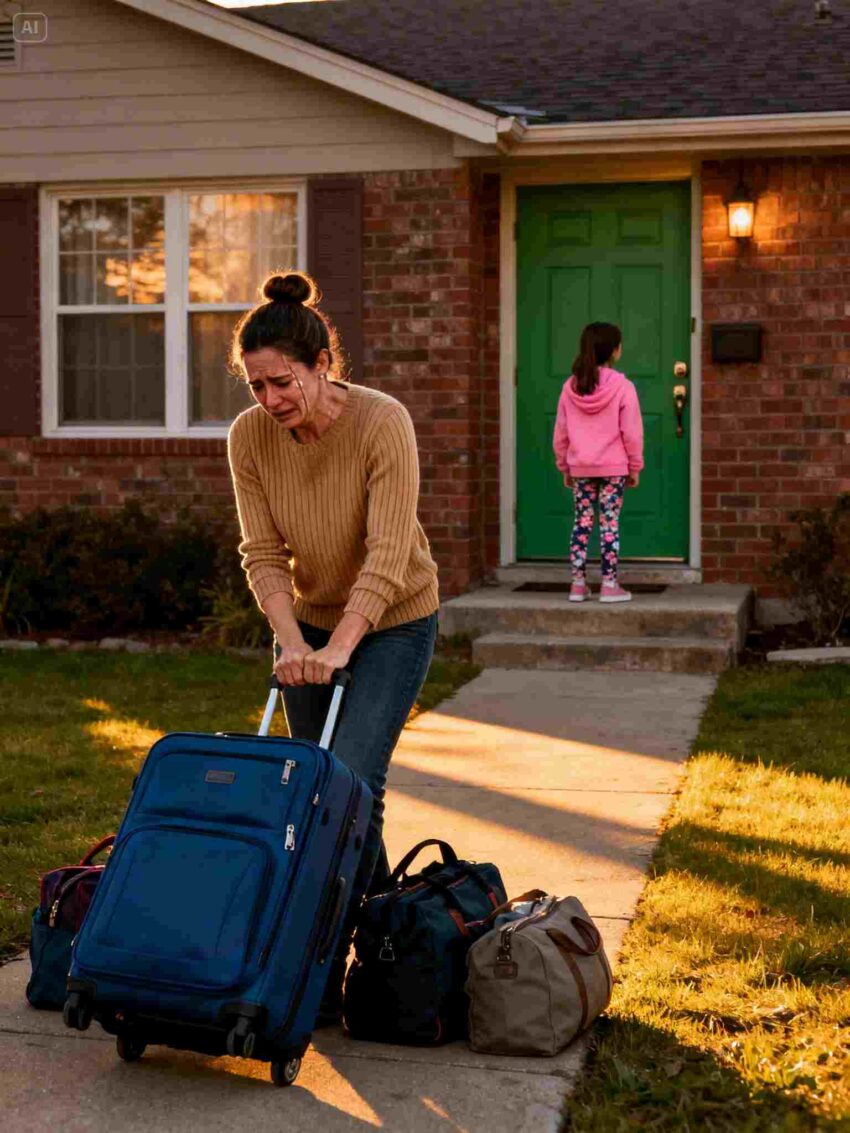
By the time the sun pushed a pale strip of light across the kitchen floor, I had already convinced myself the hardest part of the week was over. Derek had left before dawn for what he casually called a routine business trip, and I was standing at the sink, rinsing coffee grounds from a mug, trying to enjoy the thin, uneasy quiet that always followed one of our arguments.
The house should have felt peaceful. Instead, it felt strangely hollow, as if the walls were holding their breath and waiting for something I could not yet see.
Derek and I had not been good for a long time, though from the outside we probably still looked like a normal suburban family. We had the tidy two-story house, the polished kitchen, the smiling Christmas cards, and a six-year-old daughter with soft brown curls and a laugh that could still make me believe life was salvageable.
But behind closed doors, the distance between us had been growing for months. Conversations turned into cold silences, cold silences turned into sharp remarks, and sharp remarks turned into the kind of marriage where every ordinary moment felt loaded with tension.
Lately, Derek had been different in ways I kept trying to rationalize. He took more private phone calls, spent longer hours behind locked doors, and started treating our smart home system with an almost obsessive interest, as if he enjoyed controlling the lights, the locks, the cameras, the thermostat—every small function that made the house feel less like a home and more like a machine he alone understood.
When I asked about it, he always smiled in that tired, patient way that made me feel foolish for even bringing it up. “It’s just security, Audrey,” he would say. “You worry too much.”
That morning, I was still trying to believe him. Then Sadie walked into the kitchen barefoot, wearing her favorite pale blue pajama shirt, and one look at her face erased every comforting lie I had been telling myself.
She was white as paper. Her lower lip trembled, and her wide eyes looked far too old for six.
“Mommy,” she whispered, so softly I almost thought I imagined it. “We have to leave right now, because something very bad is going to happen.”
My hands froze above the sink while the faucet kept running. Water streamed over my fingers and into the porcelain basin, but all I could hear was the strange tremor in my daughter’s voice and the sudden pounding of my own heart.
I turned around slowly, trying to put on the kind of smile mothers wear when they want to protect their children from their own fear. “Sweetheart,” I said, keeping my voice gentle, “why would we need to leave so suddenly when everything is perfectly fine?”
Even as I said it, the words felt false. Nothing about Sadie’s expression looked like a child inventing a story to avoid breakfast or make a game out of an ordinary morning.
She clutched at the sleeve of her pajama shirt so tightly that her little knuckles turned pink. There were tears in her eyes, but she was holding them back with the fierce effort of someone who believed crying would waste precious time.
“We do not have time to talk about it slowly,” she whispered. “Daddy was talking to someone late last night, and I heard things that made me very scared.”
Something cold moved through me then, quick and sharp. Derek’s late-night phone calls had become so common that I had stopped asking about them, telling myself they were probably about work, about money, about the business pressure he always claimed was suffocating him.
I dried my hands on the dish towel without taking my eyes off her. “What exactly did you hear, Sadie, and why are you shaking like this?”
Her gaze flicked toward the hallway, then toward the ceiling, as if she believed the house itself might be listening. When she spoke again, each word came out slowly, like she was forcing herself to repeat something she wished she had never heard.
“Daddy told a man that everything was ready,” she said. “He said today was the day when it would all be finished.”
For a second, I could not process the sentence. The word finished hovered in the air between us, vague and ugly, and my mind rushed to reject what my body had already understood.
“Finished?” I echoed. “Finished what, baby?”
Sadie stepped forward and grabbed my wrist with a small, damp hand. I could feel the panic in her grip, and it was so real, so physical, that denial became impossible.
“He said it had to look like an accident,” she whispered, and then her voice broke. “So nobody would ever question anything.”
The room seemed to tilt. One moment I was standing in my kitchen, and the next I felt as if I were falling through the floor of my own life, every memory of Derek rearranging itself into something darker and more frightening.
A dozen explanations flashed through my mind, each weaker than the last. Maybe Sadie had misunderstood. Maybe she had only heard fragments. Maybe there was some other context, some harmless meaning, some reason the man I married would never put his wife and child in danger.
But none of those excuses survived the look in her eyes. Children can imagine monsters, yes, but they do not fake that kind of terror.
“Okay,” I said, though my voice shook so badly the word barely sounded human. “Okay, sweetheart. We are leaving right now, and you are going to stay very close to me.”
Something changed inside me then, something primal and merciless. I stopped being a confused wife and became exactly what fear had called into existence: a mother trying to get her child out alive.
I moved through the house with frantic purpose, forcing myself not to run, because running would mean losing control. I grabbed my purse, my wallet, my identification, Sadie’s inhaler from the bathroom cabinet, a roll of cash I had hidden in an old recipe tin, and the small backpack she used for school.
Every second felt loud. Every sound felt exposed.
Behind me, Sadie hovered near the front door with her arms folded tightly across her chest. She kept whispering, “Hurry, Mommy. Please hurry,” and her urgency gave shape to the panic threatening to swallow me whole.
I reached for the doorknob with my phone in one hand and my keys in the other. My fingertips had barely touched the brass when a metallic click split the silence.
The deadbolt above the handle slid into place by itself.
For half a second, I simply stared at it. Then the security panel on the wall lit up in a cold blue glow and began to emit a string of electronic beeps—the familiar sound of the smart system changing modes remotely.
Sadie made a small choking sound behind me. “Mommy,” she said, her voice cracking into a sob, “Daddy locked us inside the house with his phone.”
My stomach dropped so hard it felt like I had stepped off a cliff. Derek had installed the system himself and spent weeks bragging about how he could control everything from anywhere—locks, cameras, alarms, garage access, even the Wi-Fi network if he wanted to “troubleshoot” the system from the road.
At the time, I thought it was one of his many vanity projects. Standing there at the door, listening to that cheerful digital chirp, I realized he had built himself a cage and placed us inside it.
I called him immediately. The phone rang once, then skipped straight to voicemail.
I tried again, and this time it did not even ring. I could feel my pulse in my throat, hammering so hard it made me dizzy.
I dialed emergency services next, but the signal on my phone jumped wildly from one weak bar to none at all. I moved toward the window, lifting the phone higher, muttering under my breath for the call to connect, for someone to answer, for the universe to give me one clear line out.
“Mommy,” Sadie whispered, tugging on my sleeve, “Daddy turned off the internet last night. The TV stopped working and my tablet would not connect.”
That detail snapped everything into brutal focus. The disabled Wi-Fi, the remote locks, the fake business trip, the conversation she overheard—this was not paranoia, and it was not an argument taken too far.
It was preparation.
“Upstairs,” I said. “Quietly. No talking unless I tell you to.”
She nodded fast, tears slipping down her cheeks. I took her hand and led her toward the staircase, every creak of the wood sounding impossibly loud in the silence that had settled over the house.
We moved like intruders in our own home. I had never hated that house more than I did in those few seconds, with its open foyer and wide hallway and expensive polished surfaces that reflected light but offered nowhere to hide.
At the top of the stairs, I pulled Sadie into the master bedroom and shut the door as softly as I could. Then I crossed to the window and parted the curtain just enough to see the driveway.
Derek’s sedan was still there.
For a moment my brain refused to understand what I was looking at. He was supposed to be miles away by now, somewhere on the interstate or at an airport hotel or sitting in some bland conference room with a stale muffin and a paper cup of coffee.
But the car sat in the driveway exactly where it had been the night before, dark and still beneath the morning light. He had never left.
Sadie covered her mouth with both hands. I could hear her breathing hard through her fingers, and that soft, broken sound frightened me more than anything else in the world.
A low mechanical hum drifted up from below. One second later, the unmistakable grind of the garage door rolling open echoed through the house.
I felt every muscle in my body go rigid. Someone was coming in.
Heavy footsteps entered from below—not fast, not uncertain, but slow and deliberate. They were the footsteps of someone who believed the house had already been secured.
Sadie threw herself against me, trembling violently. I knelt in front of her and held her face between my hands, willing my own terror not to spill into hers.
“Listen to me very carefully,” I whispered. “You are going to hide in the wardrobe, and you are not coming out for anyone except me. Not for Daddy, not for a stranger, not for anybody unless I say your name clearly. Do you understand?”
She nodded, crying now in silent, shaking breaths. I kissed her forehead and guided her across the room to the wardrobe, pushing aside hanging clothes until there was space for her small body to disappear into the back corner.
Before I closed the door, she caught my hand. “Mommy,” she whispered, “is Daddy trying to hurt us?”
There are moments in life when truth and protection become impossible to separate. I looked at my little girl, at the fear on her face, and understood that whatever answer I gave would follow her for the rest of her life.
“I am not going to let anyone hurt you,” I said, because that was the only promise I had left. “Stay hidden and be brave for me.”
I eased the wardrobe door nearly shut and turned away before she could see my face break. Then I climbed onto the bed and lifted my phone toward the far corner of the window where I had once noticed the strongest signal during a storm.
One bar appeared. Then two.
I dialed emergency services again and held my breath as static crackled across the line. This time, a dispatcher answered, faint and far away, but real enough to make my knees almost give out beneath me.
“There is someone inside my home,” I whispered, fighting to keep my voice steady. “Please send officers immediately. My daughter and I are locked inside. My husband set this up. Please—please hurry.”
The dispatcher started asking questions, but I could barely hear them over the sound coming from the other side of the bedroom door.
The doorknob turned slowly.
Not rattled. Not tested. Turned—calmly, carefully, with the quiet patience of someone who expected the door to open.
I slid off the bed and backed away, pressing the phone hard against my ear. My mouth went dry, and all at once I became painfully aware of every object in the room—the lamp, the mirror, the framed wedding photo still hanging over the dresser like a cruel joke.
A man’s voice came through the wood, smooth and controlled. “Good morning, ma’am. I’m here for scheduled maintenance requested by your husband earlier.”
The lie was so clean it chilled me more than shouting ever could. No hesitation, no nervousness, no attempt to sound believable because he assumed I would be too frightened to challenge him.
“I did not request maintenance,” I said, louder now, my voice breaking around the edges. “You need to leave immediately. The police are on their way.”
Silence followed. Then came the unmistakable scrape of metal against the lock.
Not a key. Tools.
My entire body went cold. I raised the phone and whispered, “He is forcing the lock. Please, he is forcing the lock right now.”
On the other end of the line, the dispatcher told me officers were close. But close was not the same as here, and the sound at the door was getting louder, sharper, more violent with each passing second.
The lock groaned under pressure. Wood splintered somewhere near the frame.
I backed toward the wardrobe, putting myself between the door and the place where Sadie was hidden, and grabbed the heavy brass lamp from the nightstand with both hands. It was absurdly inadequate, a pathetic little weapon against whatever was coming, but gripping it gave me something to do besides collapse.
The man outside stopped working for one terrible second. Then, in a voice stripped now of all false politeness, he said, “Open the door, Audrey.”
My blood froze.
He knew my name.
At that exact moment, somewhere in the distance below us, a siren wailed.
It was faint at first, almost swallowed by the pounding in my ears. Then it grew louder, joined by another, and another, until the sound tore through the morning like a blade.
The man at the door cursed. Footsteps thundered down the hallway outside, then retreated toward the staircase in a sudden rush.
I stood there shaking, still clutching the lamp, while chaos erupted beneath us—shouted commands, pounding feet, the crash of something overturned. And in the center of it all was one unbearable realization: whoever had come into my home had not chosen us at random.
He had been sent.
I did not remember dropping the lamp. One second it was in my hands, slick with sweat and shaking so hard that the brass clinked against my wedding ring, and the next it was lying sideways on the carpet while the whole house filled with the thunder of male voices and heavy feet.
“Police! Don’t move!”
The command roared up from downstairs with such force that even the walls seemed to flinch. Then came a violent crash, the sound of a body slamming into furniture, and a hoarse shout cut short so suddenly that the silence after it felt even worse.
I stood frozen in the center of the bedroom, unable to breathe properly. My phone was still pressed to my ear, the dispatcher’s voice distant and distorted beneath the pounding of my own pulse.
“Ma’am, stay where you are. Officers are inside. Stay on the line.”
From inside the wardrobe, I heard a tiny broken sob. It was the smallest sound in the world, and it nearly shattered me.
“It’s okay,” I whispered, though my voice came out raw and thin. “Sadie, baby, it’s okay. The police are here.”
I crossed the room on weak legs and pulled open the wardrobe doors. She burst into my arms so hard that we both nearly fell, her small body trembling with such violent force that I realized she had been trying not to make a sound for far too long.
I held her against my chest and rocked her instinctively, my own fear flowing through me in cold, uneven waves. She buried her face in my neck and cried without restraint now, as if the arrival of help had finally given her permission to stop being brave.
A heavy knock sounded at the bedroom door. I flinched so hard my back hit the wall.
“Ma’am,” a firm male voice called out, calm but authoritative, “this is Officer Reynolds. We need you to state your name clearly before you open the door.”
For one terrifying second, I could not make my mouth work. I had just heard a stranger use my first name through that same door, and trust suddenly felt like a luxury I could not afford.
Then I forced the words out. “My name is Audrey Mitchell. My daughter is with me.”
There was a pause. “Mrs. Mitchell, step back from the door and unlock it if you can.”
The lock had been half-damaged by whatever tool the intruder had used, and it took me two tries to turn it. When the door finally opened, two uniformed officers stood in the hall with weapons drawn, their expressions hard and focused.
The older one, broad-shouldered with tired eyes and silver at his temples, lowered his weapon first. “Officer Reynolds,” he said. “You’re safe now.”
Safe. The word landed awkwardly, almost offensively. I nodded anyway because I did not have the strength to argue with it.
Another officer swept his gaze across the room, then toward the wardrobe, the shattered lock, the phone in my hand, and the child clinging to my body. Everything in his expression sharpened.
“Was anyone else in here with you?” he asked.
“No.” My voice cracked. “Just us.”
Officer Reynolds looked at the damaged door frame and exhaled slowly through his nose. “We’ve got one suspect in custody downstairs. EMS is on the way just to make sure neither of you is hurt. I need you to come with us now.”
I nodded again, numb and obedient. Sadie refused to let go of me, so I carried her down the stairs even though she was getting too big for it, because at that moment there was no force on earth that could have made me put her down.
The staircase that had felt like a trap minutes earlier now looked like a crime scene. One of the framed family photos had been knocked crooked on the wall. The hallway table lay overturned at the bottom landing, its drawer spilled open, keys and mail and batteries scattered across the hardwood floor.
And there, in the middle of my living room, lay the man in work boots.
His cheek was pressed against the rug. His hands were cuffed behind his back, and one officer had a knee planted between his shoulder blades while another searched his pockets and read him his rights in a clipped, practiced voice.
He looked nothing like a repair technician. His clothes were rough and dusty, his jaw covered in uneven stubble, and there was something ugly and empty in his face that made my stomach twist.
When he turned his head and looked at me, I saw no confusion there. No apology. No mistake.
Only irritation that things had gone wrong.
Sadie whimpered and buried her face in my shoulder. I turned her away from him immediately, but the image had already burned itself into my mind.
Officer Reynolds stepped closer, his tone gentler now. “Mrs. Mitchell, I’m going to ask you a difficult question. Do you know this man?”
“No.” The answer came fast and absolute. “I have never seen him before in my life.”
One of the younger officers looked up from the suspect’s phone. “His name is Leonard Pike,” he said. “Record’s not clean. Prior assault, two burglary charges, one weapons offense. He had lock tools, latex gloves, and instructions saved in his messages.”
My knees nearly buckled. “Instructions?”
Nobody answered me immediately, which was answer enough.
Officer Reynolds guided me toward the dining room chair with a hand hovering carefully near my elbow, as if he thought I might collapse. He was probably right.
“Sit down,” he said. “Just for a second.”
I sat because my legs no longer seemed interested in negotiating. Sadie remained on my lap, her arms looped so tightly around my neck that it hurt.
The house smelled wrong now. Beneath the familiar scents of coffee and laundry detergent was the bitter tang of adrenaline, sweat, and something metallic that reminded me of fear made physical.
EMS arrived a minute later, but I barely registered them. A woman in navy scrubs crouched to Sadie’s level and spoke softly, asking if anything hurt, if anyone had touched her, if she could take a look at her hands because she might have splinters from the wardrobe door.
Sadie answered in tiny nods and whispers. She did not let go of me once.
Officer Reynolds stayed nearby until the paramedics finished their preliminary checks. Then he pulled out a small notebook, glanced at the officers securing the scene, and finally sat across from me.
“Mrs. Mitchell,” he said, “I need to understand exactly what happened before we arrived. Start with whatever made you call.”
I looked down at Sadie, then back at him. The words felt unreal in my mouth, but once I started, they would not stop.
I told him about Derek’s supposed business trip. I told him about Sadie entering the kitchen with terror in her eyes. I repeated the conversation she had overheard the night before—the part about everything being ready, the part about today being the day, the part about it needing to look like an accident.
When I said those words out loud, I heard one of the officers behind Reynolds mutter something under his breath. Another officer paused in the middle of bagging evidence and looked toward me with open disbelief.
Then I explained about the deadbolt locking itself. The security panel lighting up. The failed calls. The internet going down. The garage opening. The footsteps entering the house.
By the time I got to the stranger calling himself maintenance, my hands were shaking so badly that Officer Reynolds quietly reached over and set a glass of water on the table in front of me. I did not remember anyone bringing it.
When I finished, there was a long silence.
Officer Reynolds closed his notebook carefully. “And your husband, Derek Mitchell, is supposed to be out of town right now?”
“Yes.”
“But his car is in the driveway.”
“Yes.”
He studied me for a second, not skeptically, but as if measuring the full weight of what I had just handed him. “Did he have access to the security system and internet controls?”
“He set the whole thing up himself,” I said. “He controlled everything. He liked reminding me of that.”
The officer’s face changed very slightly at those words. He leaned back in his chair and looked toward the hallway where evidence technicians were now photographing the splintered bedroom lock.
Then he said the sentence that made the room go cold again.
“We discovered messages on Leonard Pike’s phone. They appear to include specific entry instructions, timing notes, and directions on how to avoid the front camera angle.”
I stared at him.
“There are also references,” he continued slowly, “to a payout after the job was completed.”
The world narrowed until all I could hear was the faint electrical buzz of my own kitchen lights. “Are you telling me my husband hired that man?”
Officer Reynolds did not answer immediately. He chose his words with painful care, which somehow made them worse.
“I’m telling you,” he said, “that we are looking very seriously at the possibility that your husband was involved in arranging this.”
Sadie lifted her head then, her tear-streaked face crumpled with confusion. “Mommy,” she whispered, “is Daddy in trouble?”
The question split me open.
I brushed the curls away from her wet cheeks and kissed her forehead because I needed a second before speaking. “Daddy made some very bad choices,” I said softly. “And the police are figuring out what happened.”
She looked down at her hands. “I told you because I didn’t want you to die.”
For a moment, nobody in the room moved. The paramedic near the hallway looked away. One of the officers clearing the entry table stopped writing and pressed his lips together so tightly that the skin around his mouth whitened.
I pulled Sadie into me and held her like she was the only solid thing left in the world. “You saved us,” I whispered into her hair. “You hear me? You saved us.”
Her shoulders shook with fresh sobs. Mine did too.
Officer Reynolds rose from the chair and took a slow breath. “Mrs. Mitchell, do you have family nearby? Friends? Somewhere safe you can stay tonight?”
The question should have been simple, but my mind snagged on it. My parents were in Arizona for the month. My older sister lived in Oregon. The few friends I trusted had drifted to the edges of my life over the years, squeezed out by marriage, motherhood, and Derek’s constant ability to isolate me without ever making it look deliberate.
Then one name came to me.
“My friend Tessa,” I said. “She lives twenty minutes away.”
He nodded. “Good. We’ll help arrange that. But first, I need to ask one more thing.” He glanced toward the front window. “Before we brought the suspect out, one of our officers believed he saw a man standing across the street. Mid-thirties, dark jacket, holding a phone. By the time the officer moved outside, the man was gone.”
My skin went ice cold.
I stood so quickly the chair legs scraped against the floor. “Derek.”
Reynolds’s eyes sharpened. “You’re certain?”
“I didn’t see his face clearly from upstairs, but I know his build. I know the way he stands.” My voice trembled with fury now, not just fear. “He was watching.”
The officer swore quietly under his breath and spoke into the radio clipped at his shoulder. Within seconds, the calm inside the house fractured into renewed urgency. More descriptions. More movement. More officers stepping outside and scanning the street.
But I already knew he was gone.
That was Derek’s gift. He was always gone by the time the damage surfaced. Gone behind explanations, gone behind charm, gone behind your own desire to believe you had misunderstood him.
A forensic technician approached the dining room carrying a sealed evidence bag. Inside it was a burner phone, old and cheap, the kind you bought with cash if you did not want your name attached to anything.
“This was in Pike’s jacket pocket,” the technician said to Reynolds. “Recent calls to one unsaved number. We’ll trace it.”
Reynolds nodded, but I saw the frustration in his face. A man like Derek would not rely on one mistake. He would have planned for disposable numbers, false trails, excuses ready before anyone asked for them.
And yet, for the first time in years, his control had cracked.
The officers stayed another two hours. They photographed the locks, downloaded the security system data, collected the home router, documented the disabled network settings, and took statements from both me and Sadie in the gentlest way they could. A child advocate arrived before noon, a kind woman named Melissa with warm brown eyes and a soft cardigan, who knelt beside Sadie and explained that brave kids sometimes had to talk about scary things so grown-ups could stop bad people.
Sadie sat on the couch wrapped in a blanket and answered every question. Not dramatically. Not theatrically. Just plainly, the way children tell the truth when they do not yet understand how adults complicate it.
She described waking in the night because she wanted water. She described passing the upstairs landing and hearing Derek downstairs in his office. She described his voice sounding strange—lower, colder, almost excited.
And then she repeated the words she remembered: everything was ready. today was the day. it had to look like an accident.
I watched every person in that room change as she spoke. Whatever uncertainty had lingered before began to die there, sentence by sentence, under the clear, trembling testimony of a six-year-old child.
By early afternoon, Officer Reynolds approached me again. “We’re taking Pike in. He’s lawyered up already, but his phone is a problem for him, and the house data is a problem for your husband.”
“My husband,” I repeated. The phrase sounded obscene now.
Reynolds lowered his voice. “We haven’t located Derek yet, but there will be a warrant request. Based on what we have, that process is moving quickly.”
A laugh escaped me then—sharp, humorless, almost unrecognizable. “He always said I was too emotional. Too suspicious. Too dramatic.”
The officer held my gaze. “Mrs. Mitchell, what happened here today was not a misunderstanding.”
I nodded once. I appreciated that more than he probably realized.
Before leaving, I asked for five minutes alone in the house. Reynolds hesitated, then agreed, stationing an officer by the front door while the others continued outside.