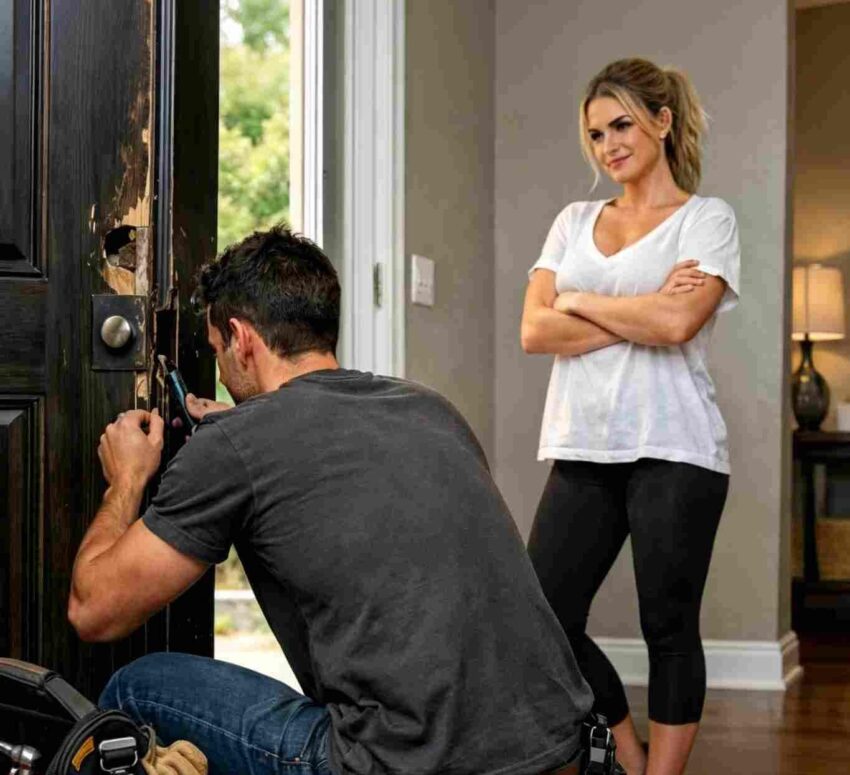
By the time Derek Vaughn started slamming his shoulder into Megan’s repaired front door, Mia was already under the kitchen table with her hands over her ears.
The first hit shook the frame hard enough to rattle the cheap picture glass in the hallway. The second made the deadbolt groan in deep metal protest. By the third, Glenn from management was outside in the corridor yelling, “Back away from the door!” like that had ever worked on a man who came fueled by humiliation and beer.
I was standing inside apartment 12 with a dish towel in one hand and spaghetti sauce still on my wrist, listening to the same lock I had fixed weeks earlier fight to hold.
“Mom,” Mia cried from under the table, “is he gonna come in?”
Megan moved toward her daughter on instinct, but I caught her arm first.
“No,” I said.
I didn’t say it gently. I said it like a promise.
Outside, Derek shouted, “I know he’s in there! You got some maintenance clown playing house with my kid?”
Another hit.
The wood bowed but didn’t split.
That mattered more than anyone in that apartment probably understood except me.
Megan’s face had gone white in the way I’d come to recognize—not panic, not exactly, but the body remembering old fear faster than the mind could argue with it. She grabbed her phone off the counter with shaking fingers. I could tell by the way she was breathing that she was fighting three instincts at once: to hide, to apologize, and to make the whole thing smaller than it was so nobody else would have to deal with it.
That was one of the things abuse did. It taught the wrong person to manage the aftermath.
“Call 911,” I told her.
Glenn was still in the hallway now, voice high and angry. “You’re trespassed from this property, Derek! Cops are already on the way.”
Derek laughed. That ugly, reckless kind of laugh drunk men got when they believed noise itself counted as power.
Then he yelled, “Megan, if he’s sleeping there now, I’ll make sure that kid gets taken from you.”
Mia made a sound from under the table I hope I never hear again as long as I live.
Megan flinched like somebody had hit her straight in the spine.
That was the moment all the pieces in my head locked together—the fake lease complaints, the stories he fed the office, the sudden concern for “community safety,” the way he kept trying to paint her as unstable and reckless while he stalked the hallway like he paid rent there. He was not trying to get back together. He was trying to ruin the ground under her feet until gratitude and fear looked like the same thing.
The deadbolt held through another slam.
I looked at that door and felt something hot and strangely calm move through me.
Weeks earlier, I had been crouched by that same lock with my tool bag open at my feet, telling myself this was just another repair in another old building full of ten-minute problems. Now I could hear the longer screws biting deep into the wall studs every time the frame shuddered. I could hear the reinforced strike plate taking the force instead of surrendering it.
Not perfect.
But solid.
Just like I had promised Mia.
Police sirens started outside, sharp and close.
Derek must have heard them too because his voice changed. Men like that always turned when real consequences got near.
“You think this is over?” he shouted. “You think this guy’s gonna stay when it gets ugly?”
I looked at Megan.
She looked back at me, and even in that moment—Mia crying, Glenn shouting, the hallway echoing with one more performance from a man who had mistaken intimidation for love—there was a question in her face older than the night itself.
Would a guy like you ever really date a single mom?
She had asked me that the first day I met her, standing in this same apartment with her daughter wrapped in a blanket on the couch and a cracked doorframe between us and the hallway.
I hadn’t understood then how big that question really was.
I did now.
Outside, officers were coming up the stairs two at a time.
Inside, Mia crawled out from under the table and launched herself straight at Megan, who dropped to her knees and held her so tightly it almost hurt to watch.
And me?
I stood there with a dish towel in one hand and the whole truth in my chest.
Because by then, apartment 12 was no longer just a work order, and Megan Kelly was no longer just the woman behind a broken lock.
She was the woman I loved.
And that door?
That door was the first thing I ever fixed for my family.
Six weeks earlier, I had no idea any of that was coming.
All I knew was that old doors in the building swelled, sagged, split near the hinges, and made trouble in slow boring ways. The brick place had been built in the fifties and renovated just enough times to become a collection of temporary solutions pretending to be permanent. I spent most of my days dealing with leaky traps, buzzing light fixtures, bent closet tracks, and tenants who reported “strange wall noises” that turned out to be mice with bad timing.
Front door damage on 12 didn’t sound remarkable.
It should have.
When I got upstairs, the first thing I noticed was the frame. Not old damage. Fresh damage. The wood around the latch was cracked open in a ragged crescent, and the strike plate was hanging by one screw like it had changed its mind halfway through falling out. There was a hard dent at shoulder height on the outside jamb too, not from weather, not from age. From force.
My tool bag hit the floor.
I crouched by the lock and ran a thumb over the split wood. It gave a little under pressure, soft with damage that hadn’t settled yet.
The apartment door opened wider behind me, and a woman’s voice said, “It still closes. You don’t have to make it perfect.”
That told me almost as much as the frame.
People only said things like that when they were worried about money, trouble, or somebody coming back before the repair was even finished.
I looked up.
She was pretty, but not in the polished, trying-to-be-seen way some women were. More like life had cut everything unnecessary right off her. Blondish-brown hair tied back fast. Oversized T-shirt, soft from too many washes. No makeup I could see. Tired eyes. Careful posture. One hand wrapped around the other wrist like she was keeping herself in place by force.
Past her, on the couch, a little girl sat under a blanket even though the apartment was warm.
I glanced back at the lock.
“I should at least make it lock right,” I said.
She gave one short nod. “Okay.”
I started taking the damaged plate off. The wood crumbled around one of the screws.
“Did management tell you what happened?” she asked.
“No. Just front door damage on 12.”
She let out a dry little laugh that wasn’t really a laugh. “Sounds cleaner that way.”
I didn’t answer.
In that building, silence usually got filled fast. Lonely people filled it because they wanted company. Angry people filled it because they wanted witnesses. She didn’t seem like either. She seemed embarrassed.
That was worse.
The little girl looked over at me. I gave her a quick smile. She didn’t smile back, but she stopped looking scared for half a second.
“Your daughter?” I asked.
“Yeah. Mia.”
“I’m Noah.”
The woman answered, “Megan.”
Then it went quiet except for the sound of my drill and the low cartoon noise coming from the TV.
I pulled the old strike plate, measured the split, checked the bolt alignment, and saw right away I’d need longer screws, wood filler at minimum, maybe a reinforcement plate if I could get one from storage. The deadbolt still turned, but the frame itself had taken a beating.
The whole time, I could feel Megan standing a few feet away like she wanted to say something and kept changing her mind.
Finally, she said, “He didn’t get in.”
I glanced back at her.
She had her arms folded tight. “I’m only saying that because I know what this looks like.”
I set the drill down.
“It looks like somebody got angry at your door,” I said.
Her face changed when I said it plain. Not softer. More relieved.
https://googleads.g.doubleclick.net/pagead/ads?gdpr=0&client=ca-pub-3619133031508264&output=html&h=280&slotname=9516160883&adk=2565490715&adf=1358072041&pi=t.ma~as.9516160883&w=832&fwrn=4&fwrnh=100&lmt=1775154428&rafmt=1&format=832×280&url=https%3A%2F%2Fus.anuongdungsongkhoe.com%2Fhoangduckok%2Fi-was-fixing-the-broken-lock-on-a-single-moms-apartment-door-when-she-asked-me-the-one-question-no-one-had-ever-answered-honestly-and-neither-of-us-knew-her-violent-ex-a-terrified-li-1%2F&fwr=0&fwrattr=true&rpe=1&resp_fmts=3&aiof=9&asro=0&aiapmd=0.0001&aiapmid=1&aiactd=0&aicctd=0&ailctd=0&aimartd=4&aieuf=1&aicrs=1&uach=WyJXaW5kb3dzIiwiMTkuMC4wIiwieDg2IiwiIiwiMTQ2LjAuNzY4MC4xNjUiLG51bGwsMCxudWxsLCI2NCIsW1siQ2hyb21pdW0iLCIxNDYuMC43NjgwLjE2NSJdLFsiTm90LUEuQnJhbmQiLCIyNC4wLjAuMCJdLFsiR29vZ2xlIENocm9tZSIsIjE0Ni4wLjc2ODAuMTY1Il1dLDBd&abgtt=6&dt=1775154420897&bpp=1&bdt=4141&idt=1&shv=r20260401&mjsv=m202603260101&ptt=9&saldr=aa&abxe=1&cookie=ID%3Ddc2a875baabf309d%3AT%3D1775154419%3ART%3D1775154419%3AS%3DALNI_MZCCMDaeANKQPylzJXJsstmcD3zzA&gpic=UID%3D000013b99f871cf6%3AT%3D1775154419%3ART%3D1775154419%3AS%3DALNI_MY4peE_XBy84LHiomVdhCuPxYRnmQ&eo_id_str=ID%3Dda5bf045ced7a983%3AT%3D1775154419%3ART%3D1775154419%3AS%3DAA-AfjYqkT-J0Otfd0nuTvZ9kTJL&prev_fmts=0x0%2C1536x730%2C1088x280&nras=2&correlator=1971857649015&frm=20&pv=1&u_tz=300&u_his=3&u_h=864&u_w=1536&u_ah=816&u_aw=1536&u_cd=32&u_sd=1.25&dmc=8&adx=344&ady=9268&biw=1521&bih=730&scr_x=0&scr_y=6381&eid=31097487%2C31097490%2C95385799%2C95386649%2C95386951%2C95387623%2C95386957&oid=2&pvsid=407591883177212&tmod=475813807&uas=3&nvt=1&ref=https%3A%2F%2Fjournex.cupofjo.us%2Fhoangduckok%2Fi-was-fixing-the-broken-lock-on-a-single-moms-apartment-door-when-she-asked-me-the-one-question-no-one-had-ever-answered-honestly-and-neither-of-us-knew-her-violent-ex-a-terrified-li-1%2F%3Ffbclid%3DIwY2xjawQ7lDlleHRuA2FlbQIxMABicmlkETFOSVBpc2RzWU41VjFCTm9zc3J0YwZhcHBfaWQQMjIyMDM5MTc4ODIwMDg5MgABHjs83XfK6lav3nKiaNlkEQoNsUIJav1Vk7nlVaiWdXL4j6-dLu-A-GVlsfQR_aem_OibEGh-jtXUr8N5bEi-8TA&fc=1920&brdim=0%2C0%2C0%2C0%2C1536%2C0%2C1536%2C816%2C1536%2C730&vis=1&rsz=%7C%7CeEbr%7C&abl=CS&pfx=0&fu=128&bc=31&bz=1&pgls=CAEaBTYuOS40&ifi=4&uci=a!4&btvi=1&fsb=1&dtd=7319
“Yeah,” she said. “My ex.”
She looked toward the hall, not at me.
“He showed up late. Wanted to talk. I said no. He pushed it. Then after…” She swallowed. “After, he texted sorry. They always do that part fast.”
I didn’t ask for details.
She noticed that too.
“That enough for you to fix it?” she asked.
“Yeah,” I said. “More than enough.”
She leaned against the wall near the kitchen opening. “I hate when people in the building know my business.”
“I’m maintenance,” I said. “I know everybody’s business for about ten minutes at a time.”
That got a real smile out of her. Small, quick, but real.
“Then you leave?” she asked.
“Usually.”
I installed the new plate and swapped in longer screws. Then I had to shave a little wood so the deadbolt would line up clean. Mia got off the couch by then and wandered closer, barefoot, blanket dragging behind her.
“Is it fixed?” she asked.
“Almost.”
She looked at the busted edge of the frame with serious kid eyes. “Can he break it again?”
Megan shut her eyes for one second like that question hurt more than anything else in the room.
I answered before she had to.
“Not like this,” I said. “I’m making it stronger.”
Mia studied me, nodded once, and went back to the couch like she had decided to believe me for now.
Megan said quietly, “Thanks.”
I kept working, but slower now because I knew this wasn’t really about screws anymore.
When I was done, I opened and shut the door a few times, then locked and unlocked it.
Solid.
Not new.
Not perfect.
But solid.
“There,” I said. “Reinforced frame. Longer screws. It’ll hold a lot better.”
She stepped up beside me and tried the deadbolt herself. Her shoulders dropped just a little.
“That’s the first good thing that’s happened all week,” she said.
I should have packed up and left right there.
That’s what I always did. Fix the thing. Keep moving. Don’t get pulled into somebody else’s mess.
Instead, I stayed one second too long.
Maybe she felt that, because when she looked at me again, something in her expression changed. Less guarded. More direct.
“Can I ask you something weird?” she said.
“You can ask.”
She glanced toward Mia, then back at me.
“Would a guy like you ever really date a single mom?”
No smile. No teasing tone. Nothing light in it at all.
It hit me harder than it should have because I knew she wasn’t really asking about me. Not exactly. She was asking whether her life automatically disqualified her now. Whether a woman with a tired face, a scared kid, and a busted front door still counted as a woman to anybody. Or if she had crossed over into being seen only as trouble with groceries and rent and bad timing.
I stood up and wiped my hands on a rag.
“Yeah,” I said.
She searched my face like she expected a catch.
I added, “If I wanted her, then yeah. The real answer is you date the whole reality or you don’t waste her time.”
For a second, she just stared at me.
Then she looked down and laughed once under her breath. It sounded like she might cry if she stayed in that feeling too long.
“Okay,” she said softly. “That’s more honest than I expected.”
“I’m not great at polished answers.”
“Good.”
I picked up my bag. Mia was pretending not to listen, which meant she had heard every word.
At the door, Megan said, “Thanks for not making that question feel stupid.”
“It wasn’t stupid.”
I stepped into the hallway, and she stayed there with one hand still on the lock I had fixed.
Usually after a job, I forgot the apartment before I hit the stairs.
That day, I made it all the way down to the second floor before I realized I was still thinking about the way she’d asked that question.
Like she had already been disappointed enough times to brace for one more.
And standing there in that old hallway with my tool bag in my hand, I had the feeling apartment 12 was not going to be a ten-minute problem.
After that, I started noticing her more than I should have.
That building trained you to look without really seeing. Unit numbers. Work orders. Hallway noise. Done.
But once you’d stood inside somebody’s apartment and heard a question like that, it got harder to go back to pretending they were just another door on the list.
Two days later, I was carrying a box of LED bulbs to storage when I saw Megan in the lobby trying to hold the front entrance open with her shoulder while Mia fought with a little pink backpack that had twisted halfway around one arm.
Mia saw me first.
“The door guy,” she said.
Megan looked up, and for the first time she didn’t look embarrassed. Just tired in the normal way. Morning tired. Mother tired. Real life tired.
“You gave him a promotion,” Megan said to Mia. “He has a name.”
Mia thought about that. “Noah better.”
“I’ll take it,” I said.
I set the box down and untangled the backpack strap. Mia let me do it without flinching. I noticed that right away.
Kids told you a lot without meaning to.
“Thanks,” Megan said.
“No problem.”
She adjusted a coffee cup in one hand and gave me a quick look. “Door’s still holding.”
“I used the stubborn screws.”
That got a smile out of her again.
Then she had to hurry Mia outside because the school bus was pulling up across the street.
I watched them go, and that should have been the end of it.
Instead, I stood there with the box in my arms like an idiot until Mrs. Donnelly from unit 7 asked if the laundry room was ever getting fixed.
After that, I kept running into them.
Not by accident every time, if I’m being honest.
I checked the deadbolt on 12 once because I told myself I should make sure the frame hadn’t shifted.
Then I checked it again three days later because I was already on that floor and it only took a second.
Megan opened the door with a dish towel over one shoulder and said, “You always this committed to one repair?”
“Only the memorable ones.”
She looked at me for a second like she was deciding whether to let that land.
Then she stepped aside and said, “You want coffee, or are building rules about to stop you?”
“I think I can survive one cup.”
Her apartment looked a little different that day.
Still modest, still careful, but lived in. A cartoon played low in the other room. Tiny socks were draped over the radiator to dry. A grocery list was stuck on the fridge with one item crossed out and three more added in different handwriting.
Mia was on the floor with crayons, drawing what I assumed was a cat until she informed me it was a self-portrait and looked offended on behalf of her art.
“Hi, Noah,” she said without looking up.
“Hi, Mia.”
Megan handed me a mug. “You’re getting popular in here. That seems risky.”
“It is.”
We stood in the kitchen while she leaned against the counter and I pretended I was there for door-related reasons.
Up close, I could see how worn down she really was. Not dramatic. Not theatrical. Just stretched thin.
“Do you ever sleep?” I asked.
She gave me a look. “Do you?”
“Fair.”
She stirred her coffee even though there was nothing left to stir.
“Management called me yesterday,” she said.
That changed the air right away.
“What about?”
“Noise complaints. Damage. Disruptions.” She gave a humorless little shrug. “All the stuff that gets written down when your life starts spilling into a hallway.”
I set my mug down.
“Because of him?”
She nodded once. “Mostly. But to them, mostly doesn’t matter. They’re tired of hearing my unit number.”
I didn’t like the way she said that. Too practiced. Like she’d already said it in her head twenty times and this was the calmest version she could manage.
“One more major incident,” she said, “and they can start talking lease problems.”
I looked toward the door.
“That’s not on you.”
She gave me a tired smile. “That has not been the winning argument so far.”
Mia wandered into the kitchen holding her drawing.
“Do you want to see?”
I took the paper from her. “That is the toughest cat I’ve ever seen.”
“It’s not a cat,” she said, scandalized. “It’s me.”
Megan laughed into her coffee.
And that was the first time I heard her laugh without anything heavy under it.
“Sorry,” I said. “Then you look very powerful.”
Mia accepted that and climbed onto a chair beside me. Close enough that her sock brushed my leg like it was the most normal thing in the world.
Something in me went very still.
Because it stopped being just attraction right there.
It stopped being me noticing a pretty woman with sad eyes.
A kid was getting comfortable around me. A small, ordinary kind of trust was starting in that kitchen, and I knew enough to understand that mattered.
I started coming by in little ways after that.
Replacing a loose cabinet hinge.
Carrying up a bag of groceries when I caught Megan at the stairs.
Tightening the wobble in a kitchen chair Mia said was trying to throw people off.
None of it looked big from the outside. That was probably why it worked.
One evening, I found Megan sitting on the hallway floor outside her apartment after my shift.
Not crying. Not falling apart. Just sitting there with her back to the wall and her keys in her hand like she needed one quiet minute before going inside.
“Mia asleep?” I asked.
“With my neighbor across the hall for half an hour.” She tipped her head back against the wall. “I said I had to make a call.”
“You didn’t.”
“I actually just needed to breathe.”
So I sat beside her.
The hallway smelled like old paint and somebody’s fried onions. Pipes clicked behind the wall. Upstairs, a TV was too loud. It was the least romantic place in America, which was probably why the moment felt real.
“He keeps changing tactics,” she said after a while.
I turned my head toward her.
“When showing up angry stopped working, he got polite. Then fake concerned. Then he started telling people I’m unstable. That I stir things up and then act innocent.”
“Who’s he telling?”
“Anybody who will listen.”
I didn’t know much about Derek then, only pieces. He and Megan had split up nine months earlier. He wasn’t Mia’s legal father, though he’d spent enough time acting like one when it suited him. He drank, disappeared, returned sorry, got angry when he wasn’t instantly forgiven, and treated boundaries like insults. Megan had moved into the building three months before I met her because the rent was barely manageable and because she thought being in a secured building would help.
The secured part had not gone as advertised.
The next morning, there was a printed complaint in Glenn’s office.
Not from Megan.
About Megan.
It said visitors were shouting, the environment was unsafe, the child in 12 was exposed to conflict, and neighbors were increasingly uncomfortable. It was written in that neat careful tone people used when they wanted a lie to sound responsible.
Glenn slapped the page against his desk and said, “I’m done babysitting 12.”
I read just enough to know exactly where it came from, even without a name.
And all at once, I understood this thing had moved past a damaged door.
Derek wasn’t just trying to get back into her life. He was trying to turn the building against her.
After that complaint hit the office, Megan changed.
Not all at once. She still opened the door when I knocked. Still thanked me when I brought up a package somebody had left downstairs. Still smiled sometimes.
But it was like part of her had started listening to something behind me all the time, even when the hall was quiet.
A few days later, Glenn asked me to sit in on a lease meeting because I had handled the repair on 12 and knew the timeline.
Megan was already in the office when I came in.
She looked small in the metal chair, hands folded tight in her lap. Not weak. Just tired in a way that made you angry on somebody else’s behalf.
Glenn did his usual thing. Flat voice. Too much paper on the desk. He talked about tenant responsibility, repeated disruptions, community concerns. He kept saying pattern like that word solved anything.
Megan stayed calm through most of it.
Then Glenn slid the complaint across the desk and said, “When a child is involved, we have to take this seriously.”
That was the first moment she looked like she might crack.
She didn’t.
She just swallowed once and said, “I am taking it seriously. I’m the one living in it.”
Glenn leaned back. “I need this situation to end.”
“It would end a lot faster if the right person got blamed for it,” I said before I could stop myself.
Both of them looked at me.
Glenn didn’t like being interrupted, but he also knew I wasn’t some random guy off the stairs. I worked there. I’d seen enough building mess to know when a story was backwards.
“The damage on her door wasn’t self-made,” I said. “And she didn’t file that complaint.”
Glenn rubbed his forehead. “Noah, this is exactly the kind of involvement I don’t need from staff.”
That word stayed with me.
Involvement.
Like carrying what happened right in front of me was the problem.
After the meeting, Megan walked out ahead of me and didn’t stop until she got to the stairwell landing.
I followed.
“I’m sorry,” she said.
“For what?”
“For dragging you into it.”
“You didn’t.”
She gave me this look that was half gratitude and half fear. “You work here. People notice things. They talk. Suddenly you’re not the maintenance guy anymore. You’re the guy mixed up in 12.”
I stepped closer. “I don’t care what they call it.”
“I do.” It came out sharper than she meant it to. She pressed a hand to her forehead. “I can’t lose this place, Noah.”
I knew that.
I’d known it for a while, but hearing it out loud made it heavier.
That night, I was finishing a sink repair on the fourth floor when I heard quick footsteps on the stairs. Mia came into view first, holding the rail with both hands, and Megan was right behind her looking worn straight through.
Mia spotted me and ran the last few steps.
“Mom forgot her keys,” she announced like this was a building emergency.
“I locked them in,” Megan corrected, sounding too tired to defend herself properly.
I went downstairs with them and opened 12 with the master.
Simple job. Thirty seconds.
But when the door swung open, Megan just stood there like she had nothing left in her.
“Did you eat?” I asked.
She shook her head.
I should have left then. Open the door. Go finish my shift. Mind my own business.
Instead, I said, “Sit down. I’ll make something fast.”
She looked like she wanted to object, but Mia was already inside saying, “Can he make grilled cheese?”
Ten minutes later I was in their kitchen with a pan on the stove while Mia colored at the table and Megan sat across from her with both hands around a glass of water, watching me like she didn’t know whether to laugh or cry.
“This is not in your job description,” she said.
“Neither is rescuing sandwiches.”
That got a tired smile out of her.
Mia asked if I could cut hers into triangles because triangles tasted better. I told her that was common knowledge.
By the time the plates were on the table, the apartment felt almost normal. Cartoon voices low in the living room. Butter browning in the pan. Megan’s hair falling loose because she’d stopped caring how it looked.
That ordinary feeling was the dangerous part.
After Mia ate, she leaned against my side while showing me a book about sea animals, like it was nothing. Like I’d been there longer than I had.
Megan saw it too. I could tell by the way her face changed.
Later, after Mia was asleep, I stayed by the sink drying the last plate while Megan stood beside me in the half-dark.
“Thank you,” she said quietly.
“You don’t have to keep saying that.”
“I know.” She looked down at the counter. “I just don’t know what to do with somebody being good to us without making it complicated.”
I set the dish towel down and turned toward her.
We were close enough now that neither of us could pretend not to feel it.
“You don’t have to do anything with it tonight,” I said.
She looked at my mouth, then back at my eyes.
“I want to,” she said. “That’s the problem.”
I moved one hand to her waist slowly enough that she could stop me.
She didn’t.
She stepped in instead.
When I kissed her, it wasn’t wild or rushed. It felt like something we had both been carrying around for weeks.
She held onto my shirt with both hands. I could feel how tense she still was, even standing that close to me, like wanting something and trusting it were still two different things in her body.
When we pulled apart, she rested her forehead against my chest for one second.
Just one.
It felt more intimate than the kiss.
Then she stepped back.
The change was immediate.
“No,” she whispered, more to herself than to me. “No. I can’t do this like this.”
I didn’t reach for her again.
“Megan.”
She shook her head and wrapped her arms around herself.
“You don’t understand how fast this goes bad for me. For Mia. For you. It doesn’t have to, but it can.”
Her eyes were wet now, and that hit me harder than anything else.
“She likes you, Noah. That’s not small. I can’t let my daughter start counting on a man when my whole life is one bad week from falling apart. And if management decides you’re part of the problem too, then what? I lose the apartment and you lose your standing here and Mia gets attached for nothing.”
I stood there and let her say it.
“And if you think that sounds cynical, that’s because it is. I don’t have room for hopeful and stupid at the same time.”
“Is that what you think I am?” I asked quietly. “Nothing?”
Her face folded for a second. “No. That’s exactly why this is bad.”
The apartment got very quiet after that.
Finally, she opened the door for me. Not cold. Not angry. Just scared in the most honest way possible.
At the threshold, she said, “Please don’t make me be the kind of selfish that grabs onto you just because I want to.”
I looked at her for a long second.
“I’m not the one who has to decide tonight,” I said.
Then I walked into the hallway feeling worse than I had in a long time.
Because for the first time since I fixed her door, I had felt like I belonged in there.
Now I was back outside it.
I stayed away for two days.
Not because I wanted to. Because I knew if I went to 12 too soon, Megan would either shut the door on me or let me in when she wasn’t ready.
Neither would help.
So I did the one thing I was actually good at.
I paid attention.
The complaint in Glenn’s office bothered me more the longer I thought about it. It was too clean. Too carefully written. Not like something a tired neighbor threw together after a bad night. And it didn’t match what I’d seen in the building.
Most of the noise around 12 hadn’t come from Megan at all.
It came from Derek showing up, hanging around the lot, buzzing random apartments, forcing contact, and disappearing before anyone wanted paperwork.
I started pulling old maintenance records.
Not sneaky. I had access because of work.
Door 12. Front entrance. Hallway light by the stairwell. Lock checks after hours.
Once I looked, the pattern was obvious.
Same stretches of time. Same kind of damage. Same notes written months apart in different handwriting.
Door frame strike damage.
Main entry forced.
Mailbox bent.
Late-night disturbance near 12.
I printed what mattered and kept going.
Then I checked camera footage with Raul, who handled most of the security system when management remembered it existed. He owed me from when I helped him clean out a flooded storage closet last winter.
“I need to know who was around 12 on a few dates,” I told him.
He gave me a long look. “This about the woman upstairs?”
“It’s about somebody getting blamed for the wrong mess.”
That was enough for him.
We pulled footage from the lobby, the side entrance, and the second-floor hallway where the angle barely caught the stairwell landing.
Not perfect.
But enough.
On two separate nights, Derek showed up, paced, left, came back, and stood outside 12 longer than any normal visit. On the night her door got damaged, you couldn’t see the hit itself, but you could see him storm out of the hall a minute later rubbing his shoulder and cursing at nobody.
That was plenty for me.
It got even better when Mrs. Donnelly from 7 heard what I was doing and said, “That man in the gray hoodie? I told your office about him twice.”
She had dates. Times too. She remembered everything because, according to her, sleep was hard enough at her age without “that fool stomping around like he paid rent.”
By the end of the day, I had a small stack.
Work orders. Incident notes. Camera stills. A witness statement in Mrs. Donnelly’s big angry handwriting.
I took it all to Glenn.
He started with his usual expression, the one that said I was bringing him another thing he didn’t want.
Then he read.
And got quieter with each page.
“Why wasn’t this all connected before?” he muttered.
“Because it was easier to keep writing 12 at the top of the page than the man causing it.”
He didn’t like that.
But he also knew I was right.
The next part moved faster than anything in that building ever had.
Glenn contacted ownership. Ownership contacted their lawyer. The complaint against Megan stopped looking useful once there was footage, a record of repeated interference, and proof staff had documented Derek before. Management finally sent the warning where it belonged.
No trespass.
No more access to the property.
Police call if he returned.
The pressure broke almost overnight.
Not her fear. Not all the nerves.
But the leverage he’d been using? That was done.
I didn’t go up to 12 until the next evening.
Megan opened the door slowly, saw me, and just stared.
“They told me,” she said.
I nodded. “You’re keeping the apartment.”
Her hand went to her mouth for one second.
Then she stepped aside without saying anything.
Mia was at the table coloring again. She looked up and smiled when she saw me. Quick and easy, like the last few bad weeks hadn’t taught her to distrust every good thing.
That hit me harder than I expected.
Megan and I stood in the kitchen while Mia hummed to herself over crayons.
“You did all that?” Megan asked quietly.
“I helped put it together.”
Her eyes were already wet. “Why?”
I looked at her for a second.
“Because I wanted to answer it right,” I said. “Because he was counting on everybody getting tired before the truth got organized. And because I meant what I told you the first day. You don’t date part of somebody’s life and pretend the rest isn’t there.”
She let out one shaky breath and looked down at the counter.
“I pushed you away.”
“I know.”
“I wanted you here anyway.”
“I know that too.”
That made her laugh through the tears. Small. Embarrassed. Real.
Then she looked at me the way she had the day I fixed her door, only different now. Less like someone bracing for disappointment. More like somebody standing at the edge of a bridge and deciding whether to trust it.
“I can’t promise this will always be easy,” she said.
“I’d be worried if you did.”
She shook her head. “Noah. I’m serious.”
“So am I.”
She swallowed. “I’m not choosing easy.”
I stepped closer. “Good.”
She looked straight at me then, and there was no fear in it this time. Just honesty.
“I’m choosing you,” she said. “Mia too. The whole real thing.”
That was when she stopped holding herself back.
She stepped into me and wrapped both arms around my waist, and I held her there in that tiny kitchen while cartoon light flickered from the living room and Mia kept coloring like maybe this was what normal could look like.
A minute later, Mia looked up and asked, “Are you staying for dinner?”
Megan pulled back just enough to look at me.
This time she didn’t look scared when she did it.
She looked ready.
“Yeah,” I said.
“I am.”
That should have been the part where the story got easy.
It wasn’t.
But it got honest.
We didn’t start with labels or big declarations. We started with routine.
I came by after work twice that first week and didn’t make a thing out of it. We had tacos one night, frozen pizza another, and Mia insisted on teaching me a card game with rules that changed every time she started losing.
Megan was quiet for the first couple of evenings, like she kept waiting for me to shift into someone else. To get impatient. To want applause for being decent. To act like the hard parts of her life were temporary inconveniences instead of permanent features.
I understood more of that than she realized.
My mother had dated men like that after my father left. Men who liked the idea of saving a woman more than they liked the actual labor of being present. Men who were charming in kitchens and gone when rent was due. Men who treated kids as proof of what a sacrifice they were making.
By the time I was twelve, I knew how to tell when a grown man’s kindness had an expiration date.
I think that was one reason Mia got to me so fast.
Children paid for adult fantasy first.
I wasn’t interested in being one more man who passed through her life teaching caution.
Megan found that out in pieces.
One night she asked, “Why are you so careful with her?”
We were washing dishes while Mia built a blanket fort in the living room and narrated every structural decision from inside it.
I handed Megan a clean plate. “Because she notices everything.”
“That’s not the full answer.”
I looked toward the fort. “My father left when I was eight. Not dramatic. Not violent. He just got tired of the family version of himself and decided he preferred the bachelor model better.”
Megan stilled a little beside me.
“After that,” I said, “my mom let the wrong men take up too much space. Some meant well. Some didn’t. But every time one of them came around, we got told to be open-hearted and grateful like affection was a bill we owed for groceries and rides to school.”
Megan’s face changed.
“I decided pretty early,” I said, “that if I was ever in a kid’s life, I’d show up right or not at all.”
That night, after Mia was asleep, Megan kissed me first.
It was slower than the kitchen kiss before. Sadder in a way. More careful. Like she was not just wanting me, but believing me a little.
We built from there.
Movie nights.
Saturday pancakes.
Mia’s school recital, where she wore cardboard fish fins and forgot two lines but smiled so hard the audience smiled back out of reflex.
Megan’s long shifts working remote customer service from the kitchen table while I fixed leaky pipes and pretended not to notice when she fell asleep over spreadsheets.
I started leaving groceries behind without making it obvious. Extra oranges. Milk. The brand of granola bars Mia liked. Megan caught on after the third time and said, “If you make me cry over cereal, I’m breaking up with you.”
“Good thing we’re not technically together yet.”
She threw a dish towel at my head.
That made Mia ask, “Are you secretly married?”
It was the first time the three of us laughed at the exact same second.
Still, fear didn’t leave just because peace showed up.
Megan carried hers in quieter ways now.
She checked the peephole twice before opening the door even when I texted first.
She woke up to hallway noise like her body had an alarm her mind couldn’t turn off.
She apologized too fast when she was overwhelmed, like inconvenience was a form of guilt.
And sometimes, if Mia was laughing too hard with me, I’d catch a look on Megan’s face that wasn’t jealousy. It was something closer to terror mixed with hope.
One night I found her in the bathroom doorway after Mia was asleep, staring at her daughter’s backpack hanging off the chair.
“What?” I asked.
She shook her head. “Nothing.”
I waited.
She gave me a tired smile. “I’m trying not to ruin this by thinking three disasters ahead.”
“That sounds exhausting.”
“It is.” She crossed her arms. “Do you know what scares me most?”
I leaned against the wall. “Tell me.”
“That Mia will believe in you faster than I do.”
The honesty in that nearly took the air out of me.
I stepped forward. “Megan.”
“She’s a kid. She loves hard. She decides quick. And if something goes wrong, she won’t have the tools I do to explain it away.”
I put one hand at the back of her neck. “Then I’ll earn it slow.”
Her eyes closed for one second.
That answer, more than any romantic thing I could have said, seemed to steady her.
By the middle of the third week, I had my own mug at 12.
Not officially.
It just kept being there.
Mia had drawn a badly proportioned wrench on it with a permanent marker and labeled it NOAH’S TOOL COFFEE. Megan pretended to be horrified. I pretended not to like it. We both lost.
Then Derek came back.
Not into the building. Glenn and Raul had made that hard. But around it.
He started parking across the street. Not every day. Just enough to be seen.
Mia noticed first.
“Why is that man sitting in the blue car again?” she asked one afternoon while coloring at the window.
Megan went still so fast it scared me.
I crossed to the curtain and saw him there, half slouched behind the wheel, looking up at the building like patience and pressure were the same strategy.
I didn’t let Megan go to the window.
Instead I called Glenn, then the non-emergency line, then documented the plate.
Derek drove off before anyone got there.
But the point had been made.
No trespass orders were paper until somebody decided to enforce them.
The next day Megan met with a legal aid attorney Glenn’s office recommended after they realized just how exposed ownership had been by not taking the earlier incidents seriously. She came back with paperwork for a temporary restraining order and a stack of forms thick enough to make her hands shake.
“I hate paperwork that decides whether I’m safe,” she said.
I sat at the table with her and helped sort it into piles while Mia built a “secret office” out of couch cushions.
“What does this one mean?” Megan asked after a while, pointing at a line about documented witnesses.
“It means Mrs. Donnelly is about to become your fiercest legal weapon.”
That got a real laugh out of her.
And when Mrs. Donnelly found out she was right, she marched downstairs in orthopedic sandals and told Glenn, “I have been waiting months to professionally ruin that fool.”
For the first time, the building started feeling like a place with sides.
Not neutral.
Not tired.
Protective.
That did something to Megan I didn’t see at first. When you’d spent enough time expecting to defend yourself alone, support could feel almost as destabilizing as danger.
A few nights later, after Mia was asleep, Megan stood by the repaired door with her fingers resting on the deadbolt.
“Some days I still hear it,” she said.
“What?”
“The way it sounded when he hit it.” She looked at the lock. “Even when it’s quiet.”
I came up behind her and put both hands on either side of the frame.
“It held,” I said.
She turned and rested her cheek briefly against my chest. “You keep talking like you fixed more than wood.”
I kissed the top of her head. “Maybe I’m arrogant.”
“No.” She tilted her face up. “I think you understand what being able to lock a door means to a woman.”
She was right.
Not from experience exactly. From watching my mother fake calm behind a chain latch while men argued on porches. From hearing her say “we’re fine” in a voice that meant the opposite. From knowing home wasn’t a place unless it could keep something out.
After that night, Megan stopped apologizing when I stayed over late.
She didn’t ask me to leave anymore just because the clock said a decent man probably should. Sometimes I still did, because Mia needed rhythm and I respected that. But sometimes I stayed on the couch watching bad reruns with Megan until midnight, our feet touching on the cushions, and the simplicity of that felt almost embarrassingly good.
Then came the hearing for the restraining order.
Megan almost canceled twice.
Not because she wanted to. Because the idea of sitting in a room while Derek behaved like the injured party made her physically sick.
“I can do it alone,” she said the morning of.
“Yeah,” I answered. “You can.”
She looked at me, caught the rest of it in my face, and nodded.
We didn’t hold hands in the courthouse elevator because she was too wound tight for comfort and I was too angry for tenderness yet. But when Derek walked into the hallway in a pressed shirt pretending to be reasonable, I moved half a step forward without thinking.
He noticed.
He looked me up and down and smiled that thin mean smile men used when they had decided decency was weakness.
“So you’re the maintenance boyfriend.”
I didn’t answer.
Megan did.
“He’s the man who showed up,” she said.
Derek’s face changed.
That line followed me for days.
He’s the man who showed up.
In the courtroom, Derek tried everything.
He said he was concerned about Mia.
He said Megan exaggerated.
He said he only wanted closure.
Then he said he barely knew me but had heard I was spending a lot of time at the apartment and maybe management should wonder why an employee was so personally involved.
The judge did not enjoy that detour.
What actually mattered were dates, reports, footage, prior messages, and Derek’s own inability to stop sounding like a man who believed persistence was romantic if he renamed it enough times.
The restraining order was granted for a year with review for extension.
Outside the courtroom, Megan sat on a bench and stared at the floor.
“You okay?” I asked.
She laughed once, shakily. “No idea.”
I sat beside her.
After a minute she whispered, “I thought I’d feel safe.”
I nodded. “Probably not all at once.”
She turned her head and looked at me. “Do you ever get tired of being right in the least satisfying ways possible?”
“Constantly.”
That finally made her smile.
On the drive back, she reached across the console and held my hand so hard it almost hurt.
I let it.
Things got better after that.
Not magically. Just materially.
Derek stopped appearing.
The building stopped treating 12 like a nuisance unit and started treating Megan like a tenant they had failed and were trying to make right.
Glenn even arranged for new hallway cameras on the second floor and upgraded lighting by the stairwell. He delivered the news with all the charisma of a tax form, but the effort counted.
Mia stopped sleeping with the blanket wrapped around her shoulders every evening.
That might have been the biggest change of all.
She started inviting me into more of her world.
To school art night.
To the library reading challenge.
To a disastrous Saturday experiment involving homemade slime that left green residue on my work boots for a week.
One afternoon, while Megan was on a work call in the bedroom, Mia looked up from her coloring book and asked, “Do you know how to braid hair?”
I said, “Not in a way the public would support.”
She considered that. “Can you learn?”
So I did.
The first braid I attempted looked like rope made by a nervous criminal. Mia reviewed it in a mirror and said, “Not your best work.” Megan laughed so hard she had to sit down. By the third try, I could do a decent side braid before school.
I didn’t miss what that meant to Megan.
One morning after Mia ran downstairs to show Mrs. Donnelly her “fancy hair,” Megan stood in the kitchen holding her coffee and watching me put dishes away.
“You don’t even know you’re doing it,” she said.
“Doing what?”
“Becoming part of the house.”
I looked around. Fridge magnets. Lunchbox on the counter. Tiny sneakers by the radiator. The mug with TOOL COFFEE still misspelled because Mia refused corrections.
Maybe I did know.
I just hadn’t been saying it.
“What if I want to?” I asked.
Her eyes met mine. “Then say it.”
So I did.
“I want to.”
She set the mug down and came to me slowly, like even now good things deserved a little caution.
“I’m trying,” she said, voice low, “not to rush toward the first thing that feels solid after a storm.”
“I know.”
“But you don’t feel like a storm shelter.” She touched my shirt just above my heart. “You feel like home, and that scares me more.”
I pulled her in by the waist.
“Maybe because home asks you to stay.”
Her face changed at that. Deepened somehow.
We kissed there in the kitchen while the coffee maker clicked and the radiator hissed and the whole apartment felt like it was holding its breath with us.
That should have been the happiest stretch.
In some ways, it was.
Then Mia’s father entered the story in a different way.
Not Derek. Her actual father, Adam, who lived in another state and had perfected the art of caring in broad sentimental statements instead of measurable acts. He called irregularly. Sent gifts late. Loved Mia in theory. Supported her financially in a way that was legally minimal and morally embarrassing.
He found out through Megan’s sister that “someone new” was around the apartment and called that Sunday.
I wasn’t there when it happened, but I heard enough after.
Apparently he opened with, “I just don’t want some random guy acting like Dad.”
Megan told him he didn’t get to weaponize a title he only visited quarterly.
He said a few things about boundaries and exposure and men around children.
She hung up on him.
Then she sat at the table shaking not because Adam scared her, but because hypocrisy sometimes exhausted her more than cruelty did.
When I got there that evening, Mia was in the bath and Megan was making dinner with the kind of hard focus that meant she needed to either cry or throw something.
“What happened?” I asked.
She told me.
I listened.
Then I said, “You want the polite response or mine?”
She actually laughed. “Yours.”
“My response is Adam can kiss the whole center of my ass.”
That got a real laugh out of her, the kind that loosened the day’s grip.
After a minute, she wiped her eyes and said, “You know what kills me? He sounded offended. Like me building an actual life is somehow ungrateful to the idea of him.”
I took the knife from her hand and finished chopping onions so she wouldn’t cut herself.
“Some men want the emotional credit for a family they never did the work for,” I said.
She leaned one hip against the counter. “Where do you keep getting these lines?”
“Years of observing disappointing male behavior.”
That night, after Mia was asleep, Megan told me more about Adam than she had before. Not horror stories. Just absences. Missed flights. Broken promises. Last-minute cancellations delivered in apologetic voices that made her feel unreasonable for being angry.
“He’s not a villain,” she said. “That almost makes it worse.”
I understood.
Villains made simple stories.
Weakness created long ones.
“I don’t need you to replace him,” she added quickly, like the thought embarrassed her.
“I know.”
“I need you to be exactly what you are.”
I looked at her. “And what’s that?”
She stepped close enough to answer against my mouth.
Then summer tipped toward fall, and we reached the night from the beginning.
The one where Derek came back drunk, mad, and stupid enough to test the door again.
It started during dinner.
Mia was telling me, in forensic detail, how a girl in her class cheated at kickball by “having dishonest feet.” Megan was laughing with one hand over her mouth, and I was pretending spaghetti required full concentration so I wouldn’t stare at her too long in front of the kid.
Then the buzzer downstairs started going off.
Once.
Twice.
Then three long aggressive presses in a row.
Megan’s face changed instantly.
I stood up before she did.
Glenn called from the hall intercom five seconds later. “Don’t open the door.”
Then came the pounding.
What happened after, you already know.
The slamming.
The threats.
Mia under the table.
The lock holding.
The police taking Derek out in cuffs loud and furious while half the second floor pretended not to watch.
What you don’t know is what happened after the sirens faded and Glenn finally stopped pacing the hallway like he’d personally invented property liability.
Megan sat at the table with Mia in her lap long after everything was over. I made tea nobody drank. Glenn came inside once to apologize in that stiff professional way people use when regret is genuine but foreign. Megan nodded like she appreciated it and had no room for more emotion. When he left, the apartment got quiet enough to hear the refrigerator hum.
Mia was the one who finally broke it.
She looked at me with swollen crying eyes and said, “You said he couldn’t break it again.”
I crouched down in front of her.
“He didn’t,” I said.
Her small face worked hard around that.
Then she nodded once, like a little judge ruling in my favor.
Megan looked at me over her daughter’s head and something passed between us so deep and wordless it made my chest ache.
Later, after Mia fell asleep in Megan’s bed with one fist still curled in her mother’s shirt, we stood in the kitchen under the weak overhead light.
Megan leaned both hands on the counter.
“I’m so tired of being afraid in installments,” she said.
I came up behind her but didn’t touch her until she leaned back first.
“He’s done,” I said.
She laughed without humor. “Men like that are never done. They just get interrupted.”
I hated that she was right.
And because I was done pretending this was still temporary, I said the thing I’d been carrying around for weeks.
“Then move in with me.”
She turned.
I hadn’t planned to say it then. Not in that kitchen, after cops and threats and spaghetti still congealing in the pot. But there it was.
My apartment in the building wasn’t much. One bedroom. Cleaner than hers because no child lived there to explode crayons into the cushions. Still, it was mine, and more important, Derek did not know the internal layout, the habits, the windows, the rhythms.
Megan stared.
“Noah—”
“Not forever. Not because you can’t handle your own life. Because tonight proved he’ll keep aiming at whatever door you’re behind.”
“That’s not a real solution.”
“It’s a real tonight solution.”
She put a hand over her eyes.
“I can’t let him chase me out of my own apartment.”
“I know.”
“I can’t keep making Mia feel like home is temporary.”
“I know that too.”
She dropped her hand and looked straight at me. “Then why are you asking?”
“Because I love you.”
The words landed between us, heavy and clean.
I hadn’t said them before.
Not because I didn’t know. Because I did. I just hadn’t wanted to weaponize them into a pressure point. Not with Megan. Not with fear standing around her life like furniture.
But this wasn’t pressure. It was truth.
Her face changed in a way I’ll remember until I die.
Not surprise exactly.
More like a tired person finally setting down something heavy because someone else had named it first.
“You don’t get to do that in the middle of a crisis,” she whispered.
“Probably not.”
She laughed then, and tears came with it.
“I love you too,” she said. “That’s what makes all of this so terrifying.”
I stepped forward and held her, and for the first time she didn’t feel tense in my arms. Shaken, yes. Exhausted. But not braced.
We did move them into my apartment for a while.
Not because it solved everything. Because it gave us breathing room while charges got filed, hallway reports got updated, and Glenn finally authorized replacing the entire door and frame on 12 instead of pretending patch jobs were enough.
Mia thought my apartment was fascinating for exactly two days before she announced it had “bad cereal storage.”
Megan brought over half her kitchen, all of Mia’s books, and three boxes labeled IMPORTANT that mostly contained school art and paperwork. My quiet bachelor place turned into a family crash landing overnight, and I had never been happier to lose floor space in my life.
Those weeks taught us things.
That Megan hated sleeping on the left side of the bed because it faced the door.
That Mia had to have one specific stuffed dolphin to fall asleep properly.
That I could do morning school prep if someone else handled the lunchbox notes because my handwriting looked like legal distress.
That domestic life didn’t arrive with violins and meaningful glances. It arrived with toothpaste arguments and lost socks and somebody always needing batteries.
And somehow, all of that made love feel less dramatic and more serious.
One night, after Mia was asleep on my couch for a “camping adventure,” Megan sat cross-legged on my bed wearing one of my old T-shirts and said, “This is going better than it should.”
“That sounds romantic.”
She smiled a little. “I mean it. I thought sharing space would make the seams show.”
“Maybe it is.”
She looked around the room. “You don’t seem bothered by the invasion.”
I leaned against the dresser. “Megan. There are glitter stickers on my nightstand and applesauce pouches in my tool drawer.”
She pressed her lips together to stop laughing.
I went on. “I’m saying I noticed.”
“And?”
“And it feels like my place finally figured out what it was missing.”
The next morning, Mia climbed into bed between us at six-thirty and announced, “I had a dream Noah adopted a raccoon and it stole our waffles.”
Megan looked at me over the child’s head and mouthed, our.
That word sat with me all day.
The criminal case against Derek dragged exactly as long as you’d expect. Enough to be annoying. Not enough to destroy us. He took a plea on the trespass and harassment charges, got mandatory treatment, supervised terms, and one final legal reminder that apartment 12 was no longer a place he would be tolerated near.
That still wasn’t the end of the emotional damage, but it was the end of his power.
Megan moved back into 12 after the new door was installed.
I helped put it in myself, partly because Glenn asked, mostly because I needed to.
Mia stood in the hall watching like it was surgery.
“Is this the strongest one now?” she asked.
“It’s the strongest one in the building,” I said.
She nodded, satisfied.
Megan stood beside me after I tested the lock for the last time.
“Funny,” she said softly. “First you fixed the bad door. Then you became the reason home felt safe again.”
I looked at her. “That sounds like a line from a movie.”
“Maybe.” Her eyes held mine. “Still true.”
I kissed her right there in the empty doorway before the furniture was even all the way back in place.
Mrs. Donnelly saw from the hallway and said, “About time,” without slowing her walker.
Winter came.
Then Christmas.
Then, almost without either of us admitting it out loud, our lives braided together beyond separating.
Mia started calling my apartment “Noah’s room” and 12 “our apartment,” which was perhaps the most honest description of our arrangement.
Adam visited once in December and met me in person.
He showed up with expensive boots, guilt gifts for Mia, and a face full of uncertainty he tried to disguise as authority. We were at the park because Megan believed in public first meetings where emotion had less room to corner people.
He watched me push Mia on the swing and finally said, “She seems comfortable with you.”
I looked at him. “Yeah.”
He kicked at the mulch. “I’m not great at this.”
I thought about a dozen cruel answers and picked the only useful one.
“Then get better.”
He actually laughed, surprised and ashamed at once.
To his credit, he did try more after that. Not enough to earn applause. Enough to matter eventually. Megan noticed it and hated how relieved she felt. Life wasn’t neat enough to let one man fail so another could look better by contrast.
That spring, Glenn promoted me to head maintenance after Raul left for a better job across town. Megan said I should negotiate harder. I did. She was right. Again.
We celebrated with takeout on the living room floor because Mia insisted promotions were “picnic events.” Halfway through dinner, she looked up and asked, “If Noah’s here all the time and helps with homework and knows where our forks go, doesn’t he already live with us?”
Megan choked on lo mein.
I set my fork down carefully. “That’s a big question.”
Mia shrugged. “It seems obvious.”
Kids did that. They walked right through adult hesitation and set a spotlight on whatever everyone else was circling.
After Mia went to bed, Megan and I sat in the dark with only the kitchen light on.
“She’s not wrong,” I said.
“No.”
“Do you want me to?”
Megan drew a long breath. “Yes.”
It came out simple as that.
Yes.
No dramatic pause. No games.
So two months later, I moved in for real.
One dresser. One toolbox corner. Too many coffee mugs. Mia made me a welcome sign that said NOAH MOVES IN / DO NOT TOUCH HIS SNACKS. Megan taped it to the inside of a cabinet.
The first week felt strangely ordinary, which might be the best thing I can say about love.
By summer, we had our rhythms.
By fall, neighbors stopped saying “Megan and Mia” and started saying “you guys.”
By the next Christmas, I was the one assembling doll furniture at one in the morning while Megan drank wine on the counter and laughed at my language.
And a year after the night Derek hit the door and failed to get in, Mia asked me the biggest question of my life.
It happened at a school breakfast.
The event was technically called “Grown-Up Morning,” which was the school’s attempt to avoid naming the enormous diversity and fragility of modern families. Megan had to work early and Adam had canceled his visit the week before because of weather that somehow existed only on his side of the calendar.
So I went.
I sat in a tiny chair drinking bad coffee and eating a blueberry muffin too dense to qualify as food while Mia showed me her classroom garden chart and introduced me to every child within range.
“This is Noah,” she said to her teacher. “He fixes everything.”
I smiled. “That’s a dangerous myth.”
The teacher laughed and went to help another parent.
Mia tugged my sleeve. “Come here.”
I bent down.
She whispered in the direct sacred way only children could manage, “If I ever wanted to call you my stepdad someday, would that be weird?”
There are moments that don’t look cinematic from the outside. No music. No dramatic weather. Just fluorescent lights, construction-paper flowers on walls, and little milk cartons on folding tables.
This was one of them.
And it nearly undid me.
I knelt so we were eye level.
“No,” I said. “That wouldn’t be weird.”
She searched my face, making sure I wasn’t just being nice.
“Would you want that?”
I had to clear my throat before I trusted my voice.
“Yeah, sweetheart,” I said. “I would.”
She threw both arms around my neck, then pulled back fast like she had remembered she was a serious student with a social reputation to maintain.
“Okay,” she said. “Don’t tell Mom yet. I want to ask her when it’s more dramatic.”
That was exactly her mother’s child.
Megan cried anyway when Mia told her that night over tacos.
Not because she was sad. Because sometimes happiness hit the same bruises grief used to, and the body didn’t always separate the two fast enough.
Later, after Mia was asleep, Megan stood by the same front door where all of this had started.
Not the damaged one.
Not the one I had reinforced.
The new one. Strong and plain and unremarkable in the best way.
She leaned back against it and said, “Do you remember the first thing I told you?”
I smiled a little. “You told me I didn’t have to make it perfect.”
“And you ignored me.”
“Frequently.”
She looked around the apartment. School forms on the counter. My boots by the mat. Her sweater over the chair. Mia’s dolphin on the couch.
“I think,” she said slowly, “I had forgotten that safe and perfect aren’t the same thing.”
I crossed to her.
“What are you remembering now?”
She put one hand on my chest.
“That the right man doesn’t love you by trimming around the complicated parts. He loves you by building for the weight of them.”
I kissed her then, and if that sounds like a movie line, fine. Some moments earned it.
We got married the following spring in the courtyard behind the building because Mia insisted that was “where the story happened.” Glenn pretended to hate the inconvenience and brought folding chairs anyway. Mrs. Donnelly wore purple and cried openly through the vows. Raul drove in for the day and said the punch tasted like regret but drank three cups. Adam came too, stood in the back, and looked appropriately humbled by the fact that family had become something sturdier than his occasional presence.
Mia wore a white dress with sparkly shoes and informed the officiant she would be supervising.
When it was time for vows, I looked at Megan and realized every version of the future I used to imagine for myself had been small.
Not wrong.
Just small.
I promised to show up.
To repair what could be repaired.
To stay when things were ugly, ordinary, expensive, exhausting, boring, joyful, and real.
I promised Mia I would never love her like an accessory to loving her mother. I would love her as herself—loud, sharp, brave, dramatic, impossible, wonderful.
After the ceremony, Megan pulled me aside for one second while Mia was busy ordering cake like a contractor.
“Do you know what I thought the first day you were in my apartment?” she asked.
“That I overcharged for screws?”
She laughed. “No. I thought you looked like the kind of man other women already got to first.”
I stared at her.
“And then,” she said, “when you answered me honestly, I thought maybe I was wrong about what my life disqualified me from.”
I touched her face.
“You weren’t disqualified from anything,” I said. “You were waiting on somebody with enough sense to see what was in front of him.”
Her eyes filled. “That’s still a very maintenance-man way to flirt.”
“I contain multitudes.”
Years later, people in the building still told the story wrong.
They said I fell for the single mom with the broken lock.
They said I became obsessed with one repair and never recovered.
They said Megan trapped me with grilled cheese and a little girl who gave promotions like candy.
They said I saved her.
That last one was the least accurate.
Because the truth was quieter than that, and better.
I fixed a broken door.
Then a woman looked at me like she wanted to know whether her life was still lovable in its real form.
I told her yes.
After that, we built everything else together.
Not perfect.
Not easy.
But solid.
And every time I lock our front door at night, I still think the same thing I thought the first day I heard Derek slam into that frame and fail.
Home isn’t the place where nothing bad ever tries to get in.
Home is the place that finally holds.