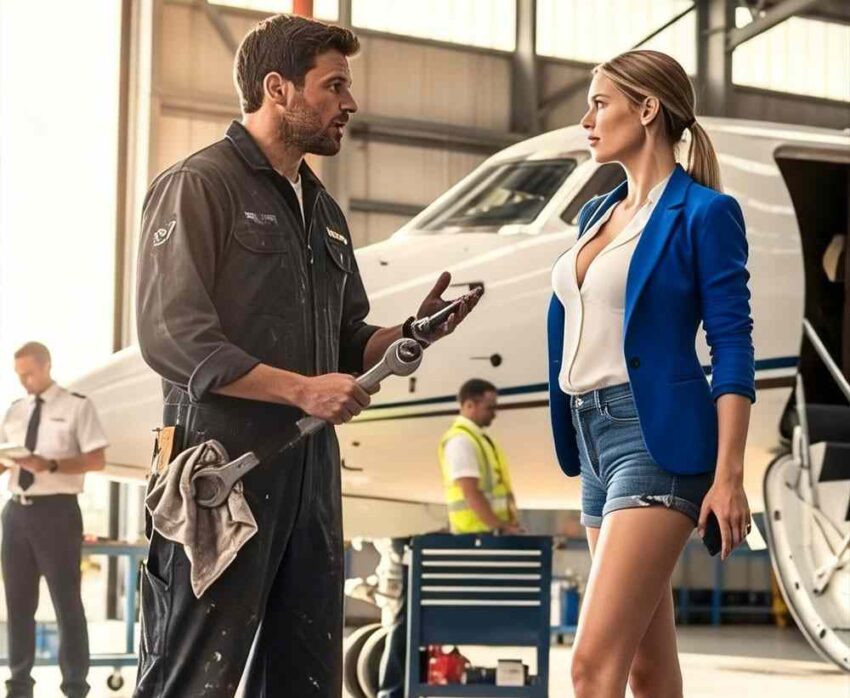
The particular silence of machines that have carried human lives across the sky and returned them safely to the earth. Marcus Webb had learned to read that silence over 14 years of working with aircraft.
Silence had textures. There was the silence of a well-maintained engine resting between flights. There was the silence of something about to fail. A silence with weight in it like the moment before a storm announces itself.
He was on his back beneath the forward landing gear assembly of a Cessna Citation CJ3 when he heard it. Not a sound exactly, more like the absence of a sound that should have been there.
He rolled out slowly, wiped his hands on the rag tucked in his belt, and stood. The hanger was still mostly dark at 6:40 in the morning. The Ohio winter holding the light hostage until past 7.
He reached up and clicked on his work lamp, tilting it toward the port side fuselage just below the wing route. There, a hairline fracture in the skin panel, barely 3 in long, running parallel to a rivet line.
Most people would have missed it. Most certified avionics engineers would have missed it. In certain lights, it looked like nothing more than a scratch. A surface imperfection left over from a minor ground handling incident.
But Marcus had spent enough years around aircraft under pressure to know the difference between a scratch and a crack. And this was a crack. This was a crack that had been growing slowly, invisibly for months.
He crouched and shown his light at a lower angle. The fracture caught the beam and opened slightly, a thin shadow appearing along its length. He pressed two fingers against the panel and felt the faintest flex, a give that should not have been there.
His jaw tightened. He straightened up and looked at the maintenance log clipped to the nose wheel door. The jet had its last full inspection 14 weeks ago. Next scheduled was in 3 days.
The current owner had filed a departure flight plan for 8:00 this morning. Marcus stood in the hanger and thought about that for a moment. He was not employed by the owner of this aircraft.
He was employed by Terrell Aviation Services, a midsized FBO that handled fueling, minor maintenance, and hangar rental for the private aircraft community at Milbrook Executive Airport. The citation belonged to a woman named Victoria Hail, whose name Marcus had seen on Departure Manifests a dozen times over the past 2 years without ever attaching a face to it.
Hail consolidated. He’d seen that name on the financial news on the sides of buildings downtown. 43 floors of glass and steel with her family’s name on it. He walked to the far end of the hanger where his son was sleeping.
Eli Webb, 6 years old, was curled on a folded tarpollen behind the tool bench. Wrapped in the dark green blanket Marcus kept in his truck for exactly this purpose. The boy’s brown hair was pressed flat on one side from sleep.
His small chest rose and fell with the steady rhythm of someone who trusted the world completely, or rather who trusted the one person in it who had never given him reason not to.
Marcus crouched beside him and spent a moment doing nothing but watching his son breathe. This was the part of his life that nobody saw. The alarm at 4:45. The bowl of oatmeal made in the dark.
The backpack checked the night before. Homework done. Permission slip signed. Lunch packed. The drive to the hanger on days when school started late and the sitter wasn’t available. The boy sleeping in the truck for the first hour while Marcus worked.
These were not things anyone praised him for. They were the architecture of his days. He touched Eli’s shoulder gently. Buddy, wake up a little. Eli stirred, blinked, looked up at his father with the uncomplicated recognition of a child who has never doubted where he belongs.
Papa. Yeah, sit up for me. Eat something. Marcus said a granola bar and a small bottle of apple juice beside him. I’ve got to go talk to someone. You stay right here.
Don’t touch anything in the tool cabinet. I know, Eli said, already unwrapping the granola bar with the practiced seriousness of a child who has heard this instruction many times and takes it seriously.
Marcus walked back to the main hanger floor. He was 34 years old and he looked it in the way that certain men look their age, not diminished by it, but carved by it.
His hands were large and scarred at the knuckles built for difficult things. His face was composed, not emotionally absent, but trained to keep the interior of himself from showing on the surface.
He was not a tall man, but he was a solid one with the particular stillness of someone who has been in situations where stillness was survival. He went to the office at the back of the hanger and asked the overnight dispatcher, a young man named Cody, whether Victoria Hail had arrived yet.
“Not yet,” Cody said. “We up at 8. She usually comes in around 7:15. I need to speak with her before she boards.” Cody looked up. There was something in Marcus’s voice that made the younger man pause.
“Is there a problem?” “There’s a problem,” Marcus said. He went back to the jet and documented everything. The fracture location, its dimensions, the degree of panel flex. He photographed it with his phone.
He wrote it in his personal notebook. The small blue one he kept in his chest pocket. At 7:22, he heard a car on the tarmac. Victoria Hail arrived in a black SUV with a driver and a personal assistant already speaking into a wireless earpiece.
Victoria herself emerged, and Marcus understood immediately why the name had always sounded like it came with its own gravity. She was younger than he expected, perhaps 28, dressed in a charcoal coat that cost more than Marcus made in a month, dark hair pulled back with nononsense precision.
She was scanning her phone as she walked, and she did not look up as she crossed the tarmac toward the hangar entrance. Marcus stepped forward from the shadow of the hangar door.
Ms. Hail. She stopped, looked up. Her eyes moved over him with the quick, dispassionate appraisal of someone who sorted people by category rapidly and filed them accordingly. Mechanic, her expression said.
Ground crew. She registered him and then her gaze moved past him toward the jet. I need to speak with you before you board. Marcus said, “Anything you need to say, say it to my chief of staff.” She was already moving again.
Your aircraft has a structural defect, Ms. Hail. She stopped again. Specifically, a fatigue fracture in the portfuselage skin panel, section 7, just after of the wing route. It’s been propagating for a while.
The panel has measurable flex under pressure. I don’t know when it would fail, but I know it shouldn’t be in the air today. She turned to face him fully now.
There was no softening in her expression, only a recalibration. Who are you? Marcus Webb. I work for Terrell Aviation. Are you a certified airframe and power plant technician? I am.
Did Terrell Aviation assign you to inspect this aircraft? A brief pause. No. Something shifted in her face. Not warmth, but sharpness. So, you’re telling me you grounded my aircraft based on an inspection you performed without authorization?
for a jet that isn’t your assignment early on a Monday morning. Her voice was even controlled, carrying the particular cadence of someone accustomed to identifying the weakest point in any argument and pressing on it.
And you expect me to miss a board meeting in New York because of your unauthorized opinion. I expect you to look at what I found before you decide,” Marcus said.
His voice was unchanged. She stared at him. There was something she hadn’t expected in his manner. No defensiveness, no apology, no scramble to justify himself, just that stillness and the quiet certainty behind it.
“Show me,” she said. He walked her to the aircraft and showed her the fracture. He held his phone light at the correct angle. He placed her hand, she did not flinch, he noted, against the panel and let her feel the flex.
He explained in precise and unhurried language what the fracture was, where it was in relation to the structural anatomy of the jet, and what it meant for flight safety under the pressurization cycles of a 600-mile flight.
When he finished, there was a silence. From behind the tool bench at the back of the hanger, unseen by Victoria Hail, a six-year-old boy in a green blanket was watching his father with absolute unblinking attention.
“How did you see this?” Victoria said, and for the first time, her voice had something other than edge in it. Our maintenance team did a full inspection 6 weeks ago.
With respect, Marcus said they were looking at the wrong things. She looked at him for a long moment. Then she turned to her assistant. Cancel New York. Get me a structural engineer here within 2 hours.
She turned back to Marcus. I’ll need your documentation. already done,” he said, and handed her the notebook page folded once. She took it, looked at the careful, dense handwriting, the diagrams, the measurements.
Something moved across her face that was hard to name. Not gratitude, not yet, but the beginning of a question she hadn’t expected to be asking. She looked up. You said you work for Terrell.
Yes. You’re just a mechanic. It was not asked cruy. It was asked with the genuine confusion of someone trying to reconcile what she saw with what she believed was possible.
Marcus Webb looked at Victoria hail across the cold hangar floor, his son watching from the shadows. The fractured jet silent between them and said nothing at all. He let the silence carry what words would have cheapened.
continue 👇
Some answers don’t need saying. Some truths announced themselves simply by standing still and refusing to move. He didn’t need to. Marcus Webb had not always been invisible. There had been a time, and it seemed on certain mornings, like something that had happened to a different man in a different century, though it was only 8 years ago, when his name meant something in rooms that mattered.
When the men around him deferred to his judgment, not out of protocol, but out of genuine regard for what he carried in his head and in his hands, when the work he did was not background noise, but signal.
when he was seen. He thought about this rarely and never with bitterness. Bitterness required a belief that things had gone wrong. And Marcus did not believe that. He believed things had gone differently than planned, which was not the same thing.
He had left the Navy at 26, not discharged, not pressured out. He had simply looked at the life he was building inside those walls of rank and mission and specialization.
And then he had looked at the small perfect fact of his son, 11 months old at the time, sleeping in a car seat in the hospital parking lot because there was nobody else to watch him.
And he had made a choice. The choice was not complicated. It was only heavy. The Navy had tried to keep him. His commanding officer, a man named Harg Grove, who was not given to sentiment, had driven to Marcus’ off-base apartment and sat at his kitchen table for 40 minutes, trying to find the argument that would change his mind.
Marcus had listened to every word with respect and with absolute immovability. In the end, Hargrove had shaken his hand with both of his own and said, “You’re the best I’ve ever had at this.
Wherever you go, the machines you work on will be safer than they deserve to be.” He thought of that handshake sometimes when he found a thing that others had missed.
The years after the Navy had been unglamorous and largely unremarkable, which was precisely what Marcus had intended. He had taken his ratings, his A&P certificate, his inspection authorization, the specialized training in avionic systems and structural analysis that the Navy had given him, and that he had doubled and
tripled through his own study, and he had found work in the civilian world that was honest and quiet and paid enough, not comfortably enough most months, but enough. Milbrook was not where he had grown up, but it had become where he lived, which was different.
He had a rented house on Culver Street, two bedrooms, a kitchen that smelled permanently of the chili he made every Sunday, a backyard with a rusting swing set that he had reinforced with new bolts the first week they moved in.
He had a truck with 140,000 mi on it that he maintained himself and expected to maintain for another 100,000. He had Eli. On most days, Eli was enough. On some days, Eli was everything.
The boy had his mother’s eyes large and dark, paying attention with a quality that made some adults slightly uncomfortable. Lena had been gone since Eli was 8 months old, not dead, gone.
She had been 23 and not ready for any of it. Marcus had never blamed her for leaving, though he had spent time being angry at the manner of it. The note on the counter, the car gone, the phone disconnected within a week.
Eli did not ask about her often. When he did, Marcus answered without editorializing. She loved you. She wasn’t ready. That’s not your fault. He believed both of those things completely.
Tuesday afternoon, 2 days after the incident with the Victoria Hails jet, Marcus was on his knees in the hanger replacing a brake assembly on a King Air when he heard voices behind him.
Voices that did not belong to any of the Terrell aviation staff. He did not turn immediately. He finished torquing the bolt. he was working on. Checked the torque reading twice, noted it in his log, and then stood.
Three men in suits were standing with Roger Terrell, his employer, a Florida man in his 50s who managed the FBO with the particular nervousness of someone perpetually worried about losing accounts he couldn’t afford to lose.
The suits had the look of corporate legal, expensive, careful, professionally neutral. Marcus, Roger said, he had the expression of a man walking across ice. These gentlemen are from Hail Consolidated.
They’d like a word. Marcus wiped his hands and waited. The lead attorney, a man named Briggs, who introduced himself with the efficient grace of someone who’d made a career of managing inconvenient people, explained that Hail Consolidated, appreciated the safety concern Marcus had raised.
The structural engineering team had confirmed the fracture. The aircraft had been grounded for repairs. Ms. Hail wished to convey her personal thanks. Marcus nodded. Then Briggs said the other thing.
Ms. Hail also wants to ensure that the documentation you prepared, your personal notes, photographs, any written observations are properly transferred to our maintenance file as the authorized record holder for this aircraft.
Marcus looked at him. I gave Miss Hail a copy of my documentation on the morning of the incident. Yes, we’d like the originals as well. Your notebook, your phone photographs.
A pause settled over the hanger. Roger Terrell was not meeting Marcus’s eyes. My notebook is my personal record, Marcus said. My photographs are on my personal device. You’re welcome to the copies I provided.
Mr. Web. Briggs’s voice developed a texture it hadn’t had before. Not threatening, but pressurebearing. Ms. Hail is one of Terrell Aviation’s most significant clients. This is a straightforward records request.
Then it can be made through the proper channels, Marcus said. FSDO, FAA, I’ll comply with any regulatory request through the appropriate process. Roger Terrell made a small miserable sound. From the corner of the hangar, invisible to the men in suits, Eli Webb was sitting on the tailgate of his father’s truck, doing his reading homework with the focused concentration of a child determined to finish before dinner.
He had learned early to be quiet in the hangar. He had learned to read his father’s silences to know when the air in a room had changed, to stay still and attentive without being seen.
He was watching his father now. He always watched his father. There was something Eli understood about Marcus Webb, something the boy could not have articulated at 6 years old, but which lived in him as a kind of bedrock conviction, which was that his father did not move.
Not in the way that mattered. You could press on Marcus Webb, and he would give you nothing. Not from stubbornness or pride, from something deeper than both, from a certainty about what was true and what was right that did not require the approval of anyone standing in front of him.
Briggs left without the notebook. Roger Terrell asked Marcus to step into his office. The conversation was not hostile. Roger was not a bad man. He was a man with a business and a mortgage and a daughter in college.
And he was frightened and fear made him practical in ways that were not always principled. He explained that Hail Consolidated represented 12% of Terrell’s annual revenue. He explained that Ms.
Hail’s team had been in contact about formalizing their relationship with the FBO, which meant more contracts, more work, more security. He explained all of this in the careful language of someone who knows he is asking a subordinate to do something the subordinate should not have to do.
I need you to cooperate with their records request, Marcus. Roger. My personal documentation is mine. I’ll cooperate with any legally mandated request. This could cost us the account. I understand.
Roger looked at him with something close to exhausted admiration. Don’t you care about this job? Marcus thought about Culver Street, the truck, the swing set. I care about it a lot, he said.
He went back to the King Air and finished the brake assembly. That evening, sitting at the kitchen table while Eli ate the chili Marcus had reheated and described with great seriousness the social complexities of first grade.
A narrative involving a disagreement about whose turn it was on the climbing structure and the diplomatic resolution engineered by their teacher. Marcus kept his face calm and his voice steady and let his son’s words fill the kitchen the way light fills a room when the curtains are opened.
Later, after Eli was asleep, he sat in the kitchen alone. On the table in front of him was a photograph in a plain wooden frame. The photograph showed a younger Marcus, 22, 23, standing with a group of men in front of an aircraft that bore no civilian markings.
He was smiling in the photograph, which was rare. The men around him had the look of people who had done something very difficult together and were standing in the particular relief of the other side of it.
He looked at the photograph for a while. He thought about what Harrove had said and about the years since and about the way a man can walk away from the largest version of himself and still still show up every morning and put his hands to honest work without resentment without theater, without asking anyone to witness it.
That was not weakness. Marcus had decided long ago that it was the opposite of weakness. It was the hardest kind of discipline. the discipline of choosing what mattered over what was impressive.
He thought about the woman in the charcoal coat standing on his tarmac in the cold. The way she had looked at his handwriting. The way she had said, “You’re just a mechanic.
” the genuine confusion in it, not cruelty, confusion, as though the world she operated in had taught her that men like Marcus Webb, quiet, undecorated, working for wages in a hanger before dawn, could not be what he so plainly, so calmly was.
Then he put the photograph face down. He would need it face down for what was coming. The structural engineers report came back on Thursday. Marcus heard about it secondhand from Cody at the front desk who had heard it from one of the flight crew.
The fracture had been worse than initially assessed. What Marcus had identified as a propagating fatigue crack had upon full inspection by Hail Consolidated’s contracted engineering firm revealed secondary micro fracturing along the adjacent rib.
An indication that the panel had been under anomalous stress for a longer period than the 14 weeks since the last inspection. The aircraft had been grounded indefinitely pending a more comprehensive structural review.
The engineering firm’s preliminary report had apparently included language like early detection prevented catastrophic failure and consistent with pressurization induced fatigue at altitude. Marcus learned all of this from Cody who told him with the excited energy of someone sharing good news.
Marcus thanked him and went back to work. He did not think about catastrophic failure. He had trained himself long ago not to think about outcomes that hadn’t happened. He thought instead about the next aircraft on his list, a Piper Senica with a fuel selector valve that had been intermittently stiff.
A symptom with a range of possible causes, most of them manageable and one of them not. It was Friday morning when Victoria Hail came back. She came alone this time.
No assistant, no SUV with a driver. She arrived in a dark gray sedan that she parked herself at the edge of the tarmac and she was dressed differently, less armor in it, Marcus thought, though he wasn’t sure why he noticed.
Still composed, still the posture of someone who had been taught since childhood that carriage communicated authority. But the coat was simpler, and she was carrying only a single leather portfolio, not the arsenal of bags and technology that had accompanied her Monday morning departure.
Marcus was on the tarmac when she arrived, doing a pre-flight walkound inspection on a Sirrus SR22 that was scheduled to depart at 10:00. He saw her come through the gate and watched her locate him across the tarmac with the purposeful directness of someone who had already decided where they were going before they arrived.
Mr. Webb, Ms. hail. She stood a few feet away from him in the cold morning air with the flat Ohio sky behind her and she looked at him the way she hadn’t looked at him on Monday.
Not categorizing, not assessing, but genuinely examining. As though she was trying to reconcile two things that did not fit into the same frame. I read the engineering report, she said.
I heard. They said what you found probably saved the aircraft and everyone on it. A pause. That would have been me, my assistant, two pilots, and a colleague from the London office.
Marcus kept his eyes on the Cirrus. I’m glad you didn’t board. She watched him work for a moment. I want to apologize, she said, for how I spoke to you Monday morning.
Something in him was still and careful. You were managing a disruption to your schedule, he said. It’s understandable. It was dismissive. I treated you like you were. She stopped like I was what I am, Marcus said without edge.
A mechanic at an FBO. That’s not inaccurate. You know things, she said. And there was something almost frustrated in her voice. The frustration of someone who has had their categories disturbed and cannot yet build new ones to replace them.
That the engineering team I pay $400 an hour couldn’t find in a full inspection. I’d like to understand that. He set down his clipboard and turned to face her properly in the thin winter light with the cold pressing color into her cheeks and the composed mask slightly down.
She looked younger than she had on Monday. She looked, he thought, like someone who was more alone than she was accustomed to admitting. Understanding it won’t change what it is, he said.
Maybe not, she said, but I’d like to try. The hangar door was open behind him. Somewhere in there, beyond the parked aircraft and the shadow of the far wall, Eli was sitting with his library book, a chapter book about a boy and a dog in a cross-country road trip, which he had been reading with the devoted seriousness of a scholar.
Marcus was aware of his son the way he was always aware of his son, as a fact, as a wait, as a reason. My son is in the hangar, Marcus said.
I have work until noon. After that, I’m taking him to lunch. She blinked. It was not what she had expected him to say. He could see that. Then I’ll be brief, she said.
She opened the leather portfolio. Inside was a document that Marcus recognized as a consulting contract, though this one was on Hail consolidated letterhead and appeared to have more zeros in it than anything he had been offered before.
I want to hire you directly to review the maintenance and inspection protocols for our fleet. Six aircraft. I want your eyes on them. Your assessment, your recommendations 3 days a month, your rate within reason.
Marcus looked at the document without touching it. I have a job. I know this would be supplemental. Weekend work if you prefer. Or I can speak to Roger Terrell about a formal arrangement.
Roger Terrell, Marcus said, is currently trying to decide whether my continued employment is worth the discomfort it causes his largest account. She had the decency to look uncomfortable with that.
That’s partly why I’m here. He looked at her for a moment. The Cirrus waited patiently beside them. The cold pressed its way through his jacket. Ms. Hail, he said. I don’t know what you think you’re looking at when you look at me.
I think I’m looking at someone who’s a great deal more than he appears to be, she said, and her voice had gone very even. Very careful, the way voices go when people are saying true things they weren’t planning to say.
A sound from the hanger. Both of them turned. Eli Webb was standing in the hangar doorway, library book tucked under one arm, looking out at them with that largeeyed, measuring attention.
He looked at his father first. The quick reassuring check of a child who has learned that when his father stands still and talks to someone in a quiet voice, everything is probably fine.
Then he looked at Victoria Hail with the direct unself-conscious curiosity of a six-year-old who has not yet learned to pretend he isn’t looking. “That’s my son,” Marcus said. Victoria looked at the boy.
Something moved across her face that she did not control in time. something that might have been unexpected tenderness or the recognition of something or the kind of longing that lives in people who have spent so long being strategic that they have almost forgotten what they actually want from a life.
He looks like you, she said. He’s better than me, Marcus said with the matter-of-act certainty of a man stating a calibrated truth. Eli, apparently satisfied by whatever assessment he had been conducting, withdrew back into the hanger.
Victoria looked down at the contract in her portfolio. She looked up at Marcus. There was a question building in her. He could see it. A question she wasn’t sure she had the right to ask or the language to ask correctly.
“Who are you?” she said. “Really?” Marcus Webb picked up his clipboard. “The Sirrus pre-flight wasn’t going to finish itself.” “I’m a man who checks the things other people skip,” he said.
“That’s all.” He went back to work. But as he moved along the port wing of the Cirrus, running his fingers along the leading edge with the unhurried precision of someone whose hands had been trained to find the thing’s eyes missed.
He was aware that she was still standing on the tarmac behind him. He was aware that she had not left. He was aware that she was watching him work with an expression he could not see, but could feel somehow.
The expression of someone standing at the edge of a question they are not yet ready to walk away from. on the toolbench inside the hanger in the corner where the fluorescent light barely reached.
Eli had opened his chapter book again, but he was not reading it. He was looking at the narrow rectangle of tarmac visible through the hangar door, at the gray sky beyond it, at his father’s broadback moving steadily along the wing of the small white aircraft.
At the woman standing still in the cold, watching Eli Webb, 6- years old son of a man the world had decided to overlook, closed his book on his thumb to hold his page.
He had a feeling. He didn’t have words for it yet, but the feeling was clear and solid, and it sat in his chest like a stone warmed by sun, heavy in the good way, the way things feel when they are real.
He looked at his father again at the careful, methodical way Marcus moved along the wing. Two fingers extended, pressing gently at intervals, reading the aircraft the way Eli’s teacher read the classroom.
That quality of total attention, that refusal to be hurried. Eli had grown up watching those hands. He had watched them fix a leaky faucet at two in the morning without complaint.
He had watched them check every seat belt before every drive. He had watched them produce 365 dinners out of a kitchen with four burners and a limited budget with the same quiet competence they brought to landing gear assemblies and fuel selector valves.
Other kids had fathers who coached their teams and drove new trucks. Eli had a father who got up before the sun and never once made Eli feel like a burden or an afterthought or anything less than the most important thing in any room they shared.
The woman on the tarmac was still there. She was watching his father the way you watch something that surprises you with the attention of someone revising their understanding of the world.
Eli opened his chapter book, found his page. his father would finish the inspection. Then they would go to the diner on Porter Street and sit in the booth by the window and Eli would talk and his father would listen completely unhurriedly as though nothing in the world mattered more.
That had always been enough. Something was beginning. The letter from Terrell Aviation arrived on a Wednesday morning, slipped under the windshield wiper of Marcus’ truck while he was inside the hanger performing a borcope inspection on a turbine engine.
He found it when he walked out for his coffee break. A plain white envelope with the company logo in the upper left corner. His name typed on the front with the impersonal precision of documents that carry bad news.
He read it standing beside his truck in the cold. Then he folded it carefully and put it in his jacket pocket and went back inside and finished the boroscope inspection.
He entered his findings in the log. He cleaned the instrument. He tagged the engine with his findings and his ID number and the date and time. Then he sat on the bumper of his truck and looked at the sky for a while.
The letter was not a termination. It was a reassignment, a lateral move, as Roger’s language carefully framed it, to the ground support division. towing, fueling, equipment maintenance, away from the aircraft, away from the inspections and assessments and the quiet daily work of keeping things in the air that were supposed to stay in the air.
The pay was the same. The title was different. The message was as clear as a hairline fracture in a fuselage panel. Roger had found a way to keep the account and keep Marcus without keeping Marcus where Marcus’ judgment could create further inconvenience.
He thought about fighting it. He had the standing to fight it. A union grievance, a call to the FAA about the circumstances, any number of levers a man with his qualifications and his documented record could pull if he chose.
He thought about all of that with the methodical thoroughess he brought to everything, weighing it, turning it over, examining it from each angle. Then he thought about Eli. Eli, who needed to eat breakfast before school and have his homework checked and his permission slip signed.
Eli, who had a dentist appointment next Thursday, and a school science project due the week after that. Eli, who slept in the small bedroom on Culver Street with the glow-in-the-dark stars on the ceiling that Marcus had stuck up there two years ago on a Saturday afternoon.
Both of them lying on their backs on the floor, deciding where each star should go. Eli directing the placement with the supreme authority of a six-year-old who understood instinctively that this was his ceiling and his sky.
Marcus Webb did not pull any levers. He reported to his new assignment on Thursday morning at 5:45 exactly as required. He fueled a Gulfream. He towed a Beachcraft Baron to the wash rack.
He performed a routine maintenance check on the airport’s ground power unit with the same thorough, unhurried attention he had always brought to everything. And he noted three items in the service log that the previous technician had apparently overlooked because he could not make himself do any work carelessly, even work that was meant to diminish him.
Cody, who worked the morning desk and was 23 and not yet wise enough to stay out of things that weren’t his business, found Marcus at the fuel truck that afternoon.
This is because of the hail thing. Cody said it was not a question. Don’t worry about it. Marcus said it’s not right. A lot of things aren’t right. Marcus said you still have to show up for them.
He said it without bitterness, which was the part that Cody would remember for years afterward, long after he had left Milbrook and built his own career and become eventually the kind of man who told the story of Marcus Webb to younger people who needed to hear it.
He would remember that Marcus said it the way you state the temperature or the wind speed, a fact, a condition of the world that you account for and then proceed.
That evening, Marcus made spaghetti made. He helped Eli with the science project which involved constructing a model of the water cycle using a plastic container, a bag of ice, and food coloring in a way that demonstrated evaporation and condensation.
They spent an hour on it at the kitchen table. Eli narrating each stage with the intensity of a scientist presenting findings of global significance. Marcus listening and asking questions and occasionally redirecting when the experiment began to drift toward chaos.
The finished model was not perfect, but it was honest and it worked and Eli was proud of it, which was enough. After Eli was in bed, Marcus sat in the kitchen with a cup of coffee that went cold while he wasn’t paying attention.
And he thought about the consulting contract that Victoria Hail had offered him. He had not signed it. He had not refused it either. He had simply placed it in the blue folder in the kitchen drawer where he kept important documents and left it there while he worked out what he thought about it.
He thought about it now. He thought about the woman who had arrived in charcoal armor and left in something quieter. He thought about the way she had looked at his handwriting in the notebook, not with condescension, but with a kind of startled attention, as though the density and precision of it had told her something she hadn’t been prepared to receive.
He thought about what she had said on the tarmac. I think I’m looking at someone who’s a great deal more than he appears to be. And about the way she had said it, not as a compliment deployed to get something, but as a genuine, slightly unsteady observation, the kind that escapes people when their defenses are briefly down.
He was not a man who let himself want things easily. He had learned through the specific education of loss and responsibility and years of being the only adult in the room to be careful with wanting.
Wanting led to expectation, and expectation was a structural weakness, a point where pressure accumulated. But he thought about her. He thought about the cold morning air and the flat Ohio sky and her standing still on the tarmac watching him work.
He thought about the longing he had seen move across her face when she looked at Eli. Something in him recognized something in her. Not romantically, not yet, but in the deeper and less articulate way that certain people recognize each other across the distance of very different lives.
Something had been through something. Something had been lonely in a way that wealth and competence couldn’t fix. He pulled the blue folder out of the drawer. He looked at the contract.
He thought about Roger Terrell. He thought about the reassignment letter folded in his jacket pocket. Then he thought about Harrove and the handshake and the thing about being the best.
He did not sign the contract that night, but he put it on top of the folder instead of back inside it. That was as close as Marcus Webb came to making a decision before he was ready.
It was for him a significant movement. In his bedroom, 6 years old and dreaming, Eli Webb slept beneath his galaxy of glow-in-the-dark stars. The small steady breathing of a child who has never had to wonder whether his father would be there in the morning.
Who has never had cause to wonder, who takes it as gravity, as given as the most reliable fact in the universe. Outside on Culver Street, the Ohio winter settled its weight on everything.
The truck sat in the driveway. The swing set stood in the backyard, its new bolts cold and solid and holding exactly as they were meant to hold. Inside, a man who had given up everything once for the right reason sat at his kitchen table in the dark and tried carefully, quietly to figure out whether he had enough left to give something again.
He had more than he knew. He always had. It was Eli who broke the silence the way children sometimes do. Not because they understand the full weight of what they’re saying, but because they haven’t yet learned to be afraid of the truth.
They were at the diner on Porter Street, the one with the green booths and the laminated menus and the coffee that came in thick white mugs on a Saturday morning 2 weeks after the reassignment.
Eli had ordered the pancakes with the blueberries, which he ate with the methodical pleasure of someone who believes that good things deserve full attention. Marcus had his usual two eggs over easy, wheat toast, black coffee, and he was reading the maintenance trade journal he kept in his jacket
for exactly these Saturday mornings when Eli looked up from his pancakes and said, “Papa, why did the men in suits come to the hanger?” Marcus set down his journal. “You saw that?” he said.
He was not surprised. He had assumed Eli had seen it. He wanted to understand what Eli had made of it. I was on the tailgate, Eli said. I didn’t move.
You said to stay. He considered this. The man with the shiny shoes was trying to make you give him something. He was, Marcus said. But you didn’t. No. Eli ate a blueberry.
Because it was yours. Because it was mine. Marcus agreed. Eli nodded with the solemn satisfaction of a child whose understanding has been confirmed. He ate another bite of pancake. Then he said carefully as though he had been preparing the question for some time.
Papa, were you in the military? The diner was warm. Someone’s kid was laughing two booths over. Outside the window, Porter Street was doing its slow Saturday morning routine. A few cars, a man walking a dog, the bakery across the street just opening its door and releasing a thin thread of steam into the cold.
Marcus looked at his son. Why do you ask? He said. There’s a picture, Eli said. The one on the table that you put face down. I saw it once before you turned it.
The airplane in the picture doesn’t have any numbers on it. Marcus was quiet for a moment. I was, he said, in the Navy a long time ago. What did you do?
I fixed aircraft, special ones. Eli considered this. How special. Marcus wrapped both hands around his coffee mug. Outside, the dog walker had stopped to let his dog investigate something on the sidewalk with great interest.
A normal Saturday, a normal street. The particular ordinary miracle of a life that held together. Special enough, Marcus said, that I can’t tell you most of it. Not yet. Maybe when you’re older.
Eli accepted this with the equinimity of a child who has learned that some of his father’s answers come in installments. Is that why you could see the crack in the airplane?
The lady’s airplane partly. What’s the other part? Practice. Marcus said paying attention for a long time. What Marcus did not say, what he had not said to anyone in 8 years.
What lived in him the way old injuries live, present and structural, and no longer painful, but never fully absent, was the rest of it, the full shape of what he had been, what he had done, what he had walked away from.
He had been in the Navy, something that did not have a simple name in civilian life. His official rating had been aviation machinist’s mate, which was accurate as far as it went and about as complete as describing a surgeon as someone who works with knives.
He had been attached for the last four years of his service to a unit whose designation appeared in no public documentation and whose work involved aircraft that officially did not exist, in locations that officially had not been visited, performing missions that had officially not occurred.
He had been the person those aircraft came back to. He had been the one who kept them in the air. The work had required a level of technical mastery that went beyond any civilian certification, beyond any conventional understanding of what an aircraft mechanic was or could be.
He had worked on propulsion systems of his own partial design. He had developed inspection protocols for composite structures under combat stress loads that were later much later quietly without attribution incorporated into classified maintenance manuals.
He had on two occasions that he did not think about if he could avoid it. Performed field repairs on aircraft under active hostile conditions in the dark with inadequate tools and the particular perfect focus that only comes when the alternative is unacceptable.
Hargrove had not been his direct commanding officer. Hargrove had been two levels above that. And the fact that Hargrove had driven personally to Marcus’ apartment to try to change his mind was a measure of what Marcus’ departure had actually meant to the program.
Though Marcus had not fully understood that at the time and had not allowed himself to think about it since, he had walked away. He had walked away because Eli needed someone to walk toward him and Marcus was the only person available for that role.
And that was that. None of this was knowable from looking at him. None of it showed in his face or his manner or the work clothes he wore to a small FBO in Ohio.
That was deliberate. He had not hidden it out of shame or modesty. He did not feel ashamed of what he had done, and modesty was not precisely the right word for a man who had simply never required external confirmation of his own worth.
He had hidden it because he had found in the years of single fatherhood and honest civilian work. That the man he had been in the Navy and the man he was on Culver Street were not in conflict.
They were the same man, the same hands, the same set of values applied to different scales of problem. He did not need anyone to know. He did not need the credit, but things had been set in motion now that could not be easily stopped.
It was the following Monday when the first of them arrived. Marcus was in the ground support bay performing a scheduled service on the airport’s primary ground power unit when he heard a voice behind him that he had not heard in 8 years and had not expected to hear again.
still checking the things other people skip. Marcus did not turn immediately. He finished tightening the fitting he was working on. Then he stood up and turned around. The man in the hanger doorway was in his 60s, gray-haired and straightbacked, wearing civilian clothes that did not quite disguise the posture they had been built on.
His eyes were the particular flat, calm, gray of someone who has spent a lifetime in rooms where emotional display was a liability. There was a scar along his jaw that had not been there 8 years ago or had been less visible.
His name was Colonel James Harrove, retired, and he was looking at Marcus Webb the way Marcus had seen very few people look at anything with a regard that was not sentimental, but was total.
Colonel, Marcus said, I heard about the citation. Harrove said, I have people who keep track of things. Marcus said nothing. I also heard about the reassignment. Something moved briefly in Harrove’s expression.
Not anger, but its disciplined cousin. That was wrong. It’s managed, Marcus said. I know it is. That’s not why I’m here. Harrove stepped into the bay and his eyes moved over the ground power unit with the automatic professional assessment that never fully left men like him.
He looked back at Marcus. Victoria Hail. Do you know who her father was? Marcus waited. Admiral Richard Hail retired. He was on the oversight committee for the program you worked in.
He died 14 months ago. Harrove held Marcus’ gaze. His daughter inherited the company and a number of his private files. Files that apparently included a full performance record for a Navy technician who was described in those files as he paused.
And the pause had weight in it. and I am quoting directly the finest aviation system specialist this program has produced in 30 years of operation. The ground power unit hummed quietly between them.
She found those files 3 weeks ago. Hargrove said she’s been trying to understand what she was reading. She didn’t know the name. She didn’t know the face. And then a mechanic at her FBO stopped her from boarding an aircraft with a fatal structural defect.
and she looked at the way he worked and she looked at his handwriting in that notebook and something matched. Marcus thought about the way Victoria had looked at the notebook page.
The way her expression had shifted, not just gratitude, something larger, something trying to locate itself. She doesn’t know yet. Harrove said she suspects something. She doesn’t have the full picture.
Marcus sat down on the bumper of the ground power unit. He thought about the photograph face down on the kitchen table. He thought about Eli asking about the airplane without numbers.
He thought about a woman standing alone on a cold tarmac with armor that didn’t quite fit anymore. Watching a man she couldn’t categorize, carrying her father’s files home in a leather portfolio and sitting with them in a 43tory building with her family’s name on it, trying to solve a question she didn’t yet know how to ask.
He thought about how long he had been invisible. He thought about whether it was time to stop in the silence of the ground support bay with the Ohio winter pressing against the metal walls and the glow-in-the-dark stars waiting on a ceiling on Culver Street and a six-year-old boy at school learning about weather systems and the water cycle.
Marcus Webb made the kind of decision that does not announce itself. It arrived quietly, the way the right decision usually does, not as a revelation, but as the recognition of something that had already been true for some time.
Tell me what she knows, he said. Harrove allowed himself something that in another man would have been called a smile. Everything, he said, or close enough. Victoria Hail had read her father’s files three times.
The first time she had read them the way she read everything, quickly, efficiently, pulling out the data points and filing them in the organized architecture of her working memory. Admiral Richard Hail had been a man of systems and documentation.
and his private files were dense with the particular language of classified military administration. Designations and ratings and performance assessments written in the compressed acronym heavy shorthand of people for whom precision was not a style choice but a survival requirement.
The second time she read more slowly. She was looking for the name. It appeared 17 times in the operational assessment files over a period of four years, always in the same context.
Superlatives, language that did not fit the measured qualifying tone of the surrounding documents. Words like exceptional and irreplaceable, and once in what appeared to be her father’s own handwriting in the margin of a technical evaluation, I have never seen anything like this.
The third time she read it sitting on the floor of her father’s study with a glass of water she forgot to drink. And she understood that she had been circling something for weeks without letting herself land on it.
She understood that the name in the files and the man on the tarmac were the same person and that she had stood 10 ft away from him on a cold Friday morning and asked him who he really was and he had told her the smallest true thing and let her walk away still not knowing.
She drove to the airport on a Tuesday, not to fly, not with an assistant or a portfolio or an agenda. She drove herself in the gray sedan and she parked at the edge of the tarmac and she sat in the car for a few minutes, which was not something Victoria Hail typically did.
She sat and looked at the hanger and the flat gray sky beyond it and the half-rozen grass at the edge of the tarmac that had been bent by the wind and not straightened.
Then she got out and walked in. Marcus was in the ground support bay. He looked up when she came in and she saw in the single second before he composed his expression that he had been expecting her.
Not today specifically, but soon. He had known it was coming. He had been waiting for it with the particular patience of a man who understood that certain things could not be indefinitely deferred.
She did not speak immediately. She looked at him across the bay. She looked at his hands which were resting on the housing of the ground power unit, and she thought about those hands in her father’s files, not described physically, but present in every line, in every account of systems repaired and problems solved and situations managed in conditions that she still could not fully picture.
Even after three readings, “My father wrote about you,” she said. “I know,” he said. She had not expected that. She stood still with it for a moment. You knew about the files?
I was told about them recently. Did you know who I was? When you stopped me from boarding. I knew your name. He said I didn’t connect it to your father.
Not then. She believed him. She believed him the way she had come over these weeks to believe most things about Marcus Webb. Not because he was charming or persuasive, but because he was constitutionally incapable of the kind of strategic presentation that she lived among daily.
He said what was true and he didn’t say more than that. He called you the finest he’d ever seen, she said. My father was not given to that kind of language.
I know that too, Marcus said. Then why? She stopped, started again. Why are you here? Why a small FBO in Ohio? Why? She gestured, not unkindly at the ground support bay, the fuel truck visible through the door behind her, the unglamorous ordinariness of all of it.
Marcus was quiet for a long moment. Then he said, “Because my son needed someone here. The ground support bay was still. Somewhere outside, a small aircraft taxied past its engine, a steady, purposeful drone.
That’s it,” she said. and then hearing herself. I don’t mean that dismissively. I mean, that’s it, he said simply. There wasn’t any other reason I needed. She looked at him.
She had been in rooms with powerful men her entire life, men with titles and holdings and the practiced ease of people who had never seriously doubted their own importance. She had learned to read them the way her father had taught her.
Look for what they protect. Look for what they fear. look for the gap between the person they present and the person they actually are. Marcus Webb had no gap. What he presented was what he was.
A man who had been extraordinary in a place no one could see, who had chosen a child over a legacy, who had built a life out of honesty and discipline and the daily unwitnessed work of being present for someone who needed him, who had been reassigned to fueling aircraft and had shown up on time and [music] done the work well.
and noted three items in the log that someone else had missed because he could not make himself do anything carelessly. She felt something break open in her chest. She had not expected that.
She was not accustomed to being surprised by her own emotions. I owe you my life, she said. That’s a strange thing to say to someone, but it’s accurate. You don’t owe me anything, he said.
I did what I saw needed doing. That’s exactly what I mean. He looked at her and for the first time she saw past the composure, not through it, but past it.
The way you sometimes see the structure of a thing when the light catches it correctly. She saw a man who was tired in the specific way that men get tired when they have been strong for a long time.
Entirely alone, not broken, not diminished, tired in the way of a loadbearing wall that has been doing its job faithfully and correctly and without recognition, and could go on doing it indefinitely, but would not refuse if someone offered to share the weight.
“I’d like to know you,” she said. “Not for the company, not for the consulting arrangement. I’d like to.” She stopped. This was harder than she expected. She had not had to find language for this kind of wanting in a long time.
I’d like to bring you coffee sometime at the diner on Porter Street with your son, if that’s if that would be all right. Something changed in Marcus Webb’s face. It was not dramatic.
It was not the kind of change that would have been visible to anyone who was not paying close attention. It was the kind of change that happens in the foundations of things.
A small structural shift that doesn’t show on the surface, but changes the loadbearing arrangement of everything above it. Saturday mornings, he said, we go at 8. She nodded. She turned to leave.
Ms. Hail. She stopped. Victoria, he said, just her name. said in the particular way a man says a name when he has decided to stop being careful about it. She didn’t turn around, but he saw her shoulders change.
She walked out of the ground support bay into the cold Ohio afternoon and Marcus Webb stood with his hands on the housing of the ground power unit and felt for the first time in a very long time something that was not the absence of anything, something present and warm and structural, like a load distributed correctly across a well-built frame.
He went back to work. Saturday came the way Saturdays come, without drama, carrying the ordinary weight of everything that matters. Marcus made oatmeal at 5:30 and let Eli sleep until 7 and then woke him gently with a hand on his shoulder and told him they were going to the diner.
Eli emerged from sleep in stages, as he always did, blinking and serious, assessing the day from the beginning of it the way his father had taught him by example. At the diner, they took the booth by the window.
Eli ordered his pancakes with blueberries. Marcus ordered his eggs. The coffee came in thick white mugs. Porter Street conducted its slow Saturday routine outside the glass. At 8:12, the gray sedan parked across the street.
Victoria Hail crossed Porter Street in a coat that was simpler than the charcoal one, her hands in her pockets, her face open in a way that it had not been the first time Marcus had seen her.
She came through the door and the hostess gestured toward the booth and she walked the length of the diner the way people walk when they are slightly nervous and determined not to show it.
And she stopped at the booth and looked at Eli and then at Marcus. Eli looked up from his pancakes. He looked at her with those large measuring eyes. He looked at his father.
He looked back at her. You’re the lady from the hanger, he said. I am, she said. You watched my dad work. I did, she said. He’s very good at it.
Eli considered this with the gravity it deserved. Then he slid toward the window to make room and said, “You can sit here. The coffee is really good.” Victoria Hail sat down.
Marcus looked at his son. Eli was already back to his pancakes. The matter settled as far as he was concerned. with the complete and generous certainty of a child who has grown up watching a man welcome every difficult problem with steady hands and open eyes and has absorbed
from that watching the understanding that the world is on balance a place where good things are possible where honest work is enough where the people worth knowing will recognize what matters when they see it outside the window Porter Street went about its business the bakery steamed a dog investigated a lampost the Ohio sky sat at flat and wide and pale above the buildings.
The kind of sky that does not promise anything dramatic. Only light, only continuation, only the next ordinary day of a life that has been, by every measure that matters, lived well.
Marcus Webb drank his coffee. Across the table, Victoria Hail was looking at him, and he let her look. Not performing, not explaining, not protecting the interior of himself from the surface.
just present in the particular way he had always been present for the things that deserved it. Completely, unhurriedly, as though nothing in the world mattered more than this moment and the people in it.
Under the table, Eli’s foot swung back and forth the way it always did when he was content. The weight of quiet hands, the legacy of a man who fixed broken things. The morning that was just a morning and everything.