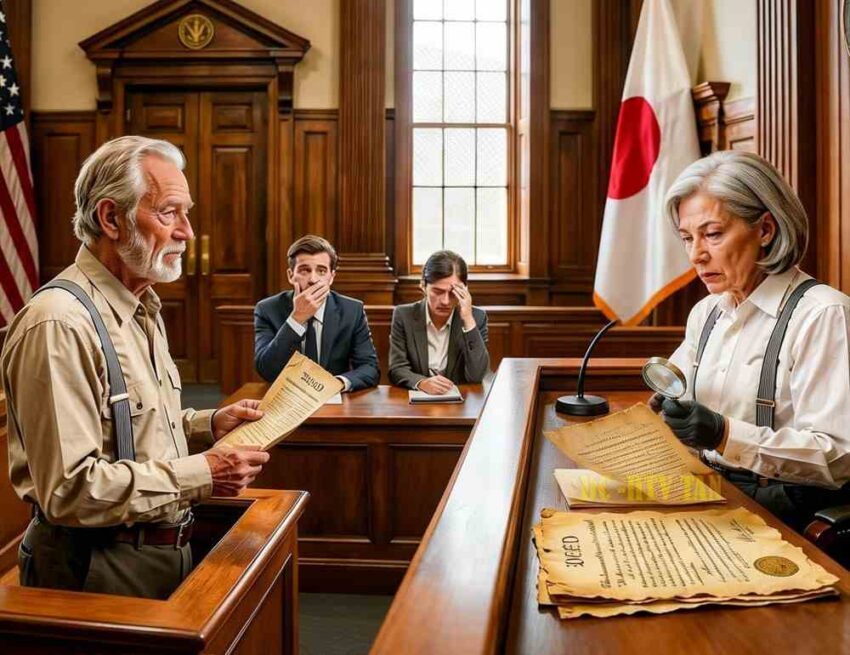
On the Monday morning the men from the bank came to take the farm, Gerald Pratt was standing in his kitchen arguing with his son about bacon.
It was not really about bacon.
Michael Pratt had driven down from Cincinnati the night before because his father had failed to answer three calls and two texts, which meant one of two things: Gerald was on his tractor and ignoring the phone on purpose, or something was wrong and he was too stubborn to say so. At seventy-six, Gerald still moved like a man twenty years younger when he wanted to prove a point, and every conversation with him became a tug-of-war between love and pride.
“You can’t live out here alone forever,” Michael said, standing at the stove with a spatula in one hand. “Not after the winter you just had.”
Gerald sat at the table in a faded work shirt, coffee mug cupped in his thick, weather-browned hands. “I’m not alone. I’ve got livestock, fences, and a tractor that needs more attention than any woman ever did.”
Michael gave him a flat look. “Mom would’ve thrown a dish at you for that.”
Gerald’s mouth twitched, almost a smile, but the smile didn’t last. Dorothy had been gone three years. The silence she left behind still sat in the corners of the house like furniture no one had the heart to move.
“You’re not funny enough to be careless with your words,” Michael said.
“I raised you, didn’t I?”
“Barely. Mom did the hard parts.”
That one landed. Not because it was cruel, but because it was true enough to sting.
Gerald looked down at the table. The wood was scarred with old knife marks, dark rings from coffee mugs, a burn mark from a skillet Dorothy had once set down while yelling at both boys for wrestling in the kitchen. Everything in that house carried fingerprints from the dead.
Michael set a plate in front of him. “Eat.”
Gerald poked at the bacon. “Too crisp.”
“You say that every time.”
“Because every time you ruin it.”
Michael opened his mouth to answer, but both men turned at the same time when they heard tires on gravel.
Three dark sedans rolled slowly up the long driveway, shiny enough to reflect the bare March trees. Gerald felt something in his chest go still.
Nobody came to a farm in three matching cars unless they were selling trouble.
Michael stepped to the window first. “You expecting company?”
“No.”
The men got out one by one. City shoes. Dark coats. Haircuts that looked expensive. One of them carried a leather briefcase. Another held a long white envelope tucked beneath his arm.
Michael looked back at his father. “Dad.”
May you like
Sister-in-law’s Greed for $600 Million Inheritance Exposed After Father’s Death, Co-workers React..
I Went To Pick Up My 3-Year-Old Daughter From My Mother-In-Law’s House After She Offered……..
“They Laughed at Me at Dinner Over My Baby—So I Gave Him the Envelope That Silenced Them All”
Gerald was already rising.
By the time he opened the front door, the three men had reached the porch. The one with the briefcase smiled like he was arriving for a chamber-of-commerce luncheon instead of at a farmhouse older than all three of them put together.
“Mr. Gerald Pratt?” the man asked.
“That depends who’s asking.”
“My name is Warren Keene. I’m counsel for Harrove Capital Group. These gentlemen are representatives of the bank handling its rural asset enforcement division.”
Michael came to stand behind his father. “What bank?”
Keene’s smile never moved. “We’re here concerning the title dispute on this property.”
Gerald stared at him.
The wind moved across the fields behind the house, bending the winter grass in long gray waves.
“I got your letters,” Gerald said.
“Then you understand the seriousness of the matter.”
“I understand you wrote words on paper.”
Keene adjusted his gloves. “Mr. Pratt, the property you occupy has been determined to fall within an unresolved legacy lien portfolio. We are serving final notice before enforcement proceedings. If you cooperate, there may still be time to arrange a dignified transition.”
Michael made a sound that was almost a laugh and almost a curse. “A dignified transition? You’re standing on land my family has worked since my grandfather was a young man.”
The man with the envelope stepped forward. “Sir, these are legal documents.”
Gerald took them but did not look down.
Behind him, inside the house, the clock over the sink ticked so loudly it seemed to belong to a different world.
Keene kept talking. Men like him always did. They spoke in polished paragraphs, in phrases designed to shrink a person inside his own home. Unlawful occupation. Outstanding encumbrance. Immediate possession. Vacate within sixty days.
Gerald let him finish.
He let every last smiling word settle into the boards of the porch.
Then he nodded once, turned without asking permission, and went back inside.
“Dad?” Michael called.
Gerald did not answer.
He walked through the kitchen, past the stove, down the narrow hallway, into the bedroom he had shared with Dorothy for forty-five years. He went to the closet, knelt, and reached behind an old cedar chest to the tin box Dorothy had once called his “museum of things too important to trust to memory.”
Inside it lay tax receipts bundled with twine, a photograph of Ruth Pratt hanging laundry in 1958, Dorothy’s wedding gloves folded into tissue paper, and beneath them all, an envelope gone yellow at the edges.
Written across the front in Raymond Pratt’s blocky hand were five words:
FOR GERALD. IF NEEDED.
Gerald stood, took the envelope, and returned to the porch.
Keene glanced at it and smiled wider, as if the old paper amused him.
“What exactly is that supposed to be?” he asked.
Gerald’s face did not change.
“My father’s handwriting,” he said. “And the reason you’ll stop smiling.”
Gerald Pratt had not come by that land easily, and neither had his father.
In the summer of 1952, when Kentucky heat lay over Calloway County like a wet blanket and the roads turned white with dust, Raymond Pratt was twenty-eight years old, broad-shouldered, newly married, and carrying more hope than money. He and Ruth had been renting a two-room place south of town with a leaking roof and a landlord who believed every repair could wait one more season. Ruth was pregnant with Gerald then, though only the women in her family knew it. Raymond was working other men’s land from sunup to dark, saving every dollar he could and coming home with cracked hands and the stubborn belief that a man should sweat for his own soil, not someone else’s.
The farm belonged to Carl Jessup, a widower with a bent back, a cough that never fully left him, and no one in the world to leave the place to. People in town said Carl had been rich once, or nearly rich, which in rural Kentucky often meant nothing more than having owned enough land to be envied. By 1952 he was living in the old farmhouse alone, his wife buried in the churchyard, his fields half-tended and slipping toward ruin.
Raymond first came to see him because someone at the feed store said Carl was looking to sell off a few acres.
What he found was a man sitting on an overturned bucket outside a sagging barn, watching crows circle a south field gone to weeds.
“You Raymond Pratt?” Carl asked without standing.
“I am.”
“You know how to work tobacco?”
“Yes, sir.”
“Corn?”
“Yes, sir.”
“Fence?”
“Yes, sir.”
Carl squinted at him. “You know how to keep a promise?”
Raymond did not answer right away. He looked past Carl toward the fields, toward the creek cutting silver through the lower stretch, toward the oak on the hill and the house crouched against the horizon as if waiting to see whether this stranger meant what he said.
“I do,” Raymond said.
That was how it began.
continue 👇
Carl Jessup had one condition and one only: whoever bought the land had to keep working it. No speculators. No developers. No letting it go back to briars. The land had fed him and his wife, and he would not watch it become dead ground in someone else’s hands.
The price he named would have sounded like a joke anywhere else.
Two dollars.
Not two dollars an acre. Two dollars total.
Carl did not need money. What he needed was certainty.
Raymond stood silent when he heard it. Ruth later said that when he came home and told her, his face looked less like a man who had bought land than a man who had narrowly escaped drowning.
“You sure he means it?” she asked.
“He means it.”
“You sure you heard right?”
“I’m poor, Ruth, not deaf.”
She laughed then, a bright surprised laugh, and set both hands over her belly without realizing she was doing it.
But even then, neither of them believed in easy blessings. Raymond went back twice more. He walked the property. He checked the boundary markers. He asked around town. He sat at Carl’s table and drank bitter coffee while the old man went over names, fence lines, flood history, and what the land would demand from any man foolish enough to love it.
At last Carl took him to the porch one late afternoon, the sky turning copper over the west field, and said, “I’m not selling you dirt, son. I’m selling you years. If you stop working it, it’ll stop being yours even if the paper says otherwise.”
Raymond held out his hand.
Carl took it.
That handshake mattered in a way modern men rarely understood. The deed would be drawn up. The county would record it. But in that moment, between one old farmer and one young one, the real transaction took place.
Ruth came out to the farm the first week after the sale with a basket of biscuits, a broom, and a look on her face that said she had already started making the place hers. She was twenty-four, small-framed and steady-eyed, with a habit of seeing what needed doing before anyone asked. She stood in the doorway of the farmhouse, stared at the cracked plaster, the warped floorboards, the soot-dark stove, and said, “Well. It’s ugly. But it’s ours.”
Gerald was born in November of that year, during a cold rain that turned the yard to mud. Ruth labored in the back bedroom while Raymond paced the kitchen, pretending not to be afraid. The midwife later said she had never seen a baby come into the world with such an outraged expression. Ruth said that was because the boy had inherited his father’s opinion about being told what to do.
From the beginning, the farm raised Gerald as much as his parents did.
He learned the taste of dust before he learned the alphabet. By six he knew how to mend a section of fence badly and be corrected without complaint. By eight he could tell one cow’s bawl from another and knew the exact shade of sky that meant a storm might miss them or break them. Ruth taught him reading at the kitchen table in the evenings, sliding a finger beneath the words while Raymond cleaned tools by the back door. When Gerald stumbled over a sentence, Raymond would say, “Boy can tell when rain’s coming three hours early, but the letter B defeats him.” Ruth would answer, “That’s why God made mothers. So fathers don’t ruin perfectly good children.”
There were hard years early and often.
A drought in 1955 burned the corn short and mean. A freeze in 1958 hit late and killed half the peach blossoms. In 1961 the creek flooded high enough to carry off two fencing posts and a stack of timber Raymond had been saving. But the Pratts stayed. They stayed because leaving had never taken root in them as an option.
Ruth kept the books in a ledger so neat it looked printed. She stretched money until it squealed. She canned beans, peaches, tomatoes, and blackberries. She patched shirts until the patches needed patches. In winter she taught Gerald long division by lantern light when the power went out. In summer she stood on the porch shelling peas and calling instructions to husband and son in a voice that could cut through any tractor noise in the county.
The farm shaped itself around them, and they around it.
Carl Jessup died in 1963. He was buried beside his wife under a simple stone in the church cemetery. Raymond attended the funeral in his only suit, dirt still under his nails. Afterward he drove home in silence, parked by the barn, and stood for a long while looking out over the north field.
“What are you doing?” Ruth asked from the porch.
“Trying to remember what this looked like the first day I saw it.”
“And?”
He shook his head. “Looks like ours now.”
Gerald remembered that sentence for the rest of his life.
By the time he was fifteen, he could work a full day beside his father and still do his school lessons after supper. He did not love school the way his mother hoped he might, but he respected it, and Ruth made certain he graduated. Raymond used to say, “The land teaches one kind of sense. Books teach another. A man who has both can’t be fooled as easily.”
That belief mattered later.
In 1973, after a county survey adjusted a disputed line near the south creek and an older courthouse indexing error came to light, Raymond made a decision that seemed small at the time and nearly ridiculous to everyone except Ruth. He went into town and had a local attorney prepare a confirmatory deed and title affidavit reaffirming the transfer from Carl Jessup and clarifying the legal description of the full 180 acres. Raymond insisted on recording it properly, signing every page, having witnesses, getting a certified copy, and storing duplicates in the farmhouse.
“It’s already ours,” Gerald said that day, leaning against the truck outside the lawyer’s office.
Raymond tucked the envelope under his arm. “Then there’s no harm in proving it twice.”
Ruth, standing beside him, gave Gerald a look over her glasses. “Your father trusts people enough to shake hands and distrusts paperwork enough to keep copies. That’s why we still have what we have.”
Gerald rolled his eyes then. Years later, he would hear those words like prophecy.
In the spring of 1974, Raymond Pratt died of a heart attack in the lower east field, seventy yards from the tractor and within sight of the hill where Ruth would later ask to be buried. He was fifty. Gerald was twenty-one.
There was no graceful way to become the man of the farm. One day you were the son. The next day people looked at you as if waiting to see whether you would hold or fold.
After the funeral, when the casseroles were gone and the visitors thinned and grief settled into the house like weather, Ruth called Gerald into the kitchen. Papers lay spread across the table: tax records, insurance documents, the deed, the confirmatory deed from 1973, the title affidavit, the county maps. Ruth had not cried while he was in the room. She still did not.
“This is yours now,” she said.
Gerald stared at the papers. “Feels like it’s his.”
“It can be both.”
He said nothing.
Ruth reached into the drawer beside the stove and took out an envelope sealed with tape. Raymond’s name was written across the back. Not to him. To Gerald.
“He told me to give you this only after the burial,” she said.
Gerald opened it with clumsy fingers.
Inside was a single folded page.
The handwriting was unmistakably his father’s, strong and square and impatient with ornament.
Gerald—
Land draws eyes, especially from people who did not sweat for it. Keep your records. Pay your taxes. Trust what you can touch. And don’t ever let them take it from you.
—Dad
That was all.
Gerald read it twice.
Then he folded it again and put it back in the envelope.
He would keep that paper for fifty years.
Grief worked strangely on young people. It did not make Gerald gentler. It made him harder where he was already stubborn and quieter where he had once been talkative. He threw himself into work because the cattle still needed feeding and the fields did not pause for sorrow. Ruth watched him from the porch with the troubled, helpless gaze mothers have when they realize their sons are becoming men through pain.
For two years it was just the two of them, mother and son running the farm like a machine held together by discipline and memory. Gerald rose before daylight, worked until dark, and spoke mostly when spoken to. Ruth balanced every account, packed his lunches, and pretended not to notice that some nights he sat at the table long after supper staring at nothing.
Then Dorothy Bell walked into the feed store in town and changed the air in the room.
Dorothy was not beautiful in the polished magazine way. She was better than that. She had a strong jaw, clear skin freckled by sun, auburn hair usually pulled back because she hated fuss, and gray-blue eyes that noticed everything. She had come in for seed, wearing boots muddy to the ankle, and the clerk was trying to sell her the wrong sacks when Gerald, waiting in line, said, “Those are for clay-heavy ground. You buying for Bell Ridge?”
She turned and looked at him as if deciding whether he was insulting her.
“Yes,” she said. “And if you know that, you also know I didn’t ask for your help.”
Gerald, who rarely met women unafraid to sharpen a sentence, felt something like delight.
“You’re still buying the wrong seed.”
She stared at him one beat longer, then glanced at the clerk and said, “Well. I hate that he’s right.”
They were married in 1976 in the small white church off Route 94 with Ruth crying openly for the first time since Raymond’s funeral. Dorothy moved into the farmhouse and within a year the place sounded alive again. She laughed loudly, argued fearlessly, and refused to let Gerald turn into one of those men who believed silence counted as virtue.
“You can say what you feel,” she told him once after he came in from a bad day and sat through supper like a thundercloud. “It won’t kill you.”
“Talking doesn’t fix fences.”
“No, but not talking breaks marriages.”
He learned.
Not quickly, and not perfectly, but he learned.
Their first son, Michael, was born in 1978 after a labor so long Gerald nearly wore a path in the hospital floor. Dorothy held the baby against her chest and looked at her husband with exhausted triumph.
“He has your forehead,” she said.
“Poor boy.”
“He has my lungs,” she added as Michael opened his mouth and screamed with astonishing force.
“Then we’re in trouble.”
Their second son, Ben, came three years later, smaller, quieter, with Dorothy’s eyes and Gerald’s stubborn chin. Michael was restless from the start, always asking questions, always wandering toward the road unless someone caught him. Ben was steadier but fiercer underneath, a boy who spoke less and felt more. Dorothy said Michael would leave home because the world would call him, and Ben would leave home because hurt would drive him. She was right twice in different ways.
In 1983, the same year they finished building the second barn with mostly their own hands, Gerald drove the last nail into a beam while Dorothy stood below with both boys and yelled up, “If that roof falls in, don’t expect me to say I’m surprised.”
“It won’t fall.”
“You said that about the porch rail too.”
“That was one board.”
“That was my ankle, Gerald.”
He grinned down at her. She shook her head in mock disgust, but there was love all over her face.
Those were the years when the farm felt endless.
The boys ran barefoot through high summer grass. Ruth taught them card games on rainy afternoons and baked pies they were forbidden to touch before supper. Gerald worked them young—not cruelly, but honestly. By ten Michael could drive the old tractor in straight enough lines to earn trust. By nine Ben knew how to sort nails by size and hand tools without being asked. Dorothy kept everyone moving, everyone fed, everyone from killing one another during wet weeks when the whole family was trapped indoors.
But no farm stays untouched by the wider country for long.
The 1980s hit rural America like a slow disaster with paperwork attached.
Interest rates climbed. Commodity prices fell. Neighbors who had worked land for generations began auctioning equipment on gray mornings while entire families stood in silence watching strangers bid on their lives. Banks became places of dread. Men who had once tipped their hats in town started avoiding each other’s eyes because every conversation held the possibility of ruin.
Gerald and Dorothy sat at the kitchen table night after night with ledgers, bills, and coffee gone cold.
“We can borrow against the north parcel,” Dorothy said once, penciling numbers in the margin.
Gerald shook his head immediately. “No.”
“We may need the operating cushion.”
“No.”
She looked up. “You keep saying no like that’s a plan.”
“It is a plan.”
“It’s denial in overalls.”
He leaned back, rubbed a hand over his face, and stared at the figures. “If we borrow against land, then the land belongs to whoever can outwait us.”
Dorothy studied him. “Your father talking?”
“My father was right often enough to be irritating.”
Ruth, older now but still sharp, sat sewing near the window. “There are worse inheritances than caution.”
They survived those years because they cut harder than most people thought possible. Dorothy took seasonal bookkeeping work in town. Gerald repaired machinery for neighbors on the side. Ruth sold preserves and quietly handed Dorothy every dollar. The boys wore hand-me-down coats two sizes too large. Christmas got smaller. Pride got quieter.
What they did not do was miss a property tax payment.
Not once.
That fact became almost sacred in the household. Every November Gerald would take the envelope to town himself and come home with the stamped receipt, laying it on the table like a soldier setting down proof of survival. Sometimes Dorothy kissed him. Sometimes she just nodded. Either way, the meaning was the same.
Still, stress leaves marks even on families that remain intact.
Michael, bright and curious, won a partial scholarship and left for college in Lexington in 1996, the first Pratt ever to choose books over acreage. Gerald drove him there in the pickup. They unloaded boxes in silence until Michael finally said, “You know this isn’t me turning my back on the farm.”
Gerald kept folding blankets. “Didn’t say it was.”
“You think it.”
Gerald looked at him then. “I think a son belongs where his life can hold him.”
Michael swallowed. “That’s almost nice.”
“Don’t get spoiled.”
They hugged awkwardly in the dorm parking lot, the way men sometimes do when love has spent years dressing itself as restraint. Michael watched his father’s truck pull away and felt, for the first time, what distance really cost.
Ben left differently.
He was sixteen when Dorothy got sick for the first time and seventeen when the word cancer entered the house like an intruder no one knew how to fight. It was not an immediate sentence then. There were surgeries, treatments, months of hope, months of fear, long drives to appointments, and stretches when Dorothy looked almost like herself again. But illness changes the air in a family. Gerald became more controlling because he could not control the thing that mattered. Ben became angrier because helplessness, in teenage boys, often wears the face of rage.
One night in 1999, after a shouted argument over nothing and everything, Ben told his father, “This farm matters more to you than any person in it.”
Gerald went white with fury. “You don’t know what you’re saying.”
“I know exactly what I’m saying.”
Dorothy, weak from treatment but still formidable, stood in the doorway and said, “Both of you shut up before I die from stubbornness alone.”
Neither man moved.
Later that night, Gerald sat on the porch while Dorothy lowered herself into the chair beside him with visible pain.
“He’s scared,” she said.
“So am I.”
“Then stop sounding like a prison warden every time he breathes wrong.”
Gerald looked out toward the dark fields. “If I loosen my grip on anything right now, I think the whole world comes apart.”
Dorothy rested her head briefly against his shoulder. “Then hold me, not the whole world.”
It was one of the few nights he cried where anyone could see.
Dorothy lived longer than some doctors predicted and not as long as Gerald needed. She died in 2021, three days after Christmas, with both sons present and snow falling outside the hospital window in heavy white silence. Her last clear words to Gerald were half command, half mercy.
“Don’t turn into a ghost in that house,” she whispered.
He promised. He broke that promise almost immediately.
After Dorothy’s funeral, Michael returned to Cincinnati because he had a wife, children, and a life built there. Ben drifted west, then south, working oil, construction, anything that kept him from staying still too long with grief. Ruth had died years earlier and been buried on the hill under the oak tree she planted in 1955, exactly where she wanted. Gerald remained on the farm, alone except for the rhythms of work and the company of memory.
He did not remarry.
He did not consider selling.
And he did not miss a single tax payment.
By 2024, the land had been worked by the Pratt family for more than seventy years.
To Gerald, ownership was not an abstract legal category. It was the grooves his father’s hands had left in old tool handles. It was the plank in the barn loft Dorothy had once nearly fallen through and laughed about later. It was the oak tree on the hill, its roots reaching down around Ruth’s bones. It was Dorothy in the churchyard and Raymond in every furrow. The creek through the south field felt like his because his life had bent around it. The sky over those acres felt like his because he had watched it in every season since childhood.
That was why the first letter made him angry in a way ordinary trouble never could.
It came on a Tuesday in late January, in an envelope too fine for local bad news. The return address read Harrove Capital Group, Nashville, Tennessee. Gerald stood at the kitchen counter and slit it open with Dorothy’s old paring knife.
The tone of the letter was almost friendly.
Harrove, it explained, had recently acquired a portfolio of legacy land assets across rural Kentucky. During the review of those holdings, the firm had identified a claim connected to 180 acres currently occupied by Gerald Pratt in Calloway County. They invited him to contact the company within thirty days to discuss resolution.
Resolution.
The word irritated him immediately.
He read the letter twice, then a third time slower, mouth tightening at phrases that seemed written by people who had never stood in mud a day in their lives. He did not fully understand the claim. The letter referred to an original deed dispute going back to 1948 and to an encumbrance placed by a lending institution called First Agricultural Bank of Western Kentucky. It hinted that the title might never have been clear.
Gerald sat down hard in Dorothy’s chair.
Then he reached for the phone and called Michael.
His son answered on the second ring. “Hey, Dad.”
“I got a letter.”
Michael was quiet for half a beat. “That tone means I should sit down. What kind of letter?”
Gerald read parts of it aloud, stumbling over a phrase here and there, hearing how ridiculous it sounded even while saying it. When he finished, Michael asked the one question that mattered.
“What exactly are they claiming?”
Gerald rubbed his forehead. “That Carl Jessup maybe didn’t have legal right to sell to my father. Something about an old lien.”
Michael swore softly. “Do not throw that away. Do not call them back by yourself. Do you hear me?”
“I’m old, not foolish.”
“You’re both when you get mad.”
Gerald ignored that. “What would they even want?”
“What do people from Nashville ever want from land in Kentucky?” Michael said. “Money. Control. Mineral rights. Some future development play. Something ugly.”
Gerald looked out the window toward the field line. “They can’t just show up seventy years later.”
“Maybe they can try.” Michael’s voice hardened. “Which means we don’t guess. We find a lawyer.”
Two weeks later, before he had done more than re-read the first letter and sleep badly, the second one arrived.
This one was not friendly.
It referenced pending legal proceedings. It mentioned unlawful occupation. It gave a court filing date and stated in plain language that Gerald Pratt had sixty days to vacate the property.
Sixty days.
He had lived there for over fifty years. His father had worked it before him. His mother lay under the oak on the hill. His wife lay in the cemetery by the church three miles away. His sons had grown from boys to men in the shadow of that barn. And now some company with polished letterhead wanted to compress all that into sixty days and a forwarding address.
Gerald did not panic.
He did not call the newspaper.
He did not nail a protest sign to the gate or stand in town raging in the feed store.
He got in his truck the next morning and drove into Murray to find Patricia Holt.
Patricia was fifty-eight years old, sharp-eyed, square-shouldered, and had practiced property law in Kentucky for thirty-two years. She wore sensible shoes, spoke plainly, and kept her office in a brick building above a hardware store where the front steps creaked and the receptionist knew every third person who came through the door by family nickname.
Gerald had met her twice before on unrelated matters, enough to know she did not smile unless she meant it.
She read both letters without interrupting. Then she set them down, removed her glasses, and looked at him over folded hands.
“These people count on confusion,” she said.
“I’m not confused.”
“You are about the paperwork. Not about the insult.”
“That’s true.”
She nodded once. “Companies like this buy old debt portfolios, incomplete records, scraps of title history, all kinds of rotten leftovers. Then they show up at the doors of elderly landowners, widows, families who’ve had property so long they assume nobody can challenge it. They use language designed to intimidate and exhaust.”
“Can they do it?”
“They can try.” Patricia slid the papers back into order. “Most people fold before the question is ever answered.”
Gerald looked at her steadily. “I won’t.”
“I know.” She leaned back in her chair. “That’s why you came to me.”
She requested everything. Not just the letters. Everything.
The original 1952 deed from Carl Jessup to Raymond Pratt. The confirmatory deed and title affidavit from 1973. Tax records going back decades. Probate paperwork from Raymond’s estate in 1974. Ruth’s records. Insurance records. Boundary surveys. Anything Gerald had.
He brought the first load in boxes.
Patricia’s junior associate took one look and said, “Sir, this is more organized than my entire apartment.”
“That’s because my wife believed in labels,” Gerald said.
Over the next week Patricia requested the complete chain of title from Harrove Capital Group and, most importantly, demanded proof of the alleged 1947 lien itself. Not a reference to it in some acquisition spreadsheet. Not a summary buried in a transfer memo. The actual lien: signed, dated, recorded, traceable.
Harrove’s lawyers responded fast, with the confidence of people accustomed to winning by momentum alone.
A thick package arrived by courier.
Merger records. Acquisition agreements. Portfolio transfers. Bankruptcy remnants from one institution swallowed by another. Layer upon layer of corporate paper trailing across four decades like snakeskins. The packet looked impressive the way complexity often does when it is meant to substitute for truth.
Patricia went through it slowly, line by line, yellow marker in hand.
Gerald sat in the chair across from her desk while she worked, hat on his knee, jaw set, saying little. The office was quiet except for page turns and the distant sound of the receptionist laughing with someone in the hall.
At one point Patricia said, “Your father’s 1973 confirmatory deed was smart.”
Gerald grunted. “I used to think he was just being overcareful.”
“That man had instincts.”
“He also had suspicions.”
“In property law, that’s another word for instincts.”
She kept reading.
Page fourteen. Nothing useful.
Page nineteen. A reference to First Agricultural Bank of Western Kentucky.
Page twenty-three. Assignment language.
Page twenty-seven. Internal portfolio notation.
Then on page thirty-one she stopped.
Completely stopped.
The silence changed.
Gerald noticed it immediately. “What?”
Patricia did not answer for three full seconds. She leaned closer, scanned the page again, and then looked back to the top as if making sure she had not imagined what she saw.
“Would you come around here?” she said.
Gerald rose, crossed behind the desk, and braced one hand against the chair.
Patricia tapped the paragraph with her pen.
“There,” she said.
The 1947 lien existed. It was real. First Agricultural Bank of Western Kentucky had placed it on the property in March of that year.
Gerald’s stomach tightened.
Then Patricia slid the pen lower.
A discharge notice. Dated September 1949. Signed by the loan officer. Recorded. Paid in full. Released from the property eighteen months before Carl Jessup sold the land to Raymond Pratt.
Gerald stared.
The room seemed to hold its breath.
“So the lien was cleared,” he said at last.
“Yes.”
“In 1949.”
“Yes.”
“And my father bought in 1952.”
“Yes.”
He looked at her, and something colder than relief came into his expression. “So they knew.”
Patricia’s face stayed still. “That,” she said, “is exactly the right question.”
The discharge was not hidden. It was not buried in microscopic type on some impossible attachment. It was right there in their own chain-of-title materials, sitting beneath the very lien they were using to threaten an old farmer off land his family had worked for seven decades.
Gerald felt anger rise in him so sharp it was almost clean.
All those words. All that legal muscle. Those men on his porch in polished shoes smiling at his age. And the truth had been sitting in their own paperwork the whole time.
Patricia copied page thirty-one, then copied it again.
“I want you to tell me something,” she said. “When those men came to your place Monday, what did you show them?”
Gerald took a slow breath. “My father’s envelope. The one he left me if I ever needed it.”
“What was in it?”
“The 1973 confirmatory deed. His note. Ruth’s tax ledgers from the years around the sale. A letter from the county surveyor confirming the corrected legal description. He kept copies of everything after that courthouse indexing mess.”
Patricia smiled without humor. “So they laughed at the 1973 deed.”
“They did.”
She set the copied page down. “Then in court I’m going to enjoy educating them.”
The next three days changed the temperature of the case.
Patricia Holt filed her response on a Thursday morning. Fourteen pages. Controlled, methodical, and mean in the most professional way possible. She built every argument from Harrove’s own documents. She did not need dramatic witnesses or speculation. She did not need sentiment. She used their paperwork against them line by line.
The central argument was devastatingly simple:
The 1947 lien had been fully discharged in September 1949. Carl Jessup sold clean land in 1952. Raymond Pratt acquired valid title. The 1973 confirmatory deed further reaffirmed and clarified that title. Gerald Pratt inherited lawful ownership in 1974. Harrove Capital Group had purchased, packaged, and attempted to enforce a claim that no longer legally existed.
Then Patricia added something extra.
A separate motion asking the court to consider whether Harrove had knowingly pursued a fraudulent or bad-faith claim, since the discharge notice had been in its own possession at the time it threatened Gerald Pratt with removal.
Page 31.
Plain sight.
When Harrove’s counsel answered the filing, the tone had changed. Less swagger. More hedging. More references to ongoing review. More suggestions that historical document interpretation could be complex.
Patricia snorted when she read that phrase aloud.
“Interpretation?” she said. “Paid in full is not a poem.”
Michael drove down the following weekend and found his father at the kitchen table with the copied page spread out beside the salt shaker.
“That it?” Michael asked.
Gerald nodded.
Michael read it once, then again, then leaned back and let out a long breath through his nose. “They really tried to run you off land they knew was yours.”
“Yes.”
Michael’s face tightened with something close to shame. “I should’ve come sooner. When the first letter arrived.”
Gerald looked at him. “You came.”
“I live three states away in my head half the time even when it’s one state on the map.”
“That’s called being middle-aged.”
Michael laughed despite himself, but the laughter died quickly. “Dad, I keep thinking about Mom. About Grandma. About that hill.”
Gerald’s eyes moved toward the window that faced the back acreage. “They weren’t counting on us remembering where things came from.”
Michael sat down. “I do remember.”
They spent the afternoon in the barn sorting old boxes Patricia might want. Under a shelf wrapped in feed sacks they found Dorothy’s handwriting on an inventory of fence lumber from 1983 and one Polaroid of the second barn raising with Gerald on the roof, Dorothy below with one hand on her hip, and both boys half-feral with summer dirt.
Michael held the photo a long time.
“She kept everything,” he said.
“She knew everything turned into evidence eventually,” Gerald said.
Michael smiled faintly. “That sounds paranoid.”
Gerald took the photo back carefully. “That sounds like marriage.”
Ben called from Oklahoma two days later after Michael finally reached him.
He had been gone so long his voice on the phone carried another region in it now, flatter vowels, rougher edges.
“Mike says some company’s trying to take the farm,” Ben said without greeting.
“Tried,” Gerald answered.
“Tried?”
“Lawyer found the lie.”
A pause. Then, quieter, “You all right?”
It was the first time in years Ben had asked that without defensiveness wrapped around the question.
“Yes.”
Another pause. “You need me home?”
Gerald looked at the receiver in his hand, at the long kitchen where Dorothy used to stand with tea towels over one shoulder and issue instructions like scripture. He thought of the fights with Ben, of all the years both men had wasted mistaking bruised love for anger.
“Not for the fight,” Gerald said. “Maybe for after.”
Ben came.
Not immediately, but before the hearing.
He arrived in a dust-coated truck with a duffel bag, two deep lines between his eyebrows, and the same wary posture he had carried at seventeen when the whole world felt like accusation. Gerald met him in the yard. For a second neither moved.
Then Ben said, “You look older.”
Gerald said, “You look tired.”
It was enough to make Michael laugh from the porch, and somehow laughter broke what pride had kept frozen. Ben stepped forward and hugged his father hard, once, quickly, as if embarrassed by his own need.
That night the three men sat at Dorothy’s table eating beef stew Michael’s wife had sent down in containers. Conversation came awkwardly at first, then easier. They talked about the case, about page thirty-one, about Harrove, about nothing and everything.
Near midnight Ben said, staring into his coffee, “I used to think you loved this place more than us.”
The words lay in the room a moment.
Gerald set his spoon down.
“I know,” he said.
Ben looked up, surprised by the lack of fight in the answer.
Gerald went on. “Truth is, I loved the place because it held all of you. Your mother. My parents. You boys running these floors like wild dogs. I didn’t know how to say that without sounding foolish.”
Michael looked away fast.
Ben swallowed. “You sounded mean instead.”
“Yes,” Gerald said. “I know that too.”
The clock ticked.
Then Ben gave one crooked, broken smile. “Well. It would’ve saved us all some time if you’d learned English sooner.”
Michael barked a laugh. Gerald, after a second, laughed with him.
It was the first good sound in the house in a long while.
The hearing was set for a Wednesday morning in March.
The courthouse in Murray was red brick and older than modern confidence, with polished wooden benches and floors that carried every footstep like memory. Gerald drove there in his truck with Michael beside him and Ben following in his own. The air was cold enough to bite. Frost still clung to the shady edges of the square.
Gerald wore his only dark suit, the one Dorothy had once said made him look like “a respectable man who’d rather be mending a gate.” Patricia met them on the courthouse steps holding a leather folder and a paper cup of coffee.
“You sleep?” she asked.
“No.”
“Good. That means you’re normal.”
Inside, Harrove’s team was already there.
Warren Keene, the lawyer from Gerald’s porch, stood near counsel table in a navy suit too smooth to belong anywhere near a farm. Beside him were two younger attorneys and a corporate representative Gerald recognized as one of the smiling men who had served papers on him. Their expressions had changed. Less shine now. More caution.
Still, when Keene saw the Pratts, he gave a polite nod that managed to contain no apology whatsoever.
Gerald did not return it.
Judge Carol Reeves entered at precisely nine. She had served nineteen years on the bench and carried herself like a woman who had no time for theater disguised as argument. Silver hair. Clear eyes. A voice that never needed to rise to command a room.
The hearing began.
Keene went first.
He spoke for twenty-two minutes about successor liability, historical encumbrances, portfolio acquisition law, unresolved defects in title, and the complexity of postwar agricultural financing. He was polished, smooth, almost musical in the way practiced attorneys can sound when they hope rhythm will distract from weakness.
Judge Reeves let him talk.
Gerald sat very still beside Patricia, hands folded, face expressionless. Michael watched the judge. Ben watched Keene like a man measuring distance to a fence post he might want to kick over later.
Finally Keene finished and sat down.
Patricia rose.
No theatrics. No raised voice. No grand flourishes.
“Your Honor,” she said, “the plaintiff’s argument fails for one very basic reason. The lien upon which this entire claim depends was discharged in September 1949, three years before the 1952 sale from Carl Jessup to Raymond Pratt and twenty-five years before Mr. Pratt inherited the property.”
She handed up copies.
Judge Reeves took them.
Patricia continued. “The plaintiff is not merely mistaken about the legal status of this property. The plaintiff possessed the discharge documentation at the time it threatened my client with removal from his home. That documentation appears in its own production materials. Page thirty-one.”
The courtroom became very quiet.
Judge Reeves read.
A long moment passed.
Then another.
She looked up at Keene. “Counselor, are you aware this discharge notice has been in your client’s possession since the time of acquisition?”
Keene’s pause lasted perhaps two seconds.
But everyone felt it.
“Your Honor,” he said carefully, “the plaintiff has still been reviewing the full scope of the legacy documents involved—”
“That was not my question.”
No one moved.
Keene shifted. “My understanding is that the file was extensive.”
Judge Reeves looked back down at the page, then at Patricia. “And the defense also cites a recorded confirmatory deed from 1973.”
“Yes, Your Honor,” Patricia said. “Executed by Raymond Pratt after a county indexing issue and survey clarification, reaffirming the transfer and legal description. It does not create title where title lacks. It confirms title already valid. The plaintiff’s representatives apparently found it amusing when Mr. Pratt produced it. They may not find it amusing now.”
A few heads in the gallery turned.
Keene began, “The 1973 confirmatory deed does not cure an underlying defect if—”
Judge Reeves lifted page thirty-one slightly in her fingers.
“Counselor,” she said, “there was no underlying defect after September 1949.”
Silence.
Keene tried again. “The plaintiff acted in good-faith reliance on inherited portfolio materials—”
“Which included the discharge.”
“Yes, Your Honor, but the review process—”
Judge Reeves set the page down with calm finality. “This court is not in the habit of rewarding litigants for failing to read the documents on which they base an eviction claim, particularly when that failure is directed at a seventy-six-year-old man whose family has occupied and worked the property for decades.”
Gerald felt Michael’s hand rest briefly on his arm.
Patricia did not smile, but something in her posture eased.
Judge Reeves spoke directly into the record.
“The claim brought by Harrove Capital Group against the property of Gerald Pratt is dismissed with prejudice.”
The words landed with a physical force Gerald felt in his chest.
Dismissed with prejudice.
Never again.
But Judge Reeves was not finished.
“Further,” she said, “the defense motion regarding bad-faith litigation conduct is taken under advisement. I am directing supplemental briefing on the plaintiff’s possession of the discharge notice and its pre-suit representations to Mr. Pratt. The court is deeply concerned by the record before it.”
Keene’s face changed then, just slightly. It was the first truly human expression Gerald had seen on him: the look of a man realizing the ground beneath his confidence was not solid after all.
Patricia thanked the court.
The hearing ended.
For a moment Gerald did not move.
He had imagined victory in so many private ways over the prior weeks that the real thing felt strangely quiet, almost ordinary, as if the world had merely returned an object misplaced for too long.
Michael squeezed his shoulder.
Ben exhaled like a man surfacing.
Patricia leaned toward him and said softly, “Mr. Pratt, you can stay mad later. For now, breathe.”
He nodded once.
Outside the courthouse the air seemed brighter than it had that morning. Cold, yes, but bright. The square was quiet except for a delivery truck down the block and a church bell somewhere striking the hour.
The three Pratt men stood beside Gerald’s truck without speaking.
Then Michael asked, “Dad, you want to go home?”
“Yes,” Gerald said.
He drove back along the same roads he had taken into town, past fence lines silver with frost, past fields still waiting for spring, past the little white church where Dorothy was buried, past the feed store where he had first met her and had the nerve to correct her seed order.
At the turnoff to the farm he slowed as he always did, tires crunching onto gravel.
The house came into view.
The barn.
The north field.
The porch where the smiling men had stood.
Gerald parked, switched off the engine, and sat for a moment with both hands still on the wheel.
Then he got out.
He did not go into the house first. Instead he walked past the barn, through the back lot, and up the slope to the hill where Ruth Pratt lay beneath the oak tree she planted in 1955. The tree had grown broad and patient, its roots sunk deep into the rise, its shadow cutting across the grass.
Michael and Ben followed at a respectful distance.
Gerald stopped at the grave marker. Then he turned slightly so he could see the church steeple in the far distance where Dorothy rested.
“Still here,” he said, though whether he meant himself or the land or the women who had made both bearable, even he could not have said.
The wind moved through the oak branches.
Ben came up on one side of him. Michael on the other.
No one spoke for a long time.
News traveled faster than Gerald liked.
By the following week, people in town knew the old farmer had beaten the Nashville company in court. Patricia received calls from two other landowners asking whether Harrove had sent them similar letters. A regional paper requested comment. Michael wanted his father to speak publicly. Ben wanted to put the court order on a billboard outside Nashville.
Gerald refused both ideas.
“I don’t need strangers clapping because some company failed to steal what wasn’t theirs.”
But consequences have a way of spreading whether a man invites them or not.
Patricia’s supplemental briefing on bad faith drew attention. Judge Reeves eventually issued a written order criticizing Harrove’s conduct in blistering terms and directing the company to pay Gerald’s legal fees. She stopped short of using the word fraud as a final finding, but she did something almost as damaging: she laid out the timeline clearly enough that anyone reading it could see what Harrove had done or failed to do.
That order reached other lawyers.
Then regulators.
Then, before summer, Harrove’s rural claims program in Kentucky appeared to stall altogether.
Gerald took grim satisfaction in that and said little more.
Spring came hard and green after that.
Grass lifted. Calves dropped. The creek fattened with rain. Michael went back to Cincinnati but began coming down every other weekend, often with his teenage daughter, Ellie, who had inherited Dorothy’s alert eyes and none of Gerald’s patience for nonsense. Ben stayed longer than anyone expected, helping repair a collapsed section of fence and sleeping in his old room, where the wallpaper still faintly held the marks of posters removed decades earlier.
One evening in April, as the three of them worked on the second barn Dorothy had helped build in 1983, Ellie stood in the doorway with a hammer tucked into her back pocket and asked, “Grandpa, is it true some rich men tried to buy history with paperwork?”
Gerald looked up from a loosened hinge. “That’s one way to put it.”
“What’s the right way?”
He considered. “They tried to take something they didn’t understand.”
Ellie nodded as if filing that away. “And you beat them with a piece of paper from 1973.”
“With a lot of pieces of paper,” Ben said.
“And with a good lawyer,” Michael added.
Ellie grinned. “Still. That’s kind of incredible.”
Gerald tightened the hinge and stood. “Incredible’s just another word for prepared.”
She laughed. “That definitely sounds like a Pratt family motto.”
Later that night, after the tools were put away and the sun dropped red beyond the west field, Ben sat on the porch steps beside his father.
“I’ve been thinking,” he said.
“That’s dangerous.”
Ben ignored him. “About what happens when you’re gone.”
Gerald kept his eyes on the yard. “I’m not dead yet.”
“I know.” Ben folded his hands. “But I left for a long time. Michael built a life somewhere else. And I keep looking at this place and realizing it outlasted all our stupid years.”
The screen door creaked behind them as Michael came out carrying two beers and a glass of iced tea for Gerald. He handed them around and sat on the other side.
“I’ve been thinking too,” Michael said.
“That’s twice as dangerous,” Gerald muttered.
Michael smiled. “Ellie wants summers here. My boys do too, even if they pretend they don’t. Ben’s talking about taking work closer to home. And I know you hate discussing the future like it might actually arrive, but we should.”
Gerald drank his tea.
The air smelled of cut hay and damp earth and whatever blossoms were opening near the creek.
“What are you proposing?” he asked.
Michael glanced at Ben, then back at his father. “A trust. Keep the land together. No selling off pieces in a panic after you. Put rules in writing. Farming rights, stewardship, family access, tax obligations. The kind of thing Grandpa Raymond would’ve approved of because it makes paperwork do useful work for once.”
Ben nodded. “I’d help run it. Not alone maybe, but I’d do my part.”
Gerald said nothing for so long both sons thought he might reject the idea on principle.
Instead he said, “Your mother would tell me I’ve delayed this conversation by ten years.”
Michael smiled softly. “Probably.”
“Your grandmother would say that if we do it, we do it right.”
“Definitely.”
Gerald took another sip of tea. Then he looked out across the land that had held his family’s labor, grief, fights, births, funerals, and stubbornness for seventy-two years.
“All right,” he said. “But we write it like we mean it.”
That summer Patricia Holt drafted the Pratt Family Land Trust.
The document was thicker than Gerald would have liked and cleaner than any piece of paper associated with Harrove deserved to exist in the same world. It placed the 180 acres under structured family stewardship, restricted outside sale, required unanimous family consent for major transfer decisions, and preserved access to the hill, the creek, the farmhouse, and the graves. It also included an attachment of historical records: the 1952 deed, the 1973 confirmatory deed, the tax payment history, Raymond’s note, and copies of the court order dismissing Harrove’s claim.
Ellie asked why that last one mattered.
“So no one forgets,” Gerald said.
“Forgets what?”
“That ownership and belonging are cousins, not twins. One lives on paper. The other lives in people. Best to protect both.”
When he signed the trust documents, his hand shook slightly, not from doubt but age. Ben signed next. Then Michael. Ellie watched solemnly from Patricia’s office chair like a witness to something larger than she yet understood.
As they stood to leave, Patricia handed Gerald the original order from the Harrove case in a new archival sleeve.
“You know,” she said, “most people are relieved when a case ends. You look offended by how much paper came with winning.”
“That’s because paper started the whole mess.”
She smiled. “Paper also ended it.”
Gerald slipped the sleeve into his folder. “Only because somebody finally read it.”
The next fall, on a clear October afternoon, Gerald walked the property with Ellie.
She was sixteen and already asking questions that came from two places at once: genuine curiosity and the dawning fear that adults, even the strong ones, did not remain forever.
“Which spot was the old line dispute?” she asked as they reached the south creek.
He showed her. Then he showed her the marker Raymond had once checked by hand after the survey. Then he took her to the barn and pointed out the beam he and Dorothy had set in 1983. Then up the hill to Ruth’s oak.
At the grave, Ellie touched the bark carefully.
“Was Great-Grandma really that organized?”
“More than any banker I ever met.”
“Was Great-Grandpa really the kind of man who left an envelope for fifty years?”
“Yes.”
She looked at him. “Were you scared?”
Gerald considered lying and saw no reason to.
“Yes,” he said.
“When?”
“The day the second letter came. The day I read page thirty-one. The morning in court. The afternoon after, when I realized your grandma Dorothy wasn’t there to hear the judge say it.”
Ellie’s eyes softened. “I’m sorry.”
He nodded toward the tree. “Fear’s not the same as surrender. That’s what people get wrong.”
She was quiet.
Then she asked, “What did you feel when they laughed at the 1973 deed?”
Gerald stared out over the fields, gone gold in the autumn light.
“Old,” he said. “And then angry. Then certain.”
“Certain of what?”
“That men who laugh before checking the records are handing you a gift.”
Ellie laughed, and he smiled too.
It was near sunset when they headed back toward the house. Michael was there that weekend, and Ben too, both working on the porch rail because some things in families never truly change. The smell of beef stew drifted from the kitchen—Ellie had insisted on Dorothy’s recipe, though she used too much thyme and refused all criticism.
Gerald stopped halfway down the hill and looked at them.
His sons, grown gray at the temples.
His granddaughter with her quick stride and sharper mind.
The porch mended again.
The barn still standing.
The fields unbroken.
For a moment he could almost feel the full shape of time—not as loss, but as layers. Raymond’s hand on a gate latch. Ruth’s voice from the porch. Dorothy laughing at him for doing a job the difficult way just because it was his way. Michael leaving and returning. Ben leaving and returning. Children becoming old enough to remember, old enough to guard.
He thought then of the men in polished shoes who had come smiling to his porch, talking about transition and possession as if the land were a number and he were an inconvenience. They had made the mistake many powerful people make. They had confused age with weakness. They had confused paperwork with inevitability. They had thought history was something you could acquire in a portfolio and enforce like a debt.
They had not understood that some records lived in safes, yes, but some lived in habits. In ledgers. In callused hands. In tax receipts kept dry for seventy years. In a widow’s insistence on labels. In a father’s note. In a 1973 deed nobody respected until a courtroom forced them to. In graves beneath an oak tree.
Gerald resumed walking.
At supper that night the family crowded around the same scarred table where Ruth had taught spelling, where Dorothy had balanced bills, where the Harrove letters had first been opened, where page thirty-one had been laid out like a weapon, where apologies too long delayed had finally found words.
Michael asked Ellie to pass the bread.
Ben complained about the stew.
Ellie told him he could cook next time.
Gerald listened more than he spoke.
After dessert he rose, went to the old cedar chest in the bedroom, and took out the tin box.
When he came back, the table fell quiet.
He opened the box and laid the contents out one by one.
Raymond’s note.
The original 1952 deed.
The 1973 confirmatory deed.
Ruth’s ledger pages.
Dorothy’s labeled packets of tax receipts.
The court order dismissing Harrove with prejudice.
Ellie stared as if looking at sacred objects.
“They’re yours too now,” Gerald said, his voice rougher than usual. “Not to own alone. To keep.”
Michael swallowed hard.
Ben stared at the papers as if each one weighed more than it should.
Gerald rested his palm lightly over the stack. “Land can be sold. That’s true. But stewardship can’t. That either gets passed down or it gets dropped. I won’t have it dropped.”
“No one’s dropping it,” Ben said quietly.
Michael nodded. “No one.”
Ellie looked from face to face. “I won’t either.”
Gerald breathed out.
Outside, wind moved through the dark. Somewhere beyond the porch the fields lay under moonlight, patient as ever. Nothing about them announced victory. Nothing about them cared for courtrooms or corporations or men with expensive shoes.
They had simply remained.
And so had he.
Later, when the house had gone mostly quiet and the dishes were done, Gerald stepped out alone onto the porch. The night air was cool and smelled faintly of hay. He could see the outline of the barn, the slope of the pasture, the distant black shape of the oak on the hill.
He thought of Raymond writing five words on an envelope.
FOR GERALD. IF NEEDED.
It had been needed.
Needed because the world always eventually sends someone smiling to take what they did not build.
Needed because memory alone, however holy, sometimes must be reinforced with proof.
Needed because there are seasons when the only thing standing between a family and erasure is one stubborn person who refuses to be intimidated by polished language.
Gerald put his hands on the porch rail.
He was old. He knew that. His knees told him in the mornings. His hands told him in the cold. His reflection sometimes startled him with how much of Raymond had come into his face. But standing there in the dark, with the farmhouse behind him and the land ahead, he did not feel diminished.
He felt placed.
The way a post is placed deep enough to hold.
The way an oak is placed by years.
The way a man is placed when he has done the one thing his father asked him to do.
Don’t ever let them take it from you.
Gerald looked out over the dark acres and answered the dead with the only answer that mattered.
“I didn’t.”