Uljana leaned her head against the cold metal wall of the aircraft galley container. The surface vibrated faintly with the hum of engines, a low, constant reminder that she was thousands of meters above the ground,
suspended in a world that never truly rested. Her legs ached from hours of standing and walking through the cabin, each step now echoing through her muscles like a dull, persistent pain.
The air onboard was dry and artificial, stripping moisture from her eyes and throat. Even blinking felt slightly irritating. The stiff collar of her uniform rubbed against her neck, a small but constant discomfort, as if the fabric itself was reminding her of the role she had to embody—calm, polished, invisible.
In her jacket pocket lay her switched-off phone. She didn’t need to turn it on. She already knew the message by heart. It had burned itself into her memory back on the ground, in a cramped hotel room before departure:
“The fund rejected the rehabilitation application for your mother. No available slots this quarter. The clinic now demands full payment. If we don’t pay by Thursday, they will give the place to someone else.”
Taisia—her adoptive mother—was the only real family she had ever known. The woman who had taken her in, raised her, given her stability when life offered nothing but fragments. Now that woman was immobilized by illness, and her recovery had been reduced to a financial deadline.
Uljana worked double shifts. She took the hardest routes, the longest flights, the most exhausting schedules. She sent every possible cent home and lived on almost nothing herself. Yet it still wasn’t enough. Medical care had become something measured not in need, but in cost.
Her father’s memory lingered differently. A quiet scholar, an Orientalist who had lived among languages rather than possessions. He left her no wealth—only books, discipline, and a belief that language was not just communication, but understanding itself. In his study, filled with the scent of tea and old paper, she had learned Arabic script before she even understood its weight.
A soft rustle interrupted her thoughts.
“Ulya,” the senior flight attendant whispered, pulling back the curtain. “First row, 1A. The passenger is pressing the call button again. He wants fresh water. Be careful—he’s a status client. One complaint and we lose our bonus.”
Uljana nodded once.
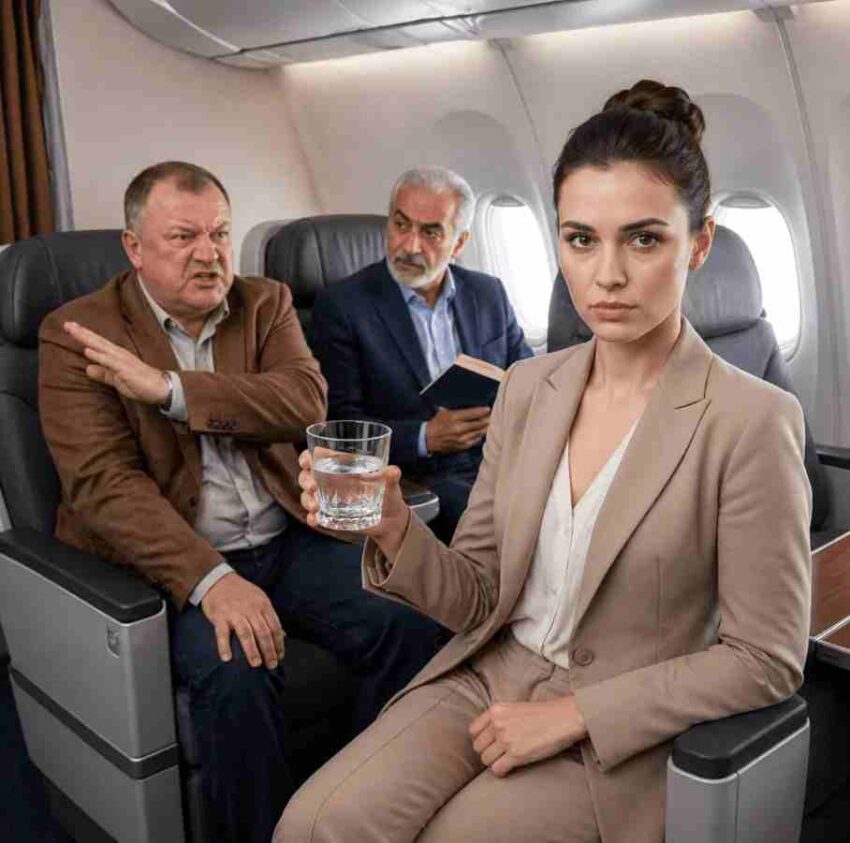
She picked up a crystal glass. Heavy, expensive-looking, absurdly fragile for something so simple. She placed perfectly shaped ice cubes inside and poured still water with precise control. Every movement was practiced, efficient, almost automatic.
When she stepped into the first-class cabin, the atmosphere changed instantly. The lighting was softer, more controlled. Everything felt quieter, more expensive—not just the seats, but even the silence itself.
Arkady sat in the first row. A broad, heavy man in a tailored suit that seemed slightly too tight, as if even luxury struggled to contain him. He spoke loudly, gesturing constantly, performing confidence rather than simply possessing it.
Beside him sat Amir—a calm, composed investor with sharp intelligence in his eyes and an effortless stillness in his posture. He held a book, listening more than speaking, his presence subtle but unmistakably dominant in a different way.
Arkady was talking about his “premium construction empire,” his voice swelling with self-importance.
“We only use the highest-grade materials,” he said loudly. “No compromises. That’s how real business is done.”
Amir replied without looking up immediately.
“True quality is not only in materials,” he said calmly, “but in how you treat the people who build them.”
Arkady smirked, dismissing it as philosophy.
Uljana approached.
“Your water, sir,” she said politely, placing the glass on the tray table.
At that exact moment, the plane dipped slightly into a pocket of turbulence. Nothing dramatic—just a brief shift, like a breath in the sky.
Arkady’s elbow struck the tray.
The glass tilted.
In a split second, Uljana reacted. Her hand caught it before it could fall. The crystal remained intact. But a few cold drops escaped the rim—and landed on the crisp white cuff of Arkady’s shirt.
Silence.
Then explosion.
“What are you doing?!” Arkady barked, his voice cutting through the cabin. “Can’t you even carry a glass properly?!”
His irritation was not just about the water. It was about being seen, interrupted, slightly embarrassed in front of Amir.
“I apologize, sir,” Uljana said evenly. “I will bring napkins immediately.”
But Arkady wasn’t finished. His tone sharpened further, his ego demanding dominance. And then he shifted languages—deliberately.
He switched into Arabic, using a rough, informal dialect, assuming she would not understand.
“This servant can’t even handle a glass,” he sneered. “They hire anyone for these jobs…”
Amir’s expression changed slightly. He closed his book.
Uljana stood still for a moment.
Then she placed the tray down.
Slowly.
Deliberately.
And looked directly at Arkady.
When she spoke, her voice was calm—but what followed was unexpected.
Fluent, precise Arabic. Educated. Clear. Controlled.
“True dignity,” she said softly, “is not measured by the price of a ticket, but by how a person treats those who cannot respond to them as equals.”
The cabin froze.
Arkady blinked, confused, the confidence draining from his face in real time.
Amir’s gaze sharpened, then softened into quiet approval.
For the first time, Arkady had nothing to say.
And something in the balance of the cabin shifted—permanently.