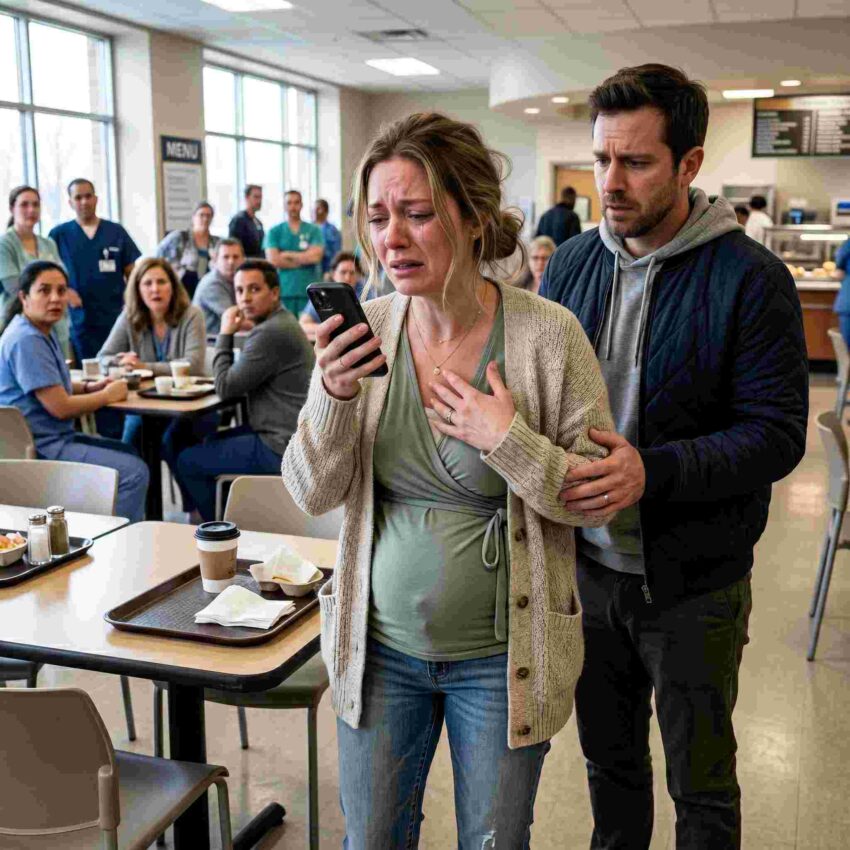
I answered, and the first thing I heard was my brother Tyler sobbing so hard he sounded like a stranger.
“Marissa,” he said, “it’s Mom. Dad. Aunt Diane. There was a crash.”
The cafeteria around me kept moving—plastic trays scraping, nurses laughing softly over coffee, a vending machine humming like nothing in the world had split open. I pressed the phone harder to my ear, one hand over my other ear, as if I could block out everything except the truth I was not ready to hear.
“What crash?”
“On I-95. Coming back from the gala. A truck jackknifed. Dad’s in surgery. Mom’s unconscious. Diane…” He stopped.
My body went cold. Five weeks earlier, I had sent one sentence into the family chat from a room full of machines and alarms: We’re in the NICU, please pray. My son Noah had been three pounds, wrapped in wires, fighting to breathe under blue hospital light.
Aunt Diane had replied with a photo of herself at the St. Jude charity gala in a silver ballgown, champagne flute raised, diamond bracelet shining.
Praying from here, darling. Stay strong.
Nobody came. Not my parents. Not Tyler. Not Diane. They sent heart emojis, vague promises, and then silence. My husband Ethan had slept sitting up beside Noah’s incubator while I learned to pump milk with shaking hands and smile at nurses who said, “He’s doing better today,” like today was a country we might survive.
Now Tyler was calling me as if I had been waiting in a quiet room for my family to need me.
“Where are you?” I asked.
“Mercy General. Baltimore. I’m alone here. I need you.”
I looked through the cafeteria window toward the NICU hallway. Upstairs, Noah was still on oxygen. Ethan was with him, reading Goodnight Moon in a whisper. I had gone downstairs for soup I never ate.
“I can’t leave,” I said.
There was a stunned pause.
“What do you mean you can’t leave?”
“My son is in the NICU.”
“Marissa, Dad might die.”
“My son almost did.”
The words came out flat, not cruel, not loud. Just finished. Tyler inhaled sharply like I had slapped him.
“I know you’re upset,” he said. “But this is serious.”
I laughed once, and it scared me because there was no humor in it.
“This has been serious for five weeks.”
“Mom asked for you before they sedated her.”
That pierced something. I pictured my mother, Elaine, with blood in her silver hair, asking for the daughter whose baby she had never held, whose hospital room she had never entered.
Then another call flashed across my screen: ETHAN.
I switched lines.
His voice was tight. “Marissa, come upstairs now. Noah’s oxygen dropped. They’re calling the neonatologist.”
For one second, both emergencies stood in front of me like doors on fire.
Then I ran toward my son.
The elevator took too long. I hit the button again and again until a man in scrubs glanced at me, then looked away when he saw my face. When the doors opened, I pushed through before anyone could step out.
My phone kept buzzing in my hand.
Tyler. Tyler. Tyler.
Then a text.
You’re really choosing this right now?
I stared at the words as the elevator climbed.
This.
My son was not “this.” My five-week-old baby with translucent skin and a fist no bigger than a plum was not an inconvenience blocking me from the real family crisis. Noah had been born at thirty weeks after my blood pressure spiked and the doctors stopped speaking in calm voices. I remembered Ethan’s face above mine in the operating room, pale behind his mask. I remembered asking, “Is he crying?” and nobody answering fast enough.
The elevator doors opened to the NICU floor. I shoved the phone into my cardigan pocket and hurried through the double doors after scrubbing in so fast the sink water splashed up my sleeves.
Inside, the room was bright and controlled. Too controlled. Nurses moved quickly around Noah’s isolette. Ethan stood near the wall, both hands locked behind his neck. His eyes found mine and broke.
“He had a brady episode,” he said. “His heart rate dipped. They’re stabilizing him.”
I went to the isolette. Noah lay under a small striped blanket, chest fluttering under tape and wires. His tiny mouth opened around the oxygen tube as if he wanted to complain but did not have the strength.
Dr. Patel, the neonatologist, looked over at me. “He’s responding. We may need to adjust respiratory support for a while, but he’s coming back up.”
Coming back up.
I held on to those words because there was nothing else to hold.
My pocket buzzed again. I ignored it. Ethan noticed.
“Your family?” he asked.
I nodded.
“The accident?”
I turned to him. He already knew. Tyler must have called him too.
“Your dad’s in surgery,” Ethan said softly. “Your mom is critical. Diane died at the scene.”
The room seemed to tilt, but not in the way I expected. Diane, with her silver gown and public kindness and private sharpness, was simply gone. The woman who had posted gala photos while my son was under a heat lamp would never post anything again.
I waited for grief to arrive cleanly. It came tangled with anger, guilt, exhaustion, and the memory of her perfume filling every family Thanksgiving while she told me I was “too sensitive” if I objected to being mocked.
“I can’t go,” I whispered.
Ethan took my hand. “I know.”
But the calls did not stop.
By evening, Noah was stable but still fragile. Ethan convinced me to eat crackers and drink water from a paper cup. I sat in the parent lounge and finally called Tyler back.
He answered on the first ring.
“Where the hell have you been?”
“In the NICU.”
“You keep saying that like it’s a magic excuse.”
I closed my eyes. On the bulletin board across from me was a flyer about premature infant CPR classes. Below it, a photo of a baby who had graduated from the NICU months earlier, round-cheeked and smiling in a knitted hat.
“Tell me what happened,” I said.
Tyler’s anger cracked under his fear. He told me the gala had run late. Dad insisted on driving because he did not like valet attendants adjusting his seat. Diane sat in the front, complaining about her heels. Mom was in the back, texting someone from the charity board. Rain came down hard near the interstate split. A semi lost control. Dad swerved. Their car hit the barrier, then another vehicle struck them from behind.
“Dad’s spleen ruptured,” Tyler said. “They stopped internal bleeding, but he’s not awake yet. Mom has a brain bleed. They’re watching pressure.”
I listened.
Then he said, quieter, “Diane’s daughter is flying in from Chicago. She’s hysterical.”
I thought of my cousin Rebecca, who had not texted once about Noah except to send a thumbs-up emoji when Ethan posted that he was off the ventilator.
“I’m sorry,” I said, because I was. Death was still death.
Tyler exhaled. “So you’ll come?”
“No.”
The silence turned heavy.
“No?” he repeated.
“Noah had another episode today. I am not leaving this hospital unless he’s transferred, discharged, or dead. Those are the only options.”
“That’s disgusting.”
“What is?”
“Using your baby like a weapon.”
The words landed so hard that for a moment I could not speak. Then something inside me, something that had been bending for years, finally stopped bending.
“No,” I said. “A weapon is what you use to force someone to bleed. My baby is a patient. I am his mother. Those are not the same.”
Tyler began to argue, but I cut him off.
“For five weeks, all of you knew where I was. Room 412, then NICU Pod C. You knew I was recovering from surgery. You knew Noah could not breathe on his own. Not one of you came.”
“People have lives, Marissa.”
“So do I.”
I ended the call before he could answer.
That night, I sat beside Noah until sunrise. Around 3 a.m., Ethan fell asleep in the chair, chin to chest, his hand still resting against the isolette. I watched our son breathe. Every rise of his chest felt like a vote being counted.
At 6:17, my mother’s name appeared on my phone.
For a second, hope lifted me.
But when I answered, it was not her.
It was Tyler again, voice hollow.
“Mom’s awake,” he said. “And she’s asking why you abandoned her.”
I did not answer quickly. I looked at Noah, who was sleeping with one hand pressed against his cheek as if holding in a secret. The monitor above him flashed numbers that had become more familiar to me than my own reflection.
“Put her on,” I said.
Tyler hesitated. “She’s weak.”
“Then don’t waste her strength speaking for her.”
There was rustling, a muffled argument, then my mother’s voice came through, thin and drugged but unmistakably hers.
“Marissa?”
“I’m here.”
A breath. A machine beeped on her end too, slower than Noah’s.
“Why aren’t you here?” she asked.
I had imagined this conversation so many times, but never with her in an ICU bed and me in a NICU chair. In my imagination, I was sharper. I had perfect sentences. In real life, I was tired enough to be honest.
“Because Noah is still in the hospital.”
“I know, honey, but your father—”
“My son,” I said, “is your grandson.”
She went quiet.
I could hear Tyler whispering near her, probably telling her not to get upset. That was how our family worked. Everyone protected the person who made the most noise, and everyone else learned to whisper around them.
Mom finally said, “We thought you had Ethan.”
“I did. Ethan had me. Noah had both of us. We still needed you.”
“You told us to pray.”
“I told you where we were.”
The silence that followed was not empty. It was crowded with every unanswered message, every holiday where I had driven two hours to keep peace, every birthday dinner where Tyler’s problems became family emergencies and mine became “drama.”
Mom began to cry softly. “Diane is gone.”
“I know.”
“She loved you.”
I almost laughed, but I did not. Diane loved performances. She loved being seen loving people. She loved fundraisers, speeches, photographs with sick children whose names she forgot before dessert. But saying that to my mother, half-conscious and broken, would not change anything.
“I’m sorry she died,” I said. “I’m sorry you’re hurt. I’m sorry Dad is hurt. But I’m not sorry I stayed with my baby.”
Her crying changed then. Less wounded, more frightened. Maybe she heard the wall in my voice and understood it was not built overnight.
Three days later, Dad woke up. He had cracked ribs, surgical drains, and a rage big enough to fill the trauma ward. He called me himself.
“Family shows up,” he said, without hello.
I was in the pumping room, holding plastic bottles of milk Noah might be strong enough to drink later.
“Yes,” I said. “It does.”
“You proving a point?”
“No. I’m living one.”
He cursed under his breath. Then he said the sentence that sealed it.
“Your aunt’s funeral is Saturday. Don’t embarrass us.”
I looked down at the two ounces of milk I had fought twenty minutes to make.
“I won’t be there.”
“You selfish little—”
I hung up.
On Saturday, Diane was buried beneath a white tent in a cemetery outside Baltimore. I know because Rebecca posted photographs: white roses, black umbrellas, my father in a wheelchair, my mother with a bandage visible beneath her hat. The caption read, Family is everything.
That same morning, Noah was moved from the isolette to an open crib.
No cameras captured it except Ethan’s phone. No donors applauded. No one wore diamonds. Our son wore a yellow preemie onesie with ducks on it, too large in the sleeves, and when the nurse placed him in my arms without wires blocking his face, I cried so hard Ethan had to sit beside me and steady my elbow.
A week later, Tyler came to the hospital.
He stood outside the NICU doors holding a paper bag from a deli and looking smaller than I remembered.
“I’m not here to fight,” he said.
“Good.”
He glanced through the glass. “Can I see him?”
“You can look from here. He’s not ready for visitors.”
For once, Tyler did not argue. He stared at Noah through the window, at the tiny rise and fall of his chest, at the tape on his cheek, at the socks that would not stay on his feet.
“I didn’t get it,” he said.
“No. You didn’t.”
“I thought because he was alive, things were okay.”
I leaned against the wall. “Alive is not the same as okay.”
He nodded, eyes red. “Mom wants to come when she’s discharged.”
“She can ask me herself.”
“She’s scared you’re done with everyone.”
I watched my brother carefully. “I’m done begging people to love me correctly.”
Noah came home eighteen days later with an oxygen monitor, three follow-up appointments, and a discharge folder thick enough to qualify as luggage. My parents did not meet him at the door. Diane never would. Tyler came by with groceries and left them on the porch without ringing.
That evening, Ethan and I sat on the couch while Noah slept against my chest. Outside, our quiet Maryland street turned gold in the sunset. My phone lit up with a message from Mom.
I’m sorry I wasn’t there. I want to do better.
I read it twice, then set the phone down.
Maybe she would. Maybe she would not. The difference was, my life no longer waited for her to decide.
Noah stirred, opened his dark unfocused eyes, and made a small sound like a complaint against the world.
I kissed his forehead.
“We’re here,” I whispered.
And for the first time in weeks, that was enough.