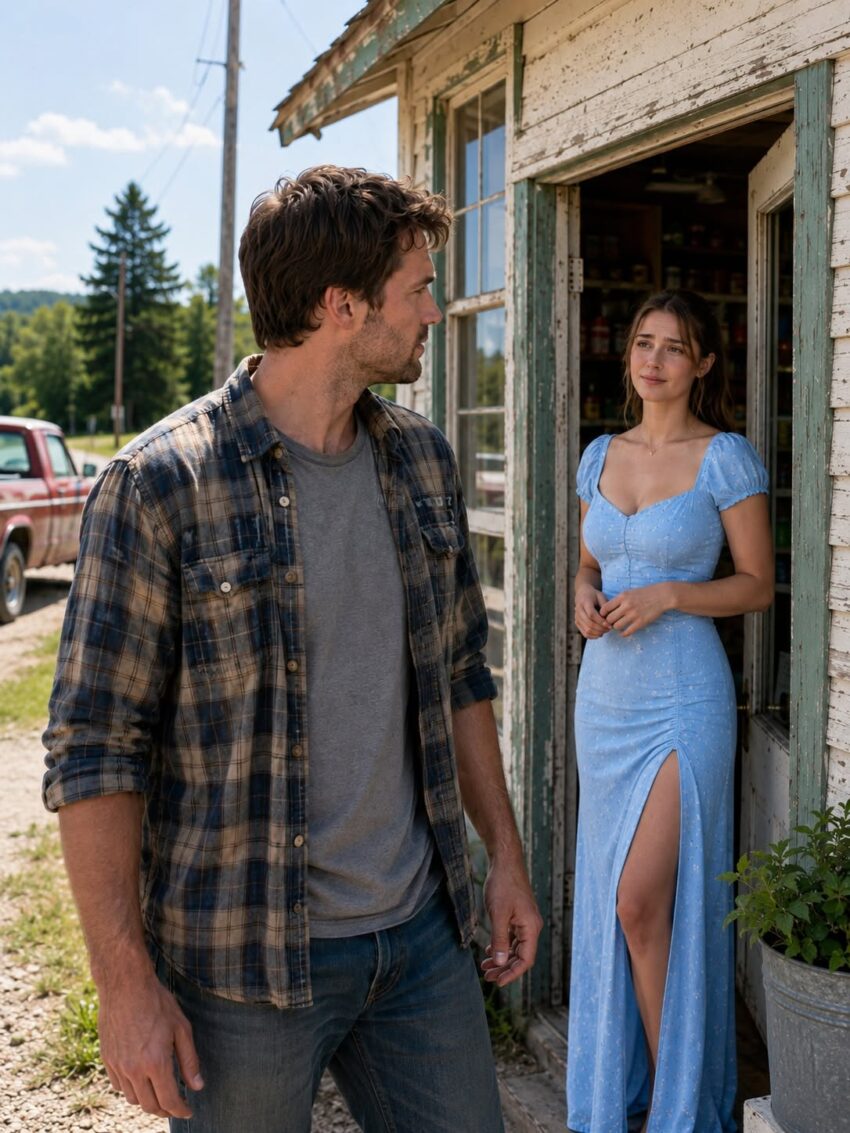
“I need a wife by tomorrow morning.”
The second those words left my mouth, every person inside the grocery store turned and stared at me like I had just confessed to a crime.
Maybe I had.
Because seven years earlier, I had ignored the woman I loved when she needed me most. Now she was dead, and the daughter I never knew existed was sitting in emergency foster care, asking why her father had never come for her.
The court wanted proof I could give her a stable family.
And I had less than twenty-four hours to find one.
PART 1
“I need a wife by tomorrow morning,” I said, and the whole store went dead silent.
A woman holding a loaf of wheat bread froze by the register. Old Mr. Harlan stopped stirring his coffee. Even the bell above the front door seemed to quit swinging.
Elra Voss stared at me from behind a stack of milk cartons.
Her face did not soften.
Her eyes did not blink.
She just said, very slowly, “Daniel Mercer, either you are drunk, dying, or out of your mind. Which one is it?”
“I just found out I have a daughter,” I said.
That sentence hit the room harder than the first one.
Elra’s hand tightened around the carton. “Come with me.”
She did not ask. She ordered.
She led me through the narrow door behind the counter into the storage room of her grocery store and coffee shop. The room smelled like roasted beans, cardboard boxes, peppermint tea, and rain-soaked coats.
Outside, half the town was pretending not to listen.
Inside, Elra crossed her arms and looked at me like I was a problem she had not decided whether to solve or throw out.
“Start talking,” she said. “And don’t make it cute.”
So I told her everything.
My name was Daniel Mercer. Thirty-four years old. Twenty acres outside Eugene, Oregon. A farmhouse with a sagging porch, a greenhouse that leaked when it rained too hard, chickens with bad attitudes, three goats, and a tractor that broke down every time I needed it most.
I told her about Catherine Walsh.
Seven years ago, Catherine and I had loved each other in that reckless, stubborn way young people do when they think love can survive anything.
She wanted Portland.
I wanted the farm.
She wanted galleries, city lights, a real apartment, Sunday brunch, a life that did not smell like wet soil and engine grease.
I wanted to keep the land my parents had left me.
The last night I saw her, rain was coming down behind the coffee shop on Fifth Street. She stood in the parking lot with her coat clutched closed, crying so hard her mascara had run down her cheeks.
“You’re not choosing me, Daniel,” she said. “You’re choosing dirt.”
I was too proud to say, “I’m scared.”
Too proud to say, “Please stay.”
Too proud to say, “I love you more than this land, but this land is all I know how to hold on to.”
So I said, “I can’t walk away from everything my parents built.”
She stared at me like I had just shut a door in her face.
“Then stay with it,” she whispered.
Then she got in her car and drove away.
I told myself I would call her in a week.
Then next week.
Then after harvest.
Then after winter.
She texted.
I read the messages.
I did not answer.
She emailed.
I opened them.
I closed them.
I told myself she needed space.
The truth was uglier.
I was a coward.
Elra did not interrupt me. She just stood there, quiet and sharp, letting every word hang between us.
“Yesterday afternoon,” I continued, “I was fixing an irrigation line in the greenhouse when a lawyer called. Her name is Linda Carver. She said Catherine died ten days ago.”
Elra’s face changed then.
Not much.
But enough.
Her jaw tightened. Her arms lowered slightly.
“She had surgery,” I said. “There was an infection. Complications. She didn’t make it.”
The storage room felt too small.
I could still hear Linda’s voice on the phone.
Careful.
Professional.
Sorry in the way lawyers are sorry when they know the next sentence will ruin your life.
“Catherine had a daughter,” I said. “Ivy Walsh. Seven years old.”
Elra’s eyes narrowed.
“She left a letter saying I’m Ivy’s biological father. There was a private DNA test, but the court still wants an official one.”
Elra pulled out a chair and sat down.
“Where is the girl now?”
“Emergency foster care in Portland.”
“Does she know about you?”
“Yes.”
“And what does she think?”
I looked down at my hands. They were cracked, dirty around the nails even after washing, and shaking like I had no control over them.
“She thinks I left her mother,” I said. “She thinks I abandoned them.”
Elra’s voice was flat. “Did you?”
I could have defended myself.
I could have said I did not know Catherine was pregnant.
I could have said nobody told me.
I could have said the phone works both ways.
But the truth sat heavy in my chest.
“I left Catherine,” I said. “And when she tried to reach me, I ignored her. So yes. Maybe I did.”
Elra leaned back.
There was no pity in her eyes, and somehow that was worse than pity.
“What does this have to do with you needing a wife?”
I took a folded letter from my jacket pocket. My fingers shook as I placed it on the table.
“Catherine asked me to give Ivy a home. Her last letter said, ‘If any part of you is still the man I loved, don’t let her think she’s been left behind again.’”
Elra looked at the letter but did not touch it.
“The emergency hearing is tomorrow morning,” I said. “The court wants proof I can give Ivy stability. Housing. Income. A care plan. Family structure.”
Elra laughed once, but there was no humor in it.
“So your solution is to marry the nearest woman who owns a coffee machine?”
“No,” I said. “My solution is to ask the only person in town I’ve ever seen calm a crying child without making them feel small.”
That made her look away.
For one second, something old and painful flashed across her face.
Then it was gone.
“Daniel,” she said, “do you understand what you’re asking?”
“Yes.”
“No,” she snapped. “You don’t.”
She leaned forward.
“You are asking a woman you barely know to marry you overnight, move onto your farm, stand in front of a judge, and help you convince the state that a grieving seven-year-old girl should be placed in your care. That child is not a court form. She is not a farm tool you forgot to pick up. She is a human being whose mother just died.”
“I know.”
“She may hate you.”
“I know.”
“She may hate me.”
“I know.”
“She may scream, shut down, refuse to eat, refuse to trust, refuse to call you anything but your name. She may spend every day testing whether the adults around her will leave.”
My throat closed.
“I know,” I said again, but this time it came out weaker.
Elra’s eyes hardened.
“No. You are panicking. There is a difference.”
That one landed.
Because she was right.
I was panicking.
I was full of guilt, fear, grief, and a strange, brutal love for a child whose face I had not even seen in person yet.
“I have money,” I said quickly, reaching for the envelope in my jacket. “Not much, but enough. The farm is paid off. I have contracts with two restaurants, farmers market income, repair work in winter. I have eighteen thousand in savings. I can transfer ten thousand to you today as security. I’ll sign a legal agreement. Co-ownership during the marriage. Divorce after a year if you want. You keep the money.”
Elra stared at the envelope like it had insulted her.
“You think I’d do this for money?”
“No,” I said. “I think you’d be smart enough not to do it without protection.”
That stopped her.
For a long moment, the only sound was the muffled chatter outside the door.
Then Elra stood and turned toward a small framed photograph on the wall.
It was an old classroom picture.
Twenty kids lined up in front of a school building.
One little girl in the second row had braids, a missing front tooth, and a smile bright enough to hurt.
Elra’s voice changed.
“Six years ago, I was a teacher.”
I stayed quiet.
“There was a girl in my class named Clara. Eight years old. Sweet kid. Always hungry. Always tired. Sometimes she came to school with bruises. She said she fell. I didn’t believe her.”
Elra’s hand pressed flat against the table.
“I wanted to report it. I almost did. But I was scared. Scared I didn’t have enough proof. Scared if I was wrong, I’d make things worse. So I waited.”
Her face went still in a way that scared me.
“One winter night, Clara ran away from home and came to the school. She thought I could help her. The doors were locked. They found her the next morning on the steps.”
My stomach turned cold.
“She died from the cold,” Elra said.
I had no words.
None that were not insulting.
Elra looked back at me.
“After that, I quit teaching. I opened this store. I stopped letting people need me.”
She picked up Catherine’s letter then.
Her eyes moved over the final lines.
“If I agree,” she said, “it will not be because of you. It will not be because of your money. It will be because I am not standing still again while a child needs an adult to move.”
“Elra—”
She raised one hand.
“I have conditions.”
I sat up straight.
“Name them.”
“First. Ivy comes first. Not your guilt. Not your pride. Not your need to be forgiven. The child. Always.”
“I agree.”
“Second. You do not force her to call you Dad. You do not force her to love you. You show up and let her decide what to do with that.”
“I agree.”
“Third. We tell her the truth at a level she can handle. No fake love story. No pretending we are some perfect couple who fell into a fairy tale.”
“I agree.”
“Fourth. If I ever believe you are hurting that child, emotionally or physically, I will report you. I will not protect you because we signed a paper.”
I looked straight at her.
“If I ever become a danger to her,” I said, “you won’t need to report me. I’ll leave myself.”
Elra studied me.
Then she asked the question I was not ready for.
“Did you love Catherine?”
The rain came back in my memory.
Her coat.
Her crying.
Her taillights disappearing.
“Yes,” I said. “And I was too much of a coward to say it when it mattered.”
Elra was silent for a long time.
Then she pushed the envelope back toward me.
“Keep your money for the child.”
My breath caught.
She stood.
“I’ll marry you.”
I almost knocked over the chair.
“But before we go to court,” she said, pointing at me, “you are going home and making that room look like a child was wanted, not stored. Books. Art supplies. Clean blankets. A lockbox for her mother’s things. And for heaven’s sake, Daniel, shower. If I’m marrying a man before breakfast, he is not showing up looking like he lost a fight with a tractor.”
For the first time in two days, I laughed.
It almost broke me.
Elra opened the storage room door.
Every customer outside suddenly became fascinated by bread, coffee, ceiling tiles, and their own shoes.
At the front counter, Elra looked back at me.
Her voice was low.
“Daniel, I am putting my life into this.”
“I know.”
“Don’t make me regret it.”
I met her eyes.
“I won’t promise with words,” I said. “I’ll prove it with what I do.”
She nodded once.
“Marriage office. Eight tomorrow morning.”
And as I stepped out into the rain, I realized the easiest part might have been asking her.
The hard part was going to be facing the little girl who had every reason to hate me.

PART 2
The clerk pronounced us husband and wife like she was afraid the building might explode.
There was no kiss.
No music.
No flowers.
Just two signatures, one emergency marriage certificate, and a woman named Martha staring at us over her glasses like she had never processed paperwork for a disaster before.
Elra wore a simple gray dress and a cream coat.
I wore a white button-down shirt I had not touched since my father’s funeral.
I had shaved. I had combed my hair. I had even cleaned the dirt from under my nails with a pocketknife at five in the morning.
I still looked like a man who had not slept.
Elra looked me over once and said, “At least the court won’t call security.”
“Thank you,” I said. “I think.”
“Don’t get used to compliments.”
Fifteen minutes later, we were standing outside family court.
Linda Carver, Catherine’s lawyer, waited by the hearing room with a leather folder pressed against her chest.
She looked at our marriage certificate.
Then at Elra.
Then at me.
“This helps,” Linda said carefully. “But do not overplay it. Social workers can smell performance from across a courthouse.”
Elra answered before I could.
“We are not here to sell a fairy tale. We are here because a child needs a safe home.”
Linda studied her for half a second.
Then she nodded.
“Good.”
The hearing lasted almost two hours.
Mrs. Grant, the social worker, had silver hair, sharp eyes, and a voice that could cut straight through lies.
She asked about my income.
My work hours.
The farm.
The nearest school.
Health insurance.
Emergency contacts.
My experience with children.
My answer to that last one was humiliating.
“Not enough,” I admitted.
Mrs. Grant wrote something down.
My stomach dropped every time her pen moved.
Then she turned to Elra.
“Mrs. Mercer, why did you agree to marry a man this quickly?”
Elra did not flinch at the new last name.
“Because a child who just lost her mother should not be bounced from home to home if her biological father can provide a safe, stable life,” she said.
Mrs. Grant looked over her glasses. “Do you love Mr. Mercer?”
My body went still.
Elra glanced at me for half a second.
Then she looked back at Mrs. Grant.
“Not in the way people usually mean when they ask that question,” she said. “But I respect him. I believe he wants to do the right thing. And right now, that matters more than pretending this is romantic.”
The room went quiet.
Mrs. Grant’s pen stopped.
“At least you’re honest,” she said.
That afternoon, we drove to Portland to meet Ivy.
I thought I had prepared myself.
I had not.
When the door opened and a small girl stepped into the room clutching a purple backpack against her chest, every apology I had practiced disappeared.
She had Catherine’s dark hair.
My gray eyes.
And a face too serious for seven years old.
Linda crouched beside her.
“Ivy, this is Daniel Mercer.”
Not your father.
Not Dad.
Daniel Mercer.
I was grateful for that.
I lowered myself to one knee.
“Ivy,” I said.
Her eyes locked on mine.
“You’re the one who left my mom.”
The sentence went through me like a blade.
Behind me, Elra took a quiet breath but did not step in.
I nodded.
“Yes,” I said. “I left. And I was wrong.”
Ivy’s grip tightened on her backpack straps.
“Mom said you used to be good.”
My throat burned.
“Your mom was better than I ever was.”
“Mom said you didn’t know about me.”
“I didn’t,” I said. “But that wasn’t her fault. She tried to reach me. I didn’t answer. I was a coward.”
Mrs. Grant watched me closely.
So did Linda.
So did Ivy.
Especially Ivy.
She asked the question that mattered most.
“If I go with you, are you going to leave again?”
Every instinct in me wanted to say, “Never.”
But I remembered Elra’s condition.
No empty promises.
So I said, “I’m going to be there every day. You don’t have to believe me today. I’ll show you.”
Ivy looked past me.
“Who are you?”
Elra stepped forward and sat in a low chair so she was not towering over her.
“I’m Elra.”
“Are you his wife?”
“Yes.”
“Because of me?”
Elra did not smile.
“Partly because of you. Mostly because adults sometimes need to act fast when a child needs help.”
Ivy stared at her.
“Do you love him?”
I stopped breathing.
Elra answered calmly.
“I don’t know yet. But I know I won’t lie to you just to make things easier.”
Something shifted in Ivy’s face.
Not trust.
Not yet.
But attention.
“What if I don’t like the farm?”
“Then you say so,” Elra said. “Mrs. Grant will keep checking on you. The lawyer will keep checking. You will not be trapped.”
Ivy looked down.
“Mom had a box. I want to bring it.”
I spoke too fast.
“You can bring everything that belonged to her. Nobody will throw anything away.”
Ivy’s mouth trembled.
“Adults say that. Then they throw things away later.”
Elra’s voice was steady.
“Then you keep the key. Your mother’s things belong to you.”
Ivy looked at her longer than she looked at me.
Finally, she whispered, “Just for now.”
I swallowed hard.
“For now is enough.”
The drive back to the farm was quiet.
Ivy sat in the back seat with her backpack and a cardboard box on her lap. Every few minutes, I caught her watching me in the rearview mirror.
Then she would look away.
The sun was going down when we turned onto the dirt road.
The greenhouse glowed orange. The porch light flickered. Queenie, the meanest hen on earth, strutted near the fence like she owned the deed.
Ivy looked out the window.
“This is your house?”
“It’s mine,” I said. “And if you want, it can be yours too.”
She did not answer.
Inside, she stood in the living room and took inventory like a tiny judge.
Old sofa.
Kitchen table.
Wood stove.
Photos of my parents.
A Bible my mother had kept on a side table even though none of us had gone to church regularly after my father got sick.
Then she looked toward the stairs.
“Your room is up here,” I said.
I led her to the spare room.
The bed had clean sheets and a blue quilt. There were children’s books on the shelf. Drawing paper and colored pencils sat on the desk by the window. Under the bed was a wooden chest I had built through the night, with a small brass lock on the front.
Ivy stepped inside slowly.
She touched the chest with her fingertips.
“What is this?”
“For your mom’s things,” I said from the doorway. “Elra said you needed somewhere safe.”
Ivy opened the lid.
Inside was a folded cloth and a small key.
Her hand shook when she picked it up.
“You made this?”
“Last night.”
She turned toward me.
For one second, her anger cracked.
Then she said, “I don’t need a father.”
It hurt.
But I stayed still.
“I know,” I said. “But if there’s ever a day you want one, I’ll be here.”
Ivy looked at me for a long time.
Then she turned away.
“I want to be alone.”
Elra nodded from behind me.
“That’s okay. We’ll be downstairs.”
When Ivy’s door closed, I went to the kitchen and sat at the table.
I put my hands under it so Elra would not see them shaking.
She set a glass of water in front of me.
“You did well,” she said.
“She said she doesn’t need a father.”
“She just lost her mother,” Elra said. “She does not need a perfect father arriving seven years late. She needs a man patient enough to be hated and still stay.”
I looked at her.
“Do you think I can do that?”
Elra did not give easy comfort.
That was one of the first things I learned about her.
Finally, she said, “I think you can learn.”
The first few weeks were brutal in quiet ways.
Ivy did not throw plates or scream.
She did worse.
She disappeared into herself.
She kept her door locked. She ate three bites of breakfast because Elra told her bodies needed food even when hearts were broken. She carried her sketchbook everywhere like armor.
She called me Daniel when she had to.
Most of the time, she called me nothing.
Elra moved into the downstairs bedroom.
I stayed upstairs.
On paper, we were married.
In that house, we were two adults trying not to ruin a child.
Every morning, I worked the farm before sunrise.
Every morning, Elra made breakfast.
Every morning, Ivy came down with messy hair, tired eyes, and a guarded face.
One Thursday, she pushed her eggs away.
“I’m not hungry.”
Elra sat across from her.
“I know grief can make food taste like cardboard. Three bites. Then I won’t bother you.”
Ivy glared.
Elra waited.
Ivy ate exactly three bites.
I stood at the sink pretending to wash a clean mug and felt like I had witnessed a miracle.
Later, Ivy left a drawing on the kitchen table.
It was one of the goats. Maple. Crooked ear. Dumb eyes. Somehow full of personality.
I stared at it too long.
Elra noticed.
“Daniel,” she said loudly enough for Ivy to hear from the living room, “what do you think of Ivy’s drawing?”
I panicked like a man being questioned by police.
Then I said, “I think Maple looks smarter in the drawing than she does in real life.”
From the living room, Ivy said, “Maple is smarter than you think.”
It was the longest sentence she had said to me since arriving.
I nodded seriously.
“Then I owe Maple an apology.”
The corner of Ivy’s mouth twitched.
Not a smile.
But almost.
That night, I went to the workshop and carved a small wooden goat based on her drawing. I worked until after midnight, sanding the edges smooth, getting the crooked ear as close as I could.
The next morning, I left it on her desk.
At breakfast, Ivy came downstairs holding it.
“You made this?”
“Yeah,” I said, keeping my eyes on the sink. “The ears are off.”
“Maple’s ears are off.”
Then she hugged it to her chest for half a second.
Quick.
Secret.
But I saw it.
So did Elra.
And the look she gave me made my chest hurt in a new way.
Not from guilt.
From hope.
Little by little, the farm began to claim Ivy.
She followed Elra into the garden. She learned weeds from vegetables. She fed the chickens. Queenie chased her across the yard one afternoon, and Ivy screamed like the devil himself was wearing feathers.
I came running from the greenhouse.
Ivy hid behind Elra.
“She hates me!”
Elra tried not to laugh.
“Queenie hates everyone. Don’t take it personally.”
I grabbed the feed bucket and lured Queenie away.
“On this farm,” I told Ivy, “Queenie is the real boss. We just pay taxes in corn.”
Ivy laughed.
Small.
Shocked by herself.
Then she covered her mouth like she wanted to take it back.
But laughter had already entered the house.
And once it did, everything changed by one inch.
One inch was enough to keep going.
But the next test would not come from Ivy.
It would come from the court.
And one sentence from Mrs. Grant could take her away again.
PART 3
Three months after Ivy came home, the social worker walked through my front door like she was carrying my whole future in a clipboard.
Mrs. Grant arrived at ten in the morning.
I had been awake since four.
I scrubbed the kitchen twice. Swept the porch. Checked the smoke detectors. Organized Ivy’s school papers. Cleaned the chicken coop, then realized no judge in America cared whether Queenie had fresh straw.
Elra finally set her coffee cup down hard.
“Daniel. Stop.”
I was holding a dish towel like it might save my life.
“What if the house doesn’t look stable enough?”
Elra looked around the spotless kitchen.
“If you clean one more thing, she’ll think we’re hiding evidence.”
I tried to laugh.
It came out wrong.
“What if Ivy tells her she wants to leave?”
Elra did not lie.
“Then we listen.”
My chest tightened.
“But,” she added, softer, “you have given her reasons to stay.”
Mrs. Grant inspected everything.
Ivy’s room.
The locked chest.
The drawings taped to the wall.
The wooden animals lined on the shelf.
The school schedule on the fridge.
The medical folder Elra had organized so neatly it looked like evidence for a trial.
Then Mrs. Grant asked to speak with Ivy alone.
Elra and I waited on the porch.
I paced until she said, “You are going to wear a trench in the floorboards.”
I stopped.
“Sorry.”
She watched me for a moment.
“You’re scared because you love her.”
I stared out at the driveway.
“Loving someone who might never forgive you is harder than I thought.”
Elra’s mouth softened.
“Welcome to parenting.”
Fifteen minutes later, the door opened.
Mrs. Grant came out first.
Ivy followed behind her, holding the wooden goat.
Mrs. Grant’s face gave nothing away.
“Ivy says she still misses her mother,” she began.
My stomach dropped.
“She says she is still angry with you.”
I nodded.
“She has every right to be.”
Mrs. Grant continued.
“She also says she is fed. She is safe. She is allowed to keep her mother’s belongings. She is not forced to call you Dad. She is not forced to forgive you before she is ready.”
My eyes burned.
“She told me she wants to stay.”
The breath left my body.
Beside me, Elra squeezed my hand once.
Quick.
Quiet.
Enough to keep me standing.
Mrs. Grant said she would recommend continuing temporary guardianship, with Elra listed as a supporting caregiver.
After her car disappeared down the driveway, Ivy stood in the yard with the wooden goat in her hand.
“I told the truth,” she said. “I’m still mad.”
I knelt in front of her.
“You’re allowed.”
“But I also said I want to stay.”
“I’m really glad.”
She narrowed her eyes.
“Don’t be weird about it.”
I laughed, and my voice broke halfway through.
“I’ll try.”
For a while, we had peace.
Not perfect peace.
Real peace.
The kind with homework battles, burned toast, muddy boots in the hallway, and Ivy telling Queenie she was “emotionally unstable poultry.”
Elra started closing the store early twice a week to be home for dinner.
Ivy started school.
At first, she refused to let me walk her to the classroom.
Then she allowed me to walk to the front steps.
Then to the hallway.
One Friday, when another child asked who I was, Ivy said, “That’s Daniel.”
I nodded like it did not hurt.
Then, two weeks later, when she was tired and carrying a science project, she muttered, “Ba, can you hold this?”
She froze.
I froze.
Elra, standing by the truck, froze too.
Ivy’s face went pale.
“I didn’t mean—”
“It’s okay,” I said quickly.
“I’m not ready to call you that.”
“I know.”
“Maybe sometimes.”
“I’ll take sometimes.”
That night, I stood in the kitchen long after Ivy went to bed.
Elra came beside me and placed one hand lightly on my arm.
“I don’t know if I deserve this chance,” I said.
“Maybe deserving is not the question,” she replied. “Maybe the question is what you do with it.”
That was the night I realized I was afraid of losing Elra too.
Not because of the court.
Not because of Ivy.
Because every day she stayed, the house became less like shelter and more like home.
Then winter hit.
The flu came fast.
Ivy had a fever by dinner. By midnight, she was burning hot and shaking under the quilt, calling for Catherine in her sleep.
“Mom,” she whimpered. “Don’t go.”
I stood in the doorway useless as a fence post.
Elra sat beside the bed, cool cloth in one hand, thermometer in the other, calm but pale.
I called the doctor. The road was mud from two days of rain. The ambulance would take too long unless her fever crossed the danger line.
I kept staring at Ivy.
Small.
Sweating.
Terrified.
And suddenly I saw Catherine seven years ago, alone in some Portland apartment with a sick baby and no one to call because I had made myself unreachable.
“This is my fault,” I said.
Elra looked up.
Her voice was quiet but sharp.
“Not now, Daniel.”
I stopped.
“She does not need your guilt right now. She needs water. Medicine. The doctor called back in ten minutes. The road checked. Be useful.”
So I was useful.
I got water.
I called the doctor.
I checked the road.
I changed the cloths.
I stopped making my regret the loudest thing in the room.
Near dawn, Ivy’s fever finally broke.
Elra’s shoulders sagged with exhaustion.
“You need rest,” I said.
“I’m fine.”
“Elra.”
She looked at me.
It was the first time I had said her name that softly.
She heard it.
So did I.
She nodded and let me take the chair.
I sat beside Ivy until sunrise.
When she woke, her eyes were weak but clear.
“You stayed all night,” she whispered.
“Yes.”
“Elra too?”
“Yes.”
Ivy stared at the ceiling.
“I was scared you would leave.”
I leaned closer.
“I’m here.”
She looked at my hand resting on the edge of the bed.
Then she placed her small hand on top of mine.
“Today,” she whispered, “you can be Ba.”
I had faced debt collectors, storms, drought, a broken tractor smoking in the driveway, and a courtroom where I thought I might lose my child.
Nothing had ever hit me like that.
“Today is enough,” I said.
After that, Ivy still had hard days.
She still missed Catherine.
She still got angry.
Sometimes she called me Daniel on purpose, usually when I told her to clean her room or stop trying to negotiate with goats.
But sometimes, when she was tired or happy or forgot to guard herself, I was Ba.
Every time, it felt like a gift I had not earned but had been trusted to carry.
One evening in late winter, after Ivy had gone to bed, Elra and I sat on the back porch.
The greenhouse reflected moonlight.
The fields were dark.
The cold air smelled like wet earth.
“Four more months and it’ll be a year,” I said.
Elra looked at me.
I forced myself to continue.
“If you want a divorce when the agreement is over, I’ll keep my word. I won’t use Ivy to trap you. I won’t use the house. You can leave with whatever protection you need.”
Elra was quiet.
Too quiet.
Then she asked, “Do you want me to go?”
“No.”
The answer came out before I could make it safe.
“Then why are you holding the door open like you’re hoping I’ll walk through it?”
“Because if I ask you to stay, I’m afraid it won’t be fair.”
She turned toward me.
“Daniel, I lived alone above that store for six years and called loneliness safety. Then you walked into my shop, panicked, muddy, and ridiculous, asking for a wife like you were ordering fence wire.”
Despite everything, I laughed.
“Not my proudest moment.”
“No,” she said. “But it made me move.”
She looked out over the field.
“I came here because of Ivy. I stayed because of Ivy. But somewhere along the way, I watched you become a father. I watched her learn to trust. I watched this house change.”
Her hand covered mine.
“I do not want a divorce.”
My heart hit my ribs.
“Elra…”
She smiled faintly.
“Are you going to say something, or do I have to keep being the brave one in this family?”
I leaned closer, stopping just short, asking without words.
She nodded.
So I kissed my wife for the first time.
Not for court.
Not for paperwork.
Not for a judge.
For us.
Then a voice from the kitchen doorway said, “Finally.”
We broke apart.
Ivy stood there holding the wooden goat, hair sticking up like she had wrestled her pillow.
“How long have you been there?” I asked.
“Long enough to know you two figured out what I knew last month.”
Elra covered her mouth, laughing.
“You are supposed to be asleep,” I said.
“I’ll sleep after I know Elra isn’t leaving.”
Elra went to her and knelt.
“I’m not leaving.”
“Not because of court?”
“No.”
“Not because I got sick?”
“No.”
“Then why?”
Elra’s eyes filled, but her voice stayed steady.
“Because I want to stay.”
Ivy turned to me.
“What about you, Ba?”
The word nearly took me out.
“I want her to stay too.”
Ivy thought about it seriously.
Then she nodded.
“Okay. Then we’re a real family now.”
And for the first time in my life, I believed I might actually know what those words meant.
But the past was not done with us yet.
Because two weeks later, Catherine’s sealed envelope arrived.
And inside it was a truth none of us saw coming.
PART 4
The lawyer’s envelope arrived on a Tuesday, and the first line inside it nearly knocked me to the kitchen floor.
Daniel, if you are reading this, it means Ivy is with you.
I sat at the table with the letter in both hands.
Elra stood beside me.
Ivy was at school.
Linda Carver had mailed the envelope after the three-month court report confirmed Ivy was stable in our home. Catherine had left instructions. Some documents were not to be released unless I had actually shown up.
I deserved that.
The letter continued.
I tried to tell you about Ivy. I was angry when you didn’t answer. Then I was proud. Then I was tired. But I need you to know something before anyone else gets involved.
Catherine had named me as Ivy’s father.
But she had also left something else.
Bank records.
A life insurance policy.
A small savings account for Ivy.
And one more document that made my hands go cold.
A notarized statement about Catherine’s cousin, Mark Walsh.
I knew the name. Barely.
Catherine had mentioned him once as the kind of relative who showed up when money was nearby and disappeared when dishes needed washing.
According to Catherine’s letter, Mark had contacted her after her diagnosis.
He had offered to “help” manage Ivy’s future.
Then he had tried to pressure her into signing over guardianship and access to Ivy’s savings.
When Catherine refused, he told her a single mother with medical bills should not “act too proud.”
I felt sick.
Elra read the line over my shoulder and went still.
“There’s more,” she said.
There was.
Catherine had saved text messages.
Mark had written:
If Daniel Mercer wanted you, he would have answered. Sign the papers. At least I know how to turn that farm bloodline into money.
Another message:
Once the kid is placed, nobody will care what you wanted.
My fist closed around the paper.
Elra’s hand landed on my wrist.
“Do not tear evidence.”
That sentence brought me back.
By four that afternoon, Linda was at our kitchen table.
By five, Mrs. Grant was on the phone.
By six, we learned Mark Walsh had already filed a petition claiming I was unfit, our marriage was fraudulent, and Ivy would be better placed with “blood relatives from her mother’s side.”
Blood relatives.
That man had not visited Catherine in the hospital once.
He had not taken Ivy to school.
He had not held her through fever.
He had not built a chest for Catherine’s belongings.
But he had smelled money.
And he was coming.
The emergency review hearing was set for Friday.
That night, after Ivy went to bed, I stood on the porch and stared at the dark driveway.
“I should have answered Catherine,” I said.
Elra stood beside me.
“Yes,” she said.
No sugar.
No rescue.
Then she added, “But you are answering now.”
Friday morning, the courthouse felt colder than winter.
Mark Walsh arrived in a navy suit with polished shoes and a smile that never touched his eyes.
He looked me up and down like farm dirt could spread.
“So this is Daniel,” he said. “The missing father.”
I said nothing.
He turned to Elra.
“And the emergency wife.”
Elra’s face did not change.
But I knew her well enough now to see the fire behind her eyes.
Inside the hearing room, Mark’s lawyer painted me as a negligent man who ignored Catherine for seven years and married a woman overnight to manipulate the court.
Every word had just enough truth to hurt.
Then Mark took the stand.
He dabbed at his eyes with a folded handkerchief like a man auditioning for grief.
“My cousin Catherine was vulnerable,” he said. “She made emotional decisions near the end. I only want what is best for Ivy.”
Mrs. Grant watched him closely.
Linda stood.
“Mr. Walsh, when did you last visit Catherine in the hospital?”
Mark hesitated.
“My work schedule was complicated.”
“So you did not visit?”
“I called.”
Linda lifted one page.
“Phone records show Catherine called you twice. You did not answer either call.”
Mark’s smile tightened.
Linda placed another document on the table.
“Did you ask Catherine to sign guardianship paperwork giving you control over Ivy’s bank account?”
“I offered help.”
“Did you text her, ‘Once the kid is placed, nobody will care what you wanted’?”
Mark’s face changed.
Just a flicker.
But enough.
His lawyer stood. “Context—”
Linda turned to the judge.
“We have the full message thread.”
Then she played the recording.
Catherine’s voice filled the courtroom.
Weak.
Tired.
Still fierce.
“Mark, Ivy is not a paycheck.”
Then Mark’s voice.
Cold.
Annoyed.
“You’re dying, Catherine. Stop pretending you have choices.”
The room went silent.
I felt Elra’s hand find mine under the table.
Linda continued.
“Catherine Walsh documented every attempt Mr. Walsh made to pressure her. She left those records sealed until Daniel Mercer had a chance to prove whether he would step up.”
Then Mrs. Grant spoke.
“Your Honor, based on my visits, Ivy is safe, cared for, and emotionally attached to both Daniel and Elra Mercer. She has expressed a clear wish to remain in the home.”
Mark’s face twisted.
“She’s seven. She doesn’t know what she wants.”
A small voice from behind us said, “Yes, I do.”
I turned.
Ivy stood at the doorway beside a court-appointed child advocate.
My heart stopped.
She was not supposed to be in the room yet.
But the advocate nodded to the judge.
“Ivy asked to speak.”
The judge softened his voice.
“Ivy, you don’t have to say anything.”
Ivy clutched the wooden goat in both hands.
“I want to stay with Ba and Elra.”
Mark gave a fake sad smile.
“Sweetheart, you don’t understand—”
Ivy stepped back.
“Don’t call me sweetheart.”
The courtroom went still.
Ivy’s voice shook, but she kept going.
“My mom said people show who they are when they think nobody important is watching. Daniel didn’t come before. That hurt her. It hurts me too. But he comes now. Every day.”
My vision blurred.
“He made a box for Mom’s things. Elra lets me be sad. They don’t throw my stuff away. They don’t make me forgive fast. When I was sick, they stayed.”
She looked at Mark.
“You wanted Mom to sign papers when she was scared. I heard her crying after you called.”
Mark’s face went pale.
The judge looked at Linda.
Linda calmly lifted one final file.
There had been a nanny cam.
Catherine had placed it in Ivy’s room after Mark started visiting unannounced. It caught him standing in the doorway while Catherine rested on the bed, telling her Ivy would be “easier to manage” if she stopped filling the child’s head with “sentimental nonsense.”
The video did not need much explanation.
Mark lost his petition that day.
He also lost his polished smile.
The judge ordered an investigation into financial coercion and barred him from contacting Ivy.
As he walked out, Mark looked at me with pure hatred.
“This isn’t over,” he hissed.
Elra stepped between us.
“It is for Ivy.”
Six months later, permanent guardianship was granted.
Mark’s reputation in the family collapsed. The local church board removed him after the recording spread through relatives faster than a storm warning. His employer opened an internal review after learning he had used company time and email to pressure Catherine about legal documents.
He wanted control.
He got exposure.
One year after the morning Elra and I signed that first cold marriage certificate, we held a small ceremony in the apple orchard behind the farmhouse.
Not because we needed to make it legal.
It already was.
But because this time, nobody was panicking.
This time, Ivy stood between us holding wildflowers.
Elra wore a blue dress Ivy had picked from a small boutique downtown.
I wore a clean shirt and boots Ivy had personally inspected for mud.
Linda came.
Mrs. Grant came.
Neighbors came.
Even Mr. Harlan from the coffee shop came, claiming he had “known from the first insane sentence” that we would end up all right.
I held Elra’s hands under the apple trees.
“The first time I married you,” I said, “I was terrified of losing my daughter. Today, I’m standing here because I don’t want a life without you in it. You didn’t save me by pretending I was better than I was. You saved me by making me become better every day.”
Elra’s eyes shone.
“The first time I married you,” she said, “I did it because a child needed a home. Today, I choose you because this home became mine too.”
Ivy cleared her throat.
“And because Ba needs supervision around tomato plants.”
Everyone laughed.
I looked down at my daughter.
The little girl who had walked into my house with angry eyes and a locked-up heart now stood in the orchard with wind in her hair, flowers in her hands, and a wooden goat tucked under one arm.
That night, after everyone left, the three of us sat on the back porch.
Fireflies drifted over the field.
Ivy leaned against my side.
“Do you think Mom would be happy?” she asked.
For years, thinking of Catherine had brought only guilt.
Now it brought grief, yes.
But also gratitude.
“I think she’d be happy you’re loved,” I said.
Ivy was quiet.
Then she whispered, “Good.”
Elra rested her head on my shoulder.
I put one arm around my wife and one around my daughter.
I used to think the farm was the thing that trapped me in the past.
I was wrong.
The farm had been waiting for me to stop surviving alone and start building something worth staying for.
I once said I needed a wife by tomorrow.
But what I really needed was a second chance.
A daughter brave enough to tell the truth.
A woman strong enough to demand better from me.
And a home that finally had more than one chair pulled up to the kitchen table.
I still do not know if I deserved any of it.
But every morning, when Ivy runs down the stairs yelling for breakfast, when Elra opens the back door and tells me I am overwatering the tomatoes again, when the porch light glows against the Oregon rain, I make the same promise.
Not with words.
With what I do next.