The night I met Victoria Harrington, I was wearing the cheapest suit I owned, driving a truck with duct tape on the mirror, and trying not to think about the bank taking my dead father’s garage.
I thought the worst thing waiting for me was a blind date at a restaurant I couldn’t afford.
I was wrong.
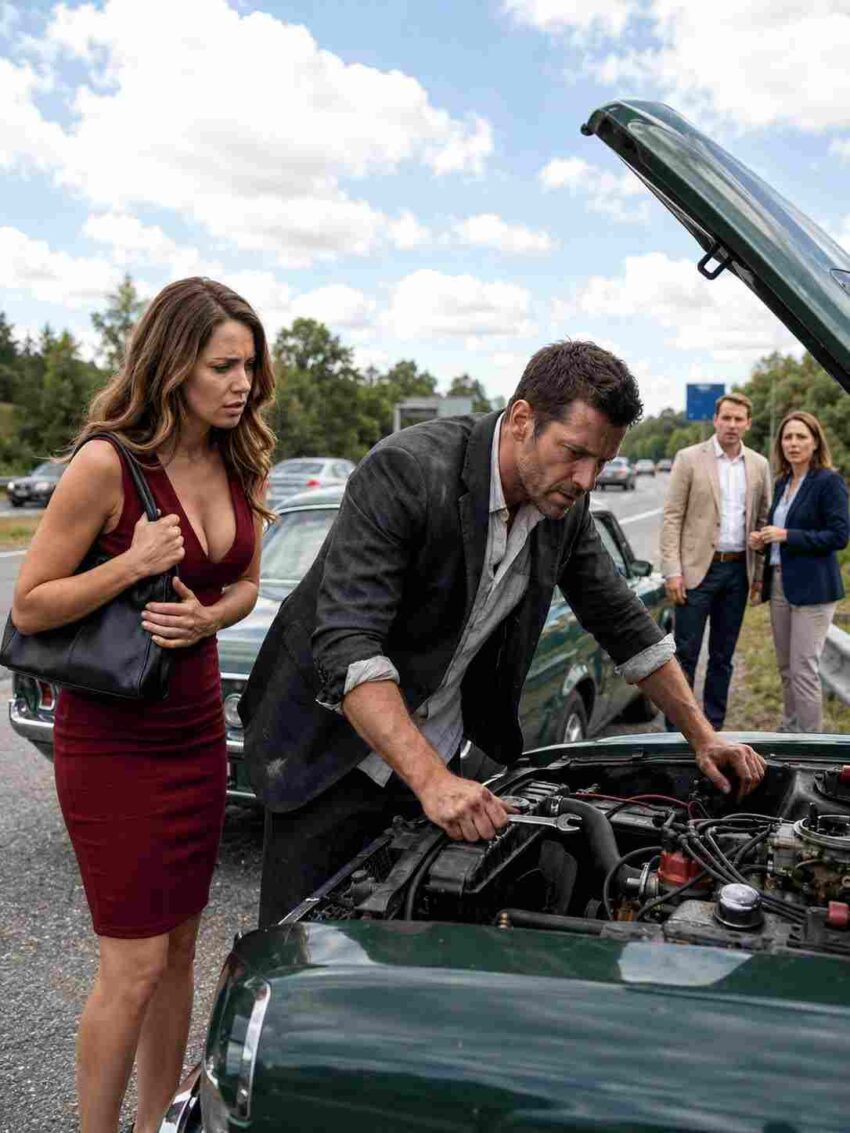
The worst thing was the woman stranded in the rain beside a broken-down vintage Jaguar.
Because I fixed her car, saved her from a dark highway, and told her exactly what I thought about rich corporate women.
Then I walked into the restaurant.
And she was sitting across from me.

Part 1 — The Woman in the Rain
“You’re going to lose the shop, Mr. Sterling,” the banker said, like he was telling me my coffee had gone cold. “Unless you bring us forty thousand dollars in fourteen days.”
I stood in the office of Sterling Restorations with motor oil under my fingernails and my seven-year-old daughter’s crayon drawing taped above my desk.
The drawing showed me, her, and my old garage under a giant yellow sun.
In real life, there was no sun.
Only Seattle rain beating against the windows, a foreclosure notice lying on my workbench, and the ghost of my father in every wrench hanging on the wall.
“My father built this place,” I said.
The banker, Miles Bannon, smiled with his teeth but not his eyes.
“Sentiment doesn’t pay debt, David.”
He wore a navy suit, polished shoes, and a watch that probably cost more than my entire engine lift. He looked around my garage like it smelled bad to him.
“You should’ve sold years ago,” he added. “Property values in this area are rising. A developer has already expressed interest.”
That made my stomach tighten.
“What developer?”
Miles slid the foreclosure papers into a leather folder.
“That’s not your concern.”
Then he left.
Just walked through the garage door into the gray afternoon, past my daughter Emma sitting on an upside-down paint bucket, building a Lego race car.
“Daddy?” she asked. “Is the shop sick?”
I looked at her.
Her brown hair was falling out of its ponytail. Her sneakers were muddy. She had one of my old shop towels tied around her neck like a superhero cape.
I forced a smile.
“No, bug. Just needs a tune-up.”
She nodded seriously.
“Then you can fix it.”
That almost broke me.
But I didn’t cry.
Not in front of her.
Not in the shop.
Not where my father taught me that men didn’t fall apart just because the engine smoked.
I folded the foreclosure notice and put it in my pocket.
At 6:00 that evening, my sister Rachel called for the third time.
“Please tell me you’re not backing out,” she said.
“I should be at home making Emma mac and cheese.”
“Emma is with me. She is eating pizza, watching a movie, and bossing my dog around. You are going on this date.”
“Rachel—”
“No. You’ve been divorced for three years. You work, you sleep, you worry, and you pretend that’s a life.”
“It is a life.”
“It’s a waiting room.”
I hated when she got quiet like that.
Then she said, “Her name is Tori. She’s smart, successful, and probably just as miserable as you.”
“Great. Two miserable people eating food neither of us can afford.”
“She picked the restaurant.”
“That’s what scares me.”
Rachel sighed.
“Le Sance. Downtown. Seven o’clock. Just show up.”
Le Sance.
Even the name sounded expensive.
The kind of place where they charged forty dollars for a carrot lying alone on a white plate.
I had fifty-two dollars in my wallet and a credit card so maxed out it probably screamed when the cashier touched it.
Still, I put on my old charcoal suit.
The one from my custody hearing.
The one I had worn when a judge gave me full custody of Emma because my ex-wife had drained our savings account, run off with a contractor from Tacoma, and left our daughter waiting on the porch with a backpack and a stuffed rabbit.
I looked in the cracked bathroom mirror above the shop sink.
I didn’t look like a man going on a date.
I looked like a man attending his own financial funeral.
By 6:15, I was on Interstate 90 in my battered 1998 Ford F-150, rain hammering the windshield so hard the wipers could barely keep up.
Traffic stopped dead ahead.
Red brake lights stretched for miles.
“Perfect,” I muttered.
I took the next exit and cut through Mercer Island, taking the old back road my dad used when we delivered restored classics to rich clients who acted like mechanics were invisible.
The road curved through heavy trees.
No streetlights.
No houses close enough to see.
Just rain, darkness, and the sound of my truck groaning like it was tired of my problems too.
Then my headlights caught something green and shining on the shoulder.
A 1969 Jaguar E-Type.
British racing green.
Long hood.
Chrome trim.
The kind of car that made a real mechanic slow down even on the worst night of his life.
Then I saw the woman inside.
She was sitting stiffly behind the wheel, dressed in something dark and elegant, her face pale in the dashboard glow.
I should’ve kept driving.
I was already late.
The blind date was already doomed.
The bank was already closing in.
But my father’s voice rose in my head.
You don’t leave people stranded in the rain, Dave.
I pulled over.
The gravel crunched under my tires as I parked behind her and turned on my hazards.
The woman jerked in her seat.
I saw her hand dive into her purse.
Pepper spray, probably.
Smart woman.
I stepped out into the storm and jogged toward her window, holding both hands where she could see them.
“You okay in there?” I shouted.
She rolled the window down two inches.
“I’m fine,” she said, in a voice so cold it could’ve frozen the rain.
“No, you’re not.”
Her eyes narrowed.
“Excuse me?”
“Your car’s dead, your phone probably has no signal in this dip, and you’re sitting in a classic Jaguar in a storm on a road where people drive like idiots. That’s not fine.”
Her mouth tightened.
“My security team is on the way.”
I looked up and down the empty road.
“Then they’re invisible.”
She glared at me.
I almost smiled.
Almost.
Instead, I pointed at the hood.
“Pop it.”
“I beg your pardon?”
“The hood. It’s a ’69 E-Type. Gorgeous machine. Terrible attitude. Especially in wet weather.”
Something flickered across her face.
Surprise.
Then suspicion.
“You know the year?”
“I know engines.”
She hesitated.
Then the hood latch clicked.
I lifted the long clamshell hood and shined my flashlight inside.
Rain soaked through my suit in seconds.
Great.
Now I was going to arrive late, broke, and looking like I fell into Elliott Bay.
A minute later, the woman stepped out with a huge black umbrella.
She held it over me and the engine.
I glanced at her.
Up close, she was stunning in a way that didn’t feel soft.
She had sharp cheekbones, dark hair pulled back, and eyes that looked like they had fired people before breakfast.
“You don’t have to stand out here,” I said.
“I don’t like sitting helplessly while someone else handles my problem.”
“Fair enough.”
“What’s wrong with it?”
“Moisture in the distributor cap. It’s shorting the spark.”
“Can you fix it?”
“Temporarily.”
I pulled a dry rag from my pocket and started working.
She watched my hands.
Not like a rich woman watching hired help.
Like she was studying me.
“So,” she said after a moment, “are you always rescuing strange women on dark roads?”
“Only when I’m avoiding a blind date.”
Her eyebrow lifted.
“A blind date?”
“Yeah. My sister’s idea of emotional rehabilitation.”
“Sounds terrible.”
“She said the woman is some corporate executive.”
The woman under the umbrella went very still.
I kept working.
“Probably one of those high-powered types who spends all day firing people and making assistants cry. She’ll ask what I do, I’ll say mechanic, and then I’ll get the polite smile.”
“What polite smile?”
“The one rich people give when they’re trying not to look disappointed.”
The woman’s jaw flexed.
“Maybe she’s not like that.”
“Maybe.”
“Maybe she’s tired of men who want her money, her connections, or her weakness.”
I looked up.
Rain ran down her cheek, but she didn’t wipe it away.
“Sounds personal.”
“It sounds realistic.”
For a second, neither of us spoke.
The storm filled the space between us.
Then I tightened the cap and closed the hood.
“Try it now.”
She slid back into the driver’s seat and turned the key.
The Jaguar coughed once.
Twice.
Then the engine roared alive, deep and beautiful.
A smile broke across her face before she could hide it.
And for one second, the ice around her cracked.
She stepped out again and handed me a silk handkerchief.
“For your hands.”
“I’ll ruin it.”
“Then ruin it.”
I took it.
Our fingers brushed.
“My name is Victoria,” she said. “But my friends call me Tori.”
“Dave.”
“Thank you, Dave.”
“Drive slow, Tori.”
She smiled, small but real.
“Good luck with your terrifying executive.”
“Good luck with whatever dinner you’re dreading.”
We drove away in opposite directions.
I had no idea the woman I’d just insulted in the rain was the same woman waiting for me at Le Sance.
And she had no idea I was about to walk straight into her world.
Part 2 — The Date I Tried to Escape
The maître d’ looked at my suit, my damp hair, and my grease-stained fingernails like I had crawled out of the restaurant’s dumpster.
“Reservation?” he asked.
“Harrington.”
His expression changed so fast I almost laughed.
Not because he respected me.
Because he respected whoever Harrington was.
“Ah. Miss Harrington’s guest.”
He said guest like he meant mistake.
He led me through Le Sance, past crystal chandeliers, velvet curtains, white tablecloths, and people who all looked like they knew which fork to use to ruin someone’s life.
I sat in a curved booth near the window.
A waiter handed me a menu.
I opened it.
A steak cost one hundred eighty dollars.
A side of asparagus cost forty-two.
I closed the menu like it had bitten me.
I checked my phone.
7:18.
I was late.
She was later.
Maybe she wouldn’t come.
Maybe I could escape, go home, make Emma pancakes, and pretend this never happened.
Then the room changed.
Conversations dipped.
The maître d’ practically sprinted to the entrance.
I turned.
And my lungs stopped working.
The woman from the road walked in.
Same sharp eyes.
Same dark hair.
Same dress, now dry enough to look expensive again.
She moved through that room like she owned the building and every person inside it.
Then she saw me.
Her hand froze on the back of a chair.
“Dave.”
“Tori.”
The maître d’ looked between us, confused.
“Oh,” he said carefully. “You are already acquainted.”
“Apparently,” she said.
He fled.
Victoria Harrington slid into the booth across from me.
For five seconds, we just stared.
Then she laughed.
Not a polite laugh.
A real one.
The kind that made three people at nearby tables turn their heads.
“You,” she said, pointing at me, “are the salt-of-the-earth single dad Jessica promised me.”
“And you,” I said, “are the terrifying corporate executive my sister warned me about.”
Her smile widened.
“To be fair, you called me high-strung before you knew my name.”
“I also fixed your car.”
“That may save you.”
Then her expression shifted.
“You don’t know who I am, do you?”
“I know you drive a beautiful Jaguar and carry expensive handkerchiefs into thunderstorms.”
“My full name is Victoria Harrington.”
I blinked.
Even I knew that name.
Harrington Global Holdings owned real estate, logistics companies, tech platforms, construction firms, and half the skyline visible from the restaurant window.
“You’re that Harrington?”
She leaned back.
“Yes.”
I swallowed.
“Well.”
“Well?”
“I’m suddenly very glad your car started.”
She laughed again.
Then, for a moment, something vulnerable appeared in her eyes.
“Does it bother you?”
“What?”
“The money. The company. The name.”
I thought about lying.
Then I didn’t.
“It doesn’t bother me. It explains the waiter’s fear.”
She stared at me.
Then she smiled like she hadn’t expected that answer.
The waiter returned.
“Would you like to begin with wine?”
Before I could say tap water, Victoria closed her menu.
“No dinner here.”
The waiter froze.
“Miss Harrington?”
“Bring the bottle already on my account. We’ll sit for twenty minutes, then leave.”
He nodded quickly.
When he walked away, I leaned in.
“You just saved me from pretending I could afford asparagus.”
“I know.”
Heat crawled up my neck.
She softened.
“Dave, I don’t want a man to bankrupt himself to impress me. I spend all day around men who spend money to hide what they lack.”
“That sounded like an insult to this entire room.”
“It was.”
I liked her more than I wanted to.
We talked.
Not small talk.
Real talk.
I told her about Emma.
How she slept with a stuffed rabbit missing one ear.
How she built Lego engines and asked questions like, “Can a car have a soul?”
How my ex-wife had used custody papers like weapons and disappeared after she realized motherhood wasn’t convenient.
Victoria listened without pity.
That mattered.
Pity is what people give when they want to feel kind without helping.
She gave attention.
Then she told me about her grandfather.
How he raised her after her parents died.
How he taught her to be ruthless because the men around him would never forgive her for being young, female, and richer than they were.
“I became good at winning,” she said. “Then one day I realized I didn’t know how to be happy.”
I looked at her across the table.
“You looked happy eating rain on the side of the road.”
“That was shock.”
“No. That was real.”
She didn’t answer.
Then a shadow fell across the table.
“Victoria, darling.”
Her face closed.
A man in a silver-gray suit stood beside us with a smile so oily I wanted to wipe it off with a shop rag.
“Richard,” she said.
Richard Carmichael.
I recognized him from a business article I’d read at the bank while waiting to be humiliated.
Board member.
Investor.
Power player.
Predator in Italian leather.
His eyes moved over me slowly.
“Who is this?” he asked. “A charity case?”
Victoria’s fingers curled around her water glass.
“Walk away.”
Richard smiled wider.
“Careful. Cameras everywhere. Wouldn’t want the public seeing America’s ice queen losing control over a mechanic.”
So he knew.
That bothered me.
“How do you know I’m a mechanic?” I asked.
Richard looked amused.
“Your fingernails announced it before you opened your mouth.”
I glanced at his wrist.
Gold Rolex Daytona.
Beautiful piece.
Badly maintained.
“Nice watch,” I said.
His smile paused.
“Excuse me?”
“Your second hand is dragging. Quarter beat off. Either it hasn’t been serviced in years, or you bought it used from someone who treated it like jewelry instead of machinery.”
The two men behind him exchanged looks.
Richard’s face reddened.
“I don’t take advice from grease monkeys.”
“No,” I said calmly. “You just wear machines you don’t understand and pretend the shine makes you important.”
Victoria’s eyes snapped to mine.
Richard stepped closer.
“You have no idea who you’re speaking to.”
“I know exactly who I’m speaking to,” I said. “A man with a loud suit, a sick watch, and no manners.”
One of the investors behind him coughed into his fist.
Richard looked ready to explode.
Then Victoria stood.
“Thank you, Richard. You’ve reminded me why I hate this restaurant.”
She reached for my hand.
I looked down at her fingers wrapped around mine.
Then back up.
“Where are we going?”
She smiled.
“Somewhere with food people actually enjoy.”
We walked out together.
Behind us, Richard called, “Enjoy your little fantasy, Victoria. Men like him always come with invoices.”
She stopped.
Only for one second.
Then she kept walking.
But I saw her face.
She wasn’t embarrassed.
She was calculating.
Outside, rain glittered under the streetlights.
My truck sat between two black luxury cars like an old dog at a show kennel.
Victoria climbed into the passenger seat without hesitation.
“You sure?” I asked. “The heater only works when it feels respected.”
“I respect it deeply.”
I drove her to Mick’s All-Night Diner.
Neon sign.
Cracked red booths.
Coffee strong enough to remove paint.
Burgers wrapped in wax paper.
Mick looked up from the grill.
“Davey! Usual?”
“Two.”
Then he saw Victoria.
His eyebrows rose.
“Fancy usual?”
“Double bacon,” she said.
Mick grinned.
“I like her.”
Victoria took one bite of the burger and closed her eyes.
“Oh my God.”
“Better than Le Sance?”
“Le Sance should be arrested.”
We ate fries.
We drank bad coffee.
We talked until after midnight.
For three hours, no one asked her to approve a merger.
No one asked me about overdue payments.
No one treated me like a poor man or her like a trophy.
At 1:12 a.m., my phone buzzed.
Rachel.
HOW IS IT GOING???
I looked at Victoria.
She stole a fry from my plate.
I typed back.
WEIRD.
Then I put the phone away.
I didn’t know that across town, Richard Carmichael was already making calls.
I didn’t know he had a secret contract with the bank trying to take my garage.
And I didn’t know Victoria’s legal team would find my name in his documents by morning.
Part 3 — The Contract They Didn’t Want Me to See
Three days later, the bank changed the locks on my garage while my daughter’s backpack was still inside.
I pulled into the driveway at 7:05 a.m. and saw two men in black jackets standing by the roll-up door.
A new chain hung across it.
A white notice was taped to the metal.
PROPERTY UNDER REVIEW.
My blood went cold.
Emma sat in the passenger seat holding her lunchbox.
“Daddy?” she whispered. “Why is our door locked?”
I got out slowly.
Miles Bannon, the banker, stepped from a black SUV, wearing that same dead smile.
“You’re early,” he said.
“This isn’t legal. You said fourteen days.”
He shrugged.
“Circumstances changed.”
“My daughter’s schoolbag is inside.”
“You can schedule a supervised retrieval.”
I looked at the two men near the door.
Not police.
Private security.
Bullies with radios.
Emma climbed out of the truck.
Miles looked at her, then back at me.
“That’s unfortunate.”
Something in me went quiet.
Dangerously quiet.
I had spent years swallowing humiliation.
From my ex-wife.
From judges before they finally saw the truth.
From bankers who talked about my father’s garage like it was scrap metal.
But this man looked at my little girl’s trembling lip and called it unfortunate.
I stepped closer.
“You’re going to open that door.”
Miles smiled.
“No, I’m not.”
That’s when the Jaguar rolled into the driveway.
Its green paint flashed under the pale morning sun.
Victoria stepped out wearing jeans, boots, and a black coat.
Behind her came a silver Mercedes van.
Four people got out.
Two lawyers.
One woman with a tablet.
One retired police detective I recognized from the local news.
Miles’s smile vanished.
Victoria looked at the chain across my garage.
Then at Emma.
Then at Miles.
Her voice was calm.
That made it worse.
“Who authorized this lockout?”
Miles straightened.
“Miss Harrington, this is a private banking matter.”
“No,” she said. “It’s a fraudulent foreclosure attempt connected to a concealed development agreement between Pacific Crest Bank, Carmichael Urban Partners, and a shell company registered in Delaware.”
Miles went pale.
I stared at her.
“What?”
She handed me a folder.
Inside were copies of emails.
Contracts.
Bank notes.
A map of the entire industrial block.
My garage was circled in red.
Richard Carmichael’s signature sat at the bottom of a purchase option.
My father’s garage wasn’t failing by accident.
They had been squeezing me on purpose.
Late fees.
Rejected payment arrangements.
Insurance delays.
A property assessment I never requested.
All to force a foreclosure and sell the land cheap to Richard.
I looked at Miles.
“You set me up.”
He lifted his chin.
“You defaulted.”
Victoria’s lawyer, a gray-haired woman named Elaine Porter, stepped forward.
“Mr. Sterling did not default. His last three payments were deposited into a suspense account rather than applied to the loan.”
Miles looked like someone had punched him in the throat.
Elaine held up another page.
“We have the transfer records.”
Victoria turned to the retired detective.
“Show him the video.”
The woman with the tablet tapped the screen.
Security footage appeared.
My garage office.
Two weeks earlier.
Miles Bannon standing at my desk after hours with Richard Carmichael.
Richard picked up the framed photo of my father and me.
He laughed.
Then he said clearly, “Sentiment makes poor men predictable.”
Miles replied, “Give me thirty days. Sterling will be desperate enough to sign anything.”
Emma’s small hand found mine.
I gripped it gently.
Inside, something old and loyal broke open.
My father had trusted that bank.
I had trusted that bank.
Victoria looked at Miles.
“You have ten seconds to remove that chain before I call the actual police and every business reporter in Seattle.”
Miles tried to recover.
“You can’t intimidate me.”
Victoria smiled without warmth.
“No. But subpoenas can.”
The chain came off.
Emma ran inside and grabbed her backpack.
Then she stopped by the workbench and picked up the drawing of the yellow sun.
She held it to her chest.
That hurt worse than the foreclosure.
Victoria saw my face.
She didn’t touch me.
She didn’t comfort me like I was weak.
She just stood beside me like a wall.
An hour later, we were in my office.
Elaine spread documents across the desk.
“The bank is exposed,” she said. “But we need leverage before they bury this in court.”
Victoria placed another folder down.
“I have leverage.”
I frowned.
“What is that?”
“A fleet maintenance contract.”
I stared.
“For Harrington Global?”
“Fifty-two executive vehicles. Twelve classic cars. Three-year exclusive service agreement. Upfront retainer: eighty thousand.”
I stepped back.
“No.”
Victoria’s eyes narrowed.
“Excuse me?”
“I won’t take charity.”
“It’s not charity.”
“It looks like charity.”
“It looks like a business contract because it is one.”
“Tori—”
“No.” Her voice sharpened. “Do not insult both of us by pretending I don’t know the difference between pity and value.”
The room went silent.
She stepped closer.
“I watched you fix a Jaguar in a storm with a pocket flashlight and a rag. I watched you stand up to Richard Carmichael without knowing his net worth, his power, or his board votes. I watched your daughter trust you more than most adults trust God.”
My throat tightened.
She lowered her voice.
“I don’t invest in broken men, Dave. I invest in men who keep fixing things while everyone else tries to throw them away.”
I looked at the contract.
Eighty thousand dollars.
Enough to stop the bank.
Enough to make payroll.
Enough to breathe.
Emma peeked in from the garage.
“Daddy, does this mean the shop is not sick anymore?”
I looked at Victoria.
She smiled at Emma.
“It means your dad found the right tool.”
I signed.
That should’ve been the victory.
It wasn’t.
At 4:30 that afternoon, a black luxury sedan stopped outside the garage.
Richard Carmichael stepped out.
He had two lawyers with him and the expression of a man who had never been told no by anyone he couldn’t buy.
“Victoria,” he called. “This is touching. Truly. But you are making a very expensive mistake.”
She walked out into the driveway.
I followed.
Emma stayed inside with Rachel, who had arrived thirty minutes earlier and looked ready to hit someone with a tire iron.
Richard’s eyes flicked to me.
“You should walk away, mechanic. This woman collects causes when she gets bored.”
I said nothing.
I watched.
I remembered.
Victoria crossed her arms.
“What do you want?”
Richard smiled.
“The board is meeting tomorrow morning. Emergency session. You used company resources for a personal relationship. You interfered in a private banking matter. You exposed confidential acquisition documents.”
Victoria’s expression didn’t change.
Richard stepped closer.
“And I have the votes to remove you as CEO.”
For the first time, I saw something flash across Victoria’s face.
Not fear.
Rage.
Richard leaned toward her.
“You should have stayed lonely, darling. Lonely women are easier to control than sentimental ones.”
My hands curled.
Victoria lifted one finger slightly.
A warning.
Not for him.
For me.
She was right.
This wasn’t my fight to swing at.
This was her engine to rebuild.
Richard looked at me.
“And you? Enjoy the contract. It will be void by noon tomorrow.”
Then he smiled at Emma through the window.
“Shame when children get attached to places they can’t keep.”
I took one step.
Victoria caught my wrist.
Her grip was light.
Her message was not.
Wait.
So I did.
Richard got back into his sedan and drove away.
Victoria watched him leave.
Then she pulled out her phone.
“Jessica,” she said. “Call Elaine. Call the detective. Call Channel 7’s business desk. And pull the boardroom camera archive from last March.”
She paused.
Her eyes stayed on Richard’s taillights.
“Richard just reminded me where the body is buried.”
The next morning, the board would try to destroy her.
They had no idea she was already holding the match.
Part 4 — The Boardroom Fire
“They voted to remove me before I even entered the room,” Victoria said, adjusting her blazer in my truck mirror.
We were parked outside Harrington Tower.
Forty-two floors of glass, steel, and money.
I had no business being there.
My boots still smelled faintly of motor oil.
My suit was the same old charcoal one, cleaned as best as I could manage.
Emma was at school.
Rachel had sent me a text that morning:
DON’T LET THE BILLIONAIRE LADY FIGHT ALONE.
So I didn’t.
Victoria looked calm.
Too calm.
Like a storm had learned manners.
“You sure you want me here?” I asked.
She turned.
“Richard humiliated you in public, attacked your business, threatened your daughter’s stability, and used your garage as bait.”
“Yeah.”
“So yes, Dave. I want you here.”
We took the elevator to the top floor.
When the doors opened, every head turned.
Board members sat around a long black table.
Men in expensive suits.
Two women who looked tired of pretending the men were smarter.
Richard sat at the far end.
He smiled.
“Victoria. And you brought the mechanic.”
Victoria walked to the front of the room.
“I brought a witness.”
Richard chuckled.
“To what? Your poor judgment?”
Board Chair Malcolm Pierce cleared his throat.
“Victoria, this emergency session concerns your misuse of company resources, exposure of confidential materials, and erratic conduct following the Pendleton acquisition.”
Victoria placed a slim folder on the table.
“No. This meeting concerns Richard Carmichael’s conspiracy to manipulate a bank foreclosure, acquire private property through fraudulent pressure, and use that property to benefit a development group he secretly controls.”
Silence.
Richard leaned back.
“That is defamatory.”
Elaine Porter entered behind us.
“No,” she said. “It is documented.”
She connected a laptop to the boardroom screen.
Emails appeared.
Bank transfers.
Property maps.
Shell company registrations.
Then the security video from my garage played.
Richard’s voice filled the room.
“Sentiment makes poor men predictable.”
A board member whispered, “Jesus.”
Richard stood.
“That footage was illegally obtained.”
Elaine looked at him over her glasses.
“It came from Mr. Sterling’s own security system. Installed by his father in 2009. Motion activated. Cloud backed up.”
I almost smiled.
Dad, you brilliant old man.
Victoria clicked a remote.
A second video appeared.
This one was from inside Harrington Tower.
A boardroom.
March 14.
Richard sat with two outside investors.
His voice was clear.
“Once Victoria is removed, we carve out the Pendleton assets, bury the debt in a restructuring, and take the Mercer corridor through Carmichael Urban. The mechanic’s garage is the last holdout. The bank will handle him.”
Malcolm Pierce slowly turned toward Richard.
Richard’s face drained of color.
“That recording should not exist.”
Victoria smiled.
“That’s a strange way to say it isn’t real.”
He pointed at her.
“You arrogant little—”
“Careful,” she said. “Cameras everywhere.”
That line hit him like a slap.
The same threat he had used at Le Sance.
Now it belonged to her.
Elaine placed another document on the table.
“And there is more.”
Richard’s wife entered the room.
Everyone froze.
She was a tall blonde woman named Margaret Carmichael, dressed in cream, holding a leather folder with both hands.
Richard looked horrified.
“Margaret, what are you doing here?”
She didn’t look at him.
She looked at Victoria.
“My attorney advised me to cooperate.”
Elaine opened the folder.
“Mrs. Carmichael has provided bank statements showing marital assets moved into Richard’s shell companies without disclosure. She has also provided text messages confirming intent to force Mr. Sterling into foreclosure and profit personally from the land sale.”
Richard’s mouth opened.
No sound came out.
Margaret finally looked at him.
“You told me I was too stupid to understand business. You were wrong.”
That was the first time I saw Richard Carmichael look small.
Not defeated yet.
But shrinking.
Victoria turned to the board.
“Before you vote on my removal, you should know I have already referred this matter to law enforcement, financial regulators, and the state attorney general’s office.”
Malcolm Pierce looked furious.
Not at her.
At Richard.
Two uniformed officers entered the room with a plainclothes detective.
Richard backed away.
“You can’t arrest me in my own boardroom.”
The detective said, “Actually, we can.”
They didn’t drag him.
That would’ve been too dramatic.
They simply turned him around, placed cuffs on his wrists, and walked him past every person he had spent years intimidating.
As he passed me, he hissed, “This isn’t over.”
I looked at him.
“No. But your watch finally stopped.”
His eyes dropped to his wrist.
The Daytona’s second hand had frozen.
One of the board members laughed.
Just once.
But it was enough.
Richard’s face burned red as the elevator doors closed on him.
After that, the vote was quick.
Victoria remained CEO.
Richard’s board seat was suspended.
His assets were frozen pending investigation.
Pacific Crest Bank issued an emergency reversal on my foreclosure.
Miles Bannon resigned before noon.
By 3:00 p.m., local news had the story.
By dinner, everyone in Seattle business circles knew Richard Carmichael had been handcuffed in the Harrington boardroom.
By the next morning, investors were calling him poison.
And my garage phone wouldn’t stop ringing.
Classic car owners.
Fleet managers.
Reporters.
One old man from Tacoma who said, “Your daddy fixed my Mustang in 1987. Glad you’re still there, son.”
That one nearly got me.
Two weeks later, I stood on the front porch of my little house with Emma.
It was Thanksgiving morning.
The air smelled like rain, pine trees, and the turkey Rachel had already called “emotionally unstable.”
Victoria’s Jaguar pulled into the driveway.
Behind it came Rachel’s SUV, Mick’s old pickup, and three employees from the shop carrying pies.
Victoria stepped out wearing jeans, boots, and a soft sweater.
No security.
No entourage.
Just her.
Emma ran down the porch steps.
“Tori!”
Victoria knelt and hugged her.
I stood there watching them under the small American flag my father had mounted beside the porch years ago.
For the first time in months, I wasn’t counting overdue notices in my head.
Victoria walked up the steps.
“You look peaceful,” she said.
“I’m suspicious of it.”
She laughed.
Inside, the house was loud.
Rachel argued with Mick about gravy.
Emma showed Victoria the Lego garage she had built.
Elaine Porter arrived with flowers and said she refused to eat canned cranberry sauce on principle.
During dinner, Victoria lifted her glass.
“To engines that refuse to die.”
Mick raised his beer.
“To bankers getting fired.”
Rachel raised her fork.
“To women with folders.”
Emma raised her juice box.
“To Daddy fixing everything.”
Everyone laughed.
I looked at my daughter.
Then at Victoria.
“I didn’t fix everything,” I said. “Some things showed up broken down on the side of the road and fixed me back.”
Victoria’s eyes softened.
Later, after dessert, we stood on the porch while the others cleaned up.
The driveway was wet from fresh rain.
The little flag beside the door moved gently in the cold wind.
Victoria leaned against the porch rail.
“You know,” she said, “my grandfather had a rule.”
“What rule?”
“If someone stands with you in the rain, don’t leave them in the storm.”
I smiled.
“Smart man.”
“He would’ve liked you.”
“My dad would’ve liked you too.”
“Even though I’m a terrifying corporate executive?”
“Especially because of that.”
She laughed softly.
Then her expression turned serious.
“Dave, I don’t want to buy your life. I don’t want to rescue you like a project. I don’t want you to ever feel small beside me.”
I took her hand.
“You don’t make me feel small.”
“No?”
“No. You make me feel like the world is bigger than the garage.”
She looked at our hands.
My rough fingers.
Her polished ones.
Different worlds.
Same grip.
“I’m still learning how to be loved without turning it into a contract,” she whispered.
“I’m still learning how to accept help without calling it pity.”
“Then we’ll learn.”
“Piece by piece.”
She smiled.
The kind of smile I first saw in the rain.
Only this time, she didn’t hide it.
Six months later, Sterling Restorations had a waiting list.
Pacific Crest Bank was under investigation.
Miles Bannon had lost his license.
Richard Carmichael’s name disappeared from buildings, charity boards, and private clubs faster than paint stripping off cheap chrome.
Margaret Carmichael divorced him and handed over another stack of documents to prosecutors.
Victoria expanded Harrington Global without him.
Cleaner.
Sharper.
Stronger.
And every Friday, no matter how busy she was, she came by the garage.
Sometimes in the Jaguar.
Sometimes in a company SUV.
Sometimes just to sit with Emma and eat fries from a paper bag while I finished a restoration.
One Friday evening, as the sun set gold over the shop windows, Emma taped a new drawing above my desk.
This one had three people.
Me.
Her.
Victoria.
And the garage under a giant yellow sun.
Victoria stood beside me, looking at it.
“Your daughter is very optimistic with weather.”
“She gets that from her mother.”
Victoria froze.
I smiled.
“Not the one who left. The one who stayed.”
Her eyes filled.
But she didn’t cry.
Neither did I.
We had both done enough surviving.
The rain outside started again, soft against the roof.
An old Mustang idled in Bay Two.
Emma laughed from the workbench.
And Victoria’s hand slipped into mine.
I used to think life was about keeping broken things running long enough to survive.
I was wrong.
Sometimes life is about stopping on a dark road when you’re late, tired, broke, and scared.
Sometimes it’s about fixing a stranger’s engine in the rain.
And sometimes, if you’re lucky, the person you save turns out to be the one who helps you rebuild everything.