I was one bad court hearing away from losing everything I had ever built.
My garage. My name. My last reason to get up every morning.
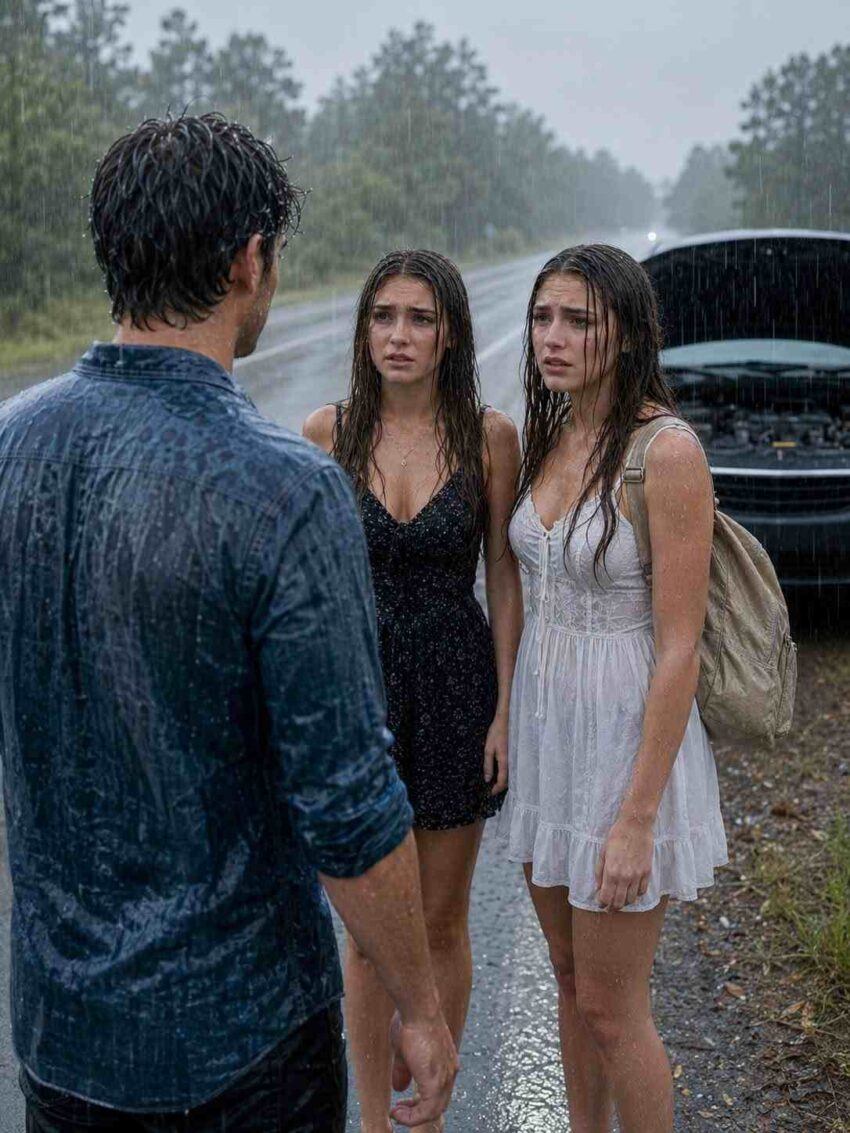
Then, on the worst Friday night of my life, I saw two young women standing beside a dead Mercedes in the pouring rain while every car in Pittsburgh kept driving past them like they were invisible.
I almost kept driving too.
I was tired, broke, soaked in diner grease, and being sued by a millionaire who wanted to erase me from my own block.
But I stopped.
And that one decision dragged a judge, a liar, a hidden camera, and a dirty real estate empire into my life.
By Monday morning, everyone in that courtroom would know my name.
PART 1 — THE NIGHT I STOPPED
“Keep walking, mechanic. Nobody with dirty hands wins against people like us.”
That was what Grant Harrington said to me three days before court, standing outside my garage in a three-thousand-dollar suit while rain clouds gathered over Pittsburgh.
He smiled when he said it.
Not angry.
Not loud.
Just smug, like he had already bought my future and was waiting for the paperwork to catch up.
My name is Henry Cole. I was twenty-nine years old, living in a small apartment above a row of old shops on the edge of the city. My apartment smelled like motor oil, coffee, and rain leaking through a window frame I couldn’t afford to replace.
Downstairs was Cole Auto Repair.
One old lift. Two tool chests. A cracked concrete floor. A faded American flag sticker on the front window from the previous owner. A crooked sign over the bay door that rattled whenever trucks passed by.
It wasn’t much.
But it was mine.
At least, it was supposed to be.
Harrington Properties had bought the whole block three months earlier. They wanted to tear down the garage, the barber shop next door, and the old thrift store on the corner to build a retail plaza with a coffee chain, a boutique gym, and apartments nobody from the neighborhood could afford.
Everyone else had taken the buyout.
I didn’t.
My lease still had fourteen months left. The contract was clear. If they wanted me out early, they had to compensate me.
Grant Harrington didn’t like that.
So he sued me.
His lawyer claimed I violated the lease with noise complaints, late rent, illegal waste disposal, and property damage.
All lies.
But lies printed on legal paper look expensive. And expensive lies can crush a poor man faster than truth can save him.
My hearing was Monday morning.
That Friday night, I worked fourteen hours.
Eight at the garage.
Six more serving coffee and burgers at a highway diner off Route 51, because my lawyer, Mr. Clark, was giving me a discount but “discount” still meant money I didn’t have.
By ten-thirty, the rain was coming down hard enough to blur the road.
I drove home in my beat-up Honda with 213,000 miles on it, one headlight slightly dimmer than the other, wipers screaming across the glass.
My shirt smelled like fryer grease.
My hands ached.
My mind kept replaying Grant’s voice.
Nobody with dirty hands wins against people like us.
Then I saw them.
A black Mercedes sat halfway on the shoulder, hazard lights blinking weakly in the rain. Two young women stood beside it, soaked through, one waving desperately at passing cars.
Nobody stopped.
Not the pickup.
Not the SUV.
Not the man in the shiny Audi who swerved around a puddle and splashed water across their legs.
I drove past them by maybe twenty feet.
Then I hit the brakes.
For one second, I sat there with both hands on the wheel, arguing with myself.
I had my own problems.
I had court papers in the passenger seat.
I had four hours of sleep waiting for me if I was lucky.
I was not anyone’s hero.
Then I looked in the rearview mirror and saw one of the girls wrap her arms around herself, shaking in the rain.
I cursed under my breath, put the Honda in reverse, and backed up.
When I stepped out, the rain hit me like ice.
“Car trouble?” I shouted.
The blonde one turned first. Her mascara had run down her cheeks, but she wasn’t crying. She looked furious and terrified at the same time.
“It just died,” she called back. “We’ve been out here almost an hour. Our phones are dead. Nobody will stop.”
The other girl stood behind her, clutching a wet purse against her chest. They looked alike enough that I guessed sisters before either of them said it.
“I’m Henry,” I said. “I’m a mechanic. Pop the hood.”
The blonde girl blinked. “Seriously?”
“No,” I said. “I just enjoy standing in traffic during storms.”
That almost made her laugh.
Almost.
She popped the hood.
I bent over the engine bay with my flashlight between my teeth. Battery terminals were corroded bad. Loose connection. Rain made it worse. Not a disaster, but not something they were fixing there without tools and a jump pack.
“This car isn’t moving tonight,” I said.
The brunette sister swallowed. “Can you fix it?”
“At my shop, yes. On the shoulder in this weather? No.”
They looked at each other.
The blonde one said, “We could call our dad.”
Then she stopped.
I caught the pause.
“But what?” I asked.
The brunette gave a small laugh with no humor in it. “He’s busy.”
The blonde stared at the highway. “He’s always busy.”
I knew that tone.
That wasn’t spoiled kids complaining.
That was the sound of people who had stopped expecting to matter.
“There’s a motel fifteen minutes from here,” I said. “I can drive you there. You can charge your phones and call for a tow in the morning.”
They both stared at me.
The blonde asked, “You’d really do that?”
“I’m not leaving you out here.”
They grabbed their bags, locked the Mercedes, and climbed into my Honda.
My car looked even worse with them inside it. There were invoices on the floor, a toolbox in the back, a diner apron tossed over the passenger seat.
The blonde sat up front. The brunette sat behind her.
“I’m Sophie,” the blonde said. “This is Maya. We’re twins.”
“Henry,” I said.
“You already said that,” Maya whispered from the back.
“I’m tired.”
That time, Sophie did laugh.
The road was slick and dark. Rain hammered the roof. For a while, nobody spoke.
Then Sophie looked at my work shirt.
“You really are a mechanic?”
“Last time I checked.”
“You own a shop?”
“Lease one. Cole Auto Repair.”
Maya leaned forward. “You sound sad when you say that.”
I should have kept my mouth shut.
But there is something about rain, darkness, and strangers that makes truth slip out easier.
“I’m being sued,” I said. “Development company bought my block. They want me gone. I won’t sign away my lease for nothing, so now they’re claiming I violated it.”
Sophie turned toward me. “Did you?”
“No.”
“Then how can they win?”
I laughed once.
It came out bitter.
“Because they have money.”
Maya said softly, “That’s not fair.”
“Fair costs money,” I said. “People like me usually can’t afford it.”
The car went quiet.
Then Sophie said, “Our dad works in law.”
I glanced at her. “Lawyer?”
“No,” Maya said. “Judge.”
I didn’t ask his name.
That part still haunts me.
If I had asked, maybe I would have panicked. Maybe I would have treated them differently. Maybe I would have said too much or too little.
But I didn’t know who they were.
So I just drove.
At the motel, I pulled under the awning.
Sophie turned to me before getting out.
“Can we have your number? For the car tomorrow.”
I handed her one of my bent business cards.
She read it out loud.
“Henry Cole. Cole Auto Repair.”
Maya looked at me through the open back door.
“Thank you for stopping.”
“It’s nothing.”
Sophie shook her head. “Good people always say that.”
Then she added something I did not understand until later.
“We want to see you again.”
They disappeared into the motel lobby.
I drove home soaked, exhausted, and strangely awake.
For the first time in months, I felt like maybe I had done one thing right.
I had no idea that by Monday morning, those two girls would be sitting behind the man who held my future in his hands.

PART 2 — THE COURTROOM
“The court calls Harrington Properties versus Cole Auto Repair.”
My stomach dropped so hard I thought I might pass out.
Monday morning, the courthouse smelled like old wood, wet coats, paper, and fear.
I sat beside Mr. Clark in the only white dress shirt I owned that didn’t have grease stains on it. My tie belonged to my upstairs neighbor, who told me it made me look “less like I was about to fix the judge’s transmission.”
Across the aisle sat Grant Harrington.
Perfect suit.
Perfect haircut.
Perfect smirk.
His lawyer, Davidson, had a leather briefcase and the kind of smile men use when they know the other side can’t afford a longer fight.
Grant leaned toward me as we waited.
“You should have signed,” he whispered. “Now I’m going to take the garage and make you pay me for the trouble.”
I didn’t answer.
I just looked forward.
That was something I had learned from cars.
When something is about to blow, listen first.
The bailiff stood.
“All rise.”
A side door opened.
The judge walked in.
Tall. Silver hair. Serious eyes. Black robe.
The Honorable Benjamin Whitmore.
I had never met him before.
But I knew his face.
Not from TV. Not from newspapers.
From the shape of Sophie’s eyes.
From the way Maya tilted her head when she was listening.
My hands went cold.
Judge Whitmore was their father.
Sophie and Maya’s father.
The same father they said never listened.
He sat behind the bench, opened the file, and read the first page.
His eyes stopped on my name.
Henry Cole.
For half a second, his expression changed.
Just a flicker.
But I saw it.
He knew.
My lawyer leaned toward me. “Are you all right?”
I couldn’t speak.
Judge Whitmore looked at me once, then down at the file.
“Be seated.”
Everyone sat.
Davidson stood immediately, smooth as oil.
“Your Honor, the plaintiff is prepared to show that Cole Auto Repair has repeatedly violated its commercial lease through excessive noise, late payments, unsafe disposal practices, and conduct damaging to the redevelopment value of the property.”
Grant stared straight ahead like he was already imagining a coffee shop where my lift stood.
Judge Whitmore raised one hand.
“Before we proceed, the court will take a short recess.”
Davidson blinked. “Your Honor?”
“Fifteen minutes,” the judge said. “Court is in recess.”
The gavel tapped.
Everyone stood.
Then the judge left.
Grant looked annoyed.
Davidson looked confused.
Mr. Clark looked worried.
I felt like the floor had moved under me.
Ten minutes later, the bailiff approached our table.
“Mr. Cole. Mr. Clark. Judge Whitmore would like to see you in chambers.”
Davidson shot to his feet.
“Your Honor cannot communicate with one party outside the presence of counsel.”
The bailiff looked at him calmly.
“Mr. Clark is counsel. The matter will be placed on the record if necessary.”
Davidson’s mouth tightened.
Grant’s eyes narrowed at me.
I followed Mr. Clark through the side door.
Judge Whitmore’s chambers were lined with bookshelves. Framed photos sat on a side table. In one of them, Sophie and Maya were younger, wearing graduation gowns, standing beside their father. He had one hand on each of their shoulders, but even in the photo, his smile looked distracted.
Judge Whitmore stood by the window.
He did not sit right away.
“Mr. Cole,” he said, “three nights ago, my daughters called me from a motel off Route 51.”
My throat closed.
“I didn’t know they were your daughters, Your Honor.”
“I know,” he said. “That is exactly why this matters.”
He turned.
“They told me their car died in the rain. They told me they stood there nearly an hour while people passed them. They told me a man who had already worked two jobs stopped, checked the car, and drove them somewhere safe.”
I looked down at my hands.
“They needed help.”
“Most people saw that,” he said. “You acted on it.”
Mr. Clark looked from the judge to me like he was finally understanding the size of the coincidence.
Judge Whitmore sat behind his desk.
“This creates a problem. If I continue this case, the plaintiff may claim bias because of what happened. I considered recusing myself.”
My chest tightened.
If he recused himself, we might get another judge. Another delay. More legal fees. More time for Harrington to bleed me dry.
“But before making that decision,” he continued, “I reviewed the file more carefully.”
He opened a folder.
“And what I found concerns me.”
Mr. Clark sat straighter.
Judge Whitmore pulled out photographs.
“These images submitted by Harrington Properties are labeled as your garage.”
I looked at them.
My mouth opened.
One photo showed a dumpster overflowing behind a brick wall.
Another showed oil stains near a blue metal door.
A third showed a cracked sign.
None of it was mine.
“That’s not my shop,” I said.
“I noticed,” the judge replied. “Your garage has a red rear door and a white cinderblock wall. These photos show a different property.”
Mr. Clark’s face hardened.
Judge Whitmore pulled another sheet.
“They also allege three months of unpaid rent. Your bank records show transfers made on time.”
“I sent those records twice,” I said. “Their property manager kept saying they couldn’t locate them.”
“Convenient,” Mr. Clark muttered.
The judge slid one more document forward.
“My clerk also found five similar lawsuits filed by Harrington Properties against small tenants in the last two years. Nearly identical accusations. Most tenants left before trial.”
I felt anger rise in me, slow and hot.
“So I’m not the first.”
“No,” Judge Whitmore said. “And if the court is not careful, you may not be the last.”
He paused.
“I will not rule in your favor because you helped my daughters. That would be improper. But I am obligated to examine the integrity of evidence submitted in my courtroom.”
He looked directly at me.
“Do you have anything else? Anything they may not know you have?”
I hesitated.
Then I remembered.
“The security camera.”
Mr. Clark turned sharply.
“What security camera?”
I swallowed.
“My neighbor from the barber shop installed one facing the alley after someone broke his window. It catches part of my rear door and the dumpster area. I didn’t think it mattered because it’s not my camera.”
Mr. Clark’s eyes lit up.
“Henry.”
Judge Whitmore leaned forward.
“Can you access it?”
“I can call him.”
“Do it.”
My hands shook as I called Manny, the barber.
He answered on the third ring.
“Henry? You in court?”
“Yeah. Manny, your alley camera. Does it save footage?”
“Thirty days. Why?”
“Can you check if anyone came around my garage taking photos or dumping anything?”
Manny went quiet.
Then he said, “Funny you ask. Two guys in suits came back there last month. Took pictures. One of them moved oil cans from the abandoned unit into your frame. I thought it was weird.”
Mr. Clark closed his eyes like he had just been handed oxygen.
“Can you send the footage?” I asked.
“Give me five minutes.”
When we returned to the courtroom, Grant was still smiling.
He stopped smiling twenty minutes later.
Davidson began his presentation with confidence.
He talked about “community standards,” “redevelopment value,” and “tenant misconduct.”
Then Judge Whitmore interrupted.
“Counsel, who took these photographs?”
Davidson paused.
“They were provided by my client’s property management team.”
“That is not what I asked.”
The room went still.
Judge Whitmore lifted one photo.
“Can you identify the location?”
Davidson glanced at Grant.
“It is our understanding that these images show Cole Auto Repair.”
“Your understanding is wrong,” Mr. Clark said.
Davidson snapped, “Objection.”
Mr. Clark stood.
“Your Honor, we have newly obtained video from a neighboring business showing representatives connected to Harrington Properties staging materials behind my client’s garage and photographing angles designed to misrepresent the property.”
Grant’s face turned pale.
Davidson said, “That is a serious accusation.”
Mr. Clark looked at him.
“Yes. It is.”
The judge allowed the video.
Manny had sent it straight to Mr. Clark’s phone.
The courtroom watched two men in dress coats walk into the alley, move old containers from the vacant unit, place them near my rear wall, take pictures, then move them back.
One of the men turned toward the camera.
Grant’s assistant.
A man I had seen standing beside him three times.
The silence after the video ended was almost beautiful.
Judge Whitmore looked at Davidson.
“Would the plaintiff like to explain why staged evidence was submitted to this court?”
Davidson’s confidence cracked.
Grant leaned over and whispered something sharp.
But it was too late.
The lie had already been seen.
And the worst part for Harrington was still sitting in Mr. Clark’s folder.
PART 3 — THE TRUTH BLEEDS OUT
“Mr. Harrington, did you just try to steal a man’s livelihood with fake evidence?”
Nobody breathed.
The question came from Judge Whitmore, calm and cold, and somehow that made it worse.
Grant stood at his table with his mouth slightly open.
Davidson jumped in.
“Your Honor, my client has not testified, and we object to the characterization—”
“Sit down, counsel.”
Davidson sat.
Grant’s neck flushed red.
Judge Whitmore turned another page.
“The plaintiff also claims Mr. Cole failed to pay rent for three months. Yet the bank records show payments were made on time. Transaction numbers are included. Mr. Clark, do you have certified copies?”
“Yes, Your Honor.”
Mr. Clark stood and submitted them.
I watched Davidson’s hand tighten around his pen.
Judge Whitmore read the documents in silence.
Then he looked at Grant.
“Why did your company represent these payments as missing?”
Grant adjusted his jacket.
“There must have been an accounting error.”
“An accounting error that became the basis of a lawsuit?”
Grant’s jaw flexed.
Judge Whitmore continued.
“An accounting error that, if accepted, would have allowed you to terminate a valid lease and recover damages from a tenant you wanted removed?”
Grant said nothing.
The courtroom felt smaller.
Hotter.
My heartbeat was loud in my ears.
For months, I had felt like a bug under someone’s shoe. Every letter from Davidson’s office. Every late night reading lease clauses. Every extra diner shift. Every time I parked outside my garage and wondered if I was looking at the last thing I would ever own.
Now the man who caused it was sweating.
And I was sitting still, watching.
Remembering.
That is what people like Grant never understand.
Quiet does not mean weak.
Sometimes quiet means I am collecting every word you say because one day I will need it.
Mr. Clark stood again.
“Your Honor, we also subpoenaed communications between Harrington Properties and the block’s management office. We received partial production late Friday.”
Davidson snapped, “Those documents are not properly before the court.”
Mr. Clark turned.
“They were produced by your office.”
Davidson’s face went gray.
Mr. Clark opened a printed email.
“An email from Grant Harrington to property manager Ellen Reeves, dated February 12. Quote: ‘Find a violation. I don’t care what kind. Cole is the last holdout and I’m not paying a grease monkey six figures to leave.’”
The words landed like a slap.
Grease monkey.
I stared at the table.
For one second, I was back in my garage, seventeen years old, my father’s old wrench in my hand, learning how to change brake pads because there was no money to pay anyone else.
Grease monkey.
That was all I was to him.
Not a business owner.
Not a tenant.
Not a man.
Just a dirty obstacle.
Sophie and Maya were in the back row now.
I hadn’t seen them come in.
Sophie covered her mouth.
Maya looked furious.
Judge Whitmore’s face did not move, but his eyes changed.
“Mr. Clark,” he said, “continue.”
Mr. Clark read another email.
“From Ellen Reeves to Grant Harrington: ‘If we push the late rent angle, Cole may not have funds to fight past the first hearing.’”
He read another.
“From Grant Harrington: ‘Good. Break him fast.’”
Break him fast.
My hands curled under the table.
Not because I wanted to hit him.
Because I wanted to stand up.
And for the first time, I felt like I could.
Mr. Clark looked at the judge.
“Your Honor, my client worked two jobs, drained his savings, and nearly lost his business because the plaintiff knowingly pursued a false claim.”
Davidson stood.
“Your Honor, we need time to review—”
“No,” Judge Whitmore said.
Davidson froze.
“You filed this action. You submitted the evidence. You represented these claims as legitimate. The time for review was before you tried to use this courtroom as a weapon.”
Grant exploded.
“This is ridiculous. That garage is a dump. He doesn’t belong on that block. I’m trying to improve the neighborhood.”
I finally looked at him.
Really looked.
And I saw the truth.
He didn’t hate my garage because it was loud.
He hated it because it reminded him that not everything could be bought politely.
Judge Whitmore leaned back.
“Mr. Harrington, thank you for clarifying motive.”
Davidson closed his eyes.
Grant realized what he had done.
But again, too late.
Mr. Clark stepped closer to the bench.
“Your Honor, we request dismissal with prejudice, reimbursement of legal fees, sanctions, and referral to the District Attorney for possible fraud upon the court and abuse of process.”
My breath caught.
Sanctions.
District Attorney.
Fraud.
Those were words men like Grant usually aimed at men like me.
Now they were pointed across the aisle.
Judge Whitmore reviewed the file for what felt like an hour, though it was probably less than two minutes.
Then he spoke.
“The plaintiff’s request to terminate the lease is denied. The complaint is dismissed with prejudice.”
My ears rang.
Mr. Clark put one hand on my shoulder.
Judge Whitmore continued.
“The court finds serious questions regarding the authenticity and handling of evidence submitted by Harrington Properties. The plaintiff shall reimburse reasonable attorney fees and costs incurred by the defendant.”
Grant shoved back his chair.
“Your Honor—”
“I am not finished.”
Grant stopped.
“This matter is referred to the District Attorney’s Office for review. The court will also issue an order preserving all communications, photographs, video records, internal emails, and accounting files related to this property and any similar eviction actions filed by Harrington Properties in the past three years.”
Davidson looked sick.
Judge Whitmore’s voice sharpened.
“And Mr. Harrington, if any document disappears after today, I strongly recommend you learn what obstruction means before someone explains it to you in handcuffs.”
The gavel came down.
“Case dismissed.”
For a moment, I couldn’t move.
The courtroom started buzzing. Papers shuffled. People whispered. Grant stormed toward the aisle, but Sophie stood up from the back row before he passed.
She looked him straight in the face.
“You called him a grease monkey?”
Grant blinked, confused by her anger.
Maya stepped beside her.
“That man stopped for us when nobody else did.”
Grant scoffed. “I don’t know who you are.”
Judge Whitmore had stepped down from the bench, still in his robe.
“They are my daughters.”
Grant’s face drained of color.
The room went dead silent again.
Sophie’s voice shook, but not with fear.
“You tried to ruin someone decent because you thought he was beneath you.”
Maya added, “And you lost.”
Grant looked at Judge Whitmore, then at me, then at the people staring at him.
For the first time since I had met him, he looked small.
Not poor.
Not powerless.
Just exposed.
Outside the courthouse, sunlight broke through the clouds.
I stood on the steps with Mr. Clark beside me, holding the folder that had nearly buried me and then saved me.
“You won, Henry,” he said.
I looked at him.
“I still have the garage?”
He smiled.
“You still have the garage.”
My phone buzzed.
Unknown number.
I answered.
“Henry?” Sophie’s voice said.
“Yeah.”
“Are you okay?”
I looked at the courthouse doors where Grant Harrington had just walked out without his smile, without his power, without the room bending around him.
“I think so,” I said. “I still have the garage.”
Maya shouted in the background, “We told you good people don’t lose forever!”
For the first time in months, I laughed.
Really laughed.
Sophie said, “Dad wants to invite you to dinner Saturday. Not as a judge. Just as our father.”
I hesitated.
She added, softer, “And we want to see you again.”
This time, I understood what she meant.
Sometimes people say thank you with words.
Sometimes they say it by opening a door.
PART 4 — WHAT THE RAIN GAVE BACK
“Dad burned the garlic bread, so if you survive dinner, we’ll know you’re meant to stay in our lives.”
That was the first thing Maya said when I stepped inside Judge Whitmore’s house Saturday night.
The house sat in a quiet neighborhood up on a hill, with wide driveways, trimmed lawns, porch lights glowing warm against the evening. My Honda looked painfully out of place parked between a polished SUV and Sophie’s Mercedes.
I checked my boots twice before walking up.
Sophie opened the door before I knocked.
“You came,” she said.
“You invited me.”
“People say yes to be polite all the time.”
“I fix cars for a living,” I said. “We’re not known for fake politeness.”
She smiled and stepped aside.
The house was beautiful, but not warm at first glance. High ceilings. Dark wood floors. Framed certificates. Expensive furniture that looked like nobody ever sat on it.
Then I heard Judge Whitmore coughing from the kitchen and Maya yelling, “That smoke alarm is not a timer!”
And suddenly the place felt human.
Judge Whitmore appeared wearing jeans, a gray sweater, and the expression of a man losing a legal argument to a baking sheet.
“Henry,” he said, offering his hand. “Thank you for coming.”
I shook it.
“Thank you for inviting me.”
He looked at me carefully.
“No. Thank you for stopping that night.”
For once, I didn’t say it was nothing.
Because I was starting to understand it had been something.
Dinner was pasta, salad, and garlic bread with one blackened edge nobody mentioned after Maya scraped it off with a knife.
We ate in the kitchen, not the formal dining room.
Sophie and Maya talked fast, interrupting each other, laughing, teasing their father every time he reached for his phone.
He reached for it once.
Sophie just looked at him.
He put it back down.
“Progress,” Maya whispered.
After dinner, I noticed a cabinet hinge hanging loose.
I asked for a screwdriver.
Maya grinned. “He’s been here forty minutes and he’s already fixing the house.”
“Occupational hazard,” I said.
Judge Whitmore watched me tighten the hinge.
Not like a judge.
Like a father watching someone do a small thing his daughters appreciated.
Later, he asked me to walk with him onto the back patio.
The city lights stretched below us.
For a while, neither of us spoke.
Then he said, “My daughters told me I gave them everything except time.”
I leaned against the railing.
“That’s a hard thing to hear.”
“It is harder knowing they were right.”
He looked older without the robe. More tired. More human.
“I spent years believing justice was something I did from a bench,” he said. “Then my daughters stood in the rain for an hour, and a stranger with less time, less money, and more problems than I had still stopped for them.”
I didn’t know what to say.
So I told him the truth.
“You can still stop now.”
He looked at me.
“Stop what?”
“Missing things.”
The words hung there.
Then he nodded slowly.
“I’m trying.”
“I think they know.”
Inside, Sophie laughed at something Maya said.
Judge Whitmore looked toward the sound like he was hearing it properly for the first time.
Over the next few months, my life did not magically become easy.
That’s not how real life works.
I still owed the bank.
I still opened the garage at seven.
I still ate lunch standing beside the toolbox.
Some nights, I still worked shifts at the diner because bills do not care about happy endings.
But something had changed.
Customers started coming in.
At first, some came because they had heard about the court case. Then they came because I did good work.
The local paper ran a story about Harrington Properties. Then a bigger paper picked it up. Then three former tenants came forward with their own records, emails, and settlement threats.
Grant Harrington resigned from two charity boards.
His investors pulled out of the project.
Davidson’s law firm announced an “internal review,” which is rich-people language for panic.
The District Attorney opened an investigation.
And the retail plaza never happened.
My crooked sign stayed up.
Then one morning, Manny from the barber shop helped me repaint it.
Cole Auto Repair.
Honest Work. Fair Price.
Sophie and Maya brought the Mercedes in the following week. I replaced the battery, cleaned the terminals, checked the electrical system, and charged them the normal rate.
Sophie frowned at the invoice.
“This is too low.”
“It’s fair.”
Maya rolled her eyes. “You are terrible at using connections.”
“I know how to fix cars,” I said. “That’s enough.”
But they kept coming back.
Not always for car trouble.
Sometimes they brought coffee.
Sometimes they sat in the office and argued about music while I worked.
Sometimes Judge Whitmore stopped by in the evening, pretending he needed me to listen to some mysterious engine sound when really he wanted advice about how to talk to his daughters without sounding like he was cross-examining them.
One night, he handed me a business card.
“There’s a small business preservation program through the city,” he said. “Independent shops affected by redevelopment pressure can apply. No favors. No special treatment. You qualify.”
I stared at the card.
“You don’t have to do this.”
“I know,” he said. “That’s why it matters.”
Six months later, I got the grant.
Not huge.
Not life-changing in the way lottery tickets are life-changing.
But enough to replace my failing air compressor, repair the lift, repaint the front, and hire a twenty-year-old kid named Luis who had been turned away from every other shop because he had no experience.
I saw myself in him.
So I gave him a chance.
A year after that rainy night, Sophie and Maya invited me to their birthday dinner at a small restaurant near the river. Nothing fancy. Just family, a few friends, Judge Whitmore, Luis, Mr. Clark, and Manny from the barber shop.
Halfway through dinner, Sophie stood with a glass of water.
“Oh no,” Maya said. “She’s making a speech.”
Sophie ignored her.
“A year ago, Maya and I were standing on the side of Route 51 in the rain,” she said. “Nobody stopped. Then Henry did.”
Everyone looked at me.
I wanted to disappear under the table.
Sophie kept going.
“He fixed our car. Then he accidentally fixed our family.”
Judge Whitmore groaned. “Sophie.”
“And he saved his garage,” Maya added.
“No,” I said quietly.
They looked at me.
I raised my glass.
“The truth saved the garage. Your dad did his job. Mr. Clark fought for me. Manny’s camera caught the lie. You two told the truth about what happened that night.”
I paused.
“But I’m glad I stopped.”
Judge Whitmore lifted his glass.
“So are we.”
Later that night, I stood alone outside Cole Auto Repair under the new sign.
The air was clear.
No rain.
No storm.
Just the quiet hum of streetlights and distant traffic.
I thought about how close I had come to driving past Sophie and Maya that night.
One tired decision.
One foot on the brake.
One choice to help when I had almost nothing left to give.
It did not make me rich.
It did not erase every debt.
It did not make life easy.
But it gave something back to me that I had almost lost.
Not money.
Not even the garage.
Faith.
Faith that decency still mattered, even when powerful people laughed at it.
Faith that truth could still rise from under dirty paperwork.
Faith that sometimes the thing you do in silence, in the rain, when nobody is watching, becomes the thing that saves you when everyone is.
My phone buzzed.
A message from Maya.
Movie night Saturday. Dad promised not to check email. You have to be there as a witness.
I smiled and typed back.
I’ll be there.
Then I locked the garage, walked to my old Honda, and drove past the same stretch of road where I first saw two girls standing in the rain.
This time, I didn’t see the storm.
I saw the moment my life turned around.
And I finally understood something.
There are nights when you think you have nothing left to give.
But if you still stop…
if you still help…
if you still choose the right thing when nobody can reward you…
that one small act might come back one day with a judge, a camera, a truth, and a second chance you never saw coming.
And sometimes, the person you save on the side of the road ends up saving you right back.