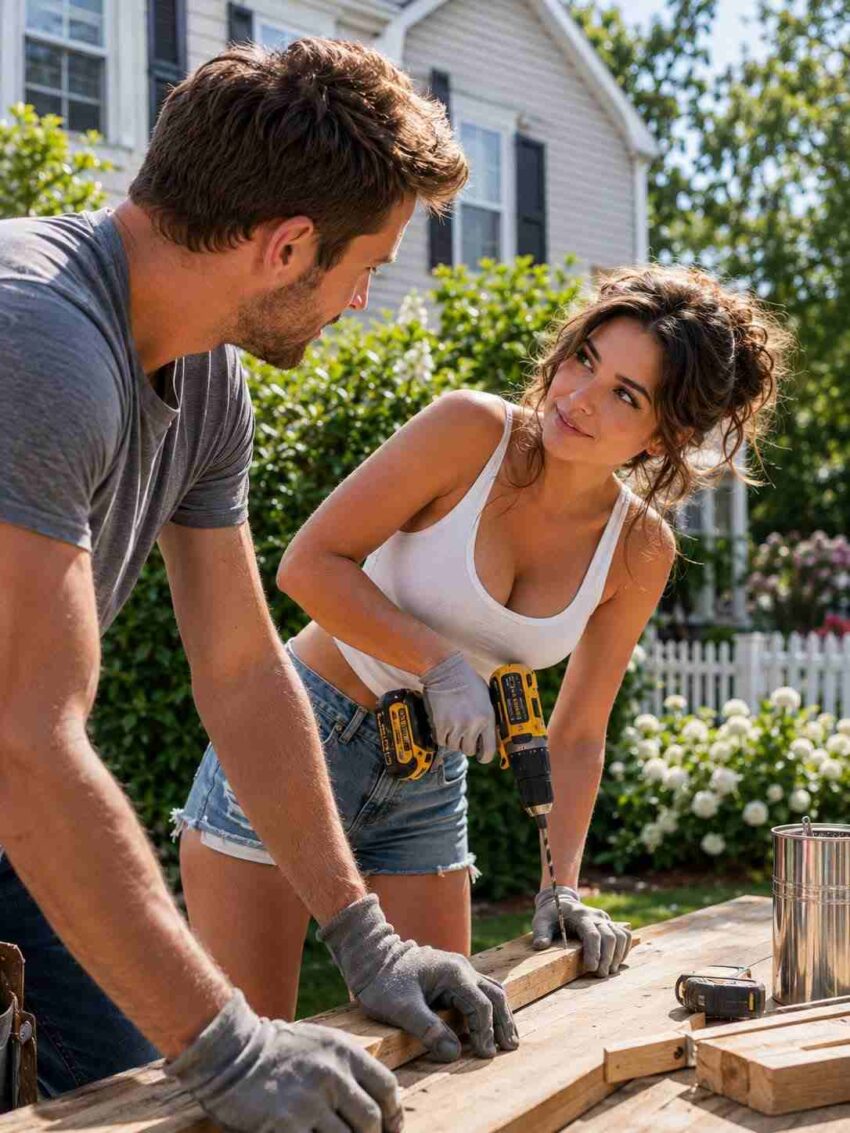
The cruelest thing I ever said to Callie Brooks sounded like a joke.
I said it with a drill in my hand, sawdust on my jeans, and cowardice sitting right in the middle of my chest.
“At this rate, you’ll never get married,” I told her, like I had any right to comment on her life.
She looked up from the deck board, smiled like she had been waiting all summer for me to be stupid enough to say it, and answered softly, “Then maybe you’re the reason.”
That was the moment I realized love had been standing in my backyard for months.
But so had trouble.

PART 1
“At this rate, you’ll never get married, Callie,” I said. “You spend every Saturday fixing a neighbor’s house.”
The drill was still whining in her hand when she looked up at me.
Then she smiled.
Not a cute smile. Not a nervous one. A calm, dangerous smile, like she had just opened a door I had spent years pretending did not exist.
“Then maybe you’re the reason,” she said.
I forgot how to breathe.
My name is Daniel Rowe. I was thirty-eight years old, unmarried, living alone in a half-renovated house in Providence, Rhode Island, and I had made an entire life out of starting things I was too afraid to finish.
The kitchen faucet had been fixed.
The porch boards had been replaced.
The back deck had been “almost done” for two years.
That was my specialty.
Almost.
Almost committed.
Almost honest.
Almost happy.
Callie Brooks moved two doors down in April, driving a white Subaru with a cracked taillight and a folded American flag sticker in the back window. She was thirty-four, a structural engineer, and the kind of woman who could look at a sagging porch and tell you exactly what year the builder got lazy.
The first thing she ever said to me was not hello.
It was, “Did you chock the wheels on that truck?”
I looked at my truck, loaded with pressure-treated pine.
Then I looked at the slight slope of my driveway.
Then I shut my mouth and chocked the wheels.
She nodded once and kept walking.
That was Callie. No drama. No small talk unless it had a purpose. No fluttering around pretending she didn’t know things. She knew things. She knew load-bearing walls, municipal codes, bad rooflines, and when a man was hiding behind silence.
I learned that last part too late.
She borrowed my DeWalt drill six weeks after she moved in. Her drill was being repaired, she said, and she had shelves to hang before a furniture delivery.
She brought it back that night with zucchini bread wrapped in brown parchment paper.
“I baked too much,” she said.
Then she left before I could ask her to stay.
I ate the entire loaf standing over my kitchen sink like a man with no manners and no defense.
After that, she started appearing in small, reasonable ways.
She held one end of a board.
She checked a measurement.
She brought coffee.
She sat in my workshop during a summer storm while rain hammered the tin roof and told me about a pedestrian bridge project over the Woonasquatucket River.
I told myself we were neighbors.
That was the first lie.
By July, I was buying better coffee because she drank it black and always noticed quality. I started working on Saturday mornings because she walked past around ten. I kept the workshop cleaner because she sometimes leaned against the bench and studied my plans.
I told myself none of that meant anything.
That was the second lie.
Then came the Saturday I made the marriage joke.
She had been crouched over the new deck board, hair pulled back, sleeves rolled up, sunlight catching the dust on her cheek. She looked comfortable in my backyard. Too comfortable. Like the space had been waiting for her.
That scared me.
So I did what cowards do.
I turned fear into humor.
“At this rate, you’ll never get married.”
And Callie, patient Callie, steady Callie, did not flinch.
“Then maybe you’re the reason.”
I didn’t answer.
I couldn’t.
Before I found words, a black Range Rover rolled up to the curb.
The engine cut off.
Callie’s face changed before the driver even stepped out.
That was the first time I saw her afraid.
Not weak.
Not broken.
Afraid in the way a woman gets when she has already survived something once and knows it has found her again.
A tall man in a navy polo got out, sunglasses on, smile sharp enough to cut skin.
“Still playing carpenter’s helper?” he called.
Callie stood up slowly.
“Go home, Evan.”
So that was Evan Marsh.
I had heard the name once, from a neighbor who talked too much while watering his lawn. Real estate developer. City connections. Big money family. Used to be engaged to Callie.
Used to be.
Evan walked right up my driveway like he owned it.
Then he looked at me.
“So you’re Daniel,” he said. “The handyman.”
“I own the house,” I said.
He laughed.
“Sure you do.”
Callie stepped between us before I could move.
“Leave,” she said.
Evan ignored her. His eyes traveled over the deck, the lumber, the tools, the unfinished railing.
Then he looked back at Callie.
“This is perfect,” he said. “You always did love broken things.”
Her jaw tightened.
“You don’t get to talk to me anymore.”
He leaned closer.
“I get to talk to you as long as my name is still attached to your house.”
The air dropped ten degrees.
I looked at Callie.
She didn’t look at me.
Evan smiled wider.
“You didn’t tell your little neighbor?” he said. “That’s awkward.”
Callie’s hand curled into a fist at her side.
Evan reached into his pocket, pulled out a folded document, and waved it like a trophy.
“Enjoy your Saturday,” he said. “Because by Thanksgiving, sweetheart, you may not have a porch to sit on.”
Then he drove away, leaving tire marks in front of my driveway.
Callie stood there in my yard, silent, humiliated, and still somehow standing straighter than anyone I had ever seen.
I wanted to ask what he meant.
I wanted to say something brave.
But she picked up the drill, drove the last screw into the board, and said, “We should finish this section before the light goes.”
That was when I understood something.
Callie Brooks didn’t fall apart in front of enemies.
She remembered.
And that made me wonder what else she had been quietly remembering.
PART 2
“That house isn’t yours, sweetheart,” Evan said two days later in front of half the diner. “It’s just taking you a while to understand that.”
Everyone at Mae’s Diner went quiet.
Forks stopped.
Coffee cups hovered.
Even the waitress behind the counter froze with a pot of decaf in her hand.
Callie sat across from me in the back booth, her hands wrapped around a mug, face calm as glass.
I had asked her to breakfast because I was worried.
That was what I told myself.
The truth was worse.
I had asked her because when Evan humiliated her in my driveway, something ugly had moved through me, and I did not know what to do with it.
Callie had ordered eggs over easy and rye toast.
I had ordered pancakes I wasn’t eating.
Then Evan walked in.
He wore a charcoal suit at eight in the morning, which told me everything I needed to know about him. Men like Evan wore suits to diners because they wanted the waitress, the cook, the retired cops at the counter, and the old church ladies in the corner to understand they were better than everyone else.
He stopped beside our booth.
“Daniel,” he said. “Still fixing things that aren’t yours?”
I started to stand.
Callie touched my wrist under the table.
One small touch.
Stay.
So I stayed.
Evan looked pleased with himself.
He loved an audience. That was obvious. He fed on the silence.
“You know,” he said, looking around the diner, “I tried to help Callie. I really did. Her mother dies, leaves her that little house, and she thinks she can handle everything alone. Taxes. Repairs. Insurance. Bank paperwork.”
Callie said nothing.
Evan leaned closer.
“So I stepped in. Like a fiancé should.”
“You forged my signature,” Callie said.
The diner went colder.
Evan smiled.
“Careful.”
She looked up at him.
“You opened a home equity line against my mother’s house while I was in the hospital after my car accident. You used a notary who never saw me sign. You paid the first six months from a joint account, then stopped paying so the bank would threaten foreclosure.”
His smile slipped for half a second.
Only half.
Then it came back.
“You’re emotional.”
Callie nodded slowly.
There was no crying. No pleading. No shaking.
Just that calm.
“I was,” she said. “When I found out.”
Evan laughed loudly, too loudly.
“You found out because I told you. Let’s not pretend you’re a detective.”
Then he bent down until his mouth was near her ear.
But I heard him.
“By Thanksgiving, you’ll sign the sale agreement, or I’ll bury you in legal fees until you’re renting a room over a laundromat.”
My hand tightened around my coffee mug.
Callie’s eyes stayed on his.
“Are you done?”
Evan straightened.
“For now.”
He walked out like a man who thought he had won.
The bell above the diner door jingled behind him.
For a moment, nobody moved.
Then the waitress walked over and refilled Callie’s coffee without asking.
“My cousin’s a notary,” she said quietly. “If you need someone to talk to.”
Callie looked at her.
“Thank you, June.”
That was how I learned half the town already knew something was wrong.
They just didn’t know how bad it was.
In the truck afterward, Callie finally told me everything.
Her mother, Linda Brooks, had left her the house in a will. Not much money, but the house was paid for. Small white place with blue shutters, a porch swing, and a maple tree her father planted when Callie graduated from high school.
Evan had come into her life during a weak season.
Her mother had cancer.
Her father had dementia.
Callie was managing hospital forms, insurance claims, work deadlines, and grief.
Evan was charming then. Helpful. Connected.
He took her to meetings at the bank.
He organized papers.
He called lawyers.
He talked about marriage like it was a rescue plan.
Then the car accident happened.
Black ice. February morning. A week in the hospital. Two cracked ribs. Concussion.
While she was recovering, someone signed her name on bank documents.
A home equity line.
A repair loan.
A management agreement with one of Evan’s companies.
A “future sale preference” contract.
Every document looked clean.
Every signature looked close enough.
By the time Callie found out, Evan had already told her no one would believe her.
“He said I was too tired to remember signing,” she said.
Her voice did not break.
That was somehow worse.
“He said grief makes people confused. He said if I fought him, he would tell the bank I was unstable. He still has emails where I told him I couldn’t think straight after Mom died.”
I pulled into my driveway but didn’t turn off the engine.
“Callie.”
She looked out the windshield at my unfinished deck.
“I’m not telling you this because I need saving,” she said.
“I know.”
“No,” she said, turning to me. “I need you to really know that. I have a lawyer. I have copies. I have dates. I have my hospital records. I have the bank statements. I have the doorbell camera footage from the week he claimed I went to the notary.”
My pulse changed.
“Camera footage?”
She nodded.
“The notary’s office says I came in at 2:15 on a Tuesday. My mother’s old porch camera shows me being carried into the house by my aunt at 2:03, still wearing a hospital bracelet. I didn’t leave again until Thursday.”
For the first time that morning, she smiled.
It wasn’t happy.
It was sharp.
“Evan just doesn’t know I kept the camera.”
I should have told her then.
I should have said, I’m here.
I should have said, You don’t have to fight alone.
Instead, fear opened an old door inside me.
Because this was not coffee and deck boards anymore.
This was real.
Lawyers.
Banks.
Police reports.
A man with money.
A woman I cared about more than I wanted to admit.
That night, I did what I had always done when something mattered.
I stepped back.
Callie texted me at 8:17.
You okay?
I stared at those two words for twenty minutes.
Then I typed the weakest sentence I had ever sent.
Yeah. Just buried in work.
The next Saturday, she came up my driveway with two coffees and a rolled set of plans.
I met her on the porch.
“I can’t work on the deck today,” I said. “Commission deadline.”
She looked at me for a long second.
She knew.
Of course she knew.
But she did not beg.
She did not accuse.
She just nodded.
“Okay, Daniel.”
Then she walked away.
That was the thing about Callie.
She would fight a thief, a liar, a bank, a forged deed, and a man who tried to steal her mother’s house.
But she would not chase someone who chose fear over her.
I watched her walk back down the sidewalk.
And I knew I had just become one more man who made her stand alone.
That night, Garrett Webb came into town.
Garrett had known me fifteen years, which meant he did not waste time pretending I was a mystery.
We met at a bar on Wickenden Street. I told him about the deck. Then Callie. Then Evan. Then the forged papers.
Garrett listened for twelve minutes.
Then he said, “You love her.”
I laughed.
He did not.
“You love her,” he repeated. “And because it’s real, you’re running.”
“I’m not running.”
“You sent her a fake work excuse after she trusted you with the worst thing in her life.”
That shut me up.
Garrett leaned forward.
“Daniel, your problem isn’t that you don’t care. Your problem is that you only stay until staying requires courage.”
I drove home angry.
Not at him.
At myself.
I sat in my truck in the driveway, staring at my house. Kitchen light on. Porch repaired. Deck unfinished in the backyard.
Almost.
Always almost.
Then my phone buzzed.
A text from Callie.
Not words.
A photo.
It showed Evan standing on her porch at 11:43 p.m., trying her front door with an old key.
Under the photo, she had written:
The camera still works.
And suddenly, “almost” was not good enough anymore.
PART 3
“The first thing the lawyer played was Evan laughing while he forged my name.”
Callie said it so calmly that the sentence almost didn’t sound real.
We were sitting in her lawyer’s office downtown, three days after Evan tried her door.
The office smelled like printer ink, old coffee, and money people had to spend because someone else lied first.
Her lawyer was Marlene Price, a small woman in a gray suit with silver hair and eyes that made grown men answer questions correctly.
On the desk sat three folders.
BANK.
DEED.
EVIDENCE.
Marlene tapped the last one.
“Mr. Marsh likes to talk,” she said. “That helps.”
Callie had done more than keep camera footage.
She had kept everything.
Emails.
Texts.
Voicemails.
Bank notices.
A hidden recording from the day Evan came to her porch after the funeral and told her, “You’ll sign whatever I put in front of you because grief makes you useless.”
A receipt from the hospital parking garage proving her aunt had been with her during the time Evan claimed she was at the notary.
A nurse’s discharge note.
A police report from the night he followed her home.
A copy of her mother’s real will, signed two years before Evan ever appeared.
And then came the best part.
The notary.
Evan had used a woman named Patricia Dell, who worked out of a strip mall office near Cranston. On paper, she had witnessed Callie sign the bank documents.
In real life, Patricia Dell had been in Florida that week for her grandson’s graduation.
“She uploaded pictures from Disney World,” Marlene said, sliding a printout across the desk.
Callie looked at it.
A grandmother in mouse ears smiled beside a boy in a cap and gown.
The timestamp was perfect.
I actually laughed.
Marlene did not.
“The bank is going to have questions,” she said. “The police will too. And Mr. Marsh’s development partners are not going to enjoy seeing their company name attached to mortgage fraud.”
Callie sat very still.
“Can we stop the foreclosure notice?”
Marlene nodded.
“We already filed an emergency injunction this morning.”
Callie closed her eyes.
Only for a second.
When she opened them, there were no tears.
Just oxygen returning to a person who had been holding her breath for months.
After the meeting, we stood outside on the sidewalk. Traffic moved past. A city bus hissed at the corner. Someone in a Red Sox hoodie argued into a phone.
Callie hugged the folders to her chest.
I looked at her and finally said what I should have said days earlier.
“I’m sorry I disappeared.”
She did not make it easy for me.
Good.
“You hurt me,” she said.
“I know.”
“You made me feel foolish for telling you.”
“I know.”
“I don’t need a hero, Daniel.”
“I know that too.”
She looked at me for a long moment.
“Then what are you doing here?”
That was the question.
Not what did I feel.
Not what did I want.
What was I doing?
Because feelings were cheap if I still ran when they asked something from me.
So I told her the truth.
“I’m standing here because I’m scared and I’m done letting that make my decisions.”
Her expression softened, but only a little.
“I don’t have room in my life for a man who needs me to drag him into honesty.”
“You won’t have to.”
“I won’t beg.”
“I won’t make you.”
She nodded once.
Not forgiveness.
Not yet.
But a door not fully closed.
That Saturday morning, I started on the deck before sunrise.
No coffee.
No excuses.
Just boards, screws, sawdust, and the sound of the drill biting into wood.
At 7:12, Callie appeared at the edge of the yard.
Two coffees in her hands.
“You started,” she said.
“I did.”
She looked at the remaining lumber.
“Without me?”
I held out the DeWalt.
“Never.”
For the first time in days, she almost smiled.
Almost.
We worked for four hours. The rhythm came back slowly, like something injured learning to trust weight again.
By noon, the far section was finished.
By two, the railing posts were up.
By four, Evan arrived.
Of course he did.
This time, he did not come alone.
He brought a woman in heels, a man in a city planning jacket, and two potential buyers dressed like they had come from a country club brunch.
Callie stood on the deck beside me, dust on her jeans, drill in her hand.
Evan spread his arms.
“Here we are,” he said. “The famous property.”
Callie walked down the steps.
“You’re trespassing.”
Evan laughed for his audience.
“I’m showing interested parties an asset connected to my company.”
I stepped forward.
Callie stopped me with one look.
Not yet.
Evan turned to the buyers.
“As you can see, the owner has allowed the place to decline emotionally and structurally.”
Callie said, “Emotionally?”
He smiled.
“Unstable owners make unstable properties.”
That was the moment I saw people on the sidewalk slow down.
A neighbor across the street lifted her phone.
June from the diner was suddenly on her porch.
Mr. Alvarez, the retired police officer from the corner house, stepped out with his dog and stopped pretending he was walking.
Evan did not notice.
Men like Evan rarely notice ordinary people until ordinary people become witnesses.
Callie kept her voice even.
“You need to leave.”
He leaned in.
“You need to sign.”
“No.”
His smile disappeared.
“You think your little lawyer scares me?”
“No.”
“Then what does?”
Callie held up her phone.
The screen showed a live call.
Marlene Price.
“Facts,” Callie said.
For the first time, Evan looked uncertain.
Then he recovered.
“You’re bluffing.”
Callie looked past him.
“No, Evan. You are.”
A police cruiser turned onto the street.
Then another.
Evan’s face changed.
Not panic yet.
But calculation.
Officer Alvarez had called them. June had recorded everything. My porch camera had caught Evan entering my driveway. Callie’s camera had caught him trying her door with an old key.
Two officers stepped out.
“Evan Marsh?” one asked.
Evan smiled like he knew someone important.
“I’m sure this is a misunderstanding.”
Callie reached into her folder and handed the officer a printed photo.
Evan at her door.
The timestamp clear.
The old key visible.
The officer looked at it.
Then at Evan.
“You’re going to need to answer some questions.”
The buyers stepped away from him as if arrogance were contagious.
The woman in heels whispered, “Evan, what is this?”
Callie answered before he could.
“This is what happens when a thief thinks a woman alone is the same thing as a woman helpless.”
The street went silent.
Evan glared at her.
“You’ll regret this.”
Callie smiled.
“No,” she said. “I already did that part.”
They did not arrest him that day.
Not yet.
Men like Evan usually got extra time because they had clean shoes and knew which hands to shake.
But the officers took statements.
The buyers left.
The city planning man would not meet Evan’s eyes.
And by sunset, everyone on our block knew.
Callie sat on my finished deck with her boots on the steps and her hair loose around her face.
I brought out two beers.
She took one.
For a long time, we said nothing.
Then she looked at me.
“That joke you made,” she said.
I swallowed.
“Yeah.”
“At this rate, I’ll never get married.”
“I was an idiot.”
“Yes.”
Fair.
She turned the bottle in her hands.
“Were you joking because you didn’t care?”
“No.”
“Then why?”
I looked at the deck we had built together.
“Because I cared too much, and I didn’t know what to do with that.”
She stared at me.
“Daniel.”
“I know.”
“No,” she said. “You don’t. I waited because I thought maybe you were worth waiting for. But patience isn’t the same as permission to hurt me.”
The words hit clean.
No shouting.
No drama.
Just truth.
I nodded.
“You’re right.”
She stood, set the beer down, and walked toward the stairs.
At the bottom, she turned back.
“If you want me in your life, stop making me guess where I stand.”
Then she walked home.
This time, I did not watch her go and do nothing.
I picked up my keys.
Because the next morning, Evan Marsh was going to court.
And I was done being the man who arrived too late.
PART 4
Evan lost everything in a room so quiet you could hear the judge turn a page.
No shouting.
No dramatic confession.
No music.
Just paper.
That was the thing Evan had forgotten.
Paper could destroy a person just as efficiently as power could protect him.
The hearing was on a gray Tuesday morning at the Providence County courthouse. Callie wore a navy dress, simple coat, and the same calm face I had seen in my backyard when Evan tried to shame her.
I sat behind her.
Not beside her.
Behind her.
This was her fight, and I was there because she had allowed me to be.
Marlene Price stood at the front table with her folders lined up like weapons.
Evan arrived ten minutes late with two attorneys and the same arrogant smile.
He glanced back at Callie.
Then at me.
“Still the handyman?” he whispered as he passed.
I almost smiled.
Because he still thought insult was power.
The judge was a woman named Honora Kline, and she had the exhausted patience of someone who had listened to too many rich men explain why rules were for other people.
Marlene started with the will.
Linda Brooks had left the house solely to Callie.
No ambiguity.
No shared claim.
No permission for Evan Marsh or any company connected to him to manage, mortgage, sell, or encumber the property.
Then came the hospital records.
Callie was physically unable to appear before a notary on the date in question.
Then the doorbell camera footage.
Then Patricia Dell’s Disney World photos.
Then the bank records.
Then the recording.
Evan’s attorney objected twice.
The judge overruled him twice.
When Marlene played Evan’s voice saying, “You’ll sign whatever I put in front of you,” the courtroom changed.
Even Evan’s own lawyer looked down.
Callie did not.
She watched the judge.
Steady.
Silent.
Unbroken.
Evan’s face turned red.
“That was taken out of context,” he snapped.
Judge Kline looked over her glasses.
“Mr. Marsh, I strongly recommend you stop talking unless your attorney instructs you to.”
For the first time since I had met him, Evan obeyed.
The ruling came fast.
The foreclosure process was frozen.
The disputed loan documents were referred for investigation.
The management agreement was suspended.
The claimed sale preference was declared unenforceable pending fraud review.
The judge ordered Evan to stay away from Callie’s property.
Then she looked directly at him.
“And if you attempt to contact Ms. Brooks outside counsel again, you may find yourself discussing it from a less comfortable chair.”
The bailiff moved slightly.
Evan understood.
After court, he tried one last performance in the hallway.
“This isn’t over,” he said.
Callie stopped walking.
She turned toward him.
For one second, I thought she might finally yell.
She didn’t.
She took out her phone, tapped the screen, and played a voicemail.
Evan’s voice filled the hallway.
“Once the bank pressure hits, she’ll fold. Women like Callie always fold when they realize nobody is coming.”
His attorney closed his eyes.
A man in a gray suit stepped forward.
I recognized him from local news.
Evan’s senior development partner.
He looked sick.
“Evan,” he said, “you’re done.”
Two words.
That was all it took.
By Friday, Evan’s company announced he was “stepping away.”
By Monday, the bank issued a formal apology to Callie and opened an internal investigation.
By Thanksgiving, the police had enough to charge him with fraud-related offenses.
His friends stopped inviting him places.
His fiancée left him.
His family’s name could not save him from screenshots, recordings, court documents, and a town full of witnesses who had watched him try to crush a woman on her own porch.
Callie did not celebrate loudly.
She did not dance on his downfall.
She just changed the locks, paid the corrected property taxes, and planted white mums under her mother’s front window.
That was her victory.
Quiet.
Complete.
Hers.
Thanksgiving came cold and bright.
She invited me to her house for dinner.
Her aunt came.
Marlene came.
June from the diner came with three pies and gossip she claimed was “for legal morale.”
Mr. Alvarez brought rolls from the church kitchen.
There was turkey, mashed potatoes, green beans, cranberry sauce, and a little framed photo of Callie’s mother on the sideboard.
The house felt alive.
Not rescued.
Not repaired by someone else.
Reclaimed.
After dinner, Callie and I stood on her porch while everyone inside argued about football.
A small American flag moved in the cold wind from a bracket near her steps.
She looked at my truck in the driveway.
Then at me.
“You never answered me,” she said.
My stomach tightened.
“About what?”
She smiled.
“At this rate.”
I knew exactly what she meant.
This time, I did not hide behind a joke.
This time, I did not look away.
“At this rate,” I said, “I’m hoping I get to be the reason for a long time.”
Her eyes softened.
“Better.”
“Only better?”
She stepped closer.
“Much better.”
In January, she bought her own drill.
It was blue.
Ugly as sin.
She left my DeWalt on my workbench with a note tucked under it.
Returning this to the owner. I bought my own. It’s uglier, but it’s mine.
I laughed alone in the workshop for almost a full minute.
Not because the note was funny.
Because I understood it.
Love had not arrived as fireworks.
It had arrived as zucchini bread on my kitchen counter.
As coffee in the rain.
As a woman holding one end of a board without asking what it meant.
As court folders marked BANK, DEED, EVIDENCE.
As courage when fear would have been easier.
As Callie Brooks standing in a diner while a cruel man tried to shame her and choosing to remember instead of collapse.
And as me finally learning that staying is not a feeling.
It is a decision.
Spring came back to Providence slowly.
The deck held through the snow.
Callie’s house held through the lies.
And I held too.
One Saturday morning, we worked side by side in my backyard, her ugly blue drill and my yellow DeWalt running at different speeds.
She was installing a new planter box.
I was pretending not to stare.
She caught me.
“What?” she asked.
I shook my head.
“Nothing.”
“Daniel.”
I smiled.
“I was just thinking.”
“That sounds dangerous.”
“It is.”
She raised an eyebrow.
I looked at the deck, the porch, the street, the house two doors down that was hers because she had fought for it.
Then I looked at her.
“I used to think unfinished things were safer,” I said. “If you never finish, nobody can take the finished thing away.”
Callie studied me for a moment.
Then she set down the drill and walked over.
“And now?”
I took her hand.
“Now I think unfinished things just keep you lonely.”
She squeezed my fingers.
No big speech.
No dramatic music.
Just her hand in mine on a deck we had built board by board.
Evan lost his reputation, his company, his power, and the right to ever make Callie feel small again.
Callie kept her mother’s house, her name, her dignity, and the life he tried to steal.
And me?
I kept showing up.
Because the woman I once joked would never get married had been right all along.
Maybe I was the reason.
But in the end, she became mine.