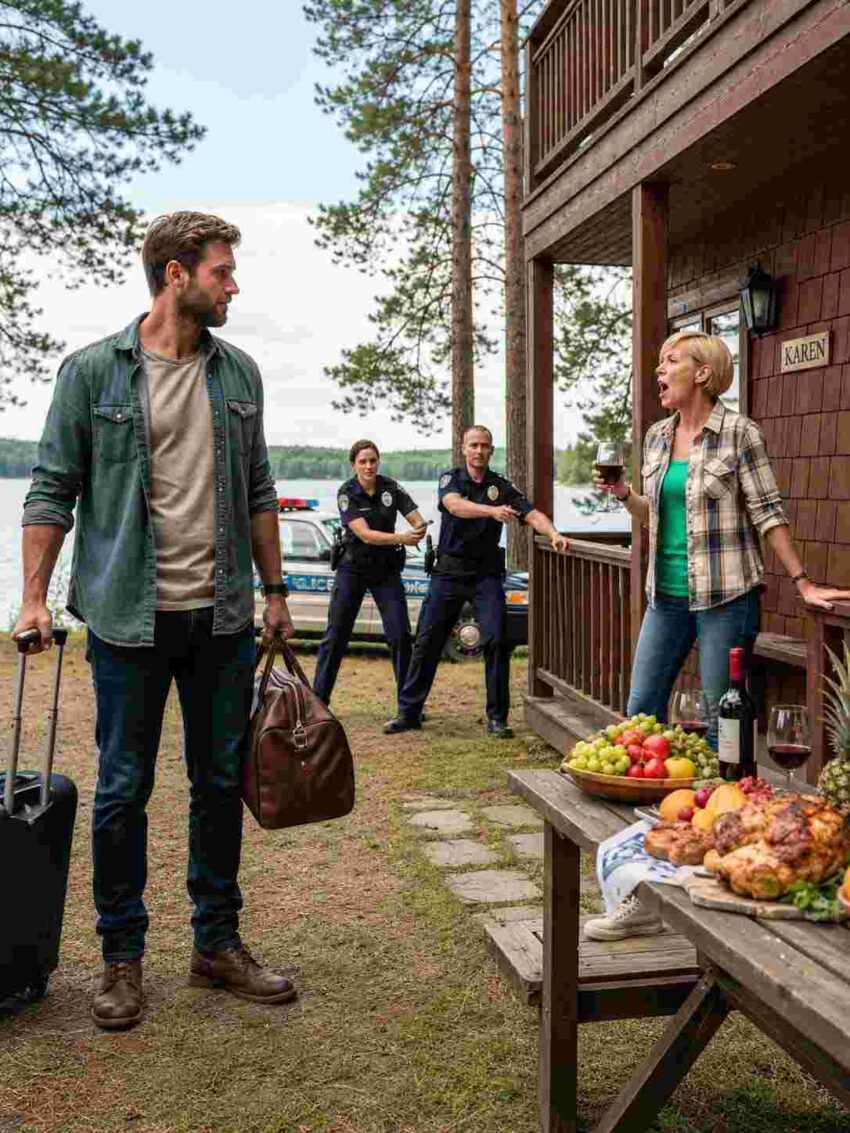
I was halfway through a cold beer on my back porch when the lawyer called and told me I had inherited five hundred acres.
For a second, I thought I had misheard him.
Five hundred acres was not the kind of phrase that belonged in my life. My life was oil-stained jeans, overdue invoices, a two-bedroom rental with a water heater that sounded like it was full of gravel, and a mechanic business that survived month to month because I could fix almost anything except cash flow.
“Say that again,” I said, setting the beer down on the arm of the chair.
The lawyer’s voice crackled through the phone. “Your uncle, Jasper Maddox, left you approximately five hundred acres outside Fair Grove. Unencumbered. Free and clear.”
“Five hundred acres,” I repeated.
“Yes, sir.”
I looked out at the sad little yard behind my rental, where a patch of brown grass had given up on life sometime in July and never recovered.
Uncle Jasper had been a strange man. Not cruel. Not warm either. The kind of relative who appeared at funerals, stood at the back, said something dry and observant, then vanished before the casseroles were uncovered. I had not seen him in years. I knew he owned land somewhere because old men in our family always seemed to own land somewhere, but I had imagined brush, rocks, maybe a collapsing barn.
Not five hundred acres.
“Are you sure he meant me?” I asked.
“You are the only named heir in the land trust transfer.”
I nearly laughed.
Me. Xavier Maddox. Owner of Maddox Custom Auto, a business that currently had three unpaid invoices, two classic cars in pieces, and one landlord who considered every rent check a personal favor. Five hundred acres sounded less like inheritance and more like a clerical error wearing a cowboy hat.
Advertisements
Two days later, I learned it was much worse than that.
I drove out with a folder on the passenger seat: deed copy, parcel map, probate notice, and directions. I expected open land. Maybe a locked farm gate. Maybe a long gravel road with weeds growing through it.
The GPS took me to a pristine metal entrance gate framed by fake stone columns and ornamental landscaping.
A brass sign gleamed in the morning sun.
Crescent Ridge Community — HOA Managed.
Beyond the gate were luxury homes.
Rows of them.
Cream stucco. Stone facades. Perfect driveways. Sidewalks. Streetlamps. Mailboxes that probably cost more than my first truck. A landscaped park with a duck pond sat visible beyond a curve in the road, and farther back I could see the roofline of a clubhouse.
I sat in my beat-up pickup and stared.
Then I looked at the parcel map.
Then at the gate.
Then at the map again.
A camera above the keypad blinked red.
A clipped voice came through the speaker. “Can I help you?”
“Yeah,” I said slowly. “I think I’m standing on my land.”
Silence.
Then sharper: “This is private property, sir. If you don’t leave, I’ll call security.”
“Go ahead. Maybe they can explain why there’s a whole subdivision built on land I just inherited.”
The gate buzzed open almost immediately.
I drove in.
I had not even stepped out before a woman came marching across the lawn beside the entrance like the whole neighborhood had been waiting for her cue. Pastel tracksuit. Sunglasses perched on her head like a crown. Shoulder-length blonde hair shaped into an immovable helmet. Clipboard clutched against her chest like it contained scripture.
I had dealt with enough difficult customers to recognize a certain species of person before they opened their mouth.
This one opened hers anyway.
“Excuse me,” she snapped. “This area is for residents only.”
“I’m Xavier Maddox. Jasper Maddox was my uncle. I just inherited this land.”
Her mouth twitched.
A tiny movement.
Fear, recognition, calculation—there and gone.
“I’m Deborah Van Holt,” she said. “President of the Crescent Ridge HOA. And I find it highly unlikely you own anything here.”
I pulled the deed copy from the folder and held it out.
She took it like it might stain her.
Her eyes moved over the page.
Her face lost color.
Then she recovered, which is what people like Deborah do best. They do not accept reality. They negotiate with it until they can turn it into someone else’s inconvenience.
“There’s obviously a mistake,” she said. “This subdivision has been here for more than eight years. We’ve invested heavily. Roads, utilities, landscaping. You’re confused.”
“I’m not confused.”
“You should speak to our lawyers.”
“I will speak to mine.”
“In the meantime,” she said, voice tightening, “I need you to leave. You’re upsetting the community.”
I looked past her. Homeowners stood on porches. One man in a suit was already on his phone. A woman holding a small dog stared like I had driven a circus wagon through church.
“I’ll leave when I’m ready,” I said.
Then I walked into the middle of the street.
I stood there breathing in the clean suburban air and looking at the perfect little HOA kingdom around me.
Every house.
Every sidewalk.
Every manicured tree.
All of it sitting on land my uncle never sold.
And now, one way or another, they were going to explain themselves.
The county clerk’s office was quieter than I expected for a Monday morning. A dusty ceiling fan rattled overhead. A woman behind the counter typed with one finger at a time and did not seem surprised by anything, which I found reassuring.
“Parcel 82B,” I said, sliding the paperwork across.
She took it, adjusted her glasses, and began clicking through records.
After a few minutes, she turned the monitor toward me.
“There it is. Entire parcel. Five hundred acres.”
“Current owner?”
“Jasper Maddox until transfer upon death. Now Xavier Maddox.”
“That’s me.”
She clicked again.
“No sale record. No lease agreement. No easement filing.”
“Could a subdivision be built on it without those?”
She looked over her glasses. “It shouldn’t be.”
“Taxes?”
“Paid every year.”
“By who?”
“Trust account set up fifteen years ago.”
I let out a low whistle. “So the HOA built a luxury subdivision without buying the land.”
She looked at the screen, then at me. “According to this, yes.”
“Can you print all of that?”
“I can. And if I were you, I’d get a property attorney.”
That afternoon, I walked into Carla Domings’s office.
Carla had represented me once when a client tried to avoid paying for a classic car rebuild by claiming a perfectly restored Chevelle had “spiritual defects.” She had a personality like a wrecking ball, a memory like a steel trap, and the kind of legal confidence that made dishonest people nervous before they knew why.
She looked up from her desk.
“Xavier Maddox. Last I heard, you were chasing a man who wired his ignition coil backward.”
“Still the same guy. But now I apparently own five hundred acres under a luxury subdivision, and the HOA says I’m trespassing.”
Carla set down her pen.
“Sit.”
I explained slowly. Deed. Trust. Parcel map. No sale. No lease. No easement. Crescent Ridge. Deborah Van Holt. The fake-stone gate.
By the time I finished, Carla was already pulling records.
“Holy hell,” she said.
“That legal analysis?”
“That is me restraining myself. If these records are accurate, they built on land they never owned. Permits, zoning, utilities, infrastructure—every approval should have required proof of ownership.”
“What does that mean for me?”
“It means you have them by the throat unless they can produce a valid deed.”
“They claim they have lawyers.”
“Everyone has lawyers when they are scared.”
She tapped the documents. “First, quiet title action. We confirm you as sole legal owner. Second, we demand all permit records, utility approvals, zoning variances, developer filings, HOA financials, everything. Third, we find out who helped this happen.”
“Helped?”
“You don’t accidentally build a gated community. Someone signed something. Someone approved something. If the land was never sold, then someone lied, someone forged, or someone was paid not to look.”
That thought sat heavy.
Two days later, I returned to Crescent Ridge, but not through the gate. I walked the tree line behind the golf course because I wanted to see the land without Deborah in my face.
That was when I found the southern utility lot.
Fenced. New posts. Fresh concrete bases. Security cameras. Generator shed. Locked utility box. A sign read: HOA Maintenance Access Only.
I checked the parcel overlay Carla had given me.
The lot sat outside the approved development zone.
Not just on my land.
On land they had not even pretended to include.
I photographed everything.
The next morning, Carla filed the quiet title action. Deeds, tax receipts, aerial maps, parcel overlays. She also requested every permit and approval attached to Crescent Ridge.
The HOA responded with a cease-and-desist letter accusing me of harassment and trespassing.
Carla read it and laughed.
“They’re bluffing. They want you scared before the county starts digging.”
The county started digging.
A week later, a plainclothes investigator from the district attorney’s office walked into Carla’s office carrying a stack of files.
“Damon Cho,” he said. “Assigned to possible permit fraud tied to Crescent Ridge.”
He explained that the initial building permits referenced a land purchase that did not exist. The deed in the file appeared forged. The notary stamp used on it had been retired five years before the supposed signing date.
Carla leaned forward. “Names?”
“Two former county employees are under review. One from clerk records. One from permitting.”
“It’s bigger than bad paperwork,” I said.
Cho nodded. “They also used the forged deed in federal infrastructure grant applications.”
Carla’s eyebrows rose. “Wire fraud.”
“Potentially. If it holds.”
I sat back and felt the shape of the thing change.
Not mistake.
Not oversight.
A cover-up.
Cho needed witness statements showing the HOA knew, or at least had reason to know, the ownership story was false.
So I hosted a barbecue.
Not a secret meeting. Not a rally. A real cookout on a section of open land near the edge of the subdivision. I sent flyers to every house: Meet the landowner. Ask questions. See the records.
Most ignored it.
Around twenty came.
Some curious. Some angry. Some afraid.
A retired firefighter named Anthony approached while I was at the grill.
“I always wondered how this place went up so fast,” he said. “They called it a legacy development. Nobody ever explained what that meant.”
“Did you see a deed when you bought?”
He shook his head. “We signed mortgage papers. The developer and HOA said everything was handled.”
“Would you talk to the investigator?”
He looked toward the houses. “If I’m living on stolen land, I want it made right.”
By sunset, six residents had agreed to give statements.
The next week, the bomb dropped.
Two former county employees were charged, one for forgery, one for bribery. The developer behind Crescent Ridge was indicted for wire fraud and conspiracy. Deborah Van Holt was subpoenaed for knowingly submitting false documents.
Crescent Ridge panicked.
Emergency HOA meetings. Houses listed overnight. Residents demanding answers. Deborah giving statements about “baseless harassment” and “outside agitators” while her board hid behind closed doors.
Then the court ruled.
Quiet title confirmed.
I was the legal owner of all five hundred acres.
Every road.
Every lawn.
Every driveway.
The clubhouse. The pool. The tennis courts. The park. The duck pond. The perfect little empire.
Carla called me with the news.
“You have options.”
“Eviction?”
“Possible for common areas. Messier for homes because residents bought in good faith. We can pursue back rent, negotiate leases, sell parcels, or use leverage against the HOA assets first.”
“I don’t want to displace families.”
“Good. Because families make bad enemies and worse collateral damage.”
“But I do want accountability.”
Carla smiled. “Then we start with the clubhouse.”
The clubhouse was Crescent Ridge’s pride. Wine tastings. Holiday brunches. Board elections. Fitness classes. The place where Deborah held court and residents learned how expensive disobedience could be.
It sat on land not covered by even the fraudulent permit filings.
We served formal notice: thirty days to purchase, lease, or vacate.
The HOA countersued within forty-eight hours, claiming the land beneath the clubhouse had been “gifted in perpetuity to residents.”
Carla laughed so hard she nearly spilled coffee.
“There is no gift. No record. No instrument. No deed. They are inventing fog and hoping the judge gets lost in it.”
Then the court granted us access to HOA financial records.
That was where everything truly came apart.
I drove through the main gate this time. It had been left open. No guard. No voice on the speaker. Residents walking dogs avoided my eyes. A few nodded quietly, the way people do when they know you are causing trouble for the right reasons but are not ready to say so publicly.
At the clubhouse, I found a spare key under a flower pot near the ramp, which told me everything I needed to know about Crescent Ridge’s security philosophy.
Inside smelled like lemon polish and chlorine.
The office filing cabinets were neat. Too neat. Alphabetized. Color-coded. Pristine folders.
Vendor contracts looked wrong immediately.
Same signature style. Same dates. Same handwriting across dozens of documents. Landscaping charges of fifteen thousand dollars a month for “decorative mulch layering” and “seasonal fountain calibration.” A maintenance line item that could have resurfaced a county road but allegedly covered tennis net tensioning.
Then I opened the locked cabinet behind the desk.
The flowerpot key worked there too.
Inside were three manila folders.
Milstone Dev.
Permit Adjustments.
DV.
I opened DV first.
Personal bank statements.
Deborah Van Holt.
Transfers from HOA accounts to her own. Small at first. Two hundred. Five hundred. Then bigger. One deposit for twenty-two thousand dollars labeled Special Assessment Overflow.
She had been skimming dues.
I drove the folders straight to Carla.
Her face hardened page by page.
“She’s cooked,” she said. “Unauthorized transfers. If these dates line up with meeting minutes and budget approvals, that is embezzlement.”
The Milstone Dev folder was worse.
Emails between Deborah and Roger Klene, a former project manager for the original developer. Notes about keeping permit files sealed. Ensuring county audits never happened. One line that read: If the county audits us, we’re finished.
Carla looked up. “We need Cho.”
At the DA’s satellite office, Cho reviewed the folders and brought in Special Agent Marston from the Department of Justice.
“That encrypted correspondence may put us into RICO territory,” Marston said.
“RICO,” I repeated.
“If we can prove the HOA position was used as part of coordinated financial crimes with the developer—mail fraud, wire fraud, bank fraud, embezzlement—it becomes federal.”
Carla handed him a flash drive already sorted.
Federal subpoenas hit Crescent Ridge the next day.
The HOA board was suspended. Dues were frozen. The clubhouse was sealed. News vans appeared at the gate. Reporters treated the brass sign like a crime scene marker.
I stayed out of sight.
Carla made the statements.
The message was simple: I owned the land. I was not targeting innocent residents. We were offering a fair path forward after the fraud was exposed.
The board vice president, Greg Penner, asked to meet.
He looked wrecked when he arrived at the law office downtown: wrinkled collar, shaking hands, eyes like he had not slept since the subpoenas.
“I didn’t know,” he said. “I joined three years ago. Deborah handled old paperwork.”
Carla leaned forward. “Then why did you approve a dues increase last year for ‘legacy land taxes’?”
Greg flinched. “She said we owed back payments to the county.”
“And you checked?”
He stared at the table.
“No.”
“You approved fake tax payments without verification,” I said.
“Yes.”
Carla clicked her pen once. “You may be facing state charges. But if you testify and we can prove you weren’t part of the original fraud, immunity may be possible.”
Greg nodded. “I’ll cooperate.”
Two weeks later, Deborah Van Holt was arrested outside her gym wearing a tennis skirt and designer sunglasses.
Residents filmed from porches.
Some cheered.
Most just watched.
She was charged with embezzlement, fraud, conspiracy, and racketeering-related offenses. Bail was denied. Roger Klene fled the state and was picked up in Nevada trying to board a private plane.
Crescent Ridge shifted after that.
People stopped looking at me like a threat and started asking questions like neighbors do when the person they feared turns out to have been stealing from them too.
Town hall meetings replaced HOA meetings.
Carla and I laid out the options: long-term nominal lot leases, eventual buyout pathways, transparent infrastructure funding, no surprise assessments, no private enforcement kingdom.
At one meeting, Denise, an elementary school teacher, stood up.
“I paid into this community for six years,” she said. “I didn’t know. But now that we do know, I don’t want another HOA. I want a neighborhood.”
The room murmured agreement.
Carla explained that if seventy-five percent voted to dissolve the HOA, they could.
By the end of the month, they had the votes.
Crescent Ridge HOA was dissolved.
I established a land trust through Carla’s office. Residents leased lots at nominal rates while retaining full rights to their homes. Money went into roads, water lines, the park, shared utilities, and transparent maintenance managed by an elected community board.
No secret meetings.
No fake assessments.
No Deborah.
I kept fifty acres near the North Ridge for myself.
Built a modest house with a deep porch, a workshop, and enough room to open the custom auto garage I had dreamed about for years. Word spread faster than I expected. Classic trucks. Muscle cars. Frame-off restorations. Real work. Honest work. Soon I had more business than I could handle.
One crisp morning, Anthony pulled into my driveway with a box under one arm.
“From the residents,” he said. “Just a thank-you.”
Inside was a hand-carved plaque.
Xavier Maddox — The Man Who Stood His Ground.
I did not need anything flashy.
That was enough.
For a while, things settled.
Then Carla called before sunrise.
“Xavier,” she said, voice clipped. “We’ve got a problem. Big one.”
I wiped grease from my hands. “What now?”
“The forensic audit found a buried expense trail. Crescent Ridge HOA funneled nearly half a million dollars over seven years into a shell company that doesn’t exist in any state registry. Labeled contracted utility services. No tax ID. No contract. Wires routed through an offshore intermediary in the Caymans.”
I leaned against the workbench.
“We’re past mismanagement,” she said. “This is laundering.”
By noon, Marston had financial crimes on site.
The HOA had not only been skimming dues. Milstone Development had been using Crescent Ridge to wash money from other real estate deals. At least three other subdivisions showed similar patterns. One decrypted email referenced a payoff to the zoning inspector who approved the original site plan.
Then the threats started.
Carla’s office was broken into. Furniture overturned. Window shattered. Bleach poured over file boxes, thankfully decoys because Carla trusted paper the way some people trusted snakes.
My mailbox was ripped open and stuffed with shredded photos of my workshop.
A resident found her tires slashed with a note under the wiper.
Stay quiet.
We reported everything.
Marston assigned protection to Carla and had trail cameras installed around my property.
I am not easy to rattle, but I started sleeping with porch lights on and a shotgun closer than usual.
Then Roger Klene flipped.
Cho called just after lunch.
“He’s naming everyone. County officials. Developers. A city councilman. Contractors. Zoning payoffs. Milstone leadership.”
“What does he get?”
“Reduced sentence. Witness protection. He’s terrified. Says they told him they’d bury him in a foundation pour if he talked.”
Three days later, dawn raids hit Milstone headquarters.
Executives in handcuffs. Laptops seized. Offices taped off. Evening news footage went viral.
But one loose thread remained.
The southern utility lot.
The fenced lot with the generator shed and security cameras.
For months, the county utility board had blocked access, citing safety protocols and restricted infrastructure. After the indictments, those barriers vanished.
We entered with federal agents.
Behind the generator shed’s false wall was a narrow stairwell.
Below it, a concrete room.
Filing cabinets. Hard drives. Dormant local server.
Milstone’s hidden archive.
Marston’s tech team pulled the data within hours.
The documents revealed the blueprint.
Milstone had intentionally built Crescent Ridge on Jasper Maddox’s land because it was inactive, undeveloped, and protected by a trust they believed no one would contest. They expected Jasper to die without an heir who cared or understood the value. Their plan was to hold the development long enough to claim adverse possession or pressure the heir into selling cheaply.
The final memo was dated two months before Deborah’s arrest.
If the Maddox heir won’t sell, pressure him. If he resists, bury him in litigation until he folds. We’ve done it before.
I read that sentence three times.
They had not just stolen land.
They had built a business model out of theft, paperwork, intimidation, and time.
The federal RICO case expanded to five subdivisions and thirty-nine defendants. Trials would take years, but the machine was broken. Its documents were seized. Its money trail exposed. Its people turning on each other with the sudden moral clarity of defendants hoping for shorter sentences.
Crescent Ridge changed in ways I had not expected.
The clubhouse became a real community center. No dues required. Volunteers cleaned the park. Residents formed a rotating infrastructure committee. The old golf course hosted a spring festival with food trucks, a local band, balloon artists, and kids running across grass that had once been maintained by fraudulent assessments.
Carla stood beside me with lemonade in one hand.
“You ever think it would end like this?” she asked.
“Not once. I expected lawsuits and headaches. I didn’t expect community.”
“You gave them more than land.”
I shook my head. “They built that part themselves. I just gave them the space.”
Later that night, after the festival lights dimmed and the last cars left, I walked up to the north ridge.
Below me, porch lights glowed across Crescent Ridge. Not the perfect sterile glow I had seen the first day, but something warmer. Realer. A neighborhood finding its own shape after the people who claimed to manage it were finally gone.
Wind moved through the trees.
Somewhere down near the former clubhouse, laughter carried faintly up the hill.
I thought about Uncle Jasper, quiet and strange, paying taxes every year from a trust while developers circled like vultures. Maybe he knew. Maybe he suspected. Maybe he simply believed land should stay in the family until someone came along stubborn enough to stand in the middle of the road and say no.
They had tried to steal it.
They had tried to bury it in forged deeds, fake permits, shell companies, intimidation, and legal fog.
But dirt remembers.
Records remain.
And sometimes the man who inherits the problem is exactly the wrong man to pressure.
I went back to my workshop before the rain started. A custom hood panel waited on the bench. Real metal. Real weight. Something bent that could be shaped correctly with enough heat, patience, and pressure in the right places.
I ran my hand along the edge and smiled.
The land was quiet now.
Not empty.
Not stolen.
Not managed by fear.
Settled.
Mine where it needed to be mine.
Theirs where it needed to be theirs.
And for the first time since the phone call that changed my life, five hundred acres felt less like a burden and more like what Uncle Jasper had actually left me.
Not land.
A line in the dirt.
And the chance to hold it.
THE END