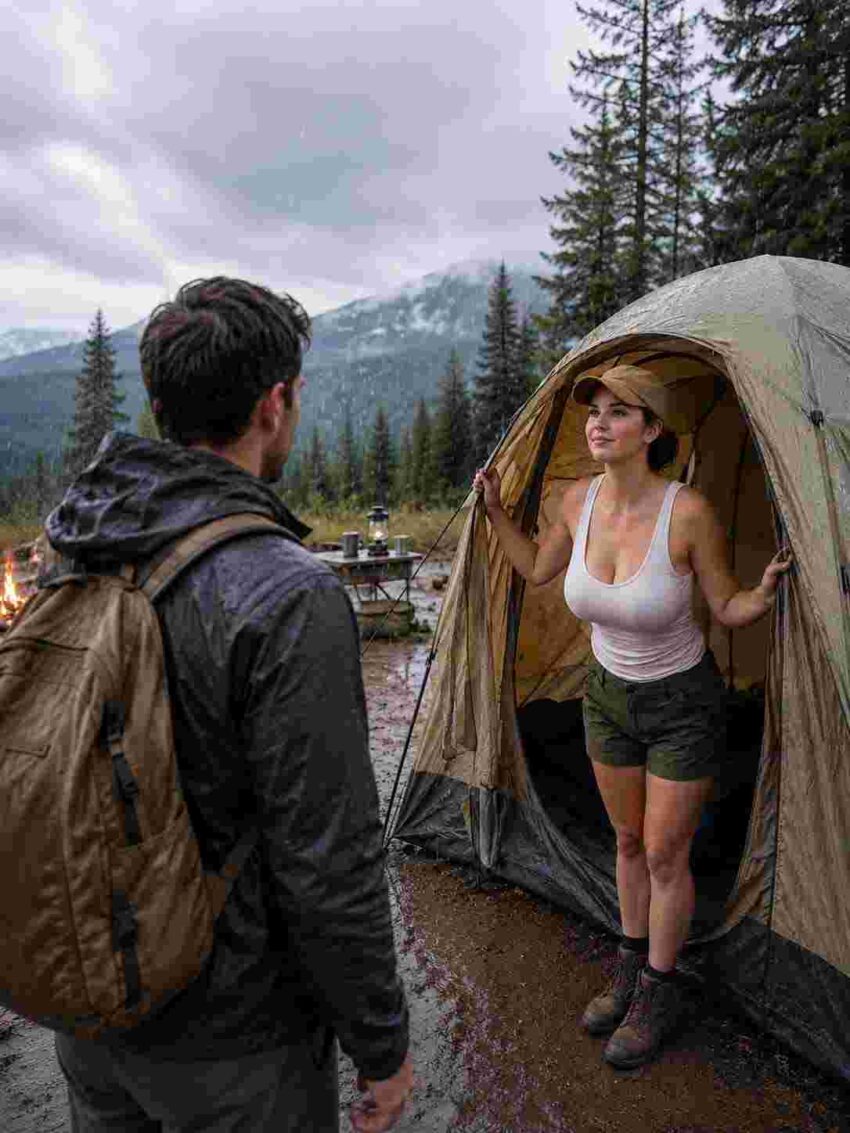
The Storm Took My Tent—Then She Said, “Stay in Mine,” But Her Boss Was Listening…
The Storm Took My Tent—Then She Said, “Stay in Mine,” But Her Boss Was Listening…
The storm did not scare me at first.
I had chased worse systems across Wyoming, Colorado, Montana, and half the bad decisions the Weather Service tells civilians to avoid. Wind was data. Rain was pressure. Thunder was timing.
Then my tent exploded across the ridge like somebody had fired a shotgun through it.
My grant data was strapped to my chest.
Claire Thomas’s entire ten-year research project was inside the only shelter still standing.
And when she looked at me through the rain and said, “Stay in mine,” I knew the storm was not the most dangerous thing on that mountain.
Dr. Aris was.

PART 1
My tent ripped open like a body bag in the wind, and Claire Thomas yelled, “Get inside before this mountain buries you.”
I should have moved faster.
Instead, I stood in the mud for half a second, watching three years of field shelter, weatherproof canvas, aluminum poles, and my last private space on earth twist around a pine stump twenty yards down the slope.
The storm had taken my tent.
Not damaged it.
Taken it.
Rain came sideways across the ridge, cold enough to sting through my gloves. The air pressure had dropped twelve millibars in under twenty minutes, which was not normal mountain weather.
That was a warning.
That was the mountain clearing its throat before it started killing people.
I dropped to one knee and tightened the strap across my chest. The Pelican case hit my ribs, heavy and hard, but dry. Inside were my pressure records, backup drives, and the kind of storm data grant committees pretended to understand while deciding whether people like me got to keep working.
Behind me, something snapped.
Not thunder.
Canvas.
I turned and saw Claire Thomas fighting her own tent with both hands.
She was across the clearing, near the tree line, braced against the wind like she had no intention of letting the mountain win. Her research shelter was lower than mine had been, angled better, smarter placed. But one north guy line had ripped loose in the mud, and every gust made the tent bow inward.
Inside that tent were her live alpine specimens.
Ten years of work.
One bad storm away from becoming compost.
“Your north corner!” I shouted.
She looked up through the rain. Her tan field cap was soaked dark. Her jaw was set so tight it looked carved.
“The stake won’t hold!” she yelled back.
“It will if we triangulate it!”
I ran.
Mud grabbed my boots. Rain slapped my face. The wind shoved me sideways hard enough to make my knee hit rock, but I kept moving because Claire was not screaming.
That worried me more.
People who panic are easy to read.
People like Claire get quiet when everything matters.
I dropped beside the loose line, pulled steel pegs from my pack, and drove the first one at an angle. The mud swallowed half of it before it caught stone.
Claire did not ask what I was doing.
She watched once, understood, then shifted three hard-sided specimen cases away from the collapsing wall.
That was when I knew she was not someone who needed rescuing.
She needed backup.
“Loose line,” I said.
She handed it over.
Our gloves touched for half a second. Cold water ran between our fingers, and then we both pulled back like professionals who understood exactly what a boundary was.
I tied the paracord through the tent ring, ran it around an exposed Douglas fir root, doubled it back, and cinched the whole frame lower against the wind.
The tent shuddered.
The pole bent.
For one ugly second, I thought we were going to lose it anyway.
Then the anchor caught.
The whole shelter dropped into a lower, meaner shape and held.
“Inside,” I said. “Now.”
Claire grabbed two specimen cases. I grabbed the third and kept it level as we ducked through the flap.
The sound changed immediately.
Outside, the storm screamed.
Inside, it became a hard drumming over wet nylon, close and constant, like someone beating their fists against the roof.
The tent smelled like damp soil, pine resin, sample alcohol, wet wool, and fear nobody was admitting to.
Claire set her cases down on a foam pad and checked each latch before she looked at me.
My jacket was dripping.
Her sleeves were soaked.
The space between us was barely wide enough for two sleeping pads, a field stove, a waterproof notebook bin, and a tarp divider hanging from the center line.
Then she said the obvious.
“The storm took your tent.”
“It did.”
“The fire road is probably flooding.”
“Already is.”
“The lower ranger station is four hours away in good weather.”
“Longer now.”
She looked toward the flap.
Then at her specimen cases.
Then back at me.
“Stay in mine.”
The words landed harder than the thunder.
She was not flirting. Not inviting trouble. Not making one of those stupid movie choices people make because the lighting is soft and the soundtrack is emotional.
She was making a survival decision.
One tent.
Two scientists.
One storm.
And a mountain that did not care about dignity.
I looked at the narrow floor space and said, “Only if you promise not to regret it.”
Her eyes narrowed slightly.
I continued before she could answer.
“I wake every few hours to check pressure metrics. My gear stays dry. I do not cross the divider. If you get uncomfortable, I move to the vestibule the moment the wind drops.”
Claire stared at me for a beat.
Then she pointed at a row of small insulated trays near the back.
“As long as you don’t step on the alpine moss incubators, we won’t have a problem.”
“Clear boundary.”
“Good.”
She pointed left.
“You take that side. I’m changing out of my wet outer layer behind the divider.”
I turned toward my equipment case and kept my eyes on the brass zipper like my life depended on it.
Fabric rustled.
A fleece zipped.
Boots thudded softly against the mat.
No jokes.
No looking.
No confusion.
When she came back out, she wore a dry field fleece and thermal base layer, practical, tired, and angry in a quiet way that had nothing to do with me.
She sat beside the specimen cases and opened a waterproof notebook.
“You’re Ethan Scott,” she said. “Storm chaser. Meteorologist. Independent contractor.”
“Mark talks too much on base radio.”
“Mark is the only reason half this field operation still functions.”
“Also true.”
I opened my tablet and pulled up the offline topographic map.
“The primary fire road is done,” I said. “South slope saturation hit ninety percent before noon. With this rain rate, that road becomes debris flow before morning.”
Claire’s pencil stopped moving.
“Aris ordered me down that road this morning.”
I looked up.
“From Denver?”
“From his office. Three hundred miles away. Dry socks. Hot coffee. Legal department down the hall.”
Her voice stayed calm, but the pencil point dug into the page hard enough to leave a groove.
“He canceled my helicopter extraction yesterday. Then he told me if I missed tomorrow’s checkpoint, he would log me as non-compliant and freeze my field account.”
There it was.
The real storm.
Dr. Victor Aris, dean-appointed director of field studies, hated Claire’s project because it was expensive, independent, and difficult to control.
He had been trying to kill her alpine adaptation study for months.
A failed extraction would give him what he wanted.
A safety violation.
A frozen budget.
A clean report blaming Claire.
I looked at the specimen cases.
Live samples. Ten years of work. One woman on a mountain with no institutional protection except her notes and her nerve.
“That’s not an order,” I said. “That’s a trap.”
Claire looked at me.
For the first time, I saw the anger under her control.
“Yes,” she said. “And he expects me to walk into it.”
The tent wall slammed inward.
The lantern swung.
For a second, rainwater ran down the seam like a silver knife.
Then the radio on Claire’s crate cracked with static.
Mark’s voice came through in broken pieces.
“Claire… Ethan… copy… Aris wants status…”
Claire reached for the radio.
I stopped her with two words.
“Record first.”
Her eyes changed.
Not softer.
Sharper.
She pulled a tiny digital recorder from her field vest, clicked it on, and placed it beside the radio.
Then she pressed transmit.
“Base camp, this is Dr. Thomas. Fire road unsafe. Shelter intact. Samples viable.”
Static hissed.
Then another voice cut through.
Cold.
Polished.
Annoyed.
“Dr. Thomas, this is Aris. Your checkpoint is not optional.”
Claire’s face went still.
The storm had just given us its first witness.
And Aris had just started talking.
PART 2
Dr. Aris said, “If you cared about your career, Claire, you would obey before you embarrass yourself.”
The radio went silent after that.
Not because the storm cut it.
Because Claire stopped breathing for one second.
Then she picked up the device and answered like a woman placing a scalpel exactly where it belonged.
“Dr. Aris, the fire road is unsafe. I am documenting current field conditions and preserving live research material.”
“You are documenting your refusal to follow protocol,” he snapped.
I watched Claire’s hand tighten around the radio.
“You canceled the approved helicopter extraction,” she said.
“Because you exceeded your budget.”
“My field account was funded through December.”
“Pending compliance.”
There was the word.
Compliance.
People like Aris loved that word because it sounded cleaner than control.
Claire’s recorder sat between us, red light blinking.
I reached into my own chest case and turned on my bodycam.
Aris kept going.
“You have made this project an embarrassment to the department. Ten years of chasing weeds on rocks, and now you expect the university to risk assets because you failed to manage weather.”
Claire flinched.
Just once.
Small enough that most people would miss it.
I didn’t.
The insult hit something deep because it was not only cruel. It was rehearsed.
He had said it before.
Maybe in meetings.
Maybe in grant reviews.
Maybe in front of people who smiled politely while Claire swallowed it because women in science are expected to be brilliant, grateful, calm, and easy to overrule.
I leaned toward the radio.
“Dr. Aris, this is Ethan Scott. Independent meteorological contractor. My pressure data shows the route was unsafe before your descent order.”
A pause.
Then his voice turned oily.
“Mr. Scott, you are not university staff.”
“No. That means I don’t work for you.”
Claire looked at me.
I kept my eyes on the radio.
“I am recording this incident log. If you continue ordering Dr. Thomas onto a compromised route, my data goes to the ranger supervisor, the university ethics board, and legal counsel.”
For three seconds, only rain spoke.
Then Aris said, “See that the samples arrive intact.”
The transmission cut.
Claire stared at the radio.
Outside, the wind tore at the ridge like it wanted the rest of the conversation.
Inside, the recorder blinked red.
Alive.
Useful.
Dangerous.
Claire leaned back against the crate and closed her eyes.
Not crying.
Not breaking.
Just holding herself still until the first wave of humiliation passed.
I said nothing.
The wrong comfort can feel like theft.
After a minute, she opened her notebook and wrote down the time, weather conditions, and exact words he had used.
Her handwriting was clean.
I admired that more than any speech.
“You’ve dealt with him a long time,” I said.
“Four years.”
“He always talk to you like that?”
“Only when there are witnesses he thinks don’t matter.”
“And today?”
She looked at the recorder.
“Today he miscounted.”
That night, we turned fear into procedure.
Claire weighed each specimen case and labeled the load distribution with waterproof tape. I marked safe points on the topo map. We split food into seven lean rations and kept two emergency packs untouched.
At midnight, the wind shifted northwest.
The tent wall bowed so hard the lantern hit the center pole.
“The paracord?” Claire asked.
“Holding.”
“The ground?”
“That’s the problem.”
I pulled on my gloves.
She stood immediately.
“I’m coming.”
“No.”
Her expression sharpened.
I raised one hand.
“Not because you can’t. Because someone needs to stay dry and watch the floor seam. If the tent shifts, move the cases onto my side and keep them off the wet ground.”
She stared at me.
Then nodded once.
“Four minutes.”
“Five.”
“Four.”
“Deal.”
I crawled out.
The storm hit me like gravel thrown from a truck.
My headlamp caught the paracord vibrating under strain. The first peg held. The second had loosened almost an inch. Mud sucked at my boots while I hammered it deeper and tied a second line to a fir root.
Lightning flashed.
For one white second, the clearing looked like a crime scene.
My torn tent wrapped around a stump.
Claire’s shelter crouched against the trees.
The fire road below camp already turning brown and fast.
I finished the anchor and crawled back inside with mud up to my knees.
Claire was waiting with a towel in one hand and the radio in the other.
“Four minutes and forty seconds,” she said.
“I negotiated with a rock.”
“Did it win?”
“It compromised.”
A tiny smile touched her mouth.
Tired.
Brief.
Real.
By morning, the ridge looked rearranged by violence.
Branches lay everywhere. Runoff cut silver channels through the mud. Below camp, the fire road was no longer a road. It was a moving brown ribbon with rocks inside it.
Day two was not heroic.
It was ugly discipline.
We checked her sample temperatures every three hours. I stepped out between rain bands to confirm my autonomous loggers under the granite outcrop were still recording. Claire stabilized the cases with heat packs tucked inside a foam collar. I kept the barometer near the vestibule and wrote down every drop.
Mark called twice through static.
“Stay alive,” he said the second time.
Claire answered, “Excellent technical guidance.”
I almost laughed.
The first mile of trust between two people is often smaller than that.
A towel handed without stepping too close.
A joke at the edge of fear.
A shared map.
A recorded threat.
By late afternoon, the rain slowed enough for us to inspect the clearing.
Claire knelt beside a patch of alpine moss half-buried in runoff and used a plastic spoon to lift mud from the root mat.
“You’re rescuing moss during a landslide watch,” I said.
“I’m documenting stress response.”
“With a spoon.”
“It’s a precise spoon.”
“I’ll update my gear list.”
“You should. Very underrated field tool.”
A gust rolled down the slope.
She pressed one hand over her notebook before the pages flipped, marked the moss color, tucked a vial into its tray, and moved on.
No drama.
No self-pity.
No wasted motion.
That was when I understood Claire Thomas did not need someone to save her from the mountain.
She needed someone to help stop powerful men from using the mountain to erase her.
The next morning, at 6:12, the mountain answered for her.
A low crack rolled through the trees.
Then came a grinding roar so deep I felt it in my teeth.
Claire and I stepped outside just in time to see the lower slope collapse.
Mud, rock, brush, and torn roots surged across the fire road in one wide, filthy wave.
The checkpoint route disappeared in under thirty seconds.
Claire lifted the radio.
Static hissed.
Then Aris came on like he had been waiting.
“Dr. Thomas, you missed your evacuation checkpoint. I am logging your team as non-compliant.”
Claire looked at the dead road.
Then at the recorder in her hand.
Then at me.
And this time, she smiled without warmth.
“Good,” she said quietly. “Let him.”
PART 3
The road Aris ordered Claire to take was gone, and he still tried to blame her for not dying on it.
“Dr. Aris,” Claire said into the radio, “the fire road has failed. I am looking at a debris flow across the checkpoint route.”
“You were instructed to descend yesterday.”
“Yesterday the route was already unsafe.”
“That will be reviewed after you return.”
“No,” she said. “It is being reviewed now.”
I heard his breathing change.
Men like Aris hate two things: documentation and women who stop apologizing.
Claire continued.
“I have a time-stamped recording of your order. Ethan Scott has saturation data, pressure data, slope risk projections, and bodycam footage from the ridge. Mark has our incident logs at base camp. If you freeze my field account, you are creating a retaliation record.”
Silence.
Rain tapped on my hood.
Then Aris spoke, lower now.
“Be careful, Claire. Careers are fragile.”
She looked at the mudslide.
Her face did not move.
“So are reputations,” she said, and cut the channel.
I swear even the wind seemed to pause.
We left after the rain weakened.
Not because the storm was over.
Because staying had become its own risk.
I loaded the heaviest specimen case onto my pack frame. Claire opened her mouth to object. I pointed at her left shoulder before she said a word.
“You’ve been shifting that strap since yesterday.”
“I can carry my own work.”
“I know.”
“Then why are you taking it?”
“I’m moving weight so you can keep walking.”
Her glare could have cut rope.
Then she exhaled and let me secure the straps.
“I dislike how reasonable that sounds.”
“I practice.”
The old survey trail was worse than the map promised.
Steep. Narrow. Slick with pine needles and loose shale. Every step asked a question, and the wrong answer could send a person sliding into brush, rock, or worse.
I watched the sky.
Claire watched the ground.
That made us useful.
Once, she caught my sleeve before I stepped onto a fresh crack hidden under wet needles.
The soil beyond it crumbled six feet down the slope.
“Good eye,” I said.
“Plants teach you to notice ground before sky.”
“I watch sky before ground.”
“That explains why we are not dead yet.”
She marked the hazard on the waterproof map with a red pencil.
Trust is not built by romantic speeches.
It is built by someone drawing a line that keeps you alive.
By late afternoon, sleet started ticking against the trees.
The secondary front had arrived early.
My barometer had been warning me for an hour, but the speed still angered me. Weather can be predicted. It cannot always be negotiated.
We took shelter beneath a granite overhang and rigged a tarp as a windbreak.
Claire checked her sample temperatures by headlamp. The numbers were bad.
“How long?” I asked.
“Forty hours before the cold packs fail. Maybe fifty-six if I insulate them and keep them off rock.”
“With what?”
She did not answer.
Because the answer was ugly.
I pulled my foam sleeping pad from my pack.
“No,” she said immediately.
“Yes.”
“You need that.”
“The samples need stable temperature more than I need comfort.”
“Your grant matters too.”
“My loggers are recording.”
She looked at the cases.
“Mine are breathing.”
I handed her the pad.
She took it like it hurt.
Then she opened her field knife and cut the foam into fitted panels with the speed of a surgeon. Within minutes, the specimen cases had a new insulation collar.
Only after she checked the latches did she look at me.
“Thank you.”
“You improved the design.”
“You donated the material.”
“Team effort.”
“Team effort,” she repeated.
That night, the stone sucked heat through my jacket and into my spine. I slept in twenty-minute pieces. The tarp snapped. Sleet clicked. Wind came down the ridge like it had learned our names.
On the fourth time I woke, Claire tossed me a folded sample blanket.
“It’s clean,” she said.
“I’m not taking sample insulation.”
“It was outer wrap. Not temperature critical now.”
“You need margin.”
“I made margin after you gave up your pad. Take it so you can still walk tomorrow.”
I hated how logical she was.
I took the blanket.
“Field tyranny,” I muttered.
“Also underrated.”
The next day was bright and cruel.
Sun flashed off wet granite and made every safe step look innocent. I tested footholds first. Claire followed, quiet and exact, carrying two cases and half a decade of other people waiting for her to fail.
Near noon, my handheld barometer dropped again.
Not much.
Enough.
I stopped beneath a crooked pine and looked west.
A shelf cloud was forming behind the far ridge. Flat-bottomed. Fast. Wrong green-gray color under the edge.
Claire saw my face.
“How bad?”
“Not lethal if we move now. Bad if we stay exposed.”
“How long?”
“Two hours. Maybe less.”
She looked at the ridge ahead.
“Can we make the tree line?”
“Yes.”
“Then stop making the storm sound dramatic and walk.”
That got me.
I almost smiled.
“Yes, doctor.”
The trail vanished and returned in pieces. Granite slab. Dwarf pine. Old snow in shadow. Mud beneath needles. Thunder chased us from behind.
Once, Claire slipped on black lichen and caught my forearm. I planted both boots and held until she found balance.
As soon as she was stable, I let go.
“You make restraint look exhausting,” she said, breathing hard.
“It’s a field skill.”
“It is not in any meteorology manual.”
“It should be.”
She laughed, and the sound moved across the ridge faster than the wind.
By sunset on day six, the cabin appeared through the trees.
Heavy logs. Metal roof. One small window catching orange light.
A United States Forest Service sign hung crooked beside the porch, half-buried under old pine needles.
Dry shelter had never looked so holy.
I found the emergency lockbox beneath the porch rail and entered the access code from my weather permit. The latch opened. The cabin smelled like dust, cold wood, old coffee, and mouse traps.
Perfect.
Claire set the specimen cases on the table.
I started the wood stove with hands that shook from exhaustion. The match caught on the second strike.
Flame climbed.
Smoke pulled cleanly up the pipe.
Claire stood by the table, staring at the cases.
“They made it this far,” she said.
“We made it this far.”
She looked at me then.
Not like I was a savior.
Not like she owed me anything.
Like I had become part of the evidence that she was never careless, never weak, never the problem Aris needed her to be.
I placed a dry fleece on the chair near her and turned toward the radio desk.
“Back room has a privacy curtain. Change out of your wet outer layer. I’ll call Mark.”
She picked up the fleece.
“Ethan.”
I looked at her face.
“You kept every boundary you named.”
“I said I would.”
“Most people say things when conditions are easy.”
For a second, the cabin felt smaller.
Warmer.
More dangerous than the ridge in a completely different way.
So I turned back to the radio.
“Then we keep conditions documented.”
The cabin radio worked on the third frequency.
Mark answered so loudly the speaker distorted.
“Tell me that’s you.”
“It’s us,” I said. “Cabin repeater active. Samples viable. Need day-seven extraction from north service road.”
Claire stepped close enough to speak into the microphone.
“Mark, log this. Dr. Aris ordered descent through a route that failed. Ethan has saturation data. I have sample temperature records and the recording. We need the university board copied before Aris edits the narrative.”
Mark paused.
When he came back, his voice had changed.
“Already started. Ranger dispatch has the mudslide timestamp. University legal has my incident file. And Claire?”
“Yes?”
“He froze your field account.”
Claire closed her eyes.
There it was.
The punishment.
The financial chokehold.
Mark kept talking.
“But the freeze triggered a compliance review because he bypassed two signatures. Legal noticed.”
Claire opened her eyes.
For the first time that day, she looked almost amused.
Aris had built a trap.
Then stepped into one with paperwork on it.
PART 4
When we reached base camp alive, Aris looked disappointed, and that was the moment everyone saw him for exactly what he was.
The snowcat arrived the next morning under a hard blue sky.
The storm had washed the world clean, but it had not made it gentle.
Pines dripped. The north service road was rutted and ugly. Mark stood beside the tracked vehicle in a red field jacket, waving both arms like an angry airport marshal.
“You look terrible!” he yelled.
Claire stepped off the cabin porch with a specimen case in each hand.
“You always know what to say to exhausted scientists.”
“I practice on Ethan.”
I loaded the heaviest case into the snowcat and secured it with two straps.
Mark handed me a sealed folder.
“Incident log. Ranger dispatch timestamp. Aris transmission summaries. Your bodycam stills. Claire’s temperature records. Legal counsel is waiting at base camp.”
Claire looked at the folder.
“You moved fast.”
“I drink diner coffee and hold grudges.”
“Useful combination,” I said.
“The best one.”
The ride down took two hours.
Nobody said much.
Claire sat across from me with one hand on the specimen case beside her boot. She was filthy, exhausted, bruised at one cheekbone from a branch strike, and more composed than half the administrators I had met in clean conference rooms.
At base camp, the command tent was already full.
Two university board members. A ranger supervisor. A campus legal counsel in a navy coat that looked too expensive for mud. Three grad students pretending not to stare. A county sheriff’s deputy near the medical tent because once money and safety violations enter the same sentence, people suddenly remember witnesses matter.
And Dr. Victor Aris.
He stood near the folding table with dry hair, polished boots, and a face that said he had expected us late, injured, empty-handed, or afraid.
We were none of those.
Claire stepped out first.
She carried the lead specimen case herself.
I followed with the weather logs and pressure data.
Aris moved toward the case.
Claire shifted it out of reach.
“Do not touch my research.”
The camp went still.
No shouting.
No dramatic music.
Just wet flags snapping in the wind, a generator humming, and one powerful man realizing the woman he tried to bury had come back with receipts.
Aris forced a thin smile.
“Dr. Thomas, this can be discussed privately.”
“No,” Claire said.
One word.
Flat.
Final.
“The field account was frozen publicly. The safety violation was logged publicly. The correction can be public too.”
Mark handed the incident folder to legal counsel.
I opened my tablet and displayed the pressure fall, saturation curve, and mudslide risk projection.
“The fire road was unsafe before the checkpoint deadline,” I said. “Dr. Thomas refused a route that later failed. Her decision preserved life, research material, and university liability.”
The ranger supervisor nodded.
“We closed that road after the slide. If they had been on it, this would be recovery, not compliance.”
Aris lifted his chin.
“Mr. Scott is not university staff.”
Legal counsel looked at him over her glasses.
“That may be why his evidence is so useful.”
Someone behind me coughed.
It sounded suspiciously like a laugh.
Claire placed the specimen case on the folding table.
“The samples are viable. Temperature logs are intact. My methodology holds. I am requesting immediate reinstatement of my field account, removal of the non-compliance note, and an ethics review of Dr. Aris’s evacuation order.”
One board member opened Mark’s folder.
The other looked at Aris.
“We will take this under review today.”
“Today,” Claire said.
The board member nodded.
“Today.”
Aris’s jaw moved once.
He wanted to speak.
He wanted to call her emotional. Difficult. Unprofessional. All the old words men keep in their pockets when facts stop helping them.
But the sheriff’s deputy was writing.
Legal counsel was reading.
The ranger supervisor was watching.
And my bodycam had audio.
By late afternoon, the results came one by one.
Claire’s field account was unfrozen pending formal review.
The non-compliance note was suspended.
Dr. Aris was removed from direct authority over the Alpine Adaptation Project.
The university opened an ethics investigation into his evacuation order and unauthorized budget freeze.
His emergency access privileges were revoked by the ranger supervisor.
And my storm data packet was accepted as supporting evidence for both the university record and my grant submission.
It was not perfect justice.
Perfect justice almost never arrives in a clean envelope.
But it was real.
It had signatures.
It had witnesses.
It had Aris standing outside the command tent on his phone, speaking in a low furious voice while nobody rushed to protect him.
That was enough.
I found Claire near the transport vans after sunset.
She held a new folder against her chest.
Not a specimen case.
Not an incident log.
A grant amendment.
“Mark witnessed this,” she said.
Mark appeared from behind the van with a bowl of something steaming.
“I witnessed many things. Including Ethan insulting my cooking in advance.”
“I said nothing.”
“You thought it loudly.”
Claire handed me the folder.
“The board approved a temporary structure. Your role is paid, documented, and separate from anything personal. Meteorological logistics consultant for the Alpine study. Safety authority on storm routes. No favors. No blurred lines.”
I read the page.
She had built the boundary before asking anything else.
That mattered.
More than charm.
More than chemistry.
More than the fact that for seven days, every time she had looked at me, I had become slightly less convinced that solitude was safer than wanting something.
“What are you asking now?” I said.
Claire glanced toward the command tent.
“Dinner.”
Mark lifted the bowl.
“I made stew.”
I looked at it.
It did not move, which felt promising.
Claire continued.
“At base camp tonight. You can say no, and the grant amendment stays exactly as written.”
“No regret clause?” I asked.
Her smile came slowly.
“Only if you promise not to insult Mark’s stew before tasting it.”
“That is a harder promise.”
“I know.”
Mark pointed his spoon at us.
“If you two are done making contract law romantic, the stew is getting cold.”
Claire laughed.
Not politely.
Not carefully.
Fully.
The sound carried across the wet clearing, bright and alive.
I took the heavier duffel from beside her boot and slung it over my shoulder.
She raised one eyebrow.
“Moving weight?”
“So you can keep walking.”
This time, she did not argue.
Inside the command tent, Mark had set three enamel bowls on a folding table beside a stack of incident reports. The stew was too thick, too salty, and somehow exactly what the body wanted after seven days of cold rain and institutional sabotage.
Claire took one bite, looked at me, and waited.
I swallowed carefully.
“It has structural integrity.”
Mark slammed a hand over his heart.
“That is the nicest thing you have ever said about my cooking.”
After dinner, Claire and I stood outside while the last strip of sunset faded behind the ridge.
My pressure loggers were safe.
Her samples were alive.
Aris no longer controlled the story.
Inside the tent, Mark was arguing with a printer jammed on page two of the ethics packet.
Claire held the grant amendment against her chest.
“Tomorrow I go back to the university,” she said.
“I retrieve my loggers once the access route opens.”
“Then you disappear into the next storm?”
The question was light.
The answer mattered anyway.
I looked toward the dark tree line.
“Not if the Alpine study needs a meteorological logistics consultant.”
“It does.”
“Then I’ll file a schedule.”
“A schedule?”
“Storms require planning.”
“So does dinner,” she said.
I turned back to her.
The air between us was cold, clean, and honest.
“Dinner again?”
“When the final review clears.”
“In town?”
“At the diner by the courthouse. No emergency rations. No weatherproof stew. No grant paperwork on the table.”
“That is a strict protocol.”
“You respect protocols.”
“I do.”
“Then follow this one.”
I looked at the woman who had carried ten years of work through seven days of storm, a mudslide, a frozen account, and a man who thought power meant permission.
She had not asked me to rescue her.
She had asked me to stand beside the truth and not make it harder.
That was rarer than romance.
“Yes,” I said. “I’ll follow it.”
She smiled, then walked back into the command tent to help Mark with the jammed printer.
I stayed outside a moment longer.
The first stars appeared over the ridge, right above the place where the storm had almost taken everything.
For years, I had thought silence meant safety.
No one to explain myself to.
No one to disappoint.
No one waiting for me to come back from the weather.
But that night, the silence felt different.
It felt like a pause.
Like a door left open.
Like someone inside might call my name and expect me to answer.
And for once, I wanted to.