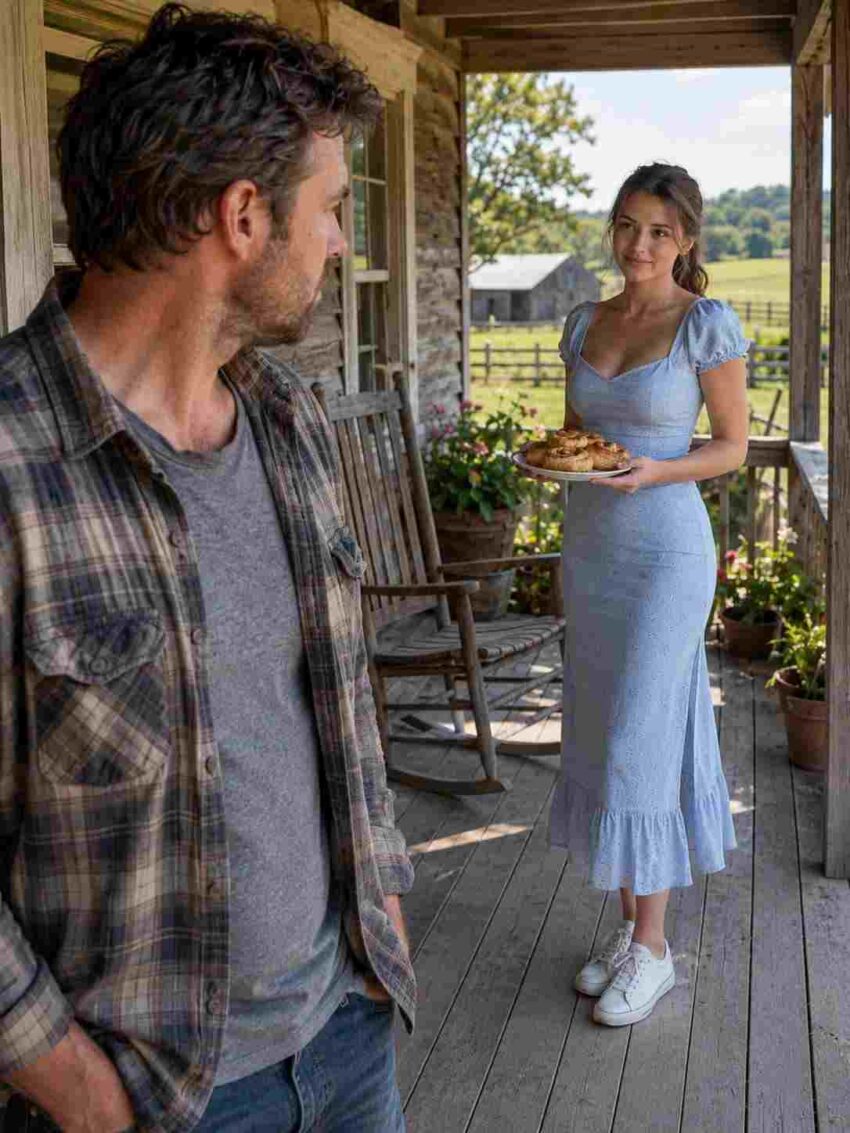
I Joked, “If I Were Twenty Years Younger… I’d Marry You.”… Then She Looked Me Dead in the Eye and Said, “That Doesn’t Matter to Me.”
The morning Margaret Hale brought me that apple pie, I was a fifty-year-old widower pretending my life was already over.
I had two hundred acres of Virginia cattle land, a quiet farmhouse, a dead wife’s coffee mug still sitting in the cabinet, and a whole town waiting for me to fade into the background like old men are supposed to do.
Then Margaret stood on my porch with flour on her cheek and fire in her eyes.
I joked, “If I were twenty years younger, I’d marry you.”
She didn’t laugh.
She said, “That wouldn’t change a damn thing.”
And by Thanksgiving, half the town was calling her a gold digger.
By Christmas, a lawyer was standing in my kitchen with a locked envelope my dead wife had left behind.
And by New Year’s, the man everyone thought Margaret should marry was being escorted out by police.

PART 1
“You’re too young to know what you want,” I told her.
Margaret Hale looked at me across my porch railing and smiled like I had just made the biggest mistake of my life.
“No, Thomas,” she said. “You’re just too scared to admit what you want.”
I was fifty years old, and I had survived droughts, bank pressure, a broken tractor in the middle of calving season, and a wife dying slowly in a hospital bed while I held her hand and lied that everything would be okay.
But that twenty-five-year-old woman with an apple pie almost broke me in one sentence.
My name is Thomas Callaway.
I own Callaway Ranch, two hundred and seven acres outside a small town in Virginia where everybody knows who bought a new truck, who skipped church, who got drunk at the diner on Friday night, and who left whose driveway at midnight.
My land had been in my family for three generations.
My grandfather bought the first eighty acres with money he made hauling timber. My father expanded it. I modernized it with GPS tractors, security cameras in the barns, automatic irrigation, cattle health software, and enough debt to make a banker smile too wide.
My wife, Eleanor, used to say I treated the ranch like a living person.
She wasn’t wrong.
For twenty-two years, she kept the books, ran our little farm store by the road, remembered every church fundraiser, and made the big white farmhouse feel warm even in January.
Then cancer took her one slow inch at a time.
After the funeral, I came home, took off my black suit, put on my work jeans, and walked straight to the barn.
People called me strong.
They were wrong.
I wasn’t strong.
I just didn’t know how to sit in a kitchen where her chair was empty.
For three years, I lived like a man following instructions from a life that no longer existed.
Coffee at 4:45.
Barn by 5:10.
Feed order on Mondays.
Farm store inventory on Thursdays.
Church on Sundays, when I could stand the pity.
The east room, where Eleanor used to do our paperwork, stayed locked.
Her sweater still hung on the back of the chair.
Her glasses still sat beside the old calculator.
Her mug stayed in the cabinet, untouched.
I told myself grief was respect.
Truth was, grief had become a fence, and I was hiding behind it.
The only person who crossed that fence without asking was Margaret Hale.
She owned the sixty-acre farm south of mine. Her parents had moved to Richmond, and everyone assumed she would sell the place within a year.
Margaret did the opposite.
She came home from college with a degree in agricultural management, turned her parents’ struggling goat farm into a profitable organic dairy business, built two greenhouses, started selling preserves online, and embarrassed half the old men in town by understanding contracts better than they did.
She was young, yes.
But she was not soft.
She could back a trailer better than most men I knew.
She could argue wholesale pricing without blinking.
She could fix an irrigation pump, bottle peach jam, post a video online, and sell out before lunch.
Two weeks after Eleanor’s funeral, Margaret showed up on my porch with soup.
“I made too much,” she said.
I looked at the pot in her hands. “You don’t have to do this.”
“I know.”
That became her answer for everything.
She brought bread.
Stew.
Fresh vegetables.
Coffee in two paper cups from the diner.
And every Tuesday morning, whether it was raining, snowing, or hot enough to melt the paint off the barn, Margaret crossed the field like she had a right to be there.
For three years, I called her a good neighbor.
That was the safest lie I had.
Then came the apple pie.
It was late September, cool enough that the porch boards held the morning chill. I was sitting outside with black coffee when Margaret walked up the steps carrying a pie wrapped in a dish towel.
She wore faded jeans, a red plaid shirt, and boots with mud on the soles. Her hair was pulled back, but a loose strand had stuck to her cheek, right over a streak of flour.
“South orchard apples,” she said. “First batch came in sweet.”
The smell of cinnamon hit me before she set it down.
I don’t know why that was the moment.
Maybe because she looked proud of it.
Maybe because I realized she had spent her morning baking for me when she had greenhouses to check and orders to fill.
Maybe because for the first time in three years, I wanted something that had nothing to do with surviving the day.
I smiled and said, “If I were twenty years younger, I’d marry you for that pie.”
I expected her to laugh.
She didn’t.
Margaret set the pie on the porch railing.
Then she looked at me with those steady brown eyes and said, “Twenty years wouldn’t change a damn thing.”
My coffee went cold in my hand.
“What does that mean?” I asked.
She didn’t blush.
She didn’t look away.
She just took one step back, like she had finally said the truth and refused to chase it.
“It means you heard me,” she said. “And now you’re going to pretend you didn’t.”
Then she walked down my porch steps and crossed the field back toward her farm.
I sat there for ten full minutes, staring at that pie like it had turned into evidence.
By noon, I had replayed her words twenty times.
By evening, I knew something I should have known long before.
Those Tuesday mornings were never just about soup.
The next week, she came again.
This time with coffee.
Neither of us mentioned the pie.
That was almost worse.
She asked about the cattle. I asked about her greenhouse orders. We talked like two people standing on opposite sides of a burning bridge, both pretending not to smell smoke.
Then Daniel Marsh showed up.
Daniel was twenty-eight, tall, clean-cut, and rich in that polished small-town way that made people trust him before he earned it.
His father owned the biggest farm supply chain in three counties. Daniel ran the local branch, drove a black Silverado that never seemed to get dirty, and wore expensive boots that had never touched manure.
He had been chasing Margaret for nearly a year.
Flowers at the farm store.
Wine at her front door.
Comments under every post she made online.
He smiled at old ladies, donated to church auctions, and shook hands like he was already running for mayor.
On paper, he made sense.
He was young.
I was not.
He had family money.
I had land, debt, and a dead wife’s photograph on the mantel.
That October, the town autumn festival became the thing everyone talked about.
I was at the feed store buying mineral blocks when I heard two men near the counter laughing.
“Daniel asked Margaret to the festival,” one said.
“She’d be stupid to say no,” the other answered. “Girl needs a real future, not some lonely old rancher’s leftovers.”
I froze with a fifty-pound bag of feed in my hands.
They didn’t know I could hear them.
Or maybe they did.
Small towns are cruelest when they pretend to whisper.
I loaded the truck, drove home, and told myself they were right.
Margaret deserved a man who could give her twenty easy years before his knees started aching in cold weather.
She deserved children without wondering whether their father would still be alive for graduation.
She deserved a future, not a man carrying a past.
That evening, I found her fixing a loose gate between our properties.
I stood on my side of the fence.
“Margaret.”
She didn’t look up. “Thomas.”
“I’ve been thinking about what you said.”
“I say a lot of things.”
“You know which one.”
She set down the wrench.
For a second, all I heard was wind moving through the dry grass.
Then I said the stupidest thing a coward can say.
“Daniel is a good man.”
Her face changed.
Not dramatically.
Just enough.
Like I had pushed a glass off a table and she had watched it shatter.
“That’s not what I asked you,” she said.
“I’m saying you should think about your future.”
“My future?” She gave a small laugh, cold and sharp. “You mean the future you already decided I’m too young to choose?”
“Margaret—”
“No.” She stepped closer to the fence. “Don’t dress fear up like wisdom and hand it to me like a gift.”
I gripped the rail.
“I’m trying to do right by you.”
“No, Thomas. You’re trying to avoid being brave.”
Then she picked up her tools and walked away.
Two days later, I heard she had agreed to go to the festival with Daniel.
And the worst part was, I knew I had handed her to him myself.
PART 2
At the autumn festival, Daniel put his hand on Margaret’s lower back like he already owned her.
And when she moved away, his smile didn’t disappear.
It hardened.
I wasn’t supposed to be there.
I had told myself I would stay home, eat leftovers in the kitchen, and not imagine Margaret under string lights with a man who made sense.
But at 8:15, I found myself driving into town.
The festival filled Main Street with food trucks, church bake-sale tables, pumpkins stacked outside the hardware store, teenagers in letterman jackets, and little kids running around with caramel apples.
A bluegrass band played near the courthouse steps.
American flags hung from the streetlights.
Everyone looked happy in that loud, forced way small towns get when they want to forget how much they gossip.
I parked behind the bank and walked toward the square.
That was when I saw Margaret.
She wore a dark blue dress under a tan coat, her hair down, her face lit by the yellow glow of festival lights.
She looked beautiful.
Not in a fragile way.
In a way that made every man near her pretend he wasn’t staring.
Daniel stood beside her holding two cups of hot cider.
He leaned close and said something.
Margaret’s mouth tightened.
I stopped near the diner window.
I should have left right then.
Instead, I watched.
Daniel guided her toward the courthouse steps, where several people from the Chamber of Commerce had gathered. His father, Warren Marsh, stood with them, laughing too loudly.
Warren Marsh was the kind of man who wore a cowboy hat to board meetings and called every woman “sweetheart” when he wanted them to feel small.
He saw Margaret and spread his arms.
“There she is,” Warren boomed. “The little goat-cheese queen.”
Margaret smiled politely. “Good evening, Mr. Marsh.”
“Oh, don’t be formal. If Daniel has his way, you’ll be family soon enough.”
Daniel laughed.
Margaret did not.
I saw it then.
The tension in her shoulders.
The way Daniel kept placing himself between her and the open sidewalk.
The way Warren looked at her farm like it was already an asset.
A few minutes later, Margaret stepped away from the group and walked toward the side street near the bank.
Daniel followed.
I moved before I thought.
They stopped under a streetlamp beside the closed bank entrance.
Daniel’s voice stayed low, but the street was quiet enough for me to hear.
“You embarrassed me back there.”
Margaret turned. “I didn’t agree to be announced like livestock at auction.”
“Don’t be dramatic.”
“Don’t touch me like I belong to you.”
Daniel’s smile vanished completely.
“You think people don’t see what’s going on?” he said. “You keep running across that field to Callaway’s place like nobody talks?”
My chest went cold.
Margaret’s chin lifted. “Be careful.”
“No, you be careful.” Daniel stepped closer. “A twenty-five-year-old woman hanging around a fifty-year-old widower with two hundred acres? That story won’t sound sweet when my father tells it.”
Margaret stared at him.
“You’re threatening me?”
“I’m warning you.” He lowered his voice. “My father has copies of your distributor agreements. Your loan renewal comes up in January. Your greenhouse expansion still needs county approval. You think doors open because you’re talented? Doors open because people allow them to.”
I felt something inside me snap.
Margaret didn’t flinch.
“You’re not a good man, Daniel,” she said. “You’re just a weak one with money behind you.”
Daniel’s face twisted.
He grabbed her wrist.
I crossed the street fast.
“Take your hand off her.”
Daniel let go and turned.
For a second, he looked shocked.
Then he smiled.
“Well, look at this,” he said. “The old rancher came to rescue his investment.”
Margaret stepped between us. “Thomas, don’t.”
But Daniel wanted an audience.
He raised his voice just enough for people nearby to turn.
“Tell me, Callaway. Does Eleanor know you’re chasing girls young enough to be your daughter?”
The name hit me like a fist.
People looked over.
A woman near the bake-sale table gasped.
Margaret’s face went white with anger.
I took one step toward him.
Then I stopped.
Because Daniel had made one mistake.
The bank entrance behind him had a security camera.
So did the hardware store across the street.
And I had spent enough years running a ranch to know this: never fight a man in the open when the truth is already recording him.
I looked at Margaret.
“Are you okay?”
She nodded once.
I turned back to Daniel.
“You should go home.”
He laughed. “Or what?”
“Or tomorrow morning,” I said, “you’ll wish you had.”
Daniel leaned in.
“You don’t scare me, old man.”
“No,” I said. “But evidence should.”
His smile flickered.
Margaret saw it too.
That night, she left the festival with me.
We did not speak until we reached my driveway.
She sat in the passenger seat, hands clenched in her lap.
I parked beside the porch.
“I’m sorry,” I said.
“For what?”
“For pushing you toward him.”
She looked out the windshield at the farmhouse.
“You didn’t push me toward Daniel,” she said. “You pushed me away from you.”
That was worse.
Inside, the kitchen felt too bright.
Too ordinary.
Two mugs in the sink. Mail on the counter. Eleanor’s old calendar still hanging beside the pantry.
Margaret stood near the table like she wasn’t sure she was allowed to stay.
“Daniel asked me tonight if we should make things official,” she said.
My throat tightened.
“What did you say?”
“I said no.”
“Because of what happened?”
“No.” She turned to me. “Because I’m not in love with him.”
The room went silent.
Then she added, “And because I am in love with you.”
There it was.
No poetry.
No soft landing.
Just the truth, standing in my kitchen with cold hands and tired eyes.
I looked at Eleanor’s wedding photograph on the shelf.
Margaret followed my gaze.
“I’m not trying to replace her,” she said quietly.
“I know.”
“Do you?”
I didn’t answer fast enough.
Her face changed again.
She nodded, like my silence had confirmed something she feared.
“I can face Daniel,” she said. “I can face this town. I can face people calling me names because they don’t understand what they’re looking at.”
She picked up her purse.
“But I can’t keep crossing that field every Tuesday and pretending I’m only bringing coffee to a man who keeps breaking my heart in polite ways.”
Then she walked out.
The next Tuesday, the porch stayed empty.
The week after that, too.
And on the third Tuesday, I received a letter from Marsh Agricultural Supply saying my credit account had been suspended pending review.
That was when I realized Daniel hadn’t just been humiliated.
He had declared war.
PART 3
The bank manager looked at me across his desk and said, “Thomas, someone filed a lien notice against your south acreage this morning.”
I laughed once because I thought he was joking.
He wasn’t.
The paper lay between us like a loaded gun.
It claimed Callaway Ranch owed unpaid supply debts to Marsh Agricultural and listed the south pasture, the section bordering Margaret’s farm, as collateral.
That land had never belonged to Marsh.
It had been my mother’s favorite field.
My father’s ashes were scattered near the creek line.
And now Daniel Marsh’s family was trying to put a legal hook into it.
I sat back slowly.
“Who signed this?”
The bank manager, Paul Reeves, rubbed his jaw.
“That’s the problem. It includes an old guarantee letter. Your signature is on the copy.”
I stared at him.
“I never signed that.”
“I believe you,” Paul said quietly. “But it’s filed with the county clerk.”
I drove straight to the courthouse.
By noon, I had a copy of the document in my hand.
By one, I was sitting in a lawyer’s office downtown.
Her name was Grace Whitaker, and she had known Eleanor from church. She was small, gray-haired, sharp-eyed, and had the warm personality of a locked safe.
She read the document once.
Then again.
Then she looked at me.
“This signature is wrong.”
“I know.”
“No,” she said. “I mean whoever forged it didn’t know Eleanor handled your supply contracts for twelve years. You didn’t sign these documents during that period. She did, with power of attorney.”
My stomach turned.
Grace tapped the paper.
“They forged the wrong person’s name.”
For the first time all week, I smiled.
It did not feel kind.
Grace leaned back. “Do you have old contract files?”
I thought of the east room.
The locked door.
Eleanor’s desk.
“Yes.”
“Then go home and open that room.”
I drove back to the ranch under a gray sky.
For three years, I had avoided the east room like grief could jump out and drag me under.
That day, I unlocked it.
Dust floated in the light.
Eleanor’s sweater still hung over the chair.
Her reading glasses sat beside the ledger.
For a second, I couldn’t move.
Then I heard her voice in my memory.
Thomas, don’t stand there being dramatic. Find the file.
So I did.
I opened drawers.
Pulled banker’s boxes from the closet.
Checked folders labeled by year in Eleanor’s neat handwriting.
And buried behind old tax returns, I found a sealed envelope.
My name was written on the front.
Thomas — open when you finally stop punishing yourself.
I sat down hard.
Inside was a letter.
Not long.
Not sentimental.
Eleanor never wasted words.
Thomas,
If you are reading this, it means you finally opened the room, which probably took you too long.
I loved you for being loyal, but I need you to understand something.
Loyalty to the dead should not become cruelty to the living.
If someone comes into your life after me, do not insult my memory by pretending love is a limited resource.
I had my years with you.
They were mine.
Let someone else have the years that remain.
Also, check the bottom drawer for the updated deed records. Warren Marsh tried to pressure your father once. I never trusted that family.
— Eleanor
I sat there for a long time with the letter in my hands.
Then I opened the bottom drawer.
Inside were copies of the original deed, old correspondence between my father and Warren Marsh, and a handwritten note from Eleanor explaining that Marsh Agricultural had once tried to attach equipment debt to land collateral, but my father had refused.
Eleanor had kept everything.
God bless that woman.
By sunset, Grace had the documents.
By the next morning, she filed a challenge.
Then she asked one question.
“Do you have cameras on the ranch?”
“Yes.”
“Good. Because forged papers are rarely the only crime.”
She was right.
Two nights later, my barn security system sent an alert to my phone at 1:17 a.m.
Motion detected near Storage Barn 3.
I opened the camera feed.
A hooded figure stood near my diesel tank.
Then a second figure appeared.
They weren’t stealing.
They were pouring something into the fuel drums.
I called the sheriff.
Then I grabbed my jacket and drove down without turning on my headlights.
By the time I reached the barn, Deputy Mills had pulled in from the county road.
We caught one of them behind the shed.
It was a Marsh employee named Tyler Briggs.
The other ran.
But cameras are patient.
They caught his face when he turned toward the security light.
Daniel.
By sunrise, the sheriff had the footage.
By breakfast, Daniel’s father was calling me.
I let it go to voicemail.
Then Margaret knocked on my kitchen door.
I had not seen her inside that house in weeks.
She looked tired, angry, and beautiful in a green coat with rain on her shoulders.
“I heard,” she said.
“About the lien or the fuel?”
Her eyes widened. “Both?”
I nodded.
She stepped into the kitchen and shut the door behind her.
“I need to show you something.”
She placed her phone on the table.
Screenshots filled the screen.
Messages from Daniel.
Some to her.
Some forwarded by a former Marsh office assistant who had quit after Daniel tried to blame her for falsified invoices.
One message read:
If Margaret won’t sell, we squeeze her loan and make Callaway look unstable. She’ll come around when both farms are bleeding.
Another read:
Once the south acreage is tied up, Dad can force a settlement. The old man won’t fight. He’s still grieving.
I felt the old man inside me disappear.
In his place stood someone colder.
Someone Eleanor would have recognized.
“Send these to Grace,” I said.
“I already did.”
Margaret met my eyes.
“Thomas, Daniel didn’t just want me. He wanted the land between us. My farm, your south pasture, the road access, the store. His father has been trying to assemble a commercial ag hub for years.”
That explained everything.
The flowers.
The charm.
The pressure.
The public humiliation.
Daniel had never loved Margaret.
He had targeted her.
I should have felt relief.
Instead, I felt rage.
Because I had almost helped him.
“I’m sorry,” I said.
Margaret looked at me carefully.
“You keep saying that.”
“I mean it.”
“I know.” Her voice softened. “But sorry doesn’t tell me what you want.”
I looked at the table.
At Eleanor’s letter.
At Margaret’s phone.
At the kitchen where I had spent three years acting like being alone was noble.
Then I told the truth.
“I want you.”
Her breath caught.
I stepped closer, slowly.
“I want to stop pretending age is the only thing between us. I want to stop using Eleanor as a shield when she was braver than I am even after dying. I want to take you to dinner, hold your hand in public, fight beside you, and let this town choke on its own gossip.”
Margaret’s eyes shone, but she did not cry.
She smiled.
A dangerous little smile.
“That was almost romantic.”
“I’m out of practice.”
“You’re also late.”
“I know.”
She looked down at Eleanor’s letter.
“Did she really write that?”
I handed it to her.
Margaret read silently.
When she finished, she touched the paper like it deserved respect.
“I would have liked her,” she said.
“She would have liked you.”
Then Margaret did something I didn’t expect.
She opened the east room door wider, looked inside, and said, “Then let’s use her office to finish what she started.”
For the next ten days, my farmhouse became a war room.
Grace came by with legal pads.
Margaret brought bank statements, distributor contracts, and the messages from Daniel.
Paul Reeves from the bank admitted Marsh had been pressuring him to deny Margaret’s loan renewal.
The former Marsh assistant gave a sworn statement.
Deputy Mills collected the barn footage.
And the hardware store owner, who had security cameras facing the festival street, handed over video of Daniel grabbing Margaret’s wrist and threatening her.
Small towns love gossip.
But they love scandal with evidence even more.
Grace told us not to leak anything.
Margaret listened.
I tried.
Then Warren Marsh made it impossible.
The Sunday before Thanksgiving, he stood outside church and told three deacons that Margaret had “confused a lonely widower for a retirement plan.”
By lunch, the quote was all over town.
By dinner, someone had posted a blurry picture of Margaret leaving my farmhouse with the caption:
Guess she found the deed before the wedding.
Margaret sat at my kitchen table, reading it on her phone.
Her face was calm.
Too calm.
I said, “We can sue.”
She set the phone down.
“No.”
“No?”
She looked at me.
“We don’t just sue.”
Then she reached into her bag and pulled out a printed invitation.
The county Thanksgiving charity dinner was in four days. Marsh Agricultural was the main sponsor. Warren would be speaking. Daniel would be on stage beside him.
Margaret tapped the invitation once.
“We let them stand in front of everyone first.”
I looked at her.
Then I started laughing.
Not because it was funny.
Because for the first time, I understood exactly why I loved her.
PART 4
At the Thanksgiving charity dinner, Warren Marsh raised his glass and said, “Family values are what built this county.”
Then the projector behind him lit up with a video of his son grabbing Margaret’s wrist under a streetlamp.
Three hundred people went silent.
The dinner was held in the community hall beside First Baptist Church.
Long tables covered in white paper cloths.
Plastic cups of sweet tea.
Turkey, mashed potatoes, green bean casserole, and pumpkin pies lined up by the kitchen.
American flags stood near the stage.
Half the county was there.
So was the sheriff.
So was Grace.
So was the bank manager.
Margaret wore a simple black dress and stood beside me like she had walked into a courtroom instead of a holiday dinner.
People stared.
Some whispered.
One woman near the dessert table looked Margaret up and down and muttered, “Shameless.”
Margaret heard her.
So did I.
Margaret smiled at the woman and said, “You might want to save that word for the presentation.”
The woman blinked.
I almost kissed her right there.
Warren Marsh took the stage after dinner.
Daniel stood beside him in a navy suit, jaw tight, eyes moving around the room like he was checking exits.
Warren smiled into the microphone.
“My friends, this county was built by honest families, strong farms, and moral leadership.”
Grace leaned toward me.
“Three minutes,” she whispered.
Warren kept going.
“We live in a time when greed hides behind pretty faces and vulnerable men can be manipulated—”
I felt Margaret stiffen.
I touched her hand under the table.
She did not need comfort.
She needed timing.
Warren lifted his glass.
“So tonight, I want to remind everyone that family values are what built this county.”
That was the cue.
The projector turned on.
At first, people thought it was part of Warren’s speech.
Then Daniel’s voice filled the hall.
You think people don’t see what’s going on? You keep running across that field to Callaway’s place like nobody talks?
The room froze.
On the screen, Daniel grabbed Margaret’s wrist.
Then came his threat.
Your loan renewal comes up in January. Your greenhouse expansion still needs county approval. You think doors open because you’re talented? Doors open because people allow them to.
A fork clattered onto a plate.
Someone whispered, “Oh my God.”
Daniel lunged toward the projector table, but Deputy Mills stepped into his path.
“Sit down,” the deputy said.
Daniel stopped.
The video continued.
Then the screen changed.
Screenshots.
Texts.
Emails.
Invoices.
A photo of Tyler Briggs near my diesel tank.
A freeze-frame of Daniel turning toward my barn camera.
Then Grace walked to the microphone.
Her voice was clear enough to cut glass.
“My name is Grace Whitaker. I represent Thomas Callaway and Margaret Hale. Tonight, since Mr. Marsh chose to discuss moral leadership in public, my clients have chosen to correct the public record.”
Warren’s face turned red.
“This is slander.”
Grace looked at him.
“No, Warren. This is discovery.”
A sound moved through the room.
Not laughter.
Not shock.
Something better.
Recognition.
Grace continued.
“The lien filed against Callaway Ranch is being challenged as fraudulent. The sheriff’s office has received evidence related to attempted property damage. The bank has opened an internal review regarding improper pressure placed on agricultural loans. And several distributor contracts are now being reviewed for interference.”
Daniel backed away from the stage.
Margaret stood.
Every head turned.
She walked to the microphone.
I watched her pass tables of people who had whispered about her, judged her, called her a gold digger, and decided her life for her.
She did not tremble.
She did not beg.
She looked straight at them.
“My name is Margaret Hale,” she said. “I run Hale Farm. Not my father. Not Daniel Marsh. Not Thomas Callaway. Me.”
Silence.
“For months, Daniel Marsh tried to make people believe I was chasing a man for land. The truth is, Daniel was chasing me for mine.”
Daniel shouted, “You’re lying!”
The sheriff looked at him once.
Daniel shut up.
Margaret continued.
“He threatened my loan. He threatened my contracts. He grabbed me in public. Then when I said no, he tried to punish the man I love by attacking his ranch.”
The words the man I love moved through the room like lightning.
I stopped breathing for half a second.
Margaret looked at me.
Only me.
Then she turned back.
“You can talk about my age. You can talk about Thomas’s age. You can whisper at the diner, at church, at the feed store, and behind your phones. But none of you get to call me stupid because I chose love, and none of you get to call me greedy because a rich man failed to buy me.”
No one moved.
Then old Mrs. Keller, who had taught Sunday school longer than I had been alive, stood up.
She looked at Warren Marsh.
“Shame on you.”
That broke the room.
People started talking all at once.
Warren stepped down from the stage, but two men from the Chamber moved away from him like bad luck was contagious.
Daniel tried to leave through the side door.
Deputy Mills followed.
So did the sheriff.
By the time dessert was served, Daniel Marsh was outside answering questions beside a patrol car.
By the following Monday, Marsh Agricultural’s local branch had lost three major accounts.
By December, Warren resigned from the county development board.
By January, Daniel was facing charges related to trespassing, attempted property damage, and fraud investigations.
Their family money did not vanish overnight.
But their power did.
And in a small town, reputation is a second bank account.
Theirs went bankrupt.
Margaret’s loan renewal was approved.
Her greenhouse expansion passed unanimously.
The lien against my ranch was thrown out.
And the former Marsh assistant got hired by Margaret to help run online orders because Margaret believed in practical revenge.
“Nothing bothers a bad boss more,” she said, “than watching his employee thrive somewhere else.”
That Christmas, Margaret and I went to Richmond for our first real date.
Not because we were hiding.
Because I wanted one evening where nobody watched us like a courthouse hearing.
We ate at a small restaurant with candles on the tables and a waiter who did not know my dead wife’s name, Margaret’s parents, or the exact acreage of my ranch.
Halfway through dinner, I asked, “Are you sure about this?”
Margaret set down her fork.
“If you ask me that one more time, I’m calling an Uber and leaving you with the check.”
I laughed.
Really laughed.
For the first time in years, the sound didn’t feel wrong coming out of me.
After dinner, we walked past storefront windows glowing with Christmas lights.
Margaret reached for my hand.
I looked down at our fingers together.
Twenty-five years did not disappear.
They didn’t need to.
They were a fact.
Not a prison.
I kissed her beside my truck while snow started falling over the street.
The kiss was careful at first.
Then not careful at all.
When she pulled back, she smiled.
“If only you were twenty years younger, huh?”
I groaned.
She laughed.
And just like that, the line that had once terrified me became ours.
We dated for a year before I proposed.
I did it in my kitchen, because some stories need fancy places and some need the exact room where the truth first walked in.
On the table sat an apple pie I had baked myself.
It was ugly.
The crust was burnt on one edge.
Margaret stared at it.
“You made this?”
“I attempted it.”
“I can tell.”
I got down on one knee.
Her smile disappeared.
“Thomas…”
“Three years ago, you brought me a pie and I joked because I was too afraid to say the truth,” I said. “I thought being older made me unworthy of you. I thought loving you meant betraying Eleanor. Then Eleanor herself told me not to be an idiot from beyond the grave.”
Margaret laughed, but her eyes shone.
“I can’t promise you easy,” I said. “I can’t promise I’ll be young. I can’t promise people will always understand us. But I can promise I will never again make fear sound like wisdom. I will never treat you like a woman who doesn’t know her own mind. And I will love you fully, not halfway, not quietly, not like I’m ashamed.”
I opened the ring box.
“Margaret Hale, will you build a life with me that we both choose?”
She looked at the ring.
Then at the burnt pie.
Then at me.
“You really proposed with a crime against pastry.”
“Yes.”
She wiped one tear, fast and annoyed, like it had offended her.
“Good,” she said. “I want this story exactly like this.”
“So that’s a yes?”
She leaned down and kissed me.
“That’s a yes, old man.”
We married the next autumn on the strip of land between our farms.
Not in a church.
Not at the courthouse.
On the grass between what had been mine and what had been hers, in front of the fence that once kept us separate.
Eleanor’s sister came.
Margaret’s parents came.
Half the town came too, including people who had whispered and later pretended they never had.
Mrs. Keller brought pie.
Deputy Mills stood in the back and cried harder than anyone.
Grace handled our marriage documents, our business agreement, our wills, and the deed protections before we left for a three-day honeymoon in the mountains.
Margaret insisted on that.
“Romance is lovely,” she said. “Paperwork keeps vultures away.”
We formed a joint company for farm operations but kept individual land ownership protected.
The east room became our office.
Eleanor’s old desk stayed in one corner.
Margaret’s computer sat by the window.
Two women, one gone and one alive, had saved me in different ways.
I was smart enough not to erase either one.
Two years later, Margaret gave birth to our son on a cold January morning.
We named him William.
The first time I held him, fear came with the joy.
I was fifty-two.
I thought about graduations.
Baseball games.
Driving lessons.
Hospital visits.
All the years I wanted and could not guarantee.
That night, on the porch, I told Margaret the truth.
“What if I’m not here long enough?”
She took my hand.
“Then be here now.”
That became my law.
Be here now.
For the bottle at 2 a.m.
For the first fever.
For the first step across the kitchen floor.
For every morning Margaret crossed the yard with William on her hip and coffee in her hand like she had been doing some version of that all along.
Three years after our wedding, on a Tuesday morning, I was checking the south fence when I saw them coming across the field.
Margaret carried William in one arm.
In the other, she carried an apple pie.
I opened the gate.
“South orchard apples?” I asked.
“The best ones,” she said.
William reached for me, and I took him.
He smelled like soap, grass, and the peanut butter he had somehow gotten in his hair.
I looked at Margaret.
At the pie.
At the farmhouse that no longer felt like a museum to a life I had lost.
And I said, softly this time, “If only I were twenty years younger.”
Margaret stepped closer and placed her hand on my arm.
“Twenty years wouldn’t change a damn thing,” she said.
Her voice was steady.
The same as it had been that first morning.
“I never needed a younger version of you, Thomas.”
She looked at our son.
Then back at me.
“I needed the man who finally came back to life.”
I kissed her there by the fence.
Then the three of us walked home together, carrying an apple pie, a hard-won peace, and a life I had once believed I was already too late to have.
This time, I didn’t look back at the field behind us.
Everything I loved was walking beside me.