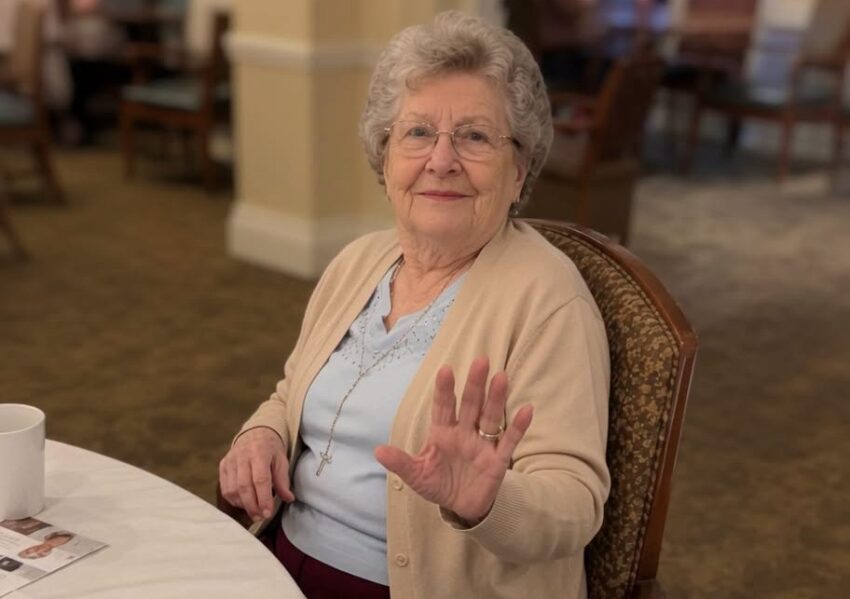
My mother did not have dementia, memory loss, or any reason to forget who I was. So when she denied knowing me in front of a man I had never seen before, I knew something was wrong. Then she made one small move that revealed she was in serious trouble and needed my help.
What do you do when your own mother looks straight at you and asks your name?
I am not asking in a philosophical way.
That is exactly what happened when I visited my mother, Christy, during the open house at her nursing home.
She knew I was coming.
We had spoken the night before.
“Come early,” she told me. “They are serving those little lemon cakes you like.”
“You like them too.”
“I am 81. Everything sweet belongs to me now.”
She sounded like herself. Sharp, cheerful, and fully aware of who I was.
That mattered because my mother did not have dementia.
She had arthritis, high blood pressure, and a talent for making nurses laugh when they were trying to stay professional.
But her mind was still clear.
Moving into the nursing home had been her decision.
After my father died, Mom stayed alone in their house for almost two years.
She fell twice, forgot a pan on the stove once, and finally called me after midnight to say she was tired of pretending she could still handle independence.
“I want people around,” she said. “And I want someone else to clean the bathroom.”
I helped her choose Oakridge House.
It was expensive, but my father had left enough money for her care, and I handled the payments because Mom hated online banking.
She loved the place.
At least that was what she told me.
She joined a book club, played cards every Thursday, and developed a rivalry with a woman named Carol over who made better banana bread.
So when I walked into the decorated lobby that Saturday afternoon, I expected Mom to wave from across the room.
Instead, she looked at me and turned away.
At first, I thought she had not seen me clearly.
The lobby was crowded.
Families stood near tables covered with flowers, brochures, and trays of snacks.
A pianist played old standards in the corner.
Staff members wore blue ribbons with their names printed in gold.
Mom stood near the dining room entrance in a green dress I had bought her for Christmas.
Beside her was a tall older man I had never seen before.
He had thin white hair, a bumpy nose, and freckles scattered across his cheeks.
He leaned close to Mom while speaking, one hand resting lightly against her elbow.
Mom hated people touching her elbow.
She once slapped a physical therapist’s hand away and said, “I am old, but not weak.”
Yet she let this man hold her there.
“Mom?” I called.
Her eyes met mine.
For one second, I saw recognition, and then fear.
It disappeared so quickly I wondered whether I had imagined it.
She turned toward the man and said something that made him smile.
I walked closer.
“Mom, hi.”
She looked at me politely, not warmly.
“Hello,” she said.
I laughed because I did not know what else to do.
“It’s me.”
The man beside her studied my face.
Mom’s expression did not change.
“I’m sorry,” she said. “Have we met before?”
The room seemed to tilt.
“Mom.”
The man glanced at her.
“Christy, do you know this lady?”
Mom looked at me again.
Her eyes were blank, but one hand tightened around the strap of her purse.
“No,” she said. “I don’t believe I do.”
I felt something sharp move through my chest.
A staff member named Denise approached carrying a tray of glasses.
“Mercy, you made it,” she said brightly.
Mom’s gaze flicked toward Denise.
Then back to me.
The old man smiled.
“Mercy,” he repeated. “That’s a lovely name.”
Mom interrupted before I could answer.
“Is it? How sweet.”
She turned away.
I stood there with my coat still buttoned.
Denise looked confused.
“Christy, this is your daughter.”
My mother gave a small laugh.
“Oh, dear. I’m afraid you’ve mistaken me for someone else.”
Denise stared at her.
I wanted to say something. Demand an explanation and ask whether she was sick.
But the man kept watching me.
There was something a bit weird in the way he looked at my face.
His eyes moved over my hair, my coat, and my wedding ring.
As though he were trying to memorize me.
“Who is your friend?” I asked Mom.
The man’s smile widened.
“Graham,” he said. “An old family acquaintance.”
Mom looked down.
I had never heard his name.
He held out his hand.
I did not take it.
Promoted Content
“How do you know my mother?”
Graham gave a soft laugh.
“Your mother?”
Mom spoke quickly.
“As I said, I don’t know this woman. I believe she is confused.”
That hurt more than I expected.
I had spent the drive there thinking about the lemon cakes.
About whether Mom would complain that I had cut my hair too short.
About the framed photograph I had brought for her room.
Now she was denying that I was her daughter.
A cruel thought arrived before I could stop it.
Maybe she was embarrassed by me.
I had gained weight over the previous few months after giving birth to her grandson.
My postpartum journey was hard, and I had spent too many nights eating cereal over the sink because I couldn’t sleep.
Mom had always been critical about appearances.
Maybe Graham was someone she wanted to impress.
Maybe she did not want to introduce her tired daughter.
The idea was ridiculous.
It still wounded me.
For the next hour, Mom avoided me.
Every time I approached, she turned toward another resident or asked a staff member a question.
During the facility tour, she walked beside Graham.
At the craft table, she admired a scarf Carol had knitted while pretending I was not standing six feet away.
Finally, we ended up in a small circle near the dining room with two residents, Denise, Graham, and a visiting couple.
Mom looked directly at me.
“What was your name again?”
My throat closed.
“Mercy.”
“Mercy,” she repeated, as if testing the sound.
Graham watched her carefully.
Then he looked at me.
“And where do you live, Mercy?”
Mom dropped her water glass.
It hit the floor and shattered.
Everyone jumped.
“Oh, how clumsy of me,” she said.
Denise hurried to clean it.
Mom’s face had gone pale.
I looked at Graham.
He was still waiting for my answer.
“I live nearby,” I said.
“Nearby, where?”
Mom laughed too loudly.
“Really, Graham. You ask too many questions.”
He smiled at her.
“I like to know who people are.”
The way he said it made my skin crawl.
I took out my phone, intending to call my mother’s doctor.
The screen was black.
I had forgotten to charge it.
Dinner was about to be served.
I decided to stay long enough to speak privately with a nurse, then leave.
I stood near the hallway, holding the framed photograph against my chest and trying not to cry.
Mom passed me on her way toward the dining room.
She did not stop.
Her shoulder brushed mine.
Then her fingers pressed something into my palm.
A folded paper napkin.
I looked at her.
She kept walking.
Graham followed a few steps behind.
His eyes moved from Mom to me.
I closed my hand around the napkin and waited until they disappeared into the dining room.
Then I unfolded it.
Mom’s handwriting covered the inside in small, uneven letters.
“Be quiet.”
“He has threatened you.”
All the blood seemed to leave my face.
Beneath the words, she had written three numbers. “214.”
At first, they meant nothing.
Then I remembered.
Room 214 was Mom’s room.
She was telling me to go there.
I folded the napkin and slipped it into my sleeve.
Then I found Denise.
“I need to use my mother’s bathroom.”
She looked toward the dining room.
“The same Christy who now says she doesn’t know you?”
“Yes, her bathroom. Please.”
Something in my face must have convinced her.
She unlocked the elevator and took me upstairs.
The moment we reached Room 214, I closed the door.
“Has that man been visiting her?” I asked.
“Graham? He has been coming in a few hours this week. He said he was her brother.”
“Her brother?”
Denise nodded.
“Christy confirmed it.”
I felt the room shift again.
My mother had never told me she had a brother.
“May I borrow your phone?”
I called the police first because clearly something was wrong.
My mother would not use the word threaten if there was no risk.
Then I called Oakridge’s director.
While we waited, I searched the room. I searched under her pillow.
When I was a child, she hid birthday money beneath the pillow, and I was always excited to wake up and find it.
I lifted it.
Below were a flash drive and an envelope with my name on it.
“Mercy,”
“My older brother Graham is here.”
“He is dangerous.”
“I cut him out of my life 44 years ago after he stole money and jewelry from our mother while she was dying. He disappeared before the police could question him.”
“After your father died, Graham learned I inherited his estate. He began emailing me. At first, he asked for money. Then he demanded it.”
“He wants me to sign documents giving him access to our money and adding him to my will.”
“Last week, he said he would find my daughter, where she lives, where she works, and harm her if I didn’t do what he wants.”
“He wrote: ‘Families are easy to find.’”
“I do know what he is capable of.”
“If he sees you, do not let him know who you are.”
“The flash drive contains everything. Give it to the police.”
I read the letter twice.
My hands shook so badly I almost dropped it.
The director, Cole, arrived with the facility’s head of security.
I showed them the napkin, letter, and flash drive.
Security moved quietly.
They did not announce anything over the speakers.
Cole took me into her office while police officers entered through a side door.
From the office window, I could see part of the dining room.
Mom sat at a table with Graham.
Her back was straight.
Her hands were in her lap.
He leaned toward her, speaking close to her ear.
Then he placed a folder on the table.
A pen rested on top.
I understood.
He had chosen the public event because he believed Mom would be too embarrassed to refuse to sign the documents in front of people.
One officer entered the dining room.
Another moved behind Graham.
He saw them too late.
He stood, knocking his chair backward.
Mom flinched.
Graham grabbed her wrist, but the officers pulled him away from her.
He shouted that she was his sister and that he was only visiting family.
Then he saw me through the open office door.
His face changed.
“So, as I suspected, that’s her,” he said.
Mom closed her eyes.
I wanted to run toward him.
Instead, I stayed where the police had told me to stay.
They found the unsigned documents in his folder.
One would have given him authority over part of Mom’s estate.
Another named him as a beneficiary.
The flash drive contained months of emails and voice messages.
In one recording, he said, “You can sign willingly, or I will find your daughter and make her understand what refusal costs.”
He was arrested for attempted financial exploitation, coercion, stalking, and making criminal threats.
Investigators later connected him to fraud involving two other elderly relatives.
After the police took him away, I found Mom sitting alone in her room.
For a moment, neither of us spoke.
Then she stood and reached for me.
I let her hold me.
“I am sorry,” she whispered.
I pressed my face against her shoulder.
“You asked my name.”
“I know.”
“You looked at me like I was nobody.”
“I had to.”
Her body shook.
“He knew I had a daughter, but he had never seen you. I never kept photographs of you where he could find them. When Denise said your name, I thought I had failed.”
I pulled back.
“Why didn’t you tell me he contacted you?”
“Because I knew what you would do.”
“What?”
“Come charging in, and there was no winning with him without having proper evidence and involving the police. He would have hurt you and your family.”
She was right.
That did not make me less angry.
“You should have trusted me.”
“I was trying to protect you.”
“By facing him alone?”
Mom sat on the edge of the bed.
“I have spent my whole life believing that if I handled problems quietly enough, they would disappear before they reached the people I loved.”
I sat beside her.
“Did that ever work?”
She gave a tired smile.
“Sometimes.”
I took her hand.
“You do not get to protect me by putting yourself at risk.”
“And you do not get to protect me by risking yourself, too.”
“Then maybe we stop doing it alone.”
She looked down at our joined hands.
“That sounds sensible.”
“It probably won’t last.”
That made her laugh.
The sound loosened something in my chest.
Graham remained in custody while the case moved forward.
He eventually pleaded guilty after prosecutors presented the emails and recordings.
He received a prison sentence and was ordered to have no contact with either of us.
Oakridge changed its visitor rules.
Residents could no longer confirm unfamiliar family members without a staff member verifying identification and contacting the listed emergency person.
Mom also allowed the nursing home’s financial advocate to review any future legal documents.
For a while, I was angry with the staff.
Then I realized Graham had spent his life learning how to appear harmless.
He was polite, well-dressed, and patient.
He knew enough family history to sound legitimate.
That was how people like him got close.
Not by looking dangerous.
By looking entitled to enter.
At the first open house after Graham’s arrest, I nearly stayed home.
Mom called me that morning.
“You are coming.”
“That sounds less like an invitation.”
“It is a command.”
“What if you pretend not to know me again?”
She paused.
“Then you may eat my lemon cake.”
I arrived early.
The lobby looked almost the same as before. Blue ribbons, music, and families carrying flowers.
Mom saw me from across the room.
This time, she lifted both arms.
“There is my daughter,” she announced loudly enough for everyone nearby to hear.
I walked toward her.
She held my face between her hands.
“Mercy,” she said. “My daughter.”
“I know.”
“I am making a point.”
“You are embarrassing me now.”
She did not care.
For months after Graham’s arrest, I still looked over my shoulder when I left work.
Mom checked her windows twice before sleeping.
Fear did not vanish just because the person causing it was locked away.
But it became smaller and manageable.
Something we could name.
Something we could face together.
My mother did not pretend not to recognize me because she was ashamed of me.
She did it because Graham was studying every face, every name, and every detail he could use against her.
Her rejection had been an act of protection.
A terrible, painful, desperate one.
I still wish she had trusted me sooner.
But I also understand the courage it took for her to stand beside the man threatening her, look directly at her own daughter, and pretend love had left no trace on her face.
The napkin she slipped into my hand saved us.
Six words in my mother’s shaking handwriting:
The words had me scared and panicking, but also courageous enough to seek help fast.
And the steps I took finally allowed both of us to stop being afraid.
Now, the question at the center of this story is: Was Christy’s silence an act of courage, or another example of trying to handle danger alone?
If you enjoyed this story, here is another one that you’ll enjoy reading: Every day at four, my son walked into my nursing home room with snacks, gossip, and some new way to make me laugh. The one day he didn’t come, a nurse handed me a letter he had left behind, and I learned that the hour I depended on most had also been the center of his life.