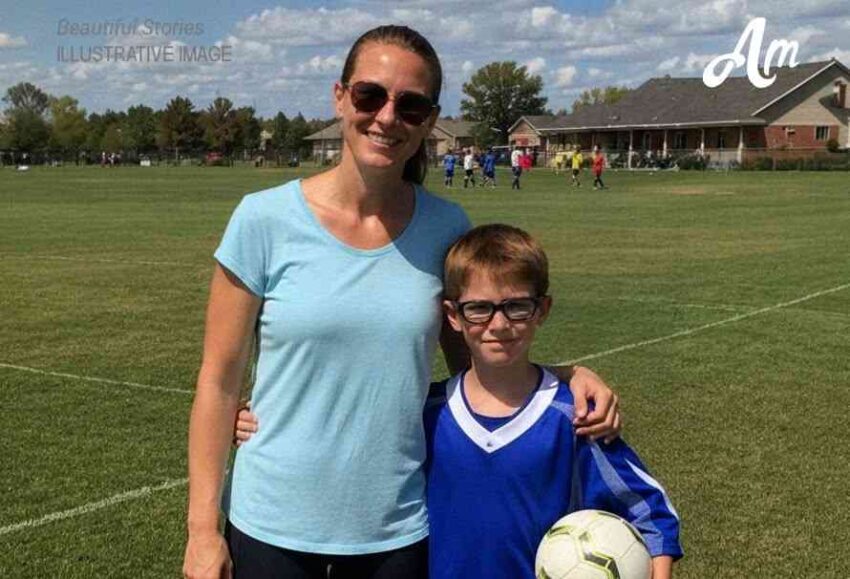
Several parents blamed my son for losing a soccer game and shouted until tears ran down his face. They thought humiliating a child would make them feel powerful, but they had no idea I was about to turn the whole field against them.
My 10-year-old son, Leo, has loved soccer since before he could pronounce the word properly.
When he was four, he kicked anything round enough to roll.
Tennis balls, oranges, balled-up socks, and even one of my decorative candles.
By six, he knew the names of professional players I had never heard of.
By eight, he was waking up early on weekends to watch matches from other countries.
Now, at ten, he spends almost every evening in our backyard dribbling between two plastic cones and taking shots at a net held together with zip ties.
The problem is that Leo loves soccer far more than soccer seems to love him.
He is not fast.
He hesitates when other players charge at him.
His passes do not always go where he wants them to go.
He understands the game, but his body does not always keep up with his brain.
Still, he works harder than any kid I know.
I am raising him on my own.
His father left when Leo was three and sends a birthday card every other year, usually late.
Because of that, Saturday soccer became our thing.
If his team wins, he talks about every play.
If they lose, he still talks about every play.
I have always told him, “Effort matters.”
Sometimes I wonder whether I say it for him or for myself.
Last Saturday started like every other game.
The field was behind a middle school.
Parents set up folding chairs along the sideline.
Leo’s team was called the Red Hawks.
Their coach, Leonardo, was a patient man in his early 30s who worked as a physical therapist.
He never yelled at the kids.
He gave corrections, clapped when they improved, and treated every player like they mattered.
I respected him for that.
Not all the parents shared his attitude.
There was one group that treated every game like a professional championship.
They stood together near midfield and criticized everything.
Greg, whose son Mason was one of the strongest players, always had something to say about the referee.
His wife, Tanya, kept statistics in a small notebook even though the league did not track official stats for 10-year-olds.
Then there was Renee, mother of a boy named Tyler.
She wore team colors from head to toe and spoke about “our season” as if she had personally played every minute.
They had never liked that Leo got field time.
I had heard comments before.
They never said Leo’s name directly, at least not when I was close enough to challenge them.
They preferred to speak loudly and let the words drift toward me.
That morning, Leo was nervous.
He looked toward the other players.
“Coach said I might play defense today.”
“You have played defense before.”
“Not this much.”
I crouched in front of him and fixed the collar of his jersey.
“Listen to me. You do not need to be perfect. Pay attention, work hard, and keep moving.”
He gave me a small smile.
“What if I mess up?”
“You probably will.”
His eyes widened.
I laughed. “Everyone makes mistakes. That is how sports work.”
He looked at me for another second, then smiled for real.
“Thanks, Mom.”
Before kickoff, he ran toward the field, then turned and gave me a little wave.
I waved back with both hands.
The game was close from the beginning.
The other team scored first.
Mason tied it before halftime.
In the second half, Tyler scored after a good pass from another player.
For a while, the Red Hawks led two to one.
Leo was playing better than usual.
He blocked one pass, cleared another, and even managed to take the ball away from a faster player.
Every time he did something well, I clapped.
So did Coach Leonardo.
A few parents said nothing.
The other team tied the score with about 10 minutes left.
In the remaining time, a ball came rolling toward Leo near the penalty area.
It should have been an easy clearance.
I could see what he meant to do.
He planted one foot, pulled the other back, and tried to kick the ball toward the sideline.
But his foot caught the grass.
He missed.
The ball rolled past him to a player from the other team, who shot before our goalkeeper could react.
The ball hit the net.
The whistle blew almost immediately after the restart.
The game was over.
For one second, the field was silent.
Leo stood where he had missed the ball.
His shoulders were stiff, and his face had gone pale.
Then Greg started clapping.
A slow, sarcastic clapping.
“Great job,” he called. “Really great job.”
Tanya threw both hands into the air.
“How do you miss that?” she shouted. “It was right in front of you.”
Renee stood up from her chair.
“That cost the whole team the game.”
I looked toward Coach Leonardo. He was speaking to the referee and had not heard the first comments.
Leo had.
He turned toward the sideline.
Greg shook his head.
“Unbelievable.”
Another father near them said, “Some kids should not be playing defense.”
Renee made sure everyone could hear her.
“Some kids should not be on the team.”
Leo froze.
The other children were still scattered across the field.
A few had started walking toward the bench, but most were staring at the adults.
Then I saw tears run down Leo’s face.
He stood there, trapped in the middle of the field while grown adults blamed him for a 10-year-old soccer game.
Something in me changed.
I stood up.
There was a plastic bottle of orange soda beside my chair.
I had bought it for Leo for after the game. I picked it up without thinking.
Tanya saw me coming and glanced at the bottle.
So did Greg.
His expression shifted.
For one satisfying second, I think he believed I was about to dump it over his head.
I was angry enough to understand why he thought that.
But I was not going to give him a reason to make himself the victim.
Before I reached them, I bent down and placed the bottle on the grass.
Then I walked into the middle of their little group.
“He’s 10 years old,” I said.
My voice carried farther than I expected.
The conversations along the sideline stopped.
Greg crossed his arms.
I looked at each of them.
“You’re adults. Listen to yourselves.”
No one answered.
I pointed toward the field.
“My son made one mistake in a children’s soccer game, and you decided to humiliate him in front of his teammates.”
Greg rolled his eyes.
“We are allowed to be frustrated.”
“Frustrated?” I said. “You sarcastically applauded a crying child.”
“He cost them the game.”
“No. The team lost the game. A team wins together, and a team loses together.”
Tanya closed her notebook.
“Nobody is attacking him.”
“You shouted, ‘How do you miss that?’ while he was standing 20 feet away.”
“Because it was an easy play.”
“Then put on a uniform and make it yourself.”
A few parents nearby laughed.
Tanya’s face turned red.
Renee stepped forward.
“We all pay for our kids to be here. We expect the coach to put the strongest players on the field.”
“And I expect adults to know better than to bully a 10-year-old.”
“Bullying?” she said. “That is dramatic.”
“No. What you did was dramatic. Screaming over a Saturday game like college scouts were waiting in the parking lot was dramatic.”
That was when Coach Leonardo reached us.
“What is going on?” he asked.
Before I could answer, another mother spoke from behind me.
“They were yelling at Leo.”
Her name was Melissa. Her daughter, Grace, played midfield.
She folded her arms.
“They blamed him for the loss and said he should not be on the team.”
A father named Kevin nodded.
“I heard it too.”
Greg looked around.
“Oh, come on. Everyone was thinking it.”
“No,” Kevin said. “We were not.”
Another parent stood.
“Do not include me in that.”
Then another mother spoke.
“They have been making comments about weaker players all season.”
Renee stared at them.
“Now everyone suddenly has something to say?”
Melissa answered, “We should have said something sooner.”
The field had gone quiet.
Even the players from the other team were watching.
Coach Leonardo looked at Greg, Tanya, and Renee.
“Did you yell at Leo?”
Greg shrugged.
“We expressed frustration.”
Coach Leonardo’s jaw tightened.
“Did you tell him he should not be on the team?”
Renee lifted her chin.
“I said what a lot of people believe.”
Coach Leonardo took a slow breath.
“This league has a zero-tolerance policy for adults insulting players.”
Greg scoffed.
“Zero tolerance? Are you serious?”
“Completely.”
He pointed toward the parking lot.
“I need the three of you to leave.”
Tanya stared at him.
“You cannot remove us. Our children are on the team.”
“Your children can stay with another approved guardian. You are banned from attending the next three games.”
Greg stepped closer.
“You are overreacting.”
Coach Leonardo did not move.
“No. I am protecting my players.”
For the first time since I had known him, Greg had nothing to say.
Renee grabbed her bag.
“This is ridiculous.”
Coach Leonardo looked directly at her.
“What is ridiculous is that children showed more self-control today than their parents.”
A few people clapped.
Greg looked around and seemed to realize how badly the moment had turned against him.
The group he had counted on was gone. No one defended him.
He picked up his chair and walked toward the parking lot.
Tanya followed, holding her notebook against her chest.
Renee left last.
As she passed me, she muttered, “I hope you are proud of yourself.”
I looked toward Leo.
“I am proud of him.”
She did not answer.
When I turned back to the field, Leo was still standing near the penalty area.
Coach Leonardo started toward him, but the kids reached him first.
Mason was the first one there.
I had expected him to be angry because his father had been the loudest.
Instead, he put a hand on Leo’s shoulder.
“It wasn’t your fault,” he said.
Leo wiped his face.
“I missed.”
“So what?” Mason said. “I missed two shots.”
Grace joined them.
“I gave away the ball before their first goal.”
Tyler walked over more slowly.
“I was supposed to mark the kid who scored.”
Within seconds, the entire Red Hawks team stood around Leo.
Not every child knew what to say, so some of them said nothing.
They simply stayed beside him.
Coach Leonardo knelt in front of the group.
“You know what I saw today?” he asked.
No one answered.
“I saw a team fight hard. I saw mistakes. I saw good plays. I saw courage. And right now, I see teammates taking care of each other.”
Leo looked toward me.
His eyes were still red, but he was no longer standing alone.
I smiled at him.
After the kids lined up to shake hands with the other team, parents began packing chairs and coolers.
Several people came over to apologize for not speaking sooner.
Melissa hugged me.
“I heard comments before,” she said. “I kept telling myself it was not my business.”
“It is hard to step into conflict.”
“You did.”
“They were talking about my son.”
She looked toward the players.
“Next time, I will speak before another parent has to.”
As I folded my chair, a man I recognized from the sideline approached me.
His name was Victor.
His son, Micah, had joined the Red Hawks at the start of the season.
Victor was usually quiet during games.
He clapped, gave his son water, and never shouted instructions over the coach.
He waited until Leo was talking with his teammates before he spoke.
“Christy?”
“Yes?”
“I wanted to say you handled that well.”
“Thank you.”
He looked toward Leo.
“I also wanted to ask you something, but I do not want it to come across the wrong way.”
After the morning I had just experienced, I was not in the mood for coded criticism.
“What is it?”
“I coached high school soccer for 14 years.”
I had not known that.
He continued carefully.
“Leo has potential.”
I almost laughed.
Victor noticed my expression.
“I mean it,” he said. “He sees the field well. He knows where the ball should go. His problem is not understanding. His problem is confidence and footwork.”
I glanced toward Leo.
Victor said, “When he feels pressure, he rushes. Then his balance goes. Both problems can improve.”
“Are you offering advice?”
“I am offering help.”
He pointed toward Micah.
“I train with my son after school three days a week. Nothing extreme. An hour at the park. Passing, positioning, first touch, and balance. Leo is welcome to join us.”
I studied him.
“Why?”
Victor looked surprised.
“Because he wants to learn.”
“Plenty of kids want to learn.”
“Not like him.”
He nodded toward the empty field.
“After he missed, he did not blame the grass, the goalkeeper, or another player. He stood there because he cared.”
Victor paused.
“Then, after adults embarrassed him, he still shook hands with the other team. Skill matters. Character matters longer.”
I felt my throat tighten.
“Would this cost anything?”
“No.”
“I cannot accept free private coaching.”
“It is not private coaching. He would train with Micah. My son needs a consistent partner, and Leo needs repetition. They can help each other.”
“I will ask him.”
Leo said yes before I finished explaining.
The first training session was the following Monday.
I expected Victor to run the boys until they were exhausted. Instead, he started with basic movements.
He showed Leo how to plant his foot beside the ball.
He taught him to look up before receiving a pass.
He made both boys repeat simple drills until their movements became smooth.
Victor never promised he would become the best player.
He promised that practice would make my son more prepared.
Micah helped too.
He was more skilled than Leo, but he never treated him like a burden.
If Leo struggled with a drill, Micah slowed down.
If Micah got frustrated, Leo encouraged him.
By winter, they had become close friends.
A few months later, the Red Hawks played in a spring tournament.
Near the end of the second game, the score was tied.
The other team sent a long pass toward our penalty area.
Leo was the nearest defender.
For one second, the scene looked almost exactly like the mistake that had broken him months earlier.
The ball rolled toward him.
A player charged from behind.
The parents held their breath.
Leo looked up, planted his foot, and cleared the ball cleanly toward the sideline.
Victor was standing beside me.
He did not cheer wildly. He only nodded.
“That is progress,” he said.
Micah collected the clearance and passed to Grace.
Grace sent the ball forward to Mason, who scored.
The Red Hawks won.
The kids celebrated, but Leo did not run toward the scorer.
Leo came running toward me with mud on his socks and grass stains on his shorts.
“Did you see that clearance?”
“I saw it.”
“I did not rush.”
“I noticed.”
“Victor said my footwork is now perfect.”
Victor called from behind him, “I said it was better.”
Leo grinned.
“That is basically the same thing.”
I pulled him into a hug.
He smelled like sweat, dirt, and the orange sports drink Micah had spilled on his sleeve.
“I am proud of you,” I said.
“Because we won?”
“No.”
“Because you missed once, got embarrassed, and still came back.”
His smile faded into something softer.
“I almost wanted to quit.”
“I know.”
“But then everyone stood by me.”
I looked across the field at his teammates, Coach Leonardo, Victor, and Micah.
“That is what a team is supposed to do.”
Leo nodded.
Then he grabbed his bag and ran toward the others.
Today, those parents who once made him feel like he did not belong now sit quietly while his teammates call his name.
His teammates ask for the ball and trust him to make the next play.
Those parents tried to make one mistake define my son.
Instead, they gave him a reason to prove them wrong.
Do you think the other parents’ silence before Christy stepped in made them partly responsible for allowing the bullying culture to continue?