I kept showing up for someone who never asked me to and barely appreciated it. At the time, it felt small and almost pointless, like something no one would ever notice. I had no idea those quiet gestures would one day change everything.
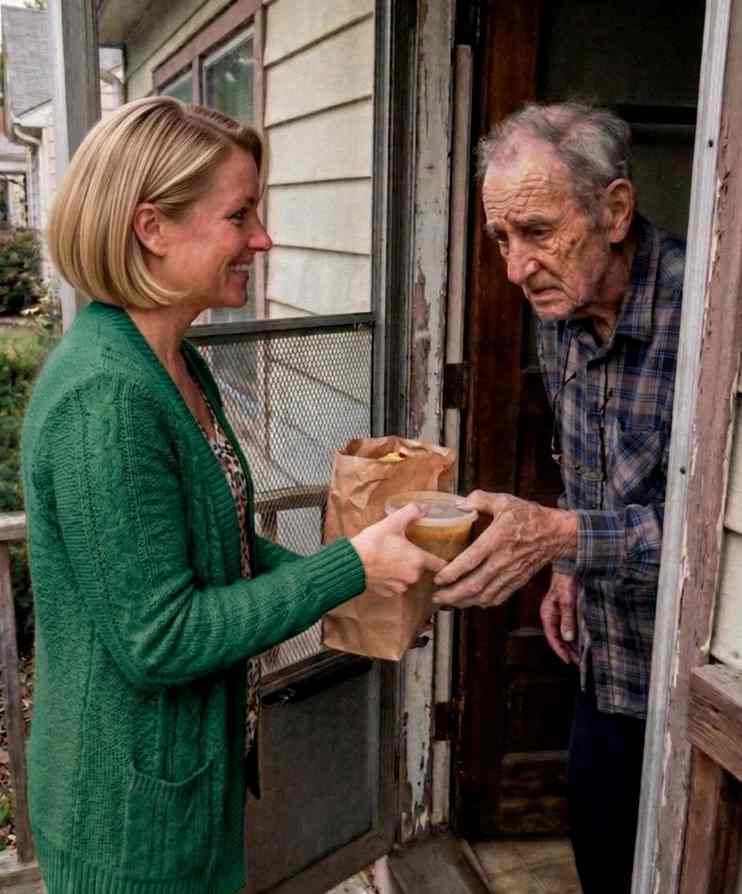
I’m 45 years old, raising seven kids on my own, and for seven years I cooked dinner for the meanest old man on my street. His name was Arthur, and he lived three houses down in a worn-out white house with peeling paint and a porch that looked forgotten.
Newspapers piled up by his door like no one had touched them in days.Most people avoided him, and honestly, I didn’t blame them. Arthur had a way of making you feel unwelcome just for existing.
If my kids rode their bikes too close to his fence, he’d yell at them and call them “wild animals.” He told anyone who would listen that I was raising troublemakers.
If I waved, he turned his back. If I smiled, he slammed the door. That was Arthur.
No one had ever been inside his house, at least as far as anyone knew. So when I started bringing him food, people thought I’d lost my mind. But they didn’t see what I saw.
Everything changed one freezing winter morning. I was rushing to my shift at the diner when I saw him lying flat on the icy sidewalk. He wasn’t moving, and for a moment I froze before running to him.
“Arthur? Can you hear me?”His eyes opened slowly, and instead of relief, he looked annoyed. “Don’t make a scene,” he muttered.
I helped him sit up, noticing his hands trembling, but not from the cold. When I walked him to his door, he paused and looked at me differently than before. His voice dropped as he asked why I would help someone like him.
“I don’t deserve it,” he said.I shook my head gently. “No one deserves to be left alone.”He didn’t answer and just went inside, but something shifted in me that day. Behind all that anger, I saw loneliness.
Life didn’t get easier after that. My ex-husband had been gone for years, leaving behind bills and broken promises. My kids still asked when he was coming back, and I never had a good answer.
I worked mornings at a diner, cleaned offices in the afternoon, and did laundry at a roadside motel until midnight. Some nights, I stretched soup with water just to make it last. I counted spoonfuls so each child had enough.
Still, every night I made one extra plate.The first time I brought it to Arthur, he barely opened the door. “I didn’t ask for charity,” he grumbled.
“Good,” I replied. “Because I didn’t ask if you wanted it.”He took the plate anyway, and the next morning it was empty. That became our routine. There was no thank you and no real kindness, just a quiet exchange that repeated every day.
Over time, something began to change, though it was subtle. About five years later, I knocked as usual, and instead of closing the door, he called out for me to come in.
I hesitated, then stepped inside.The house was clean, almost surprisingly so, but it wasn’t that that caught my attention. It was the walls, covered in photos of children, birthdays, school portraits, and holidays. Smiles were frozen in time everywhere I looked.
“Your family?” I asked softly.Arthur stood by the window, staring outside. “I have three kids,” he said. “They stopped coming.”That was all he gave me, but it was enough. After that, I didn’t just bring food. I showed up with intention, every single day.
Seven years passed like that. Then one night, his porch light wasn’t on, and I knew something was wrong. When he didn’t answer, I tried the door and found it unlocked.
“Arthur?” I called.There was no response.I found him in his bed, lying peacefully as if he had simply fallen asleep. He was 80 years old.
The funeral was small, and that’s where I saw his children for the first time. Daniel, Claire, and Mark stood together, dressed well and speaking quietly about inheritance. None of them asked who I was.
After the service, a man approached me and introduced himself as Thomas, Arthur’s lawyer. He told me Arthur had requested my presence at the will reading. I was confused, but I showed up anyway.
We sat around a long table that afternoon, his children across from me, clearly unsure why I was there. The lawyer pressed play, and Arthur’s voice filled the room.
He explained that he hadn’t chosen me because of kindness. Years before I ever brought him food, he had seen me sitting alone on my front steps after my husband left. My children were asleep inside, and I was trying to figure out how to survive.
He said he didn’t see weakness in me. He saw strength.Arthur admitted that he had acted difficult on purpose to test me. He wanted to see if I would walk away. When I didn’t, he decided I was someone he could trust.
Then came the shock.He had already transferred ownership of his house to me, and I would decide what happened next. I could sell it and split the money, or turn it into something that helped others.
In the following days, his children came to see me one by one. Daniel brought expensive gifts and pushed me to sell. Claire brought groceries and spoke about practicality. Mark came with anger and accused me of taking what wasn’t mine.
But I couldn’t stop thinking about Arthur’s words.So I went back to the house, this time bringing my kids. I told them to explore, and within moments the house filled with laughter. Their voices echoed through the rooms, replacing years of silence.
For the first time, the house felt alive.Three days later, I made my decision. I told them I wasn’t selling.
They were furious, but the lawyer stopped them and revealed one final recording. Arthur said that if I kept the house, it meant I understood what truly mattered. Because of that, the rest of his fortune would go to me.
The room fell silent.Weeks later, my life changed. I paid off debts and moved my kids into a better home. For the first time in years, I could breathe.
But I didn’t forget Arthur.I turned his house into a place where no one eats alone. Every evening, the doors opened, and people came. At first, it was just a few neighbors, but soon it became something much bigger.
Months later, Mark showed up. Then Claire. Then Daniel.They stayed longer each time and began to help, not because they had to, but because they wanted to.
One night, we were all sitting together at a long table. My kids, his kids, and neighbors shared food and laughter. Plates passed from hand to hand, and the house felt full in a way it never had before.
In that moment, I understood something simple.Arthur didn’t just leave me a house.He gave me a purpose.And somehow, he brought his family home.