The first thing I saw when I turned off Highway 36 onto the old fire road was a stone entrance sign where my grandfather’s pine trees used to be.
Ridgeline Heights, it said, carved into pale sandstone beneath a black iron arch. A Whitmore Luxury Community.
For a few seconds, my brain refused to accept what my eyes were telling it. I actually checked the GPS on my phone, then the folded survey map on the passenger seat, then the road ahead again, as if one of them might apologize and correct itself. But the coordinates were right. The road was right. The slope of the land was right. Even the far ridge, the one shaped like the broken back of a sleeping mule, was exactly where it had always been.
Everything else was gone.
The forest my grandfather had bought in 1971, the forty-seven acres of Colorado pine and aspen he had protected for half a century, had been scraped raw, paved over, divided into lots, and covered with houses.
Not cabins. Not a few accidental encroachments. Not some confused neighbor’s fence line creeping twenty feet too far north.
An entire subdivision.
Ninety-six houses stood where ponderosa pines used to rise. Mediterranean stucco boxes with fake balconies, tile roofs, HOA-mandated beige paint, and identical young maple trees staked in yards that had been forest three years earlier. Fresh black asphalt curved through cul-de-sacs with names like Vista Laurel Drive and Juniper Crest Lane, though I could see no laurel and they had cut down most of the juniper. Streetlights stood at even intervals, still wrapped in plastic near the bases. A moving truck blocked one driveway. A family unloaded dining chairs from a trailer. Somewhere, a nail gun popped in short bursts like distant gunfire.
I sat in my Silverado with my hands on the steering wheel and the engine idling rough beneath me.
My grandfather’s ashes were in a cedar box on the passenger seat.
I had brought him there to come home.
Instead, I had brought him to see what had been stolen.
My name is Dakota Flint. Yes, like the stone. I am forty-seven years old, divorced, a structural engineer by training and a tired man by habit. I drive a 2008 Chevy Silverado that burns a quart of oil every month and has a driver’s seat permanently shaped to the exact curve of my disappointment. My knees hurt in cold weather. My ex-wife says I apologize like it’s a nervous tic. My kids, Emma and Tyler, are old enough to have their own opinions about my failures and kind enough not to list them unless I ask.
There is nothing flashy about me.
At least, there wasn’t.
The only unusual thing I had ever owned was forty-seven acres of Colorado land my grandfather bought with cash before land became a toy for people with portfolios.
William Flint purchased the property in 1971 for $8,200. I know that because he kept the receipt in a leather ledger that smelled like pipe tobacco, motor oil, and the old tin box where he stored tractor parts. My grandfather kept everything. Deeds, tax receipts, timber permits, fence repair invoices, hand-drawn maps, weather notes, photographs, letters from county clerks, and grocery lists from 1983 for reasons God and William Flint alone understood.
He had been a Depression-era child raised by people who did not trust banks, politicians, or men in shiny shoes who said “opportunity” too often. He bought land because land stayed put, at least in theory. He bought those forty-seven acres because they had trees, a seasonal creek, and a view west toward the Rockies that made him take off his hat the first time he saw it.
“Ground like this doesn’t belong to a man,” he told me once when I was sixteen and too restless to care. “A man belongs to it awhile. Then he either leaves it better or proves he never deserved it.”
When he died in 2019, he left the land to me.
The deed came in a thick envelope from his attorney, along with a stack of records and one handwritten note tucked inside the leather folder.
Dakota,
Don’t let the bastards take what’s yours.
Grandpa
That was all.
No sentimental paragraph. No blessing. No “I love you,” though I knew he did. William Flint believed affection was best demonstrated through sharpened tools, paid taxes, and showing up before a storm rolled in to help mend a roof. The note made me laugh when I first read it. It sounded exactly like him: suspicious, practical, and somehow tender by accident.
I paid the property taxes every April after that. Six thousand four hundred dollars a year, automatically, online, never late. I had receipts. Email confirmations. Bank statements. County records. I meant to visit sooner, but life has a way of turning intention into postponement if you let it.
My divorce from Jennifer had become final six months after Grandpa died. Not ugly, not dramatic, just sad in the slow way long marriages sometimes stop surviving their own quiet. Emma was in college. Tyler was starting culinary school. My engineering firm kept handing me seventy-hour weeks because I had a reputation for saying yes before checking whether yes would kill me. Then there was COVID, then work, then tuition bills, then my truck’s transmission threatening mutiny, then another year gone.
Three years.
I did not visit the land for three years.
I told myself it was fine because I paid the taxes. Because the deed was recorded. Because land does not need daily affection to remain yours.
I learned that day that thieves do not require your absence to be legal. They only require it to be useful.
A security booth stood just inside the entrance to Ridgeline Heights. It had a little peaked roof, stone trim, and a young guard inside wearing sunglasses even though the sky was overcast. He stepped out as I rolled forward, one hand lifted.
“Residents only,” he said.
I looked past him at the houses, at the newly poured sidewalks, at a man carrying a crib frame toward house number 43.
“I own this property,” I said.
He smirked. “Sure.”
I picked up my phone and pulled up the deed photo I had taken that morning before leaving the house. “Dakota Flint. Parcel APN 55932408. Forty-seven acres. My grandfather was William Flint.”
The guard did not look at the phone.
“Sir, I’m going to need you to turn around.”
“I’m not turning around. I’m asking why there’s a subdivision on my land.”
That was when the white Range Rover appeared.
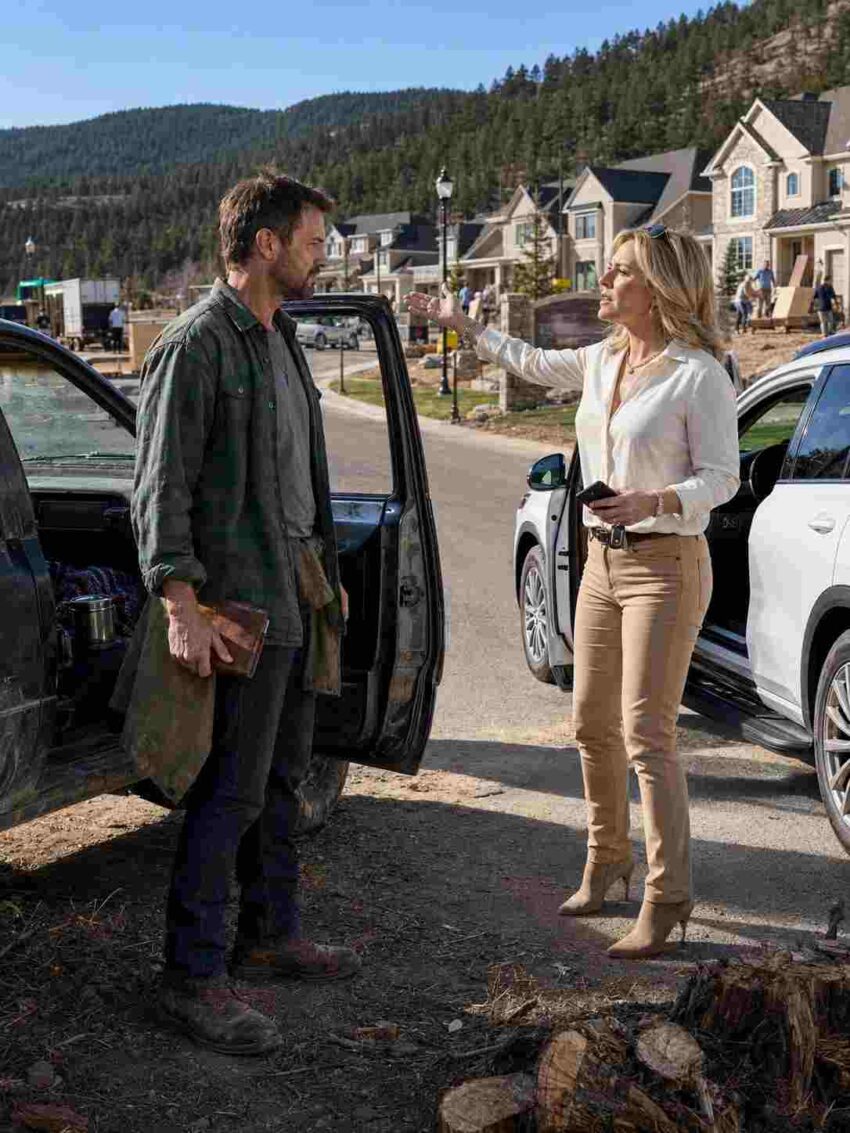
It glided up behind the guard booth as if summoned by entitlement itself. The driver’s door opened, and a woman stepped out wearing white linen trousers, a tan cashmere wrap, oversized sunglasses, and the kind of confidence money gives people before consequences arrive. She was in her mid-fifties, maybe older, her face smoothed into permanent mild surprise by expensive procedures. A Rolex flashed at her wrist. Her nails were pale pink and immaculate.
She removed her sunglasses slowly.
“Problem, Ray?” she asked the guard.
“This gentleman says he owns the development.”
The woman finally looked at me.
Not at my face at first. At my boots. My jacket. My truck. The oil stain near the front fender. My hands, calloused from years of site inspections and home repairs I could not afford to hire out. I watched her assemble me in her head and file me under irrelevant.
“How charming,” she said. “If you’re looking for construction work, most of our crews have already filled their labor positions, but I can take your number.”
The guard laughed under his breath.
“I’m not looking for work,” I said. “I am the legal owner of this property.”
Her smile sharpened a degree.
“Name?”
“Dakota Flint.”
Something flickered in her eyes. Recognition. Not surprise. Recognition.
That mattered later.
“Ah,” she said. “The Flint issue.”
Issue.
My grandfather’s land had become an issue.
She opened a slim leather phone case and scrolled with one manicured thumb. “Our title company conducted a forensic review. This land was abandoned for more than three years. Under Colorado adverse possession statute—”
“Adverse possession in Colorado requires eighteen years,” I said. “And payment of property taxes. I’ve paid every year.”
Her smile did not move, but the air around it changed.
“That’s adorable,” she said. “You know just enough to be dangerous.”
“My taxes are on file with Boulder County.”
She tucked the phone away. “Then you should speak with counsel.”
She reached into her bag, removed a business card, and held it between two fingers as if it had already touched something unpleasant.
“Brian Keer. Our attorney. He can explain why your claim is, what’s the legal term? Frivolous.”
I took the card.
“How many houses have you sold?”
“All ninety-six,” she said. “Preconstruction sales totaled just over sixteen million dollars. Families are already moving in. We will not allow a confused local man to harass homeowners because he believes he inherited some fantasy claim from a dead relative.”
My vision narrowed.
“You built on my land.”
She leaned closer, perfume cutting through the smell of wet asphalt and diesel.
“Mr. Flint, this is a legitimate development properly permitted through Boulder County. We are significant contributors to the community, including the sheriff’s department equipment fund. If you return and trespass, I will call Sheriff Mitchell personally.”
Then she lifted her phone and photographed my license plate.
The sound of the camera shutter seemed louder than the nail guns.
“Just in case,” she said, “you decide to come back and vandalize anything. We have excellent security footage.”
The guard watched me like he hoped I would give him a reason.
The cedar box containing my grandfather’s ashes sat on the seat beside me.
Cassandra Whitmore—I learned her full name later—put her sunglasses back on.
“Trust me, honey,” she said. “People like you don’t win against people like us.”
I drove away because if I stayed, I would become the kind of man her lawyer wanted me to be.
My hands shook all the way home.
That night, I spread my grandfather’s records across my kitchen table.
The house was quiet except for the hum of the refrigerator and the occasional cough of the furnace trying to start. I set the cedar box with Grandpa’s ashes near the salt shaker, because he had spent half his life at kitchen tables sorting papers and would have appreciated the placement. Then I opened the leather ledgers.
There it was. Everything.
The 1971 deed. Cash receipt. Survey maps. County correspondence. Property tax receipts from years before I was born, some typed, some handwritten, some yellowed at the edges. Timber sale records from 1984, when Grandpa selectively harvested deadfall and wrote in the margin, Don’t let the sawboys near the north pines. Fence repair invoice, 1996. Road grading receipt, 2003. A photograph of Grandpa standing beside a metal survey marker, hat low over his eyes, looking like he had personally negotiated with the mountain and won.
My own receipts were digital, but I printed them that night until my cheap printer overheated. Annual property tax payments. Email confirmations. Bank withdrawals. Parcel numbers. Dates. Six thousand four hundred dollars every April.
Never late.
Never missing.
Never abandoned.
I lined everything up chronologically, then sat back and looked at it.
Cassandra had threatened me. Photographed my truck. Called me confused. Implied I was a criminal. Told me people like me did not beat people like her.
She had also done something very helpful.
She had told me she knew who I was.
The next morning, I called Brian Keer’s office.
His receptionist had one of those professionally pleasant voices people use when their job is to protect men who charge too much to be interrupted.
“Mr. Keer is in depositions all week. May I take a message?”
“Dakota Flint. Regarding the Ridgeline Heights property.”
A pause.
“Oh,” she said. “Yes. Mr. Keer anticipated your call.”
I gripped the phone harder.
“He has authorized me to offer a nuisance settlement of fifteen thousand dollars if you sign a quitclaim deed by Friday.”
I laughed once because my body did not know what else to do.
Fifteen thousand dollars for forty-seven acres worth at least four million before they poured roads and houses on it.
I knew about quitclaim deeds from my divorce. Jennifer had taken our timeshare in Branson that neither of us wanted, and my divorce lawyer explained that a quitclaim deed basically meant signing away whatever rights you might have without any promise that those rights were worth anything. Legal surrender with a notary stamp.
“Tell Mr. Keer I’ll see him in court,” I said.
Then I hung up before she could make the offer sound more insulting.
I needed a lawyer.
Not the divorce guy who billed me $2,200 to divide furniture, retirement accounts, and the emotional wreckage of a marriage we both knew was over. I needed the kind of lawyer who made other lawyers check their malpractice insurance before answering emails.
My friend Marcus gave me one name.
Marcus Weller was a civil engineer in Cheyenne and the only man I knew who could explain drainage law at a barbecue without losing friends. When I told him what happened, he went quiet, then said, “Call Lydia Chen.”
“Who is she?”
“The woman railroads hate.”
That was enough.
Lydia Chen’s office sat in a converted Victorian building in Boulder with dark wood floors, old leather chairs, and bookshelves that looked like they had not been chosen by a decorator. The air smelled like lemon polish and paper. Lydia was around sixty, maybe a little older, with gray hair pulled into a tight bun, reading glasses on a beaded chain, and eyes that had clearly disappointed many men who expected softness.
Her consultation fee was five hundred dollars.
I paid it on a credit card and tried not to think about my daughter’s tuition payment due in January.
Lydia listened to my story without interruption. She took notes in handwriting so clean it looked printed. I told her about the land, the development, Cassandra, the adverse possession claim, the guard, the license plate photo, the nuisance settlement.
When I finished, she held out one hand.
“Tax receipts.”
I gave her the folder.
She flipped through the printed confirmations, the county records, the ledgers, the old receipts. Page after page. Year after year.
For the first time, her mouth twitched.
Not quite a smile. More like a predator scenting blood.
“Colorado adverse possession requires eighteen years of actual, adverse, hostile, exclusive, and continuous possession,” she said. “There are additional requirements when property taxes are involved. If you have been paying taxes and there is no judgment quieting title in their favor, their claim is dead on arrival.”
“So we stop construction.”
“You could.”
The way she said it made me cautious.
“But?”
She closed the folder and folded her hands on top of it.
“But here is what I would do, and you are going to think I have lost my mind.”
“I’m listening.”
“Let them finish.”
I stared at her.
She looked back calmly.
“They are building ninety-six homes on my land,” I said.
“Yes.”
“And you want me to let them keep building.”
“For now.”
“Why?”
“Because if we stop them today, Whitmore Development files emergency motions, blames the title company, claims your delay caused their damages, declares bankruptcy, and drags every lender, contractor, buyer, insurer, and county office into a legal swamp. You will still win title eventually, but it may take years. Meanwhile, ninety-six families who bought in good faith will be terrified, furious, and suing everyone, including you.”
“I didn’t do anything to them.”
“That will not stop them from being afraid.”
I looked out her window at a bare tree moving in the wind.
She continued. “If you let them finish construction, document everything, and then file for declaratory judgment, fraud, trespass, unjust enrichment, and related claims, the posture changes. They did not accidentally cross a property line. They intentionally developed and sold land they did not own. Completed homes increase the value of the improvements. Their exposure increases daily. Their incentive to settle increases daily.”
“That sounds cold.”
“It is strategic.”
“What about the families?”
“They are victims too,” she said. “Never forget that. Cassandra Whitmore wants you to become the villain in their story. Do not help her.”
I looked down at my grandfather’s deed.
“What if they somehow win?”
“They won’t.”
“What if they do?”
“Then your land is already occupied. You lose nothing by waiting except the illusion that immediate action always equals strength.”
That sentence stayed with me.
My whole life, I had been a man who reacted late and apologized early. In my marriage, at work, with my kids, I had often chosen the path that created the least visible conflict while quietly costing me the most. Lydia was not asking me to be passive. She was asking me to be patient in a way that looked like weakness only to people who could not see the blade being sharpened.
“How much?” I asked.
“Forty thousand in legal fees, possibly fifty. More if they fight stupidly. They will.”
My stomach clenched.
I had twelve thousand dollars in savings. My truck needed a transmission. Emma’s tuition was due in January. Tyler’s culinary program had sent another fee notice the week before. I could not afford justice.
But I could not afford surrender either.
“I’ll figure it out,” I said.
Lydia studied me for a long moment.
“Good. One more thing. You do not contact Cassandra. You do not post online. You do not talk to reporters yet. You tell your children, maybe one trusted friend, and no one else. In property litigation, surprise is worth more than gold.”
I signed the retainer that day.
The number on the agreement made my stomach hurt.
When I got home, I opened the cedar box with Grandpa’s ashes and set his handwritten note beside it.
Don’t let the bastards take what’s yours.
“I hired a woman who scares me,” I told him.
It felt like he would approve.
September bled into October.
I drove past Ridgeline Heights twice a week, always staying on the public road, always filming on my phone. The construction moved fast. Too fast. Framers swarmed the lots like ants. Roof trusses rose. Siding went up. Landscapers arrived with sod rolls and small ornamental trees. Concrete trucks rumbled in before dawn. The air smelled of sawdust, diesel, wet cement, and money being spent by people certain no one could stop them.
I documented everything.
Date. Time. Weather. Visible progress. Addresses. Vehicles. Conversations. Photographs with timestamps. Videos from the shoulder of the road. License plates when I could catch them. It felt ridiculous sometimes, one man in a leaking truck photographing a luxury development from a distance like a jealous ghost.
But Lydia had told me evidence was made from boredom.
So I became boring.
Cassandra spotted me during the third week.
I saw her from two hundred yards away, standing near the model home in white pants and a camel coat, phone to her ear, one hand slicing the air as she pointed toward my truck.
Twenty minutes later, a sheriff’s cruiser pulled up behind me.
The deputy who stepped out was young, probably late twenties, with a trimmed beard and the uncomfortable posture of someone who knew the law was not the only force in his day.
“Sir,” he said, approaching my window, “I need to see your license.”
I handed it over. “I’m parked on a public road.”
He looked at the license. “Dakota Flint?”
“Yes.”
“Mrs. Whitmore says you’ve been harassing her, following her, taking pictures of residents.”
“I am documenting construction on property I own. Boulder County records. Parcel APN 55932408.”
He walked back to his cruiser and ran my information. I watched him in the mirror, watched him speak into his radio, watched him glance toward the development and then back at me.
When he returned, his face had changed slightly.
“Look,” he said, lowering his voice. “If this is a property dispute, that’s civil court.”
“It is.”
“But Mrs. Whitmore has filed a formal complaint. If she calls again saying you threatened her or any residents, I’ll have to take action.”
“Did she tell you she built a subdivision on my land?”
His jaw tightened.
“I’m telling you what my position is.”
Translation: She donates. You don’t.
“What’s your name?” I asked.
“Deputy Torres.”
“Can I have your card?”
He hesitated, then gave it to me.
I kept filming after he left.
By November, families began moving in.
That was the hardest part.
Cassandra was easy to hate. Preston Whitmore, once I learned about him, was easy to hate. Brian Keer and his polished legal threats were easy to hate. But the families were not easy. They arrived in U-Hauls and SUVs full of boxes, children, mattresses, lamps, bikes, and hope. I watched a young couple carry a crib into house number 43. I watched a man in scrubs unload kitchen chairs while his teenage daughter took pictures of the front porch. I watched an older couple plant a maple tree in their yard, the husband holding the trunk steady while his wife packed soil around it with gloved hands.
These people were not stealing from me.
They were buying what someone else had stolen.
At night, I lay awake and imagined being one of them. Signing closing papers. Emptying savings. Telling your kids, This is our forever home. Not knowing the ground beneath the foundation belonged to a man sitting in a dented truck on the public road with grief in his glove compartment and a lawsuit in his future.
“Do not let Cassandra make you hate her victims,” Lydia told me when I confessed this.
“I don’t.”
“Good. Because eventually, you will need them to understand you are not their enemy.”
Thanksgiving week, a certified letter arrived.
The post office clerk, Deb, had known my grandfather. She turned the envelope over and wrinkled her nose.
“Whitmore Development,” she said. “That the lady building those McMansions on Old Mill Road?”
“Yes.”
“My sister tried to buy one. They wanted four hundred eighty-five thousand dollars for eighteen hundred square feet.” She snorted. “Highway robbery.”
“That’s one word for it.”
I opened the envelope in my truck.
Three pages of legal language on Brian Keer’s letterhead accused me of trespassing, harassment, intimidation, and interference with lawful business operations. Attached was a photo of my Silverado parked on the public road, taken from inside Ridgeline Heights. My license plate had been circled in red marker. In the margin, someone had written: Document everything.
I drove straight to Lydia’s office.
She read the letter.
Then she laughed.
Not a polite chuckle. A full, delighted laugh that made her assistant glance through the open door.
“They are documenting their own knowledge,” she said, wiping one eye. “Every letter, every photo, every complaint. They are establishing that they knew there was an ownership dispute and continued building anyway. This is beautiful.”
“It doesn’t feel beautiful. It feels like I’m being stalked.”
“You are. But you are being stalked by stupid people with expensive stationery.”
She placed the letter into a folder.
“Do nothing.”
“That seems to be your favorite advice.”
“It is often underused.”
She gave me homework instead. Research Cassandra Whitmore, Preston Whitmore, Whitmore Development LLC, Ridgeline Capital Group, the title company, the permits, the financing, the county approvals, the contractors. Public records only. No drama. No confrontation. No social media.
I spent the next two weeks becoming an amateur detective.
Engineers are good at records. We know how to read plats, maps, permit logs, drainage reports, inspection schedules. We know that disasters usually begin long before the collapse. A wrong assumption here, a skipped check there, a signature from someone who preferred speed to accuracy. Buildings fail in slow motion before anyone hears the crack.
So do fraud schemes.
Whitmore Development LLC was registered in Delaware, which Lydia called “the preferred habitat of people hiding money behind curtains.” Cassandra was listed as managing member. Financing came through Ridgeline Capital Group, a Denver-based investment firm controlled by Preston Whitmore and two partners. Preston, Cassandra’s husband, had been sued twice for construction defects and once for investor fraud in a failed resort development near Aspen. The cases settled. Records sealed. Press releases vague.
The Boulder County permit applications described the land as formerly tax delinquent and acquired through adverse possession claim filed in March 2022.
But there was no judgment.
No court order quieting title.
No recorded transfer from me.
They had filed a claim, then acted like filing was the same as winning.
That was not a mistake.
That was strategy.
I sent everything to Lydia in an encrypted email because by then I had stopped assuming people like the Whitmores relied only on visible weapons.
She called an hour later.
“This is better than I thought.”
“Better meaning worse?”
“Better meaning provable. Preston has a pattern. If we can show he knew about your ownership and proceeded anyway, this becomes more than civil trespass. It becomes fraud.”
“How do we show that?”
“Let me worry about that.”
Cassandra escalated in December.
The first attack came through Boulder County Code Enforcement.
A man named Rick Pollson called on a Tuesday sounding tired enough to have been born holding a clipboard.
“Mr. Flint, we received a complaint about illegal dumping on parcel APN 55932408.”
I looked at my phone. “Illegal dumping?”
“Construction debris, old vehicles, possible hazardous waste.”
“I don’t even have access to my own property. There are ninety-six houses on it.”
“I’m required to inspect.”
I met him at the entrance that afternoon, phone recording in my coat pocket. Rick Pollson was around fifty, sunburned even in winter, wearing a county vest and boots that had actually touched mud before. He walked the perimeter, checked behind houses, photographed drainage areas, looked at access roads, and returned shaking his head.
“There’s nothing here.”
“There are houses here.”
He gave me a look. “Besides that.”
“Who filed the complaint?”
“Anonymous tip.”
“But?”
He sighed. “It came through Mrs. Whitmore’s office as a concerned citizen complaint.”
“So she is trying to get me fined for violations that don’t exist on land she occupies.”
Rick looked at me for a long moment.
Then he lowered his voice.
“Off the record, I’ve inspected six Whitmore projects. Every single one had complaints filed against neighboring landowners right before or during construction. Junk vehicles. Drainage issues. Noise. Hazardous materials. Usually anonymous. Usually useful to them.”
“Would you say that on the record?”
He hesitated.
Then he handed me his card.
“If subpoenaed.”
I drove home with his card in my pocket and rage in my chest.
By Christmas, eighty-four houses were occupied. Families hung lights from rooflines. Children built snowmen in yards where elk used to bed down. Wreaths appeared on doors. A plastic Santa stood on a porch that sat above land my grandfather had once refused to clear because “the north slope likes its shade.”
My court date was scheduled for January 12.
Eight days before it, my daughter Emma texted at 11:07 p.m.
Dad, did you get arrested?
I was brushing my teeth. Foam still in my mouth, I stared at the message.
What?
Someone posted on Facebook that you’re harassing families and taking pictures of kids. It has like 300 shares. Dad, what is going on?
My stomach dropped.
I opened Facebook for the first time in months and found the post in the Boulder County Community Watch group.
Cassandra had written it herself.
ALERT: Local man Dakota Flint has been stalking our family-friendly Ridgeline Heights community, taking photos of homes and children, and making residents feel unsafe. He falsely claims to own our neighborhood despite clear legal title. Boulder County Sheriff’s Office is aware. Please report sightings immediately. Protect your families.
Below it was a photo of my truck, license plate visible.
The comments were worse.
Creep.
Why is he photographing kids?
Somebody needs to check if he’s on a registry.
I saw that truck last week. Calling sheriff next time.
My hands shook so badly I almost dropped the phone.
Cassandra had not merely attacked my claim. She had attacked the one thing a man may never fully recover once taken: the presumption that he is safe around children.
I called Lydia.
She answered on the first ring.
“I saw it,” she said.
“She’s calling me a predator.”
“I know.”
“My daughter is asking if I got arrested.”
“I know.”
“My son is probably going to see it.”
“I know, Dakota.”
Her calmness made me angrier for half a second, then steadied me.
“Do not respond,” she said.
“She is destroying my life.”
“She is creating defamation evidence. Screenshot everything. Shares, comments, messages, threats. Do not defend yourself online. Do not message her. Do not even use an angry reaction emoji. Cassandra wants you emotional.”
“I am emotional.”
“Be emotional somewhere without a keyboard.”
I spent the next three hours documenting the spread. By midnight, the post had 847 shares. Someone created a hashtag: StopDakotaFlint. A woman I went to high school with messaged me, Please tell me this isn’t true. Another man wrote, Stay away from my grandkids.
I did not sleep.
The next morning, my boss called me into his office.
Martin had run our structural engineering firm for twenty-two years. Ex-Navy, broad-shouldered, gray-haired, decent in the gruff way men sometimes become when softness embarrasses them. He closed the door behind me, which was never good.
“Dakota,” he said, “I got a call from a potential client this morning.”
I sat.
“They Googled the firm and found your name attached to a situation.”
“The Facebook post.”
“Yeah.”
“It’s false.”
“I figured.”
“But?”
He rubbed both hands over his face.
“But the client is a school district. They asked whether you’d be assigned to the project. I told them no.”
The words landed like a punch.
“I understand.”
“No, listen. I told them you are on paid leave pending resolution of a legal matter, which effective today, you are.”
He slid an envelope across the desk.
“Two weeks. Paid. I know you, Dakota. You’re solid. But this thing is moving fast, and I need to protect the firm until your lawyer knocks their teeth in.”
It was meant kindly.
It still hurt.
On the way to my truck, Jenny from accounting saw me, froze, and crossed to the other side of the parking lot.
Jenny brought cookies every Christmas. Jenny asked about my kids. Jenny had once cried in my office because her foundation contractor cut corners and I helped her figure out what questions to ask.
Now she would not walk past me.
That was when I understood Cassandra’s full strategy.
She did not need to win in court if she could make me too radioactive to stand there.
I sat in my truck and called Lydia.
“They’re destroying me,” I said.
“No,” she replied. “They’re trying. There is a difference.”
“I got put on leave. People are crossing the street.”
“I’m filing for a temporary restraining order against Cassandra for defamation, harassment, witness intimidation, and interference with business relations.”
“Will that fix it?”
“No. It will help. Dakota, this will get worse before it gets better. If you want to walk away, I can still negotiate a settlement. Maybe half a million. You leave town, start over.”
I looked at my cracked dashboard, at the oil change sticker I had ignored for too long, at the floor mat stained with mud from job sites across three states.
Then I thought about Grandpa’s note.
“No,” I said. “We finish this.”
“Then buckle up,” Lydia said. “Cornered rich people do not become humble. They become creative.”
She was right.
January 7, someone spray-painted PERVERT across my garage door in black letters.
I filed a police report. The responding officer, Patterson, took photos with the enthusiasm of a man documenting a pothole.
“Any idea who did it?”
“Someone who believed Cassandra Whitmore’s Facebook post.”
He wrote something down.
“We’ll increase patrols.”
That night, I slept with a baseball bat beside the bed.
January 9, Emma called crying.
She was twenty-one, in college in Fort Collins, studying environmental policy because she inherited my grandfather’s love for land and my ex-wife’s talent for making arguments beautiful. Someone had sent her Cassandra’s post with a message: Your dad’s a creep and everyone knows it.
I drove to her apartment that evening.
Her roommate watched me from the kitchen like she was trying to decide whether to leave.
Emma sat on the couch, eyes red. “Dad, just tell me the truth.”
That sentence nearly broke me.
I took out the folder I had brought: Grandpa’s deed, the tax receipts, Lydia’s filings, photographs, maps, Cassandra’s letter, everything.
I spread the documents across Emma’s coffee table.
“This is the truth.”
She read in silence.
I watched her face change from fear to fury.
“She lied about everything,” Emma said.
“Yes.”
“And people believed her.”
“Yes.”
She looked up at me. “Then why are you hiding?”
“I’m not hiding. Lydia says we wait for court.”
Emma shook her head. “Dad, you’ve played defense your whole life. Divorce, work, family, all of it. You always wait for someone else to be reasonable. Just once, hit first.”
I almost said that wasn’t who I was.
Then I realized I was not sure anymore.
On January 11, the night before court, a text came from an unknown number.
Drop the lawsuit or everyone finds out what you really are.
I forwarded it to Lydia.
She replied immediately.
Perfect. Bring your phone tomorrow. We’re going to bury them.
The Boulder County Courthouse smelled like floor wax, recycled air, and institutional patience running thin.
I met Lydia outside courtroom 3C at 8:45 a.m. She wore a navy suit, low heels, and an expression that made me grateful she was on my side. I wore my only suit, the one from Emma’s high school graduation, and it felt too tight in the shoulders.
“You ready?” she asked.
“No.”
“Good. Overconfidence causes errors.”
“Do we have enough?”
She looked at me over her glasses.
“We have a nuclear bomb.”
Inside the courtroom, Cassandra sat at the defense table beside Brian Keer and a man I recognized from property records: Preston Whitmore. He was about sixty, gray hair slicked back, expensive suit, face trained into the bland confidence of someone who had settled lawsuits before they reached discovery. Cassandra saw me and smiled.
Actually smiled.
Like we were both attending a ribbon cutting and I had misunderstood the dress code.
Judge Angela Ramirez entered at nine sharp. She was in her fifties, with reading glasses, a narrow face, and the air of a woman who had lost patience with humanity long before breakfast.
We stood.
“Be seated.”
She looked at Keer first. “Counselor, I received your motion to dismiss at 4:57 p.m. yesterday. Would you like to explain why you think that timing is appropriate?”
Keer stood, already sweating.
“Your Honor, the plaintiff’s claim is defective on its face. Whitmore Development holds clear title via adverse possession. Mr. Flint abandoned the property for more than three years—”
“Did he pay property taxes?”
Keer blinked. “Well, yes, but—”
“Then your adverse possession theory appears defective under Colorado law. What else?”
I watched his confidence crack like cheap concrete.
“Your Honor, the title company conducted a thorough search—”
“Ms. Chen?”
Lydia stood.
The temperature in the room seemed to drop.
“Your Honor, we are not here to debate adverse possession as a good-faith error. The evidence shows fraud.”
She opened her briefcase and removed a document.
“I would like to submit Exhibit A, an internal email from Preston Whitmore to Cassandra Whitmore dated February 18, 2022.”
Keer frowned.
Preston went still.
The judge read the email. Her eyebrows rose.
“Counselor Keer,” she said, “were you aware of this document?”
Keer took the copy Lydia handed him. His face went white.
“No, Your Honor.”
“It was produced to defense counsel last week,” Lydia said smoothly. “Perhaps it was overlooked.”
She gave me a copy.
My heart began pounding before I finished the first paragraph.
From: Preston Whitmore
To: Cassandra Whitmore
Subject: Old Mill Road property risk assessment
Cassie, spoke with our title attorney. The Flint parcel is not abandoned. Owner William Flint’s grandson has been paying property taxes continuously since 2019. Adverse possession claim will not hold up if challenged. However, if we move fast, file AP claim, get permits approved, and start selling lots before anyone notices, we can create enough chaos that Flint either settles cheap or gets buried in litigation costs. Worst case: build everything, file bankruptcy, let title insurance sort it out. We’ve done this before. Risk medium. Reward sixteen million gross.
I read it three times.
They had known.
From the beginning, they had known.
Judge Ramirez looked at Preston and Cassandra.
“Is this email authentic?”
Preston started to stand, but Keer grabbed his sleeve.
“Your Honor, we need time to consult—”
“That sounds like a yes,” Judge Ramirez said.
Lydia continued, voice calm. “This email establishes intentional knowledge of Mr. Flint’s ownership, awareness that adverse possession was baseless, and a deliberate strategy to overwhelm him financially and legally.”
Judge Ramirez closed the folder.
“The motion to dismiss is denied. This case proceeds on an expedited schedule. In the meantime, I am issuing a temporary restraining order. Whitmore Development will cease all sales, marketing, transfers, and occupancy-related closings connected to Ridgeline Heights pending resolution.”
Cassandra’s face had gone pale.
Judge Ramirez looked directly at her.
“And Mrs. Whitmore, if I see one more Facebook post, one more anonymous complaint to county officials, one more threat or third-party intimidation effort directed at Mr. Flint or his family, I will consider contempt sanctions. Am I clear?”
Cassandra swallowed.
“Yes, Your Honor.”
Outside the courtroom, I leaned against the hallway wall because my legs had gone unsteady.
“How did you get that email?” I asked Lydia.
“Whistleblower,” she said. “One of Preston’s former partners from the Aspen project. He has been waiting five years for someone to make Preston bleed.”
“You found him?”
“I told you,” she said. “I’m good at my job.”
For the first time in months, I felt like I could breathe.
That night, I bought a bottle of whiskey I could not afford and sat on my back porch while snow began to fall. My phone buzzed every few minutes. Emma. Tyler. Marcus from Wyoming. Even Jennifer, my ex-wife.
Heard you had a good day in court, she wrote. Kids are proud. I am too.
That message did something strange to me.
Jennifer and I had not loved each other well by the end, but once, she had been the person who knew what my silences meant. Pride from her felt like a postcard from a country I had once lived in.
At 9:47 p.m., Lydia texted.
My office tomorrow 10 a.m. Bring coffee. We are building the kill shot.
I showed up at 9:30 with two large coffees and a box of donuts because if I was going bankrupt for justice, I could at least bring glazed carbohydrates to the battlefield.
Lydia’s conference room had become a war room. A whiteboard covered one wall, filled with names, dates, arrows, corporate entities, permit numbers, and dollar amounts. It looked like a conspiracy theory created by someone with excellent penmanship.
“You brought donuts,” Lydia said, taking one. “I like you more now.”
“What is all this?”
“This,” she said, tapping Preston’s name with a marker, “is how we turn your property dispute into a criminal referral.”
She had spent the night tracking Whitmore projects across Colorado. Seven developments in ten years, all in mountain or semi-rural communities, all with title irregularities, elderly owners, tax confusion, boundary disputes, or aggressive claims. The pattern was ugly.
Find vulnerable land. File claims. Pressure title companies. Secure permits fast. Sell preconstruction lots. Let the complexity crush whoever objected.
“They are not developers,” Lydia said. “They are land pirates with LLCs.”
She explained the next phases. Discovery. Depositions. Title company records. Contractor subpoenas. Lender communications. County permit approvals. Potential RICO claims if a pattern of fraud could be established. Federal referral. Treble damages. Personal guarantees. Asset exposure.
I stared at the numbers she wrote.
Sixteen million gross.
Times three.
Forty-eight million potential exposure.
“Can they pay that?” I asked.
“No. Which is why they will eventually beg to settle.”
“You’re enjoying this.”
“I enjoy competence meeting consequence.”
“What do I do?”
“Three things. First, build a detailed log of every visit, every interaction, every harassment incident. Deputy Torres, Rick Pollson, the certified letters, the Facebook posts, the vandalism, the threats.”
I pulled out my phone. “I’ve been keeping one.”
She nodded approvingly. “Good. Second, allies. Anyone in the community harmed by Whitmore. Former contractors, neighbors, unpaid vendors, county employees, previous landowners.”
“I know where to start.”
“Third, we go public.”
I stiffened.
“Not Facebook,” she said. “That is Cassandra’s mud pit. We use real journalism. I know Patricia Hughes at Channel 9 in Denver. Investigative reporter. She loves corporate fraud with receipts.”
“You want me on TV?”
“I want the truth on TV. You, me, and eventually the homeowners. Because those ninety-six families need to understand you are not trying to steal their homes. Cassandra stole from all of you.”
I thought about Sarah Chen, the woman Lydia told me had called her office crying after the title freeze. Two kids. Entire savings in the down payment. Forever home turned legal nightmare.
“All right,” I said.
The depositions began January 18.
Preston went first, in a glass-walled conference room on the fourteenth floor of a Denver office building with views of the Rockies glowing white in morning sun. He arrived with a new attorney, Diane Kelso, who had the sharp predatory look of someone who billed $800 an hour and gave no discounts for human weakness.
He did not look at me.
The court reporter swore him in. Lydia began gently. Name. Address. Occupation. Corporate roles.
Then she slid the February email across the table.
“Mr. Whitmore, do you recognize this document?”
“Yes.”
“Did you write it?”
“Yes.”
“In this email, you state that the Flint parcel was not abandoned and that William Flint’s grandson had been paying taxes continuously since 2019. Correct?”
Diane leaned forward. “Objection to form. You may answer.”
Preston shifted. “That was based on preliminary information.”
“You wrote, ‘Adverse possession claim will not hold up if challenged.’ Did you believe that when you wrote it?”
“I was summarizing possible risk.”
“Did you believe it?”
Diane objected again.
He answered anyway. “Yes.”
Lydia nodded as if grateful.
That was how she operated. No dramatic speeches. No sudden ambush yet. Just rope. More rope. Let them hold it. Let them tie themselves.
By noon, Preston had contradicted his deposition prep at least four times. By two, he was sweating through his shirt. By three, Diane requested a break in a tone that suggested she wanted to strangle her client privately.
When it ended, Diane stayed behind after Preston left.
“Your client should settle,” she told Lydia quietly.
Lydia closed her notebook.
“Your client should have thought of that before committing fraud.”
“Name a number.”
“Ten million. Preston and Cassandra personally fund the transfer of clean title to every Ridgeline Heights homeowner. They dissolve Ridgeline Capital’s development arm. Full restitution. Written apology. Attorney fees. Cooperation with state and federal authorities.”
Diane laughed without humor.
“He’ll never agree.”
“Then I’ll see him at trial.”
The intimidation grew uglier after that.
Tyler called me from Fort Collins two days later. He was twenty-three, working as a line cook while finishing culinary school, a good kid with his mother’s emotional intelligence and my talent for worrying late at night. His voice shook when I answered.
“Dad, someone came to the restaurant.”
My chest tightened.
“A man in a suit. He said he was a private investigator looking into you. Asked my manager if I was reliable, if you’d ever been violent, if there were incidents he should know about.” Tyler’s breathing hitched. “My manager pulled me aside after and asked if there was something I needed to disclose.”
“What was the investigator’s name?”
“Thomas Brennan. Apex Investigations. He left a card.”
I closed my eyes.
“Send me a photo. Do not talk to him again. If he comes back, tell him to contact my attorney.”
After we hung up, I called Lydia and left a message that probably sounded less stable than ideal.
She called back at eight.
“I know,” she said.
“How do you know everything before I tell you?”
“Because fraudsters are repetitive. Apex Investigations has worked for Preston before.”
“He went to my son’s job.”
“That is witness intimidation. We are filing an emergency motion.”
Then came the IRS notice.
Anonymous third-party report. Alleged irregularities in my last three years of tax returns. There were no irregularities. I was a W-2 employee with mortgage interest, tuition payments, and the most boring tax life imaginable.
I forwarded the notice to Lydia.
She called immediately.
“They are panicking.”
“It feels like they’re winning.”
“They are burning bridges they may soon need. False IRS reports, private investigators at family workplaces, vandalism, online defamation—Dakota, desperate people always overplay.”
“Easy to say when it’s not your garage door.”
Her voice softened.
“I know.”
That helped more than any legal analysis.
The Ridgeline Heights sales contracts leaked on January 25.
A Boulder real estate blog posted the headline: Luxury Developer Sold Homes on Stolen Property; Buyers May Lose Everything.
My phone began ringing within an hour.
Homeowners.
Panicked. Angry. Terrified.
Some cursed me. Some begged. Some cried. A woman named Sarah Chen called from house number 67, her voice breaking as children made noise in the background.
“Mr. Flint, please. We moved here from California. We used our savings. My husband is a nurse. I’m a teacher. We have two kids. This was supposed to be our forever home.”
“I am not trying to take your house,” I said.
“But what happens if you win?”
The honest answer was complicated and frightening.
So I gave the truest promise I could.
“I will fight the Whitmores. Not you.”
That was not enough.
But it was all I had then.
Patricia Hughes came to my house on January 30.
She arrived with a cameraman named Steve, two lights, and the practical air of a woman who had climbed through figurative and possibly literal dumpsters for stories. She was in her forties, with gray-streaked hair in a ponytail and a blazer over jeans. She shook my hand firmly.
“Mr. Flint, I’ve covered real estate fraud for twelve years. This is one of the most brazen cases I’ve seen.”
“You say that to all the victims?”
“No. Usually I say, ‘This may take a while.’”
I liked her immediately.
We filmed in my living room, which I had cleaned by shoving laundry into closets like a teenager before prom. Patricia asked about my grandfather first. Smart. She understood the story was not just land. It was legacy.
I told her about William Flint. The ledgers. The deed. The note. The way he taught me that owning land meant taking responsibility for it. I told her about finding Ridgeline Heights, about Cassandra’s insults, about the Facebook post, the threat, the families moving in.
“Are you angry at the homeowners?” she asked.
“No,” I said. “They were sold a lie too. I’m angry at the people who stole from all of us.”
She studied me.
“What do you want?”
I looked at the camera, though she had told me not to.
“I want my grandfather’s land acknowledged as mine. I want the people who committed fraud held accountable. And I want every family who bought in good faith to sleep in their homes without wondering if they’ll be thrown out because a developer treated property rights like a casino game.”
Patricia turned off the camera after ninety minutes.
“Off the record,” she said, “Cassandra threatened to sue us if we air this.”
“Will you?”
She smiled.
“Threats mean I’m on the right driveway.”
The segment aired February 2 at six.
I watched alone, sitting forward on the couch with a beer I was too nervous to drink.
Patricia’s voice filled my living room.
“He inherited the American dream: forty-seven acres of Colorado forest. But when Dakota Flint returned to scatter his grandfather’s ashes, he found something else entirely—a luxury subdivision built on land he says was never for sale.”
They showed aerial footage of Ridgeline Heights. My interview. Grandpa’s deed. Tax receipts. The Preston email. County permit records. A graphic showing the alleged chain of corporate entities. Patricia had even obtained documents showing a fifty-thousand-dollar donation from Ridgeline Capital partners to a county commissioner’s campaign before permit approvals accelerated.
The piece ended with me saying, “If people with enough money can build on land they don’t own, smear the owner, and then say it’s too complicated to undo, then what do property rights mean? What do laws mean?”
My phone exploded before the segment ended.
Emma called crying, proud this time.
Tyler texted: Grandpa would be losing his mind.
Marcus wrote: You just became a folk hero.
Even Martin, my boss, emailed: Come back Monday. We’re proud to have you.
Then, at 7:15, a message came from a blocked number.
You just made the biggest mistake of your life.
I forwarded it to Lydia.
She called within minutes.
“Do not go anywhere alone. Vary your routes. Keep doors locked. If anything feels wrong, call police.”
“You think they’d actually do something?”
“I think they are looking at financial ruin and possible prison. That makes people stupid.”
Two days later, I came home from grocery shopping and found my front door ajar.
I stood on the porch with two bags of groceries in my arms and every nerve in my body screaming.
I had locked it.
I knew I had locked it.
I set the bags down and called 911.
Deputy Torres arrived with backup. They cleared the house room by room. Nothing was stolen. No drawers dumped. No electronics taken. No obvious damage.
But on my kitchen table sat a single sheet of printer paper.
DROP IT OR LOSE EVERYTHING.
Torres bagged it as evidence.
“This is the Whitmores,” I said.
“Can you prove that?”
No.
Not then.
Two hours later, my neighbor Carol knocked.
Carol was seventy, a retired librarian with silver hair, sharp eyes, and a talent for noticing everything. She had lived across from me for twelve years and once told me which teenager dented my mailbox before the teenager’s parents knew he had taken the car.
“Dakota,” she said, “I saw a black Audi SUV parked across the street yesterday around noon.”
My pulse quickened.
“A man in a suit walked up your driveway. Came back about ten minutes later. Thought he was a salesman, but it seemed odd.”
“Did you see his face?”
“No. But I wrote down the plate.”
She handed me a sticky note.
Colorado KLM4892.
Torres ran it.
Registered to Apex Investigations. Thomas Brennan.
The same PI who had gone to my son’s job.
Torres looked deeply uncomfortable.
“Walking up to your door isn’t proof he broke in.”
“No, but it’s not nothing.”
“No,” he admitted. “It’s not nothing.”
I slept at Emma’s apartment that night, on the couch, baseball bat beside me like a bad movie cliché I was suddenly grateful for.
On February 6, three days before trial, Lydia called.
“The title company flipped.”
I sat up.
“Rocky Mountain Title is cooperating. They admit the adverse possession claim was unsupported. They also admit Preston paid a forty-five-thousand-dollar consulting fee to push the review through.”
“That sounds like a bribe.”
“It smells like one too. They are giving us emails, payment records, and recorded calls.”
“So we have them.”
“We have them.”
She paused.
“What?”
“Cassandra knows it too. Her attorney called this morning begging for a settlement conference.”
“What did you say?”
“That we would see them in court.”
Trial day came gray and bitter cold.
Emma rode shotgun to Boulder because she said I needed family there and refused to let me argue. Tyler wanted to come but could not miss work after the PI stunt nearly cost him his job. Jennifer sent a text that morning: Go win what your grandfather left you.
The courthouse parking lot was chaos. News vans. Cameras. Reporters. Homeowners huddled in groups, faces pale with fear. Patricia Hughes spotted me but did not approach. Lydia had told everyone: no comments before court.
Courtroom 3C was packed.
At least forty Ridgeline Heights homeowners sat in the gallery. I recognized Sarah Chen near the front, holding her husband’s hand. An elderly couple I later learned were the Rodriguezes sat behind her. A young father bounced a toddler on his knee until the bailiff told him gently to step outside if needed.
These were the people Cassandra had placed between me and justice like human shields.
Cassandra and Preston sat at the defense table with four attorneys. Cassandra wore a cream suit, perfect makeup, and a face composed so carefully it might have been painted. But when she reached for her water glass, her hand trembled.
Judge Ramirez entered.
We stood.
Before anyone began, she looked over her glasses at the packed room.
“This is a court of law, not a circus. Anyone who disrupts proceedings will be removed. Understood?”
The room murmured agreement.
“Ms. Chen,” the judge said. “Opening statement.”
Lydia stood.
She did not need a microphone.
“Your Honor, this case is about theft. Not the kind that happens in dark alleys with masks and guns, but the kind that happens in boardrooms with LLCs, forged assumptions, and people rich enough to call stealing a development strategy.”
The courtroom went utterly still.
“Dakota Flint inherited forty-seven acres from his grandfather, William Flint, who bought that land in 1971 and maintained it for nearly half a century. Mr. Flint paid taxes. He kept records. He held lawful title. The defendants knew this.”
She lifted the enlarged Preston email.
“They knew Mr. Flint owned the property. They knew their adverse possession claim would fail. They built anyway because they calculated that chaos could become leverage. They planned to bury one man beneath litigation costs, frightened homeowners, title insurance disputes, and public defamation.”
She turned slightly toward the gallery.
“The homeowners here are not the wrongdoers. They are victims of the same fraud. Mr. Flint has made clear he will not seek to punish families who bought in good faith. But fraud cannot be rewarded simply because it was committed on a large scale.”
She faced the judge again.
“We are asking for title to be confirmed, damages awarded, fees paid, and this matter referred for criminal investigation. We have the receipts.”
She sat.
I realized I had been holding my breath.
The defense tried.
Diane Kelso argued title complexity. Honest misunderstanding. Reliance on professionals. Economic hardship. Innocent buyers. She tried to separate Preston from Cassandra, Cassandra from Whitmore Development, Whitmore Development from Ridgeline Capital, Ridgeline Capital from the title company, and everyone from the email that tied them together in one neat fraud-shaped bow.
Judge Ramirez listened with a face that gave nothing away.
The trial lasted seven hours.
Lydia called the title company representative, who admitted the claim was “aggressive,” unsupported by judgment, and approved under pressure after payment from Preston’s associated entity. Rick Pollson testified about the false code complaints and the pattern he had observed across Whitmore projects. Deputy Torres described the harassment reports and the Facebook post. Patricia’s segment was not evidence, but the underlying documents were. My grandfather’s ledgers were admitted, page after page of pipe-tobacco-scented proof that William Flint had existed, paid, cared, and passed his land to me.
Preston took the stand.
Lydia destroyed him in forty minutes.
Every question was a trap with polished edges.
“Did you write this email?”
“Yes.”
“Did you identify Dakota Flint as the tax-paying owner?”
“I referenced possible ownership issues.”
“Please read the highlighted sentence.”
He read, voice thinning. “‘The Flint parcel is not abandoned.’”
“Did you advise Cassandra Whitmore to proceed quickly before Mr. Flint noticed?”
“That is not how I would characterize—”
“Please read the highlighted sentence.”
His attorney objected. Judge Ramirez overruled.
Preston read.
“‘If we move fast… before anyone notices…’”
By the end, he was no longer a developer in a suit. He was a man surrounded by his own words.
Cassandra refused to testify.
Fifth Amendment.
Her lawyers knew what Lydia would do to her.
At 4:47 p.m., Judge Ramirez said she would issue a written ruling within twenty-four hours.
In the hallway afterward, the homeowners surrounded me.
Sarah Chen reached me first. “What happens to us?”
Her husband stood behind her, face tight. Her little girl clutched a stuffed rabbit and looked up at me like I controlled whether bedtime still happened in her house.
“If you win,” Sarah said, “do we lose our homes?”
I looked at Lydia.
She nodded.
I turned to the crowd.
“No,” I said loudly enough for everyone to hear. “You keep your homes. Every one of you. The Whitmores committed fraud. Not you. We will structure the remedy so families who bought in good faith are protected.”
For a second, nobody moved.
Then someone clapped.
Then another.
Then the hallway filled with applause.
Not celebration exactly. Relief. Desperate, fragile relief.
Cassandra walked past with her attorneys, face white, eyes full of hate.
I did not look away.
Outside, Patricia Hughes caught me on the courthouse steps.
“Mr. Flint, how are you feeling?”
I looked at Emma, at Lydia, at the homeowners behind us, at the Rockies rising snow-covered in the distance.
“Like my grandfather is watching,” I said. “And he’s proud.”
The clip went viral overnight.
Three million views by morning.
Judge Ramirez’s ruling arrived at 10:16 a.m.
It was eighteen pages long, but the first paragraph said enough.
The defendants engaged in a calculated and systematic scheme to defraud Dakota Flint of his lawful property through false adverse possession claims, improper influence, intentional misrepresentation, and continued development despite actual knowledge of plaintiff’s ownership. Such conduct is reprehensible and will not be tolerated by this Court.
We won everything that mattered.
The court confirmed my title to all forty-seven acres, including the ninety-six houses. It awarded damages for trespass, emotional distress, and loss of use. It awarded Lydia’s attorney fees. It referred the matter to state and federal authorities for investigation into fraud, bribery, harassment, witness intimidation, and related conduct.
Whitmore Development collapsed within a week.
Ridgeline Capital’s development arm dissolved. Preston was indicted on multiple fraud-related charges. Cassandra accepted a plea deal later, probation and restitution, plus a lifetime ban from Colorado real estate development. The title company lost its license. Brian Keer resigned from his firm before disciplinary proceedings could finish chewing through him. Apex Investigations closed quietly after Thomas Brennan’s name appeared in too many filings. A county commissioner suddenly discovered the joy of spending more time with family after Patricia Hughes aired a follow-up segment on campaign donations and permit acceleration.
Cassandra’s Range Rover went to auction.
So did the Aspen house.
So did her jewelry collection.
I did not attend.
There is a point where watching becomes less like justice and more like hunger. I had seen enough.
But the ruling created the question everyone feared.
What happens to ninety-six families living on land the court had just confirmed belonged to me?
Legally, I had power.
That is a dangerous thing to hand a wounded man.
I could have forced them out. Sold the homes. Negotiated brutal leases. Taken millions. Some people told me I should. They said the homeowners had title insurance. They said I deserved compensation. They said Cassandra had cost me my reputation, my peace, my job, my safety, and months of my life. They said I would be a fool to walk away from money rich people would never hesitate to take.
Maybe they were right about what rich people would do.
But I was not raised by rich people.
I was raised by William Flint.
On March 15, I called a town hall meeting at Ridgeline Heights.
All ninety-six families came.
We met in the unfinished clubhouse Cassandra had promised would include a gym, coffee bar, and co-working lounge. At that point, it had bare drywall, temporary lights, folding chairs, and a concrete floor dusty enough to coat everyone’s shoes. Snow melted from boots near the entrance. Children whispered. Adults watched me with hope, suspicion, and fear braided tightly together.
Lydia stood beside me with a folder.
Emma and Tyler sat in the front row. Jennifer came too, with her new husband, which surprised me. She hugged me before the meeting and whispered, “For what it’s worth, I always knew you’d do the decent thing once you stopped apologizing for being in the room.”
That was my ex-wife in one sentence: kind and insulting with remarkable efficiency.
I stepped forward.
“I know you’re scared,” I said.
The room quieted.
“You bought homes in good faith. You did nothing wrong. I am not here to punish you for someone else’s fraud.”
A woman near the back began crying softly.
“My grandfather bought this land in 1971. He loved it. He protected it. When I found Ridgeline Heights here, I felt like something sacred had been cut down.”
I looked toward the windows, beyond the clubhouse, toward roofs and roads and small yards where forest had stood.
“I can’t undo that. None of us can. But we can decide what grows from it.”
Lydia handed me the papers.
“We are creating the Ridgeline Heights Community Trust, a nonprofit land and housing trust. I am transferring the residential portions of the property into the trust. Each family will retain the right to live in and ultimately own the home you purchased in good faith. If you paid in full, you owe nothing more. If you have remaining payments, those payments go to the trust at zero interest, based on what you originally agreed to pay, not inflated fees or penalties.”
Someone gasped.
Sarah Chen covered her mouth.
“The trust will use funds for roads, maintenance, property taxes, legal cleanup, and a community scholarship. No HOA controlled by developers. No Cassandra. No hidden management fees.”
A man stood. “What do you get?”
The honest answer was not simple.
“I keep five acres at the north end,” I said. “The old-growth pines. The part my grandfather loved most. I also receive damages from the Whitmores and other responsible parties as the court process allows. But I am not taking your homes from you.”
Silence.
Then Mr. Rodriguez, the elderly man I had seen in court, stood slowly.
“You are giving us our homes?”
“No,” I said. “You paid for your homes. I’m making sure the thief doesn’t get to keep standing between you and them.”
He came forward and shook my hand with both of his.
“Your grandfather raised you right.”
That broke me more than the applause.
And there was applause.
It began with Sarah Chen, then spread through the room until people were standing, crying, clapping, hugging. A little girl offered me a sticker shaped like a unicorn. A teenage boy asked if the trust would still allow basketball hoops. Someone else asked about the beige paint rules, and Lydia said, “We will discuss aesthetic tyranny later,” which became the first joke of the new community.
For the first time since August, Ridgeline Heights did not feel like a crime scene.
It felt like people trying to build a neighborhood from wreckage.
The William Flint Memorial Scholarship launched that September.
Ten thousand dollars annually for a Colorado student studying engineering, forestry, environmental science, or land management. Emma helped design the application. Tyler insisted we fund culinary students too because “people who feed communities matter,” and after debate, we added a smaller community grant for trade school students because Grandpa had respected anyone who could fix what they broke.
The first scholarship winner was a girl from Fort Collins named Maribel Ortiz, whose essay described wanting to restore wildfire-damaged forests. At the award ceremony, she shook my hand and said, “I read about your grandfather. I think he would like this.”
I had to turn away for a second.
I kept the five acres.
The north pines were still there.
Cassandra’s bulldozers had stopped short of them because the slope made development expensive and because even thieves sometimes leave the hardest work for later. I built a small cabin there. Two bedrooms. One porch. Wood stove. Nothing fancy. I sold my house in town after the garage was repainted and the police reports became old paper. Moved into the cabin in October.
The first morning I woke there, the air smelled like pine and cold earth. Deer grazed near the tree line. My coffee tasted better than it had any right to. Grandpa’s cedar box sat on the kitchen table, still unopened from the day I discovered Ridgeline Heights.
I carried him out to the ridge at sunrise.
The sky was pale gold. Frost silvered the grass. Far below, the subdivision roofs caught morning light, no longer a monument to Cassandra’s theft but a living community beginning to belong to itself. Children would wake there. Parents would make lunches. People would argue about trash pickup, snow removal, paint colors, and school bus stops. Imperfect. Human. Real.
I opened the cedar box.
For a moment, I could not move.
“I’m sorry I stayed away so long,” I said.
The wind moved through the pines.
“I know you would have caught this sooner. I know you would have marched down there with a shotgun and a tax receipt and made everyone regret breakfast.”
I laughed once, wet and uneven.
“But I didn’t let them keep it. Not the way they wanted.”
I scattered his ashes beneath the oldest pine.
They lifted briefly in the wind, then settled into the needles and soil.
“I kept what mattered,” I whispered.
The months that followed were not perfect.
Legal aftermath never is. There were title corrections, trust meetings, infrastructure repairs, insurance disputes, tax adjustments, and enough paperwork to make even Lydia threaten retirement twice. Some homeowners were grateful. Some were suspicious. Some wanted more than fairness because fear had taught them to grab. The old HOA dissolved, and the community trust argued for three hours about whether chickens should be allowed in backyards. Lydia, who attended that meeting for reasons unknown to God, said it was the most democratic nonsense she had ever witnessed.
Martin took me back at work, but I eventually cut my hours and started consulting independently. After a year of fighting for land, inspecting office parks felt less urgent. I still engineered structures. I just stopped letting every client emergency become my identity.
Emma graduated. Tyler finished culinary school and began working at a restaurant in Denver that charged thirty dollars for something he called “elevated cornbread,” which I told him sounded like a felony against corn. He told me I had no palate.
Jennifer visited the cabin once with her husband.
That could have been awkward, but it wasn’t. We sat on the porch drinking coffee while deer moved through the trees.
“I’m glad you kept this part,” she said.
“Me too.”
She looked toward the ridge. “I’m sorry for some things.”
I knew what she meant. Our marriage. The ways we had both let exhaustion become distance. The times I had treated silence like peace.
“Me too,” I said.
She smiled.
“Look at us. Mature adults. Disgusting.”
I laughed.
Patricia Hughes won her third Emmy for the follow-up story: From Stolen Land to Community Trust. She came to the cabin to film the closing shot. I hated every second of being on camera again, but she promised me it mattered.
In the segment, Sarah Chen stood in front of her house holding her daughter’s hand.
“We thought Mr. Flint was going to take everything,” she said. “Instead, he saved the homes we almost lost because of people who lied to all of us.”
Then the camera cut to me on the ridge.
“He could have become rich from our fear,” Sarah continued in voice-over. “He chose legacy instead.”
I did not know how to respond to that when I watched it later, so I turned off the television and went outside.
A week after the segment aired, Sarah’s daughter left a drawing in my mailbox.
A crayon house. A stick figure labeled Mr. Dakota holding an enormous deed. In the corner, a green tree grew taller than the house, and beside it was a small gray shape labeled Grandpa Rock because someone had apparently explained my last name badly.
I framed it.
It hangs in the cabin near my grandfather’s note.
Don’t let the bastards take what’s yours.
For a long time, I thought that meant hold on tight. Fight hard. Never surrender a single inch. And sometimes it does mean that. Sometimes bastards arrive with Range Rovers, lawyers, forged claims, and Facebook posts calling you a monster. Sometimes they count on your exhaustion. Sometimes they build ninety-six houses on your land because they believe chaos can become ownership if they spend enough money fast enough.
When that happens, you fight.
You gather receipts. You hire the lawyer who scares you. You document everything. You stand in court even when your suit is too tight and half your town thinks you’re guilty because a rich woman lied better than you defended yourself. You do not quit.
But I think Grandpa’s note meant something else too.
Don’t let them take what’s yours.
Not just land.
Not just acreage, title, timber, and tax records.
Don’t let them take your name.
Don’t let them take your children’s trust.
Don’t let them take your ability to look at innocent people and refuse to turn them into enemies because someone cruel placed them between you and justice.
Don’t let them take the part of you that knows ownership is responsibility, not appetite.
I kept five acres.
I gave ninety-six families a way to keep their homes.
I funded scholarships with money born from damages and shame.
I wake each morning to pine trees my grandfather refused to sell, and sometimes, when the wind moves through them just right, I can almost hear him grumbling that the cabin porch needs better bracing or that my truck still sounds like hell.
He would be right about both.
Last spring, on the anniversary of the ruling, the community trust held a picnic in the unfinished clubhouse, which is finished now. There is a playground outside, a basketball hoop approved after fierce debate, and a community garden where the HOA’s fake ornamental shrubs used to be. They named the main room Flint Hall, which embarrassed me so badly I threatened to stop attending meetings. No one believed me.
Sarah Chen’s daughter, older now, ran up and handed me a cookie.
“Mr. Dakota,” she said, “my mom says you’re the reason we didn’t have to move.”
“No,” I said. “Your mom fought too.”
“But you fought first.”
I looked across the room at Lydia, who was arguing with a retired teacher about bylaws and losing for the first time in recorded history. Emma stood near the scholarship table. Tyler had catered the picnic and was telling three teenagers why hot dogs deserved respect. Families filled the room, laughing, eating, complaining, belonging.
I thought of the first day at the gate.
Cassandra in white linen. The security guard smirking. The carved stone sign where pine trees used to be. My grandfather’s ashes on the passenger seat. My own hands shaking on the wheel.
People like you don’t win against people like us.
I smiled at the little girl and accepted the cookie.
“Sometimes,” I said, “people like us just keep better records.”
That evening, I walked back to the north ridge alone.
The sun was setting over Colorado, turning the mountains purple and the sky the color of banked fire. Ridgeline Heights glowed below, windows lighting one by one. Beyond it, the old pines stood dark and steady.
I sat beside the tree where I had scattered Grandpa’s ashes.
For once, I did not feel late.
I did not feel like the man who had stayed away too long or waited too quietly or apologized too quickly. I felt like a grandson. A father. A neighbor. A man who had been handed land and finally understood that keeping it did not mean locking everyone else out.
“I did it,” I said into the wind.
The pines answered in their old language.
Not praise exactly.
Something better.
Permission to rest.
THE END.