PART 1
I walked into the CEO’s private office at midnight and saw something that should have gotten me fired, arrested, or both. Instead, it made me $3,000 a week.
My name is Thomas Miller. Former infantry. Single dad. Current toilet scrubber for Apex Holdings, forty-second floor.
I was supposed to finish my route, clock out, catch the 12:10 bus, and get home before the sleet turned my commute into a nightmare. But Greg — the night manager, a sweaty, clipboard-clutching control freak who smelled like microwaved Hot Pockets — caught me in the locker room at eleven p.m.
Top floor needs a sweep, Tommy. Boardroom. Empty the bins. Don’t touch the desk in the main office.”
He said it like he was doing me a favor.
He was not doing me a favor.
The service elevator opens differently on the fiftieth floor. Slower. Like even the building knows you don’t belong up here.
Down on forty-two, the carpet was industrial gray, meant to survive ten thousand scuffing work boots. Up here, it was deep charcoal, the kind that swallowed sound entirely. My steel-toed boots made zero noise. The air smelled like leather and lemon oil and something expensive I couldn’t name.
I kept my head down. That was the job. Eyes on the floor, hands on the trash bag, brain on the math.
Rent was due in four days. I was eighty dollars short.
Overtime tonight covered forty. A weekend shift at the diner on Cermak covered fifty. That left enough for milk, bread, and — if I skipped lunch twice — the refill on Sarah’s Ventolin inhaler.
Sarah. Seven years old. Asthma that sounded like wet paper crumpling in her chest every time the radiator kicked on too hard in our apartment.
I did not have the luxury of being afraid of rich people. I had a kid to keep breathing.
The boardroom was easy. Three crushed Starbucks cups, a stack of shredded documents, a whiteboard someone had wiped clean. Three minutes, done.
I checked my watch. 11:47.
One door left.
Evelyn Croft. Chief Executive Officer.
Brass nameplate. Faint yellow light bleeding through the gap at the bottom of the door.
I stood there for a full five seconds doing the math on risk. Greg said empty the bins. If I skipped her office, he’d dock my pay and call it negligence. If I went in and broke something, I was fired. Building security had already logged out all the executives. The light was probably just a careless assistant forgetting to hit the switch.
I pushed the door open.
She was standing ten feet from me.
Evelyn Croft. CEO of a company that owned three logistics firms, a biotech startup, and a controlling stake in a commercial real estate portfolio valued at six-point-two billion dollars.
She was not sitting behind her glass desk running the world.
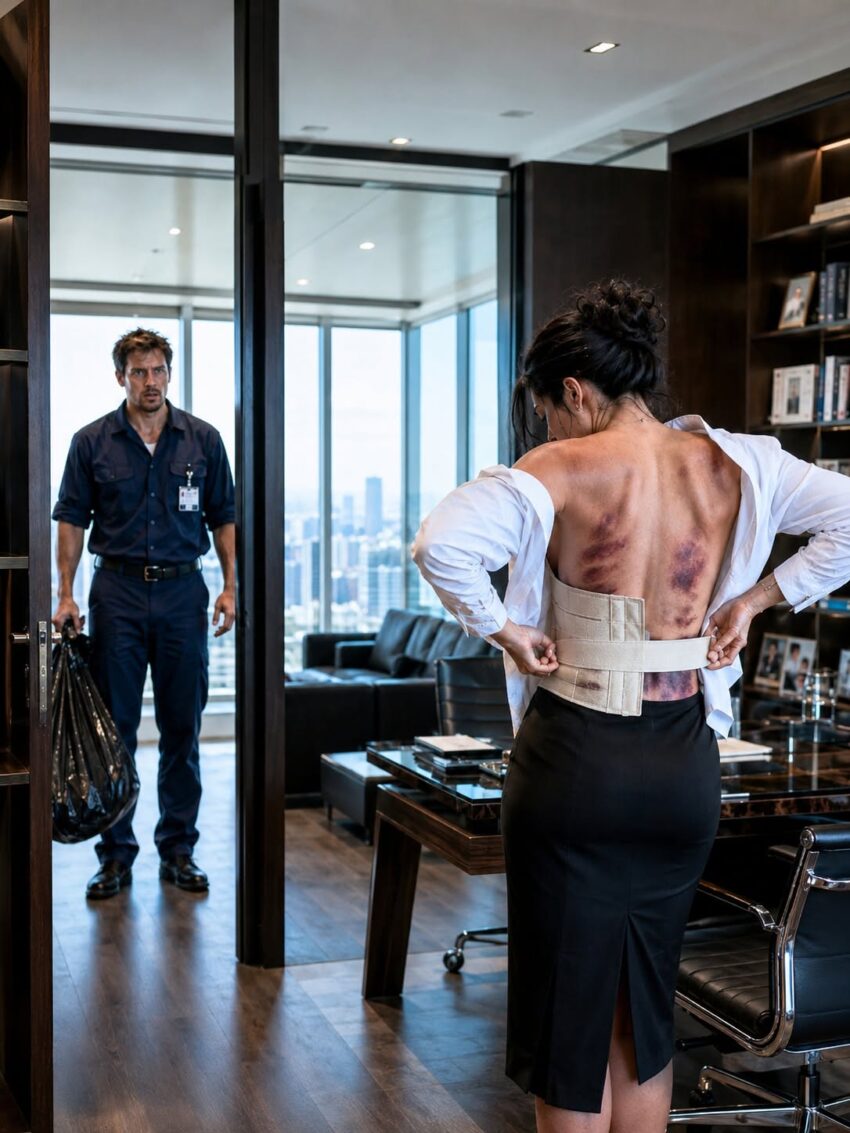
She was standing in the middle of her own office in the dark, arms twisted behind her back, fingers straining at metal clasps I didn’t immediately understand — and she was half dressed, her silk blouse hanging off one shoulder, and across her ribcage was the most brutal-looking piece of medical equipment I had ever seen outside of a combat field hospital.
A rigid thoracic brace. Heavy canvas. Metal rods. The kind of hardware they bolt onto soldiers after IED blasts. It was cinched so tight I could see the bruising bleeding out around the edges — purple-black and yellow-green pressed against pale skin.
She didn’t scream.
She didn’t lunge for her phone.
She turned her head and looked at me the way a cornered animal looks at the thing that just stepped on a branch.
“You aren’t Marcus.”
Not a question. A scalpel.
My brain did the only thing a broke, single dad standing in a billionaire’s private office at midnight could do.
It completely short-circuited.
“I’m sorry — the door — my manager said — I didn’t —”
“Get out.”
Flat. No volume. The kind of quiet that’s louder than yelling.
I got out.
I yanked the door shut so hard the brass nameplate rattled. I stood in the hallway with my back against the mahogany paneling, trash bag still dangling from my fist, heart slamming against my ribs like it was trying to escape.
I had just walked in on the CEO of Apex Holdings.
I had seen something she clearly did not want a single person on earth to see.
I thought about the $80 I needed for rent.
I thought about Sarah’s inhaler.
I thought about the fact that billionaires don’t forget faces.
I sprinted to the service elevator. I clocked out. I walked six blocks in freezing rain to the bus stop because I was too rattled to remember I had a transit card in my wallet. I sat in the back of an empty midnight bus, forehead against the cold window, replaying the look in her eyes.
Not embarrassed. Not furious.
Calculating.
She was already running numbers on me the same way I was running numbers on her.
The next morning, I woke up at 4:30 to Sarah coloring at the kitchen table, her breathing clear for once, crayon squeaking against printer paper. Generic cornflakes. Heels of the bread loaf for her lunch.
“Daddy, you look gray,” she said.
“Just tired, bug.”
I kissed her forehead. Slightly too warm. I filed that away in the permanent low-grade terror folder in the back of my mind and called Mrs. Gable downstairs to watch her.
By ten p.m. I was standing outside the Apex Holdings lobby in sleet that had turned to freezing rain, staring at the revolving doors like they were a sentencing hearing.
I pressed my badge to the reader.
Green light.
I walked to the locker room. Greg was by the punch clock, clipboard under his arm, looking at me like I was a grenade with the pin already pulled.
“Leave the cart,” he said. “You’re wanted upstairs. Fiftieth. Go straight up. Don’t clock in.”
I rode that service elevator for forty-two seconds. I counted every one.
A man named Hayes met me at the top. Tailored gray suit. Face like a bureaucratic glacier. He walked me straight down the main corridor and opened the mahogany door without knocking.
The office looked different in daylight. Intimidating in a different way — all glass and city skyline and the specific silence of rooms where billion-dollar decisions get made.
Evelyn Croft was behind her desk. Black blazer, hair pulled back with military precision, posture rigid in a way I now understood had nothing to do with arrogance.
She didn’t look up when I walked in.
“I’m sorry,” I said immediately. “I know I wasn’t supposed to be there. I’m sorry. I saw—”
“Sit down.”
I sat on the edge of the white leather chair, very aware of the dried paint on my work pants.
She finally looked up.
“You didn’t run to the press,” she said.
“No.”
“You didn’t tell your manager.”
“No.”
“Why?”
The question landed like a trap. I looked at her straight.
“Because I need this job. I scrub toilets for fifteen dollars an hour. If I talk about the CEO, I get fired. I have rent. I have a kid. I can’t afford to care about your secrets.”
The silence that followed was the longest four seconds of my life.
Then she reached into her desk drawer, pulled out a manila folder, and slid it across the glass toward me.
“Thomas Miller. Thirty-four. Honorable discharge, infantry. Blown knee from a training exercise. Single father. Outstanding debt to a pediatric clinic. Credit score in the low five hundreds. No criminal record.”
She paused.
“Desperate.”
My face went hot. My hands closed into fists on my thighs.
“You don’t get to—”
“I was in a helicopter crash four months ago,” she said.
That stopped me cold.
“Pilot error. We went down hard in the Cascades. Three fractured vertebrae. Four shattered ribs. The press thinks I was on a spiritual retreat in Kyoto. The board thinks it was a minor ski accident.”
She let that sit for a moment.
“The board is looking for blood. We’re in the middle of a hostile acquisition. If shareholders find out the CEO can’t sit in a chair for two hours without narcotic painkillers, the stock tanks. They invoke the medical clause and vote me out by Friday.”
“Why are you telling me this?”
“Because I need a handler,” she said. “Someone off the grid of my corporate circle. Someone who needs money badly enough to do exactly what I say, when I say it, without asking questions.”
She looked at my hands.
“I need you to drive the car. Carry the bags. Stand in the corner of gala rooms with my medication. And when my spine locks up in public—” she held my gaze — “hold me upright so the cameras don’t see me fall.”
I laughed. One short, disbelieving sound.
“I’m a janitor with a bad knee.”
“You’re infantry. You know how to carry dead weight.”
She slid a number across the desk on a separate piece of paper.
Three thousand dollars. Per week. Cash. Full corporate medical — for me and Sarah — effective immediately.
I stared at that number for a long time.
Three thousand a week was more than I made in three months pushing a mop. It was a new apartment. It was the name-brand inhaler. It was Sarah seeing a pulmonologist instead of an urgent care doc who barely looked up from his clipboard.
“What’s the catch?”
“You belong to me,” Evelyn said. “No days off until the merger closes in six weeks. If you slip, if you talk, if you look at me with pity — I will make sure you can’t get a job sweeping streets in this city.”
I looked at her. I saw the arrogance. I saw the ruthlessness. I also saw the faint impression of a canvas strap digging into her collarbone above her blazer collar, and a woman bleeding out in a shark tank, paying the nearest broke person to act as a tourniquet.
I didn’t like her.
“When do I start?”
PART 2
On Wednesday I was scrubbing urinals. On Friday I was wearing a twelve-hundred-dollar suit and learning that powerful people fall apart in very expensive ways.
The suit didn’t fit right.
It was bespoke — Hayes arranged it in forty-eight hours, which apparently money can do — but it was built for someone with a banker’s body. I had a laborer’s frame. The wool pulled tight across my shoulders. The collar scratched the back of my neck raw.
I looked like a bouncer who’d stolen a hedge fund manager’s wardrobe.
Evelyn looked at me once and said, “Passable.”
That was the closest thing to a compliment I got for the first two weeks.
Her days were military operations disguised as capitalism.
Five a.m. start. A black Escalade that I drove from the underground garage. Back-to-back meetings in boardrooms that smelled of truffle oil and stale cigar smoke. Private dinners at restaurants where the prix fixe menu cost more than my monthly grocery budget. Late nights in her penthouse apartment that felt less like a home and more like a high-end airport lounge — all clean lines, no personal photos, zero evidence that an actual human being lived there.
My job was to be invisible and load-bearing at the same time.
I learned her tells fast. When her left hand went to grip the edge of a table, knuckles draining white, the nerve pain in her spine was firing. When her voice dropped below a certain register in a negotiation — quiet in a way that made other people lean in — she was riding out a nausea wave from the painkillers. When she stopped making eye contact and focused on a fixed point on the wall, she had maybe ninety seconds before her legs stopped cooperating.
I didn’t wait for her to ask. That was the job.
She was not an easy person to work for.
“Slower over the speed bumps, Miller. I didn’t hire you to test the suspension.”
“The suspension is fine. The city hasn’t repaved this stretch since Clinton’s second term. You want me to reroute and make you ten minutes late for the acquisition meeting?”
“I want you to do your job without the running commentary.”
In the rearview mirror, I could see her pressing one hand flat against her lower ribs, eyes closed, jaw tight. Her face had gone the color of old concrete.
I took the next block at fifteen miles an hour and didn’t say anything else.
The line between us broke during week three.
We’d just come back from a four-hour dinner with a group of European logistics investors — men in suits who laughed too loud and ordered the most expensive Bordeaux on the list with the specific confidence of people who had never once checked a price tag in their adult lives.
Evelyn had been standing for most of it.
She walked into the penthouse foyer, and I watched her cross the hardwood in that careful, controlled way she moved at the end of long nights — like someone navigating a minefield they’d memorized but still didn’t fully trust.
She made it to the velvet sofa.
Then her legs gave out.
I caught her before she hit the floor. Both arms. Her nails went into the sleeves of my jacket, and she made a sound I hadn’t heard from her before — sharp and ragged, the sound of someone who had been holding something in for hours finally losing the grip.
“Don’t,” she hissed. “I can stand.”
“No. You can’t.”
I used the voice I used in the field. Not loud. Just final.
I picked her up. My bad knee screamed. I carried her to the bedroom and set her on the edge of the bed.
She was shaking. Not from cold.
“The brace,” she said, pointing at her ribs. “The clasp is jammed. It seized.”
I knelt in front of her.
The proximity was strange. For three weeks she’d been a voice from the backseat, a presence behind a glass desk. Now I was close enough to see the fine lines exhaustion had carved around her eyes, the places where her foundation had worn through.
I reached under her blazer. Found the cold metal ratchet clasps of the thoracic brace. The left-side locking mechanism had torqued inward, digging hard into bruised tissue.
“I have to force it,” I told her. “It’s going to hurt.”
She looked at me. For a second, nothing. No CEO. No shark. Just a person in pain who needed help.
She nodded.
I braced my forearm against the canvas, careful to avoid direct pressure on her skin, and pulled.
The metal held, then gave way with a loud metallic crack.
She dropped forward, forehead landing against my shoulder, a sound coming out of her that was somewhere between relief and agony.
I didn’t move.
I stayed exactly where I was and let her breathe.
After a minute, I unlaced the rest of the brace, peeled the heavy sweat-soaked canvas away from her ribs, and set it on the floor.
She pulled her blouse closed and stared at the wall.
“Thank you,” she said. Quiet. Like it cost her something.
“You’re welcome,” I said. I stood up, my knee popping loud enough to echo. I turned to leave.
“Is this yours?”
I looked back.
She was holding a folded piece of paper that had fallen from my pocket when I knelt. Crayon on printer paper. A stick figure in blue. A little girl with a green balloon.
Evelyn’s thumb moved slowly across the jagged crayon lines.
“Sarah,” she said.
“Yeah.”
“Is the insurance covering the treatments?”
“She got the good inhalers Monday. She hasn’t wheezed in three days.”
Evelyn looked at me. Really looked. Not the way she assessed risk in a boardroom. Something else.
“Make sure Hayes blocks your Sunday,” she said. “Take her to the park.”
I stared at her.
“Good night, Ms. Croft.”
“Evelyn,” she said, to my back. “When it’s just us. It’s Evelyn.”
Week five. The Metropolitan Museum benefit gala.
The merger’s final social obstacle.
The room smelled of white lilies, Chanel No. 5, and the specific variety of arrogance that comes with a net worth above nine figures. I stood near a marble column in a rented tuxedo, eyes locked on Evelyn.
She was in an emerald gown engineered to hide the brace underneath. Champagne flute she hadn’t touched once in two hours. She’d been on her feet since six p.m.
It was now past nine.
I saw her left hand drift toward a cocktail table. Saw her fingers close around the linen.
White knuckles.
Then Richard Caldwell materialized out of the crowd.
Caldwell was on the board of directors. Mid-sixties, silver hair, the kind of man who smiled warmly while actively calculating how to take something from you. He had two associates flanking him, both with the rehearsed casual body language of people who had been briefed on what to say.
They were going to push on the medical clause.
Right here. In public. In front of cameras.
I moved before she could signal me.
I cut through the crowd, stepped smoothly to her left, and positioned my body between her and Caldwell.
“Ms. Croft — Tokyo Operations is holding on line one. They need immediate authorization on the freight routing.”
Caldwell’s smile stayed fixed. His eyes didn’t.
“We’re in the middle of a conversation.”
“I apologize, sir. Tokyo won’t wait.”
I offered her my arm.
The moment her hand closed on my sleeve, I felt the full weight of what she’d been hiding all night. She was in freefall. Her grip was the grip of someone grabbing a rope over a cliff edge.
I walked her out of the grand hall.
Down a side corridor. Through the first unlocked door I found — a coat room, dark, smelling of damp wool and cedar and someone’s spilled wine.
I locked the door behind us.
She didn’t make it to a chair.
She slid down the wall to the floor, one hand pressing against her ribs through the structured gown, champagne flute shattering on the tile. In the dark, without the chandeliers and the cameras and the board members circling, she was just a woman whose body had been failing her for four months while she refused to let it stop.
I dropped to one knee in the broken glass. Pulled the silver pill case from my tuxedo pocket. Water bottle from a nearby catering cart.
Two tablets. She swallowed them without water.
I sat down beside her on the floor.
“You saved me,” she said, to the ceiling.
“I did my job.”
“No.” She turned her head. “You saw me going under. You pulled me out.”
I looked at my boots.
“We’re both just trying to survive, Evelyn. Your monsters just wear nicer suits than mine.”
The merger closed on a Thursday.
The press covered it as a triumph of strategic vision under decisive leadership. The Wall Street Journal ran a profile. Evelyn was photographed standing in front of the Apex Holdings logo in a tailored blazer, looking like someone who had never once been afraid of anything in her life.
The brace came off the following week.
Three months of physical therapy. Two vertebrae that would always ache in cold weather. Four ribs that had knitted back together slightly wrong.
She called me into her office on a Monday morning.
“You’re being moved to forty-nine,” she said. “Director of Executive Logistics.”
I looked at her.
“That’s not a real job.”
“It has a salary, a desk, and healthcare that covers pediatric pulmonology specialists. Unless you’d prefer I put you back on urinal detail.”
I took the job.
I won’t tell you Evelyn Croft became a different person. She didn’t. She was still ruthless. She still fired a regional VP via email at seven a.m. on a Tuesday without losing a step. She still moved through boardrooms like a controlled demolition.
But she also sent Hayes to Sarah’s school once when I got stuck in a board deposition and Sarah had an asthma attack at recess. Hayes — the mannequin in the glacier suit — sat with my daughter in the nurse’s office for forty minutes, reading her a Wikipedia article about stegosauruses because it was the only thing on his phone she thought was interesting.
Evelyn never mentioned it.
I never brought it up.
That was how we worked.
Six months after the night I walked through the wrong door, I was driving home on a Friday afternoon with Sarah in the backseat, her window cracked, chattering about whether T-rexes could have beaten a triceratops in an actual fight.
Her breathing was clear.
My phone buzzed in the cupholder.
From: E.C. Take her for ice cream. Use the corporate card.
I stared at the message for a second.
Then I laughed. Actual, real, no-irony-attached laughter.
I tossed the phone onto the passenger seat.
“Hey, bug,” I said. “You want ice cream?”
Sarah’s face appeared in the rearview mirror, eyes wide.
“It’s not my birthday.”
“Doesn’t have to be.”
She pressed her nose to the window and grinned.
The city looked different at four in the afternoon on a day when you’re not doing frantic math about whether you can afford a child’s medication. Wider. Less like a system designed to grind you down.
Some doors you walk through by accident.
Some accidents turn out to be the only thing that was ever going to save you.